

Door pediment and door crown ideas for interior doors


Quick answer
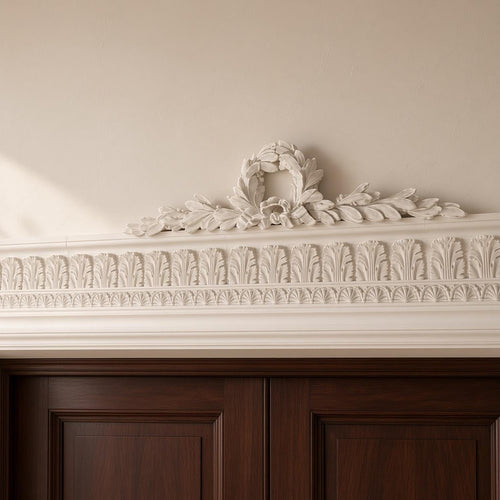
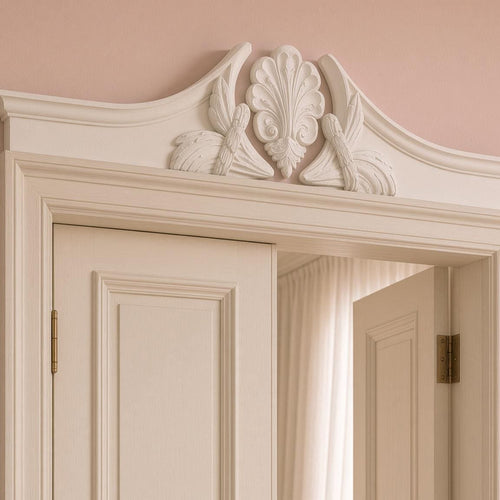
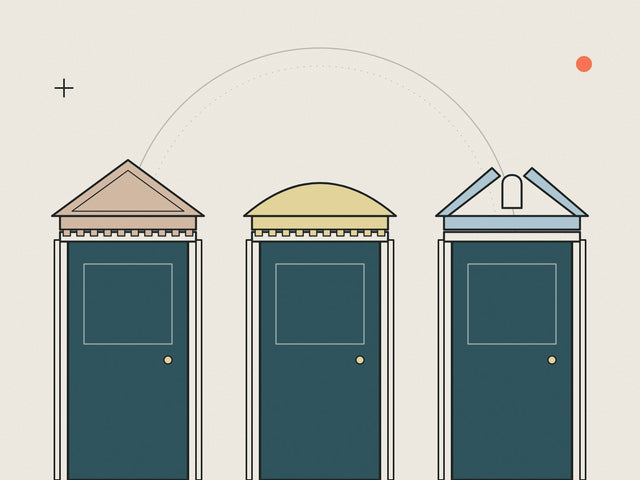
A door pediment (or door crown) is a decorative head placed above a door frame. The main styles are the triangular pediment, the broken pediment, the curved segmental pediment, the flat crosshead or crown, and ornamental crests such as acanthus or laurel [1]. Inside, a pediment turns a plain doorway into the focal point of a hall or landing; choose one slightly wider than the door casing and paint it to match the trim.
Pediments came to Britain from classical architecture and were popularised by pattern books such as James Gibbs's A Book of Architecture (1728), which was widely used in colonial America too [2][3]. Today, a pediment over an interior door is one of the quickest ways to add architecture to an American home.
The styles
| Style | Where it comes from |
|---|---|
| Triangular | The classic Georgian and Greek Revival form [1][4]. |
| Broken | A triangle with a gap at the top, often with an urn or finial; Georgian and Colonial. |
| Segmental | A shallow curve; Georgian and Federal. |
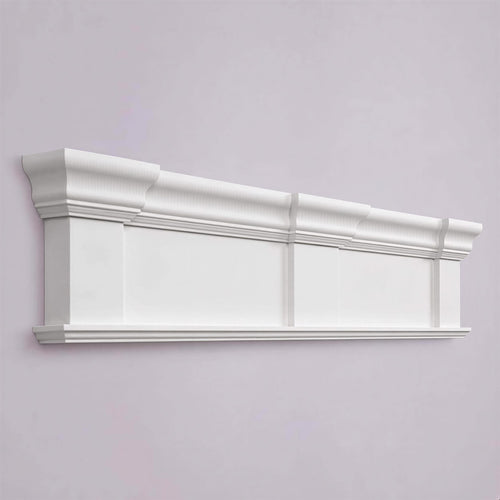
| Crosshead / crown | A flat, molded head; Craftsman and simple classical rooms. |
| Ornamental crest | Acanthus, laurel or shell above the casing; Rococo, French and Victorian. |
Where to use one
- Over the main interior door off the entry hall.
- On the landing, over the doors you see from the stairs.
- Over a doorway into a dining room or library.
- Over a plain opening or archway to give it a frame.
- Over French doors or a closet you want to disguise as a room.
Sizing
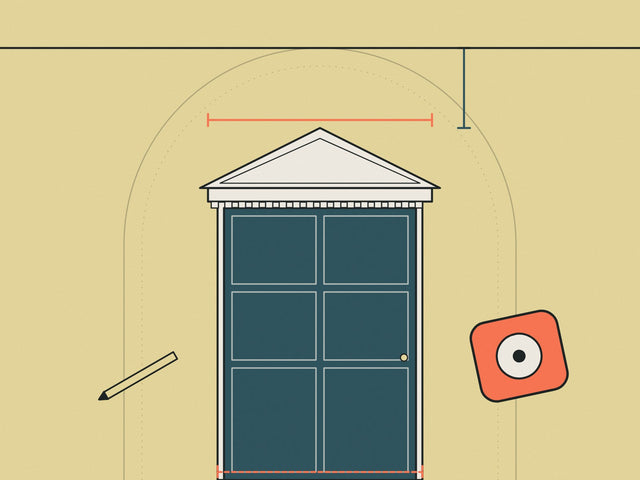
A pediment should be slightly wider than the outside of the door casing, typically by 1 to 3 inches each side, so it reads as sitting on the frame. Its height is usually a small fraction of the door width; too tall and it looks top-heavy.
Fitting
Interior plaster pediments are fixed with construction adhesive plus finish nails or screws that can be removed once the adhesive has set, then caulked and painted. Brent Hull's video shows a carpenter's approach to building one in wood [5].


A craftsman's guide to pediments [5].
Video: Brent Hull, “How to Build the Pediment. 1 great Carpentry Hack to avoid custom moldings!”, via YouTube.
The Gibbs surround: a doorway that crossed the Atlantic
One of the most recognizable colonial door treatments is the Gibbs surround, a frame interrupted by projecting blocks so the doorway looks built of stone. It is named after the architect James Gibbs, whose 1728 A Book of Architecture illustrated it.[2] At the Hammond-Harwood House in Annapolis, the curator explains how the builder William Buckland owned Gibbs's book by the early 1770s, as part of one of the largest architectural libraries in the colonies, and how the house's own Gibbs surround is actually southern pine carved and finished to look like stone.[6] That is a useful lesson for anyone adding a pediment today: colonial builders cared about the effect, and used the material that suited the job.
Inside: a pediment that does the same job
Most of us are not rebuilding a façade. Indoors, a plaster pediment over a hall or dining-room door gives the same sense of arrival without changing the casing. Measure the outside width of the casing first, then choose a piece a little wider so it sits comfortably over the top.

Good to know
Common questions
What is a door pediment?
A decorative head above a door frame, often triangular or curved.
What is a door crown?
A flat, molded head above a door casing, also called a crosshead.
How wide should a door pediment be?
Slightly wider than the outside of the casing, typically 1-3 inches each side.
Can you put a pediment over an interior door?
Yes. It makes a plain doorway a focal point.
Sources
References and further reading
Harvard style. Web pages were checked on the access date shown.
- Calloway, S. and Cromley, E. (eds) (1996) The elements of style: a practical encyclopedia of interior architectural details from 1485 to the present. Rev. edn. London: Mitchell Beazley.
- Gibbs, J. (1728) A book of architecture, containing designs of buildings and ornaments. London.
- McAlester, V.S. (2013) A field guide to American houses. Rev. edn. New York: Alfred A. Knopf.
- Summerson, J. (1945) Georgian London. London: Pleiades Books.
- Brent Hull (n.d.) How to build the pediment: 1 great carpentry hack to avoid custom moldings [Video]. YouTube. Available at: www.youtube.com/watch?v=25bsKtlgqDQ (Accessed: 14 November 2026).
- Lovett, R. (n.d.) A window into architecture: the Gibbs surround at the Hammond-Harwood House Museum. Hammond-Harwood House. Available at: hammondharwoodhouse.org/a-window-into-architecture-the-gi... (Accessed: 16 November 2026).
How to cite this article
van Locke, J. (2026) ‘Door pediment and door crown ideas for interior doors’, The Flare Journal. Flare Studio UK. Available at: https://flarestudio.uk/blogs/journal/door-pediment-and-door-crown-ideas (Accessed: 16 November 2026).
Shop the style




Conversation
Join the conversation
Questions about the history, a room you are planning, or a piece you have seen in the wild? Leave a comment and Joseph will reply.