

Colonial and Georgian Revival interiors: the British roots of an American classic


Quick answer
Colonial and Georgian Revival interiors are rooted in British Georgian architecture: symmetry, classical proportions, paneled walls, crown molding (cornice), pedimented doorways, a central ceiling medallion, and a restrained palette of soft greens, blues, creams and grays [1][4]. American builders learned the style from British pattern books such as James Gibbs's A Book of Architecture (1728) [2].
Colonial Revival was the most popular American house style for much of the twentieth century [1]. Its roots are in Georgian Britain, which makes it one of the easiest American styles to decorate with British craftsmanship.
Gibbs’s pattern book
James Gibbs’s A Book of Architecture was used by builders in Britain and the colonies [2].
Colonial Georgian
American houses adopted symmetrical facades, pediments and paneled rooms [1].
The British roots
Georgian architecture took its rules from Palladio and classical Rome, filtered through British architects and pattern books [3][5]. Gibbs's 1728 book was widely used by builders on both sides of the Atlantic [2]. Paneled rooms, pedimented doorcases and classical cornices in a Colonial house are close cousins of those in a Georgian English house.
Key interior features
| Feature | Detail |
|---|---|
| Symmetry | Doors, windows and fireplaces centered and balanced [1]. |
| Crown molding | The American name for a cornice. |
| Paneling and chair rails | Wainscot to dado height or full height. |
| Pedimented doorways | Triangular or broken pediments over principal doors; see door pediment ideas. |
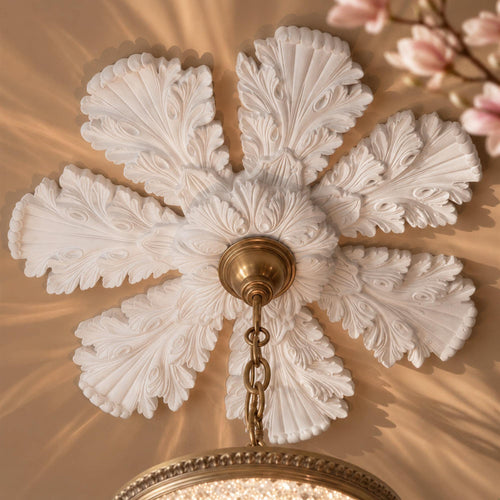
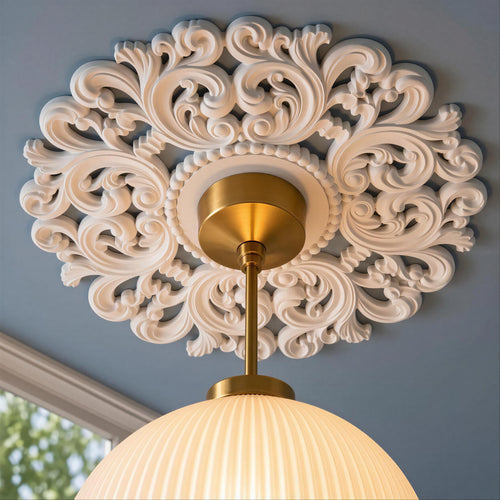
| Ceiling medallion | A restrained classical design in the center of the ceiling [4]. |
| Color | Soft greens, blues, creams, grays; white trim. |
Decorating a Colonial Revival house today
- Respect the symmetry: pairs of sconces, lamps and chairs.
- Add a classical medallion and crown molding if they are missing.
- Put a pediment over the main interior door.
- Use a calm Georgian palette and paint trim consistently.
- Mix antiques with comfortable modern upholstery.


A craftsman explains Colonial Revival [6].
Video: Brent Hull, “What is Colonial Revival Architecture?”, via YouTube.
Good to know
Common questions
What is Colonial Revival style?
An American style based on colonial Georgian houses: symmetrical, classical, with paneling, pediments and crown molding.
Is Colonial the same as Georgian?
American Colonial Georgian houses followed British Georgian architecture; Colonial Revival revived them later.
What colors suit a Colonial Revival home?
Soft greens, blues, creams and grays with white trim.
What details suit a Colonial Revival interior?
Crown molding, a classical medallion, paneled wainscot, pedimented doorways and paired sconces.
Sources
References and further reading
Harvard style. Web pages were checked on the access date shown.
- McAlester, V.S. (2013) A field guide to American houses. Rev. edn. New York: Alfred A. Knopf.
- Gibbs, J. (1728) A book of architecture, containing designs of buildings and ornaments. London.
- Summerson, J. (1945) Georgian London. London: Pleiades Books.
- Calloway, S. and Cromley, E. (eds) (1996) The elements of style: a practical encyclopedia of interior architectural details from 1485 to the present. Rev. edn. London: Mitchell Beazley.
- Cornforth, J. (2004) Early Georgian interiors. New Haven and London: Yale University Press.
- Brent Hull (n.d.) What is Colonial Revival architecture? [Video]. YouTube. Available at: www.youtube.com/watch?v=qF-wSnjVzrg (Accessed: 14 November 2026).
How to cite this article
van Locke, J. (2026) ‘Colonial and Georgian Revival interiors: the British roots of an American classic’, The Flare Journal. Flare Studio UK. Available at: https://flarestudio.uk/blogs/journal/colonial-and-georgian-revival-interiors (Accessed: 15 November 2026).
Shop the style






Conversation
Join the conversation
Questions about the history, a room you are planning, or a piece you have seen in the wild? Leave a comment and Joseph will reply.