

Do I need an overdoor? Where door pediments work, including on modern doors



No one needs an overdoor, strictly speaking. But a pediment above a doorway does something a flat architrave cannot: it gives the opening presence and tells you where to look. Here is where they earn their place.
What an overdoor does
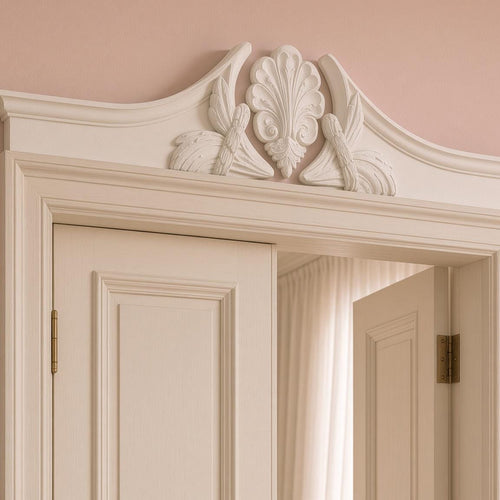
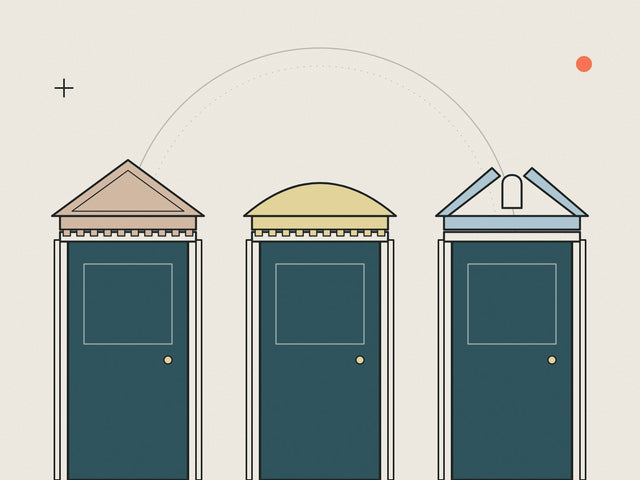
The overdoor, or door pediment, is the ornament that crowns a doorway, a descendant of the classical temple front. Historic England's glossary defines the pediment as the triangular upper part of the front of a classical building, also used over doors and windows;[1] in a Greek temple it is the triangular space enclosed by the gables at either end, often decorated with sculpture.[2] The V&A describes Palladianism as fashionable in Britain between 1715 and 1760 and the temple front as a pediment supported by columns or pilasters,[3] and the Metropolitan Museum of Art notes that the temple's columns and pediments were reborn in eighteenth-century buildings.[4] In Georgian houses it grew into the doorcase we know today (see the history of the overdoor pediment); a carved and gilded doorcase of 1756 in the V&A, designed by Giovanni Battista Borra, has a broken swan-neck pediment.[5] Historic England's selection guide lists door cases among the fine details that can support the listing of terraced houses.[6] On a modern door it works as a quiet focal point: a feature above the frame that adds height and finish.
Rooms and doors that suit one
- Hallways and entrances: the first thing visitors see, and the place a little formality pays off
- Living and dining room doors: particularly in the main reception rooms of period houses
- A doorway at the end of a hall: a pediment gives it presence as a focal point
- Plain modern doors: a simple pediment lifts a flat, featureless opening without needing a full architrave
Where to think twice
Very low ceilings, narrow corridors and doors with no wall space above the frame leave little room for a pediment. Check the clearance between the top of the door lining and the ceiling or cornice first (our rule of thumb).
Choosing the style
Match the pediment to the house, or contrast on purpose:
- Georgian or Regency: crisp, classical profiles, such as the Wellington
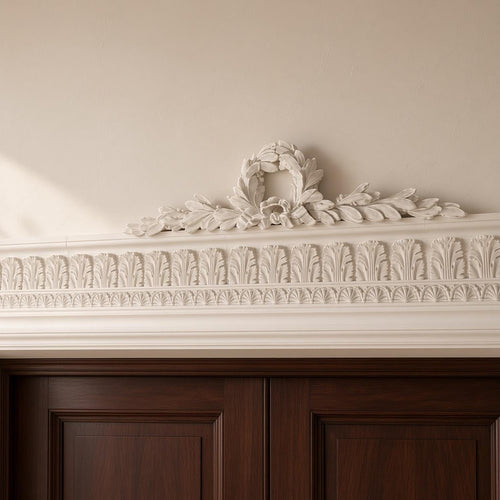
- Neoclassical: laurel and ribbon, such as the Laureate
- Baroque and ornate: richer scrolls, such as the Versailles
Width and proportion
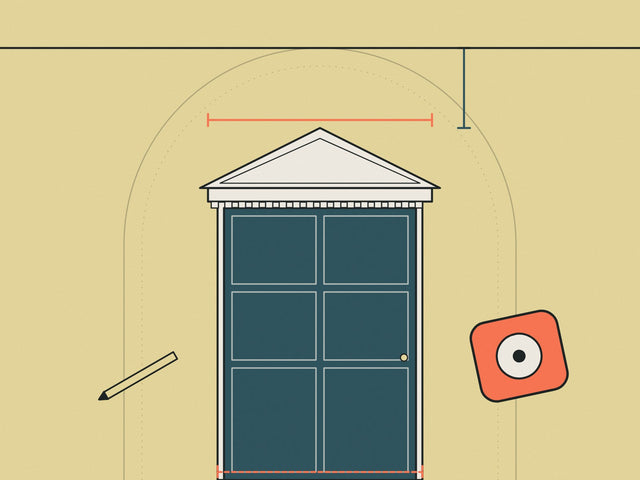
As our rule of thumb, the pediment should be at least as wide as the door frame and often a touch wider, so it reads as part of the doorway. Measure first: our guide to how to measure for an overdoor shows how.
Painting
Paint it the same colour as the architrave and frame for a crisp, classical look. Or paint the doorway as a whole in a strong tone and let the pediment be part of it. For a period house, the Victorian Society notes that interior joinery was usually painted before the 1960s and that "Brilliant White" was not available until after the Second World War, so it advises an off-white or cream for an authentic result.[7] The Georgian Group notes that Georgian front doors were always painted and often preserve the archaeology of their historic paint schemes.[8] See fitting and painting.
Styling the hall
Pair it with a wall light or two either side of the door; any new wiring should be done by a qualified electrician. Our piece on styling a hallway with architectural details has ideas.

Shop overdoors


Browse all overdoors and door toppers.
Frequently asked questions
What is an overdoor pediment?
A decorative ornament above a doorway, descended from the classical temple front and the Georgian doorcase.
Can I use an overdoor on a modern door?
Yes. A simple pediment adds height and a focal point to a plain, flat door opening.
How wide should an overdoor be?
As our rule of thumb, at least as wide as the door frame, and often slightly wider, so it reads as part of the doorway.
What colour should I paint it?
The same colour as the architrave for a crisp classical look, or paint the whole doorway in a strong tone.
Sources
References and further reading
Harvard style. Web pages were checked on the access date shown.
- Historic England (no date) Glossary for the Early Georgian Townhouse Walking Tour. Available at: historicengland.org.uk/campaigns/visit/walking-tours/spot... (Accessed: 27 October 2026).
- The Metropolitan Museum of Art (no date) Architecture in Ancient Greece. Available at: www.metmuseum.org/essays/architecture-in-ancient-greece (Accessed: 27 October 2026).
- Victoria and Albert Museum (no date) Palladianism: an introduction. London: V&A. Available at: www.vam.ac.uk/articles/palladianism-an-introduction (Accessed: 27 October 2026).
- The Metropolitan Museum of Art (no date) The Neoclassical Temple. Available at: metmuseum.org/TOAH/hd/neoc_2/hd_neoc_2.htm (Accessed: 27 October 2026).
- Victoria and Albert Museum (no date) Doorcase. London: V&A. Available at: collections.vam.ac.uk/item/O53147/doorcase-borra-giovanni... (Accessed: 27 October 2026).
- Historic England (no date) Listing Selection Guide: Domestic 2: Town Houses. Available at: historicengland.org.uk/images-books/publications/dlsg-tow... (Accessed: 27 October 2026).
- The Victorian Society (no date) Victorian and Edwardian paint colours and finishes. Available at: www.victoriansociety.org.uk/advice/paint-colours-and-fini... (Accessed: 27 October 2026).
- Brooking, C. (no date) 'Historic details: front doors', The Georgian. The Georgian Group. Available at: georgiangroup.org.uk/wp-content/uploads/2024/07/GGM_Brook... (Accessed: 27 October 2026).
How to cite this article
van Locke, J. (2026) ‘Do I need an overdoor? Where door pediments work, including on modern doors’, The Flare Journal. Flare Studio UK. Available at: https://flarestudio.uk/blogs/journal/do-i-need-an-overdoor-pediment (Accessed: 12 November 2026).
Shop the style




Conversation
Join the conversation
Questions about the history, a room you are planning, or a piece you have seen in the wild? Leave a comment and Joseph will reply.