

British ceiling rose patterns by period: Georgian to modern, and how to recognise each



Ceiling roses follow fashion like everything else. If you know what to look for, the pattern in the middle of a ceiling tells you roughly when a room was decorated, and helps you choose a replacement that belongs. Here is the sequence, period by period.
Georgian (1714 to 1830): the classical rosette
Georgian ceilings follow classical order (the National Trust dates the period 1714 to 1830).[1] Expect circles divided into regular segments, rosettes, anthemion (honeysuckle) and acanthus leaves, often in low relief and crisp lines; that is our description of the usual pattern. Historic England notes that later eighteenth-century terraces are generally more austere than earlier ones.[2] The architect Robert Adam made the ceiling a work of art, as in the compartmented stucco ceiling of the Lansdowne House dining room (1766 to 1769), executed by Joseph Rose.[3] See Robert Adam and the neoclassical ceiling and our guide to Georgian interiors. Regency detailing became more restrained, but the ceiling rose stayed a feature of many rooms,[4] as in the Regency rose.
Victorian (1837 to 1901): florals and abundance
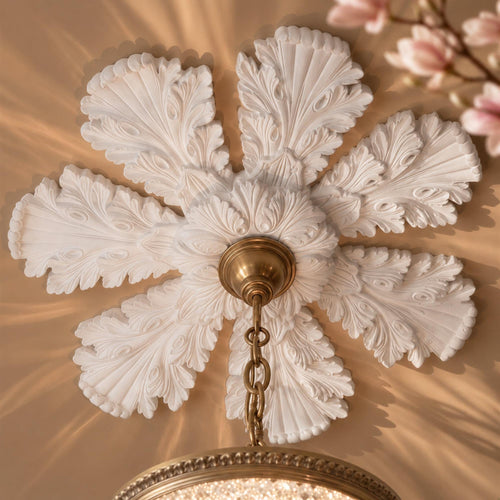
Victorian roses are bigger, deeper and more naturalistic: layered petals, fruit, leaves and scrolls. The patenting of fibrous plaster (plaster of Paris reinforced with hessian and timber laths) in 1856 made cornices and small enrichments easy to mass-produce,[5] and Historic England describes mid-Victorian villa interiors with rich plasterwork that were "opulent, if standardised".[6] Not every Victorian room had a rose: bedrooms, attic rooms and servants' quarters usually had the minimum of architectural decoration.[7] See the Victorian ceiling rose: a short history. The Duchess is in this tradition.
Art Nouveau and Arts and Crafts (around 1890 to 1914): the curve of nature
Whiplash lines, lilies, lotus and stylised plants, flowing rather than regular. Arts and Crafts versions are simpler and more hand-made in feel, in keeping with a movement the V&A describes as celebrating simplicity and honest forms.[8] Sources date the styles differently: Britannica puts Art Nouveau at about 1890 to 1910,[9] while the V&A traces the Arts and Crafts home from the 1860s, so our "around 1890 to 1914" is a convenient overlap, not a fixed boundary. See the Art Nouveau guide. The Lotus belongs here.
Edwardian (1901 to 1910): lighter and finer
Edwardian strictly means the reign of Edward VII (1901 to 1910), though the era is commonly extended to the First World War in 1914.[10] In plasterwork the usual generalisation is that roses lose depth and fuss, with garlands, ribbons and delicate floral borders replacing heavy Victorian foliage; treat that as our rule of thumb, because Historic England describes some designs either side of 1900 as "subtle and undemonstrative and easily overlooked" while the best houses of the early twentieth century were opulent.[6] See Edwardian interiors.
1920s and 1930s Art Deco: geometry
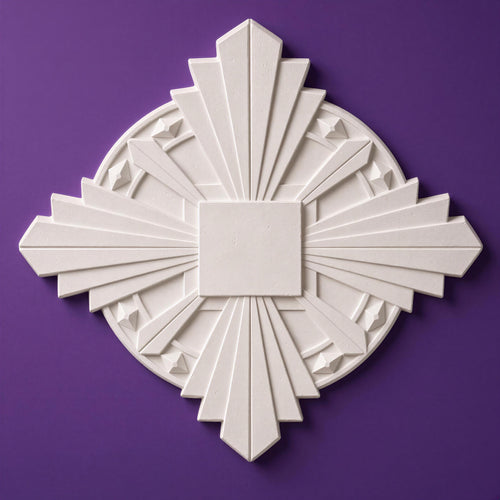
Sunbursts, fans, stepped rings and chevrons. Symmetrical, bold and often shallow, with strong shadows (our description). Britannica dates Art Deco to the 1920s and names the 1925 Paris exposition as its source, with geometric or stylised ornament, sun rays among its motifs and a taste for symmetry and repetition,[11] while the National Trust places the style's appearance just before the First World War, so dates differ by source.[12] Do not assume a 1930s semi has a Deco rose: Historic England notes that suburban architecture also fell under the spell of neo-Georgian and neo-Tudor styles, and that speculative estates sometimes skimped on materials.[6] See Art Deco ceilings and plasterwork. The Sunburst is the classic.
1950s and 1960s: atomic and plain
After the Second World War, lightweight gypsum plasters and plasterboard in new construction contributed to the decline of lime plaster and fibrous work,[5] and flat, plain ceilings took over. A few starbursts and atomic shapes appear in the Festival of Britain spirit; that is our observation rather than a documented rule. See mid-century modern design.
1970s: textured and covered
Many ceilings were covered in textured coatings, and some original roses were boxed in or lost. The Health and Safety Executive lists textured decorative coatings such as Artex among materials that can contain asbestos, which was banned in 1999, and says buildings built or refurbished before 2000 may contain it.[13] If you uncover or remove one, check the coating for asbestos first and do not try to repair or remove suspect material yourself: see fitting over artex.
1980s onward: revival and reinterpretation
Cast roses never quite disappeared: fibrous work continued to be used to make cornices and ceiling roses for the domestic and "restoration" markets.[5] The rose returned as a fashionable period feature in the 1980s revival (our reading; see 1980s interiors), and today designers use simple rings and geometric forms to bring character to modern ceilings. See using a ceiling rose in a modern home.
How to date the rose in your ceiling
- Look at the relief: as our rule of thumb, deep and leafy suggests Victorian; shallow and geometric suggests the 1930s.
- Check the shape: classical segments suggest Georgian; flowing plants suggest Art Nouveau.
- Consider the house: the rose is often of the same date as the house, unless it has been replaced. Unevenness where the ceiling plaster has been patched can show where one was removed.[7]
- Treat the material as a weak clue: lime was the usual plaster binder before the mid-nineteenth century,[14] and a 1901 survey of the Old Palace ceilings at Bromley-by-Bow noted that a much larger proportion of hair was used than was customary at the time.[15] But casting in gypsum was common by the end of the eighteenth century, so a gypsum rose is not necessarily modern.[5]
Choosing for your home
For help matching a rose to a period property, read which ceiling rose for your home.


Frequently asked questions
How can I tell the age of my ceiling rose?
Look at the relief and shape: deep leafy forms suggest Victorian, shallow geometric ones the 1930s, classical segments Georgian. The rose is usually the same date as the house.
What did Victorian ceiling roses look like?
Large, deep and naturalistic, with layered petals, leaves, fruit and scrolls.
What is an Art Deco ceiling rose?
A shallow, symmetrical geometric design: sunbursts, fans, stepped rings and chevrons.
Which rose suits my period house?
See our guide to choosing a ceiling rose for your home.
Sources
References and further reading
Harvard style. Web pages were checked on the access date shown.
- National Trust (no date) Interior design through the ages. Available at: www.nationaltrust.org.uk/discover/history/architecture/in... (Accessed: 27 October 2026).
- Historic England (no date) Listing Selection Guide: Domestic 2: Town Houses. Available at: historicengland.org.uk/images-books/publications/dlsg-tow... (Accessed: 27 October 2026).
- The Metropolitan Museum of Art (no date) The Lansdowne Dining Room, London. Available at: www.metmuseum.org/essays/the-lansdowne-dining-room-london (Accessed: 27 October 2026).
- Designing Buildings (no date) Ceiling rose. Available at: www.designingbuildings.co.uk/wiki/Ceiling_rose (Accessed: 27 October 2026).
- Historic England (2019) Historic Fibrous Plaster in the UK: Guidance on its Care and Management. Swindon: Historic England. Available at: cadw.gov.wales/sites/default/files/2019-07/Historic%20Fib... (Accessed: 27 October 2026).
- Historic England (no date) Listing Selection Guide: Domestic 3: Suburban and Country Houses. Available at: historicengland.org.uk/images-books/publications/dlsg-sub... (Accessed: 27 October 2026).
- The Victorian Society (no date) Victorian and Edwardian plaster mouldings, cornices, coving and dado rails. Available at: www.victoriansociety.org.uk/advice/plaster-mouldings-and-... (Accessed: 27 October 2026).
- Victoria and Albert Museum (no date) Arts and Crafts: design for the home. London: V&A. Available at: www.vam.ac.uk/articles/arts-and-crafts-design-for-the-home (Accessed: 27 October 2026).
- Encyclopaedia Britannica (no date) Art Nouveau. Available at: www.britannica.com/art/Art-Nouveau (Accessed: 27 October 2026).
- Wikipedia (no date) Edwardian era. Available at: en.wikipedia.org/wiki/Edwardian_era (Accessed: 27 October 2026).
- Encyclopaedia Britannica (no date) Art Deco. Available at: www.britannica.com/art/Art-Deco (Accessed: 27 October 2026).
- National Trust (no date) Architecture through the ages. Available at: www.nationaltrust.org.uk/discover/history/architecture/hi... (Accessed: 27 October 2026).
- Health and Safety Executive (no date) Asbestos - FAQs. Available at: www.hse.gov.uk/asbestos/faq.htm (Accessed: 27 October 2026).
- Society for the Protection of Ancient Buildings (no date) Lime. Available at: www.spab.org.uk/advice/lime (Accessed: 27 October 2026).
- Godman, E. (1901) 'The ceilings and modelled plasterwork', in Survey of London Monograph 3: Old Palace, Bromley-by-Bow. London: Guild & School of Handicraft, pp. 15-17. Available at: www.british-history.ac.uk/node/98754 (Accessed: 27 October 2026).
How to cite this article
van Locke, J. (2026) ‘British ceiling rose patterns by period: Georgian to modern, and how to recognise each’, The Flare Journal. Flare Studio UK. Available at: https://flarestudio.uk/blogs/journal/ceiling-rose-patterns-by-period (Accessed: 12 November 2026).
Shop the style



Conversation
Join the conversation
Questions about the history, a room you are planning, or a piece you have seen in the wild? Leave a comment and Joseph will reply.