

Ceiling roses for low ceilings: what size and depth works under 2.4m


A low ceiling does not rule out a ceiling rose. Plenty of 1930s semis, cottages and loft conversions have ceilings around 2.2 to 2.4m in our experience (England's nationally described space standard asks new homes for only 2.3m over at least 75% of the floor area[1]), and interwar semis were typically built in a pared-down, mass-produced form[2], so a well-chosen rose is often what stops them feeling flat. The trick is to make the piece work with the height rather than against it.
Go smaller than the formula says
Our rule of thumb (room length plus width in feet, read as inches) gives an upper limit, not a target. Under 2.4m, take a size or two off it. In most low rooms a rose between 8 and 12 inches (20 to 30cm) looks settled, while in our experience anything over about 15 inches starts to press down on the room.
Choose shallow relief
Depth matters as much as diameter. Deep, heavily modelled roses throw strong shadows and read as heavy overhead. Look for low relief and crisp, simple detail: a rosette, a stepped geometric pattern or a single ring of petals. Low-relief moulded plaster is no novelty: casting low-relief decoration in moulds began in the 16th century[3], and by the late 18th century the relief on fashionable ceilings was being "simplified and lightened"[4], in interiors known for their "lightness of touch"[5]. Geometric forms later became a hallmark of Art Deco design[6]. Our Windsor (8 inch) and Catalyst (9.8 inch) are both made for this sort of room.
Paint it the colour of the ceiling
Painting the rose the same white as the ceiling lets the shadows do the work and keeps the eye moving up. A contrasting colour draws attention to the piece, which is lovely on a high ceiling and heavy on a low one. If you want colour, go one shade deeper than the ceiling, not a different tone altogether. The Victorian Society makes a similar point about plaster detail: picking it out in different colours is an option as long as it does not look too fussy[7]. Our guide to painting a plaster ceiling rose covers primer and finish.
Think about the light under it
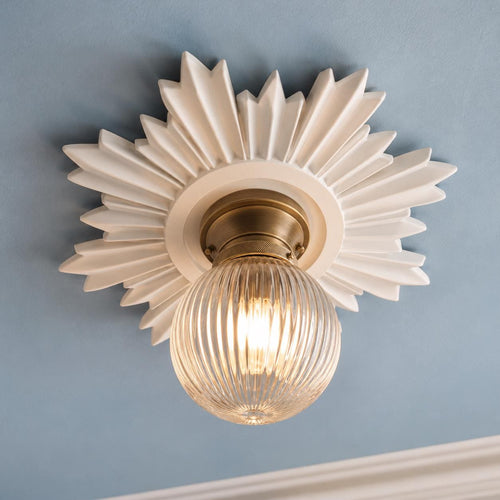
On a low ceiling a pendant hangs closer to head height, so a long drop or a wide shade can cause trouble. A flush or semi-flush fitting that sits close to the rose suits low rooms best, and a rose gives it a frame that a bare ceiling plate never does. Leave at least 2.1m (our rule of thumb) clear below any hanging fitting over walkways. In bathrooms and other wet rooms, Electrical Safety First prefers enclosed ceiling lights to ones that hang down[8].
Keep the detail simple elsewhere
One feature on the ceiling is plenty. If you are adding a rose, skip heavy coving and keep the walls light so the room reads as taller. Mirrors and wall lights that draw the eye sideways and upwards help too, as we explain in how to make a small room feel bigger.
Quick checklist
- Diameter: 8 to 12 inches for most rooms under 2.4m
- Relief: shallow, with crisp edges
- Colour: ceiling white, or one shade deeper
- Fitting: flush or semi-flush, minimum 2.1m clear underneath
- Test first: cut a paper circle and tape it up for a day
Shop smaller roses
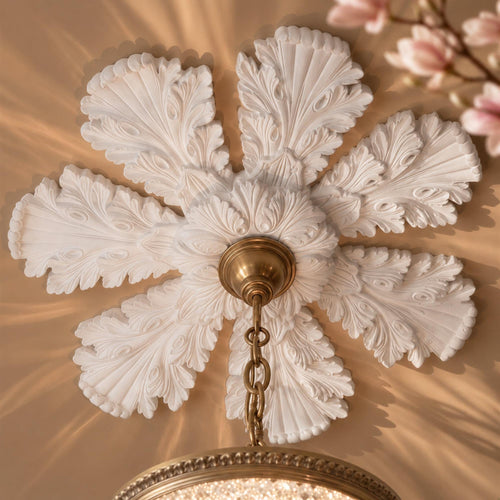
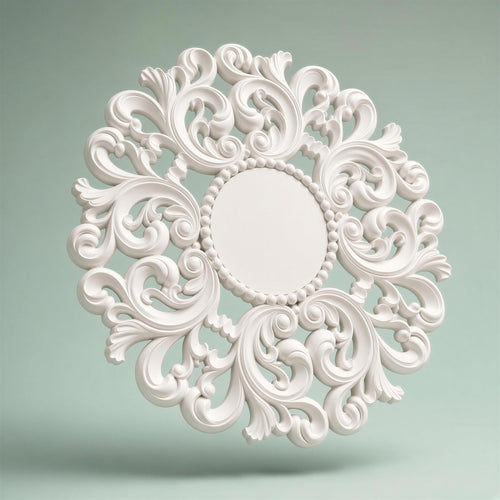
Compact designs that suit lower ceilings, each with dimensions on the listing. More in petite ceiling roses.


Before you buy
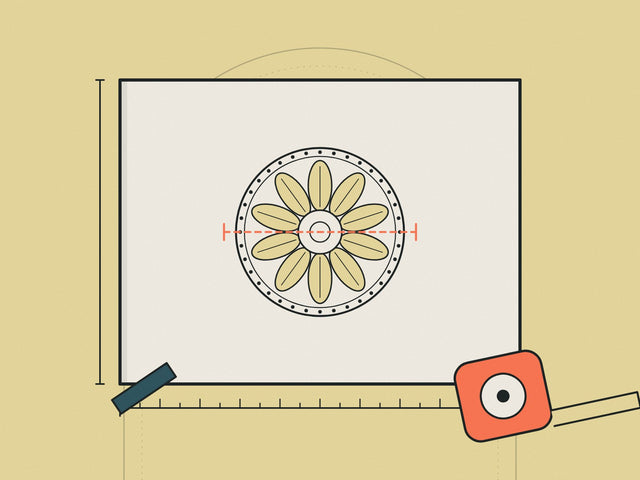
Our sizing guide works through the proportions, and the fitting guide shows how to mark the centre point. Not sure? Ask us with your room dimensions.
Frequently asked questions
What size ceiling rose is best for a low ceiling?
For ceilings under about 2.4m, a rose between 8 and 12 inches (20 to 30cm) usually looks balanced. Go smaller than the room-size formula suggests and choose shallow relief so the rose does not look heavy overhead.
Will a ceiling rose make a low ceiling look lower?
Not if it is small, shallow and painted the same colour as the ceiling. Deep, heavily modelled roses in a contrasting colour draw the eye down and can make the ceiling feel lower.
Can I fit a ceiling rose with a flush light?
Yes. Flush or semi-flush fittings suit low rooms best and the rose frames them neatly. Make sure the fitting canopy sits against the rose and the flex hole is the right size.
How do I test the size before I buy?
Cut a circle of paper to the diameter you are considering, tape it to the ceiling and look at it from the doorway, your usual chair and the far corner for a day.
Sources
References and further reading
Harvard style. Web pages were checked on the access date shown.
- Department for Communities and Local Government (2015) Technical housing standards – nationally described space standard. HM Government. Available at: www.gov.uk/government/publications/technical-housing-stan... (Accessed: 27 October 2026).
- Historic England (n.d.) Domestic 3: Suburban and Country Houses – Listing Selection Guide. Historic England. Available at: historicengland.org.uk/images-books/publications/dlsg-sub... (Accessed: 27 October 2026).
- Cadw (n.d.) Historic fibrous plaster in the UK: guidance on its care and management. Cadw. Available at: cadw.gov.wales/sites/default/files/2019-07/Historic%20Fib... (Accessed: 27 October 2026).
- Encyclopaedia Britannica (n.d.) Interior design: England. Encyclopaedia Britannica. Available at: www.britannica.com/art/interior-design/England (Accessed: 27 October 2026).
- National Trust (n.d.) Georgian style house interior design. National Trust. Available at: www.nationaltrust.org.uk/lists/georgian-interior-design (Accessed: 27 October 2026).
- Victoria and Albert Museum (n.d.) An introduction to Art Deco. V&A. Available at: www.vam.ac.uk/articles/an-introduction-to-art-deco (Accessed: 27 October 2026).
- The Victorian Society (n.d.) Advice about Victorian and Edwardian plaster mouldings, cornices, coving and dado rails. The Victorian Society. Available at: www.victoriansociety.org.uk/advice/plaster-mouldings-and-... (Accessed: 27 October 2026).
- Electrical Safety First (n.d.) Electrical safety advice for the bathroom. Electrical Safety First. Available at: www.electricalsafetyfirst.org.uk/guidance/safety-around-t... (Accessed: 27 October 2026).
How to cite this article
Tire, G. (2026) ‘Ceiling roses for low ceilings: what size and depth works under 2.4m’, The Flare Journal. Flare Studio UK. Available at: https://flarestudio.uk/blogs/journal/ceiling-rose-for-low-ceilings (Accessed: 12 November 2026).
Shop the style






Conversation
Join the conversation
Questions about the history, a room you are planning, or a piece you have seen in the wild? Leave a comment and Joseph will reply.