

How to make a small room feel bigger with light and detail

To make a small room feel bigger, light the walls and ceiling rather than the middle of the room, move lamps off tables and floors onto the walls, paint walls, woodwork and ceiling in one colour so the edges blur, keep details in proportion to the space, and place a mirror where it catches daylight. None of these changes the floor area, but together they change how the room reads the moment you walk in.
The common mistake is to paint everything brilliant white and add one bright ceiling light. That leaves the corners dim and the walls flat, which makes a room feel smaller and colder, not larger.
Wall lights instead of lamps
In a small room, every table lamp and floor lamp takes up space you need for something else. Wall lights free the surfaces and the floor, and they light the walls themselves, which pushes the boundaries of the room outwards.
- Uplight where you can. A fitting that throws light up the wall and across the ceiling makes the ceiling feel higher.
- Use pairs. Either side of a bed, a sofa or a mirror, two matching lights give balance without clutter.
- Light the corners. Dark corners shrink a room. A light near a corner, or on the wall facing the door, opens it up.
- Keep the bulbs warm. The Energy Saving Trust describes warm white bulbs of 2700K to 3000K as suiting most household lighting; cool whites can feel harsh.
Our wall lights come as shade only, battery LED with a remote, or UK mains hardwired. The battery version is useful in a small bedroom or rented flat where there is no cable in the right place. Mains wiring should always be done by a qualified electrician; in England and Wales, notifiable work falls under Part P of the Building Regulations.
Colour drenching
Colour drenching means using one colour, or a few closely related tones, across walls, woodwork and ceiling. Little Greene describes it as taking a single colour across all aspects of a space, in contrast to the habit of white ceilings and trim.
Be honest about what it does. It does not make a room look physically larger. What it does is remove the hard lines where wall meets ceiling and skirting meets wall, so the eye stops measuring the edges. A small room drenched in a soft mid-tone often feels calmer and more generous than one chopped up by white trim. Little Greene itself suggests embracing a small space with a cosy, intimate approach rather than fighting it.
- Choose a mid-tone. Very pale colours can look grey in poor light; a soft clay, sage or warm stone holds up better.
- Change the finish, not the colour. Use matt on walls and ceiling and a tougher finish on woodwork in the same shade.
- Include the details. Paint a ceiling rose, switch surround or plaster wall light in the drench colour and it becomes texture rather than clutter.
A small room does not need to pretend it is large. It needs light on its walls and no hard edges to trip the eye.
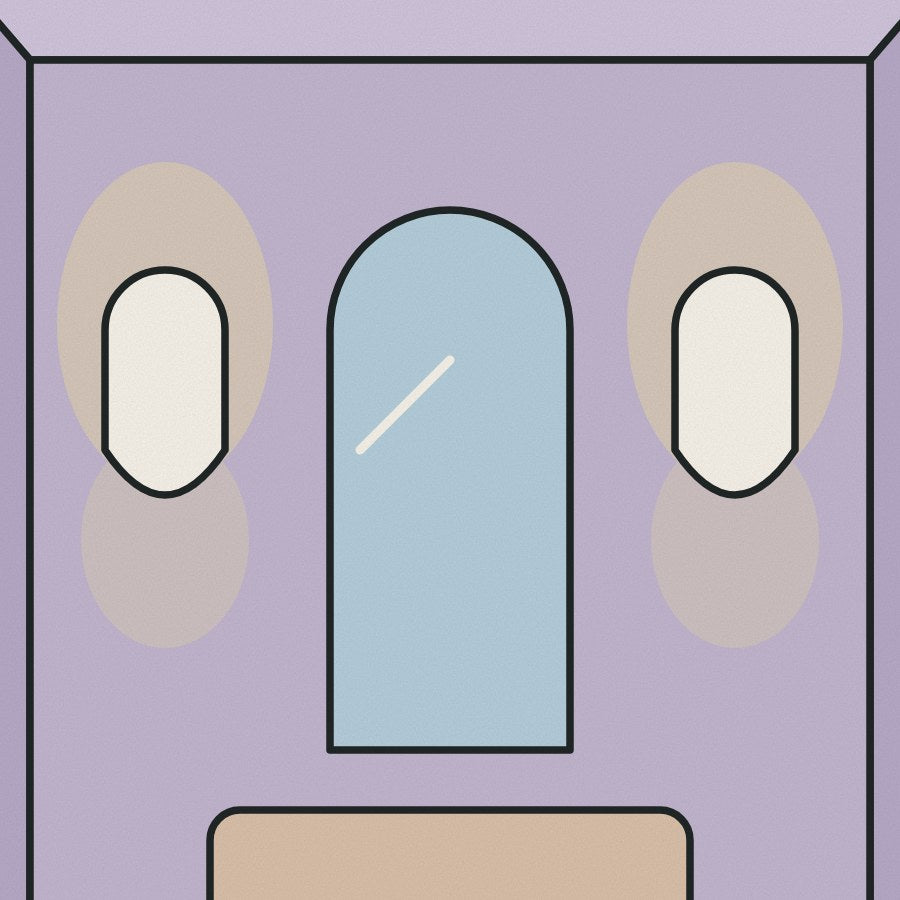
Details at the right scale
Small rooms can carry architectural detail, but the scale has to be right.
- Go petite overhead. A small, shallow ceiling rose suits a box room far better than a grand one.
- Prefer slim profiles. A flat, close-to-the-wall light takes up less visual space than a deep one.
- Fewer, better pieces. One well-chosen detail, such as an overdoor or a pair of wall lights, gives more character than several small ones.
- Keep the same family. Choose details from one style so the room reads as a whole.
Our guide on how to choose a ceiling rose size helps with proportion.
Mirrors, used well
A mirror doubles whatever it faces, so be deliberate about what that is.
- Catch the daylight. A mirror on a wall next to or opposite a window bounces light deeper into the room.
- Reflect the view, not the clutter. Hang it to reflect a window, a lit wall or a good piece, not the laundry basket.
- Light it from the sides. A pair of wall lights either side of a mirror gives flattering light and doubles the glow in the evening.
- Go large and simple. One big mirror reads as a window. Lots of small ones read as busy.
Bringing it together
Start with the light: plan wall lights for the walls you look at most, and remove a lamp or two. Choose one colour for the whole room. Add one or two details at a modest scale, then place a mirror where it will catch daylight. Our pieces are hand-cast to order in Shrewsbury from natural plaster and paint with ordinary emulsion, so they can disappear into a drenched scheme. Browse our wall lights and the modern minimal collection.
Good to know
Common questions
How can I make a small room look bigger?
Light the walls and ceiling rather than the centre of the room, swap lamps for wall lights to free surfaces, use one colour across walls, woodwork and ceiling to soften the edges, keep details modest in scale, and hang a mirror where it catches daylight.
Does colour drenching make a room look bigger?
Not physically. Colour drenching removes the hard lines where walls, ceiling and woodwork meet, so the eye stops measuring the edges and the room often feels calmer and more generous. Little Greene suggests embracing a small room's cosiness rather than trying to make it look large.
Are wall lights good for small rooms?
Yes. They take up no floor or table space and light the walls, which makes a room feel more open, and uplighters make the ceiling feel higher. Battery LED wall lights suit rooms with no cable in place; mains wall lights should be fitted by a qualified electrician.
Sources
References and further reading
Harvard style. Web pages were checked on the access date shown.
- Little Greene (n.d.) What is colour drenching? Our complete guide. Available at: www.littlegreene.com/advice-hub/embracing-colour-drenching (Accessed: 8 October 2026).
- Energy Saving Trust (n.d.) Energy saving light bulbs and lighting. Available at: energysavingtrust.org.uk/advice/lighting/ (Accessed: 8 October 2026).
- Innes, M. (2012) Lighting for Interior Design. London: Laurence King.
- Ministry of Housing, Communities and Local Government (2013) Electrical safety: Approved Document P. Available at: www.gov.uk/government/publications/electrical-safety-appr... (Accessed: 8 October 2026).
- Calloway, S. (ed.) (2005) The Elements of Style: An Encyclopedia of Domestic Architectural Detail. London: Mitchell Beazley.
How to cite this article
Meredith, S. (2026) ‘How to make a small room feel bigger with light and detail’, The Flare Journal. Flare Studio UK. Available at: https://flarestudio.uk/blogs/journal/making-small-rooms-feel-bigger (Accessed: 12 October 2026).
Shop the style






