

Lighting hallways and stairs with wall lights

To light a hallway and staircase well with wall lights, mount them at a consistent height of roughly 1.6 to 1.8 metres in the hall, follow the angle of the stairs so each fitting sits the same height above the treads, space them evenly so there are no dark patches, and make sure the stair lights can be switched on from both the top and the bottom. Use warm bulbs, avoid glare in the eyes of anyone coming down, and have any mains wiring done by a qualified electrician.
Halls and stairs are where most homes rely on a single pendant. It lights the top of your head, throws your own shadow onto the steps in front of you and leaves the walls dim. Wall lights fix all three problems because they light the surfaces you are walking past.
Heights in the hallway
In a hall, wall lights are seen from close up and from a standing position, so height matters.
- Start around 1.6 to 1.8 metres. Measured to the centre of the fitting, this keeps the light near eye level without shining straight into it.
- Keep one line. Set every light in the hall at the same height, even if doors and radiators interrupt the wall.
- Allow for ceilings. In a tall Victorian hall you can go a little higher; under a low ceiling, come down slightly so an uplight has room to spread.
- Watch the width. In a narrow hall, choose a slim, flat fitting that will not catch shoulders or bags.
Following the stairs
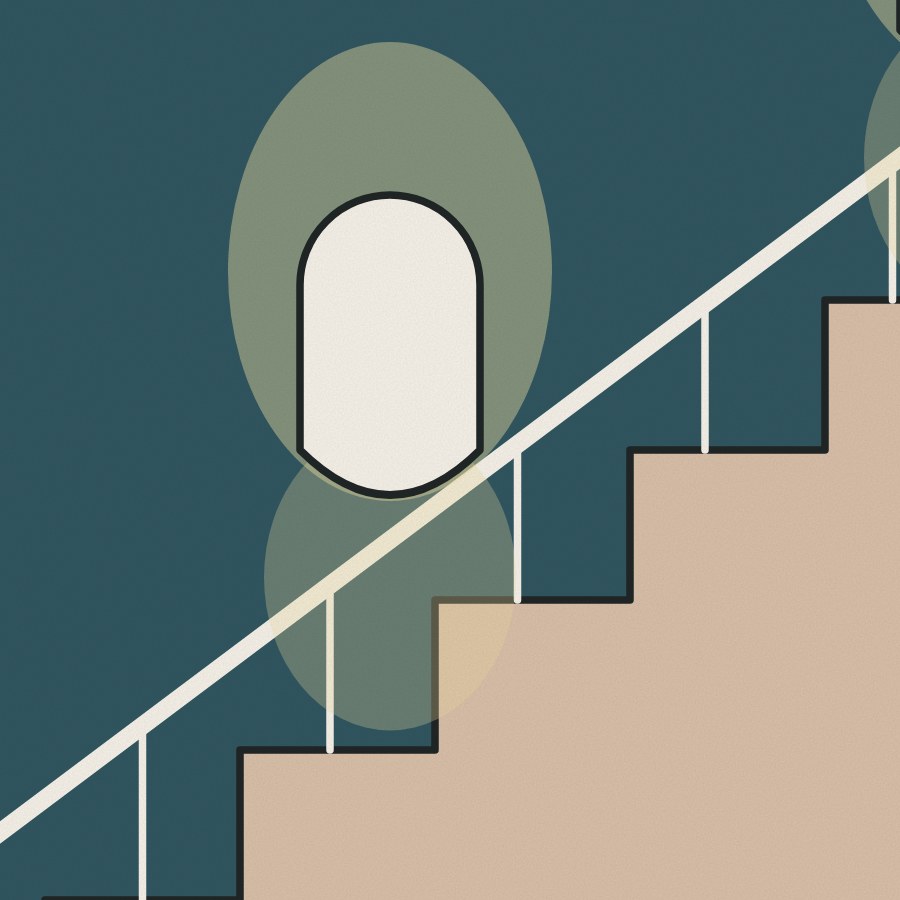
On a staircase, the floor is a slope, so the height of each light should be measured from the steps below it, not from the hall floor. A simple method is to mark the same height above the nose of the tread at each position. The lights then step up in line with the stair, which looks deliberate and keeps the light at a constant distance from people using it.
Think about the view from the top. Someone coming downstairs looks forward and down. A bare bulb or a bright, open shade at their eye level on the landing can dazzle them at exactly the wrong moment. Uplighters and closed shades that send light onto the wall and ceiling are kinder.
When it comes to spacing, a few rules cover most halls and stairs:
- Light the treads. The aim on stairs is to see the edge of each step clearly. Even light with soft shadows is better than one bright spot and a dark section.
- Cover the turns. Put a light near each change of direction, at a half landing and at the top.
- Space evenly in the hall. Two or three lights along a long hall look calmer than one at each end.
- Use the end wall. A single light at the far end of a corridor draws you through it and makes it feel shorter.
On a staircase, light the steps and the walls, never the eyes of the person coming down.
Switching at both ends
You should be able to turn the stair lights on before you set foot on the stairs, from either end. This is usually done with two-way switching, with a switch at the bottom of the stairs and another on the landing. Many older houses already have it for the pendant; if you are adding wall lights, ask for them to be wired the same way.
This is not a DIY job. Mains wiring should be done by a qualified electrician. In England and Wales, notifiable electrical work falls under Part P of the Building Regulations, and a registered electrician can certify the work for you. While they are there, ask about dimmers and about a low-level light for night-time trips.
Warm light and the right brightness
Halls set the mood as you come in. The Energy Saving Trust describes warm white bulbs of 2700K to 3000K as suiting most general household lighting, and cool whites of around 4000K as a bit harsh for many rooms. On stairs, warm white is the sensible choice: it is comfortable and still bright enough to see step edges.
Brightness is measured in lumens, not watts. As a guide, an LED of around 800 lumens gives roughly the light of an old 60-watt bulb. In a hall with several wall lights, you rarely need that much in each fitting, especially with a dimmer.
Plaster wall lights for halls
Plaster is a good material for hall lighting. Its matt surface softens light, and an uplighter shape throws a gentle glow up the wall without glare. Our wall lights are hand-cast to order in Shrewsbury from natural plaster and can be painted with emulsion to match the hall or picked out in a contrast colour.
Each design comes in three versions: shade only, battery LED with a remote, or UK mains hardwired. The battery version suits rented homes or a spot where there is no cable, and lets you test a position before calling in an electrician.
Next steps
Walk your hall and stairs at night with a torch and note where you hesitate. Those are your light positions. Browse our wall lights, check the fitting instructions, and read our piece on styling a hallway with architectural details.
Good to know
Common questions
What height should stair wall lights be?
Set each light at the same height above the stair treads beneath it, rather than measuring from the hall floor, so the fittings step up in line with the stairs. In the hall itself, around 1.6 to 1.8 metres to the centre of the fitting is a common starting point.
Do stair lights need a switch at the top and bottom?
It is strongly advisable to be able to switch stair lights on from both ends before using the stairs. This is usually done with two-way switching. Adding or altering switches is mains wiring and should be done by a qualified electrician, under Part P in England and Wales.
What colour bulb is best for a hallway?
Warm white bulbs of 2700K to 3000K suit most homes and are comfortable in halls and on stairs while still showing step edges clearly. The Energy Saving Trust notes cool white bulbs of around 4000K can feel harsh in many rooms. Choose by lumens, not watts.
Sources
References and further reading
Harvard style. Web pages were checked on the access date shown.
- Ministry of Housing, Communities and Local Government (2013) Electrical safety: Approved Document P. Available at: www.gov.uk/government/publications/electrical-safety-appr... (Accessed: 8 October 2026).
- Electrical Safety First (n.d.) Part P of the building regulations - Explained. Available at: www.electricalsafetyfirst.org.uk/find-a-registered-electr... (Accessed: 8 October 2026).
- Energy Saving Trust (n.d.) Energy saving light bulbs and lighting. Available at: energysavingtrust.org.uk/advice/lighting/ (Accessed: 8 October 2026).
- Innes, M. (2012) Lighting for Interior Design. London: Laurence King.
- Society of Light and Lighting (2018) SLL Lighting Handbook. London: CIBSE.
How to cite this article
Meredith, S. (2026) ‘Lighting hallways and stairs with wall lights’, The Flare Journal. Flare Studio UK. Available at: https://flarestudio.uk/blogs/journal/lighting-hallways-and-stairs (Accessed: 12 October 2026).
Shop the style






