Rococo in Britain: shells, scrolls and asymmetry


Rococo is a light, playful decorative style built from shells, curling C-scrolls and S-scrolls, flowers and deliberate asymmetry. It began in France in the 1730s as a reaction against the heavy, formal grandeur of Louis XIV's court, and in Britain it flourished from roughly 1740 to 1770. Where Baroque and Palladian design insist on perfect balance, Rococo lets one side of a mirror frame or ceiling panel curl differently from the other.
In Britain it was mostly a style of interiors, furniture, silver and plasterwork rather than whole buildings. The best places to see it today are Claydon House in Buckinghamshire and the Rococo Garden at Painswick in Gloucestershire.
Where the name comes from
The word grew out of the French rocaille, the rock and shell work used to line grottoes and fountains since the Renaissance. The style was first called style rocaille. "Rococo" itself is a later, mocking coinage, used by critics who thought the style frivolous and old-fashioned. The French goldsmith and designer Juste-Aurèle Meissonnier spread it across Europe through his engraved designs.
That origin matters for anyone who loves coastal decoration. Rococo is, at heart, the art of the seashell: ribbed, rippled, scalloped and turned slightly on its side. I explore the shell's long history in the scallop shell in design.
How Rococo reached Britain
The style arrived in the 1730s through immigrant craftsmen, including Huguenot refugees such as the silversmith Paul de Lamerie. William Hogarth's St Martin's Lane Academy, founded in 1735, became a meeting place where painters, engravers and designers absorbed the new French taste. In 1753 Hogarth published The Analysis of Beauty, praising the serpentine "line of beauty", an S-curve that sums up the Rococo eye.
The book that carried the style into British homes was Thomas Chippendale's The Gentleman and Cabinet-Maker's Director, published in 1754. Its subtitle offered designs "in the Gothic, Chinese and modern taste", and "modern" meant Rococo. A near reprint followed in 1755 and an enlarged third edition in 1762, by which time Neoclassical ideas were creeping in.
Baroque wants to impress you. Rococo wants to make you smile.
How to spot Rococo
Use these clues on a ceiling, a chimneypiece or a mirror frame.
- Rocaille. Rippled, rock-like and shell-like forms, often at the top or centre of a frame.
- C-scrolls and S-scrolls. Curves that curl back on themselves and run into one another, with no straight edges.
- Asymmetry. The two halves of a cartouche or panel echo each other but do not match.
- Nature, lightly done. Trailing flowers, leaves, birds and sometimes pagodas, the Chinese-inspired ornament called chinoiserie.
- Pale colour. White, cream and soft pastel grounds that let the ornament read as delicate relief.
Rococo is easy to confuse with its neighbours. Baroque, which came before it, is heavier, grander and usually symmetrical. Neoclassicism, which replaced it from the 1760s, went back to straight lines, ruled symmetry and motifs from ancient Rome, as Robert Adam's interiors show. Our piece on Robert Adam and neoclassical interiors covers that shift. If a design curls, ripples and refuses to match, it is almost certainly Rococo.
Where to see it
Claydon House, Buckinghamshire. Ralph Verney, 2nd Earl Verney, rebuilt the house between 1757 and 1771. The National Trust, which has cared for it since 1956, describes it as containing some of the finest Rococo interiors in England. The London carver Luke Lightfoot produced the exuberant painted wooden carvings in the North Hall and the Chinese Room, a tea pavilion of fretwork and pagoda-like canopies. From 1768 the architect Sir Thomas Robinson took over and brought in Joseph Rose for the plasterwork.
Painswick Rococo Garden, Gloucestershire. Designed in the 1740s as a pleasure garden for the owner of Painswick House, it describes itself as the UK's only complete surviving Rococo garden. It shows the same love of surprise and asymmetry, laid out in hedges, follies and paths.
Museums are rewarding too. The Victoria and Albert Museum held a landmark exhibition, Rococo: Art and Design in Hogarth's England, in 1984, and its British Galleries remain a good place to see Rococo silver, porcelain and furniture side by side.
Using Rococo ideas today
Rococo works best in small doses. One shell-topped mirror, a scrolled bracket or a shell wall light can carry a room without turning it into a stage set. Pair curved ornament with plain walls in chalky white or soft sea tones so the relief catches the light. It suits bedrooms, bathrooms and seaside houses particularly well.
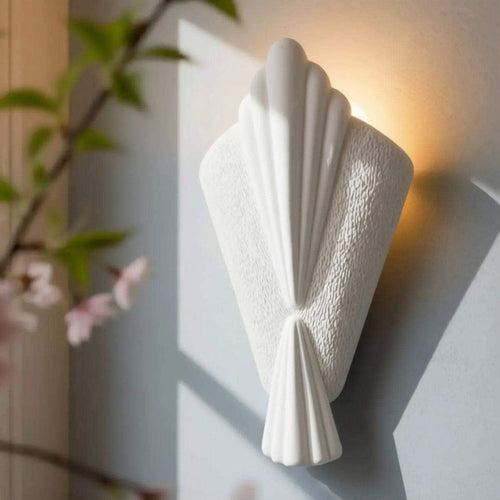
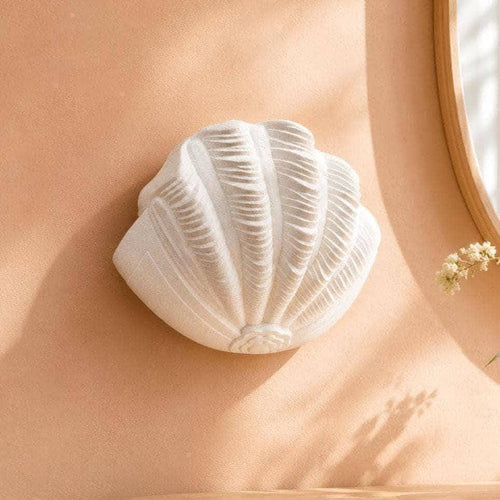
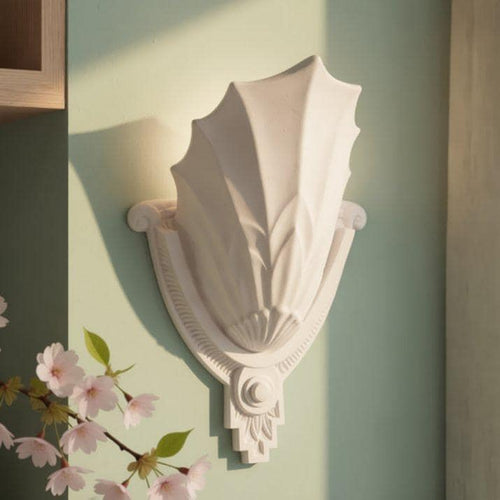
Our Coastal collection includes shell wall lights hand-cast to order in Shrewsbury. They arrive in natural plaster to paint with ordinary emulsion and come as shade only, battery LED with remote, or UK mains hardwired. Mains wiring should be done by a qualified electrician, and in England and Wales notifiable work falls under Part P of the Building Regulations. See our fitting instructions for more.
Good to know
Common questions
What is the difference between Baroque and Rococo?
Baroque is heavy, grand and usually symmetrical, designed to impress. Rococo, which followed it in the 1730s, is lighter and more playful, built from shells, C-scrolls and S-scrolls, flowers and deliberate asymmetry, often on pale grounds. In Britain Rococo was mainly a style of interiors, furniture, silver and plasterwork.
Where can I see Rococo interiors in England?
Claydon House in Buckinghamshire, cared for by the National Trust, has some of the finest Rococo interiors in England, including Luke Lightfoot's carved North Hall and Chinese Room. Painswick Rococo Garden in Gloucestershire is a complete 1740s Rococo garden, and the V&A shows Rococo silver, porcelain and furniture.
When was Chippendale's Director published?
Thomas Chippendale published The Gentleman and Cabinet-Maker's Director in 1754, with designs in the Gothic, Chinese and modern taste, modern meaning Rococo. A near reprint followed in 1755, and an enlarged third edition appeared in 1762, by which time Neoclassical ideas were beginning to show.
Sources
References and further reading
Harvard style. Web pages were checked on the access date shown.
- Snodin, M. (ed.) (1984) Rococo: Art and Design in Hogarth's England. London: Trefoil Books and Victoria and Albert Museum.
- Chippendale, T. (1966) The Gentleman and Cabinet-Maker's Director. Reprint of the 3rd edn (1762). New York: Dover Publications.
- Beard, G. (1975) Decorative Plasterwork in Great Britain. London: Phaidon.
- National Trust (n.d.) The history of Claydon House. Available at: www.nationaltrust.org.uk/visit/oxfordshire-buckinghamshir... (Accessed: 8 October 2026).
- Painswick Rococo Garden (n.d.) Painswick Rococo Garden. Available at: www.rococogarden.org.uk/ (Accessed: 8 October 2026).
How to cite this article
van Locke, J. (2026) ‘Rococo in Britain: shells, scrolls and asymmetry’, The Flare Journal. Flare Studio UK. Available at: https://flarestudio.uk/blogs/journal/rococo-style-guide (Accessed: 12 October 2026).
Shop the style