Art Deco vs Art Nouveau: how to tell them apart


Art Nouveau and Art Deco are often confused because their names sound alike and both feel decorative and a little glamorous. The quickest way to tell them apart is the line. Art Nouveau is curved and organic, drawn from plants, flowers and flowing hair. Art Deco is straight, geometric and symmetrical, drawn from machines, skyscrapers and sunbursts.
They also belong to different moments. Art Nouveau flourished from about 1890 to 1910. Art Deco took over after the First World War and peaked in the 1920s and 1930s. In many ways Deco was a reaction against Nouveau: where one tried to grow ornament like a plant, the other tried to build it like an engine.
Dates and origins
Art Nouveau took its name from the Maison de l'Art Nouveau, a Paris shop opened by the dealer Siegfried Bing in 1895. It went by other names across Europe: Jugendstil in Germany, Secession in Vienna, and Stile Liberty in Italy, after the London shop Liberty & Co. Its designers wanted a new art that broke with copying the past, and they looked to nature for it.
Art Deco is named after the 1925 Paris exhibition of modern decorative arts, the Exposition internationale des Arts décoratifs et industriels modernes. The short name only caught on in the 1960s. Deco borrowed from Cubism, from the speed of cars, liners and aeroplanes, and from the craze for ancient Egypt that followed the opening of Tutankhamun's tomb in 1922. I have written more on its roots in What is Art Deco?
Lines versus curves
As a designer, this is the test I trust most. Trace the main line of a piece with your finger.
- Art Nouveau. The line wanders. It swells and tapers, often in the famous "whiplash" curve, like a stem bending in the wind. Designs are frequently asymmetrical.
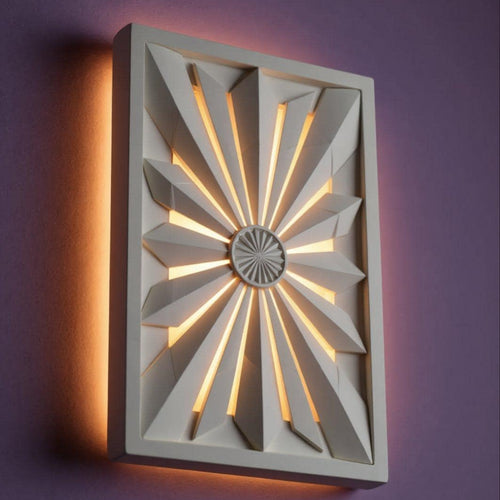
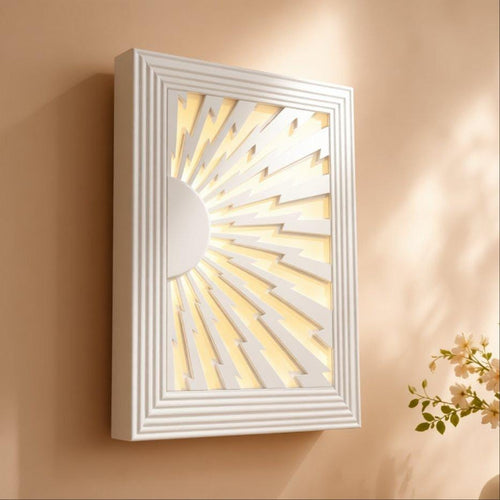
- Art Deco. The line is ruled. It steps, zigzags and radiates from a centre. Designs are almost always symmetrical, balanced either side of a central axis.
Art Nouveau is drawn with a paintbrush. Art Deco is drawn with a ruler and compass.

Motifs and materials
The two styles chose very different subjects and very different materials to express them.
- Art Nouveau motifs. Lilies, irises, poppies, peacock feathers, dragonflies, tendrils and women with long, flowing hair.
- Art Nouveau materials. Wrought iron bent into stems, stained and art glass, carved wood, ceramic tiles and hammered copper and pewter.
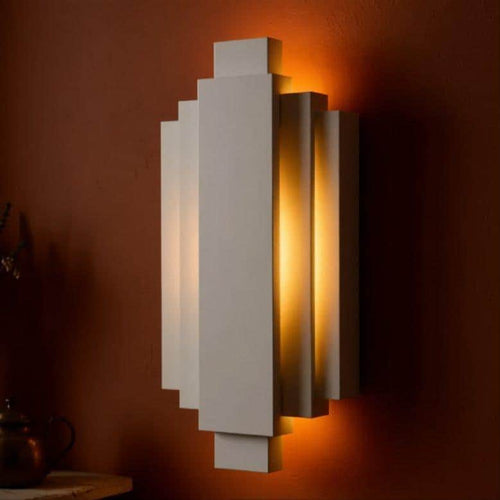
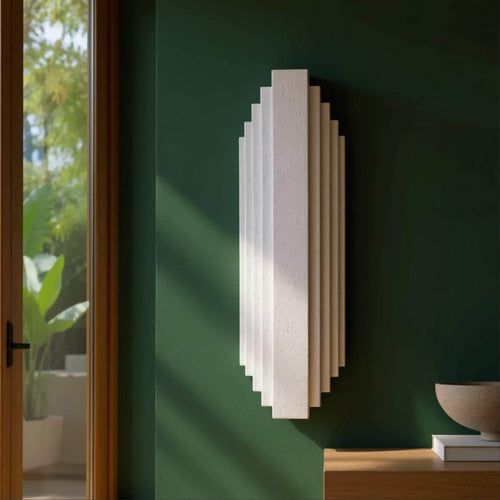
- Art Deco motifs. Sunbursts, fans, chevrons, stepped ziggurat forms, speed lines and stylised fountains.
- Art Deco materials. Chrome, mirror glass, lacquer, Bakelite, exotic veneers such as macassar ebony, and smooth, crisp plasterwork.
Even when Deco used flowers, it flattened them into geometry. A Deco rose looks cut from card. A Nouveau rose looks as though it is still growing.
Famous examples you can visit
For Art Nouveau, Hector Guimard's cast-iron entrances to the Paris Métro, designed around 1900, are the classic image: green stems rising into lamp-like buds. In Brussels, Victor Horta's Hôtel Tassel of 1893 is often called the first true Art Nouveau house. Closer to home, Charles Rennie Mackintosh developed a cooler, more linear version in Glasgow, which I cover in our piece on the Glasgow Style.
For Art Deco, New York's Chrysler Building of 1930, with its stepped crown of sunbursts, is the landmark. In London, look at the Hoover Building on the Western Avenue at Perivale, the Daily Express Building on Fleet Street with its black glass front, and the 1930s interiors at Eltham Palace in south-east London, now cared for by English Heritage. Many British towns also have an Odeon cinema from the 1930s that shows the style in brick and faience.
A quick checklist
Standing in front of a fireplace, a door or a ceiling and not sure which style you are looking at? Run through these questions.
- Curved or straight? Flowing, asymmetric curves point to Nouveau. Straight lines and arcs struck from a centre point to Deco.
- Plant or pattern? Recognisable plants and insects suggest Nouveau. Abstract fans, steps and rays suggest Deco.
- Balanced or wandering? Strict mirror symmetry is a strong Deco sign.
- Handmade or machined? Nouveau celebrates the craftsman's hand. Deco celebrates the polished, machine-made finish, even when it was made by hand.
- Which date? A house built before 1914 is unlikely to be Deco; one built in the 1930s is unlikely to be Nouveau.
There is some overlap. Late Nouveau work, especially in Vienna and Glasgow, became more geometric and pointed the way to Deco. If a piece has squares and straight stems but still feels botanical, you may be looking at that transitional moment.
Bringing either style home
You do not need to choose one style for a whole house. Nouveau suits soft, natural colours and rooms that feel calm and garden-like. Deco suits stronger contrasts, a little metallic sheen and rooms meant for evenings. A single well-chosen piece, such as a ceiling rose or wall light, will often say more than a room full of reproductions.
Our pieces are hand-cast to order in Shrewsbury and arrive as natural plaster, ready to paint. Browse the geometric designs in the Art Deco collection, or the flowing, leafy shapes in Botanical & Art Nouveau.
Good to know
Common questions
What is the main difference between Art Deco and Art Nouveau?
Art Nouveau is curved, organic and often asymmetrical, inspired by plants, flowers and flowing hair. Art Deco is geometric and symmetrical, inspired by machines, skyscrapers and sunbursts. A simple test is to trace the main line: if it wanders like a stem it is Nouveau; if it is ruled or radiates from a centre it is Deco.
When was Art Deco popular?
Art Deco emerged after the First World War and was at its height in the 1920s and 1930s. It took its name from the 1925 Paris exhibition of modern decorative arts, though the short term 'Art Deco' only became widely used in the 1960s, helped by Bevis Hillier's 1968 book.
Where can I see Art Deco interiors in London?
Eltham Palace in south-east London, cared for by English Heritage, has some of the finest 1930s interiors in the country. The Hoover Building at Perivale and the Daily Express Building on Fleet Street are notable Art Deco exteriors, and many towns have a 1930s Odeon cinema.
Sources
References and further reading
Harvard style. Web pages were checked on the access date shown.
- Greenhalgh, P. (ed.) (2000) Art Nouveau 1890–1914. London: V&A Publications.
- Benton, C., Benton, T. and Wood, G. (eds) (2003) Art Deco 1910–1939. London: V&A Publications.
- Hillier, B. (1968) Art Deco of the 20s and 30s. London: Studio Vista.
- Victoria and Albert Museum (n.d.) Art Nouveau – an international style. Available at: www.vam.ac.uk/articles/art-nouveau-an-international-style (Accessed: 8 October 2026).
- English Heritage (n.d.) Eltham Palace and Gardens: History and stories. Available at: www.english-heritage.org.uk/visit/places/eltham-palace-an... (Accessed: 8 October 2026).
How to cite this article
van Locke, J. (2026) ‘Art Deco vs Art Nouveau: how to tell them apart’, The Flare Journal. Flare Studio UK. Available at: https://flarestudio.uk/blogs/journal/art-deco-vs-art-nouveau (Accessed: 12 October 2026).
Shop the style