Japandi: where Japanese and Scandinavian design meet


Japandi is an interior style that combines Japanese minimalism with Scandinavian comfort. It takes the calm, pared-back order of a Japanese room and adds the warmth, soft textiles and practicality of a Danish or Swedish home. The result is a space that is simple without feeling cold.
The name is recent, a blend of "Japan" and "Scandi" that spread through interiors magazines and social media in the late 2010s. The affinity is much older. Both traditions prize natural materials, honest craftsmanship, uncluttered rooms and objects made to be used every day. Japandi simply puts them in the same room.
Two ideas: wabi-sabi and hygge
Japandi rests on two ideas that are easy to name and harder to translate.
- Wabi-sabi. A Japanese way of seeing beauty in things that are imperfect, impermanent and incomplete. A hand-thrown bowl with an uneven rim, timber that has greyed with age, a wall whose surface shows the hand that made it.
- Hygge. A Danish word for a feeling of cosiness, contentment and ease, often linked to candlelight, wool blankets and time with people you like.
Wabi-sabi gives Japandi its restraint and its love of natural wear. Hygge stops that restraint from becoming austere. A Japandi room should look quiet but feel lived in.
Fewer things, better made, with room around each one to breathe.
Materials
Japandi is a material-led style. Choose a small palette and repeat it.
- Timber. Pale oak and ash from the Scandinavian side; darker, sometimes charred or stained timber from the Japanese side. Mixing one light and one dark wood is a common Japandi move.
- Natural fibres. Linen, cotton, wool, paper, rattan and bamboo.
- Clay and stone. Stoneware, terracotta, slate and river stones.
- Mineral walls. Limewash, clay paint and plaster, which give a soft, slightly varied surface instead of a flat, perfect one.
Avoid high gloss, chrome and anything that looks mass-produced. Matt and tactile finishes matter more than any particular object.
Colour
The Japandi palette is drawn from nature and kept muted. Start with a warm base: oatmeal, putty, stone, bone white and pale clay. Add depth with charcoal, ink black, walnut brown and deep olive. Small notes of colour might come from indigo, rust or a soft sage. The aim is low contrast across most of the room, with a few darker anchors such as a black-framed chair or a dark timber sideboard.
Brilliant white is usually too sharp. A white with a little warmth in it will sit better against wood and linen.
Plaster and texture
Texture does the work that pattern does in other styles. Traditional Japanese houses often used earthen and clay plaster walls, valued for their soft colour and the slight movement of the trowel. Scandinavian interiors have long used limewashed walls and simple, rounded forms. Plaster belongs to both traditions.
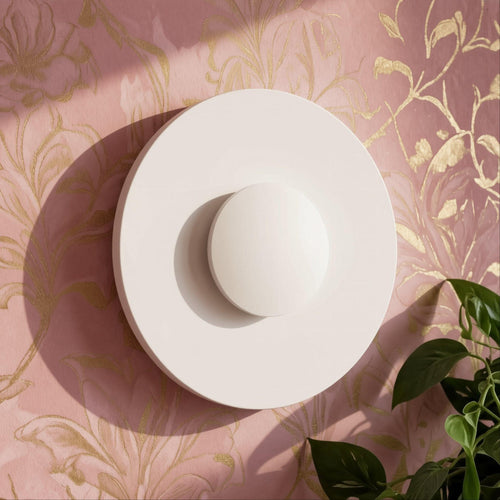
As a designer, I find natural plaster suits Japandi because it is quietly imperfect. It has a chalky, mineral surface that catches light softly, and it can be left raw or painted in a muted emulsion to match the wall. A plaster wall light or ceiling rose with a simple, organic shape adds interest without adding clutter. Choose forms with curves, pebble-like edges or clean geometry, and avoid heavy classical ornament.
How to do it at home
- Edit first. Clear surfaces and put away what you do not use. Japandi is as much about what you remove as what you add.
- Keep furniture low. Low sofas, benches and beds keep the eye level calm and the room feeling larger.
- Leave space. The Japanese idea of ma, meaningful empty space, applies to walls as well as floors. One object on a wall says more than six.
- Layer soft light. Replace a single bright overhead light with several low, warm sources. Isamu Noguchi's Akari paper lamps, made from the 1950s, and Poul Henningsen's PH lamps from Denmark show how each tradition shaped glare-free light.
- Bring in one living thing. A single branch in a vase, or one large plant, rather than a crowd of small ones.
- Buy handmade where it counts. A few crafted pieces give the room its character.
Lighting the Japandi room
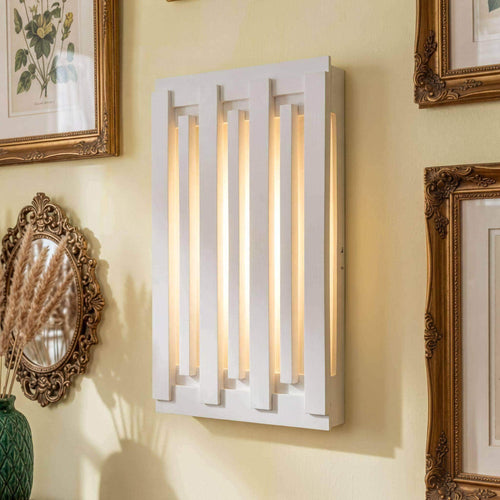
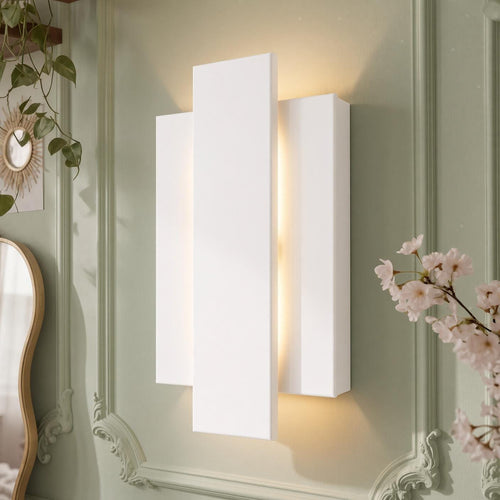
Wall lights are particularly useful in Japandi rooms because they free up surfaces and floor space. Our plaster wall lights are hand-cast to order in Shrewsbury and come in three versions: shade only, battery LED with a remote, or UK mains hardwired. The battery option is a simple way to add soft light without chasing cables into the wall. If you choose the hardwired version, it must be connected by a qualified electrician; in England and Wales, notifiable electrical work falls under Part P of the Building Regulations.
Explore calm, simple shapes in our Modern Minimal collection, and read about the roots of this way of thinking in Bauhaus and modern minimalism.
Good to know
Common questions
What is Japandi style?
Japandi is an interior style that combines the calm, pared-back order of Japanese design with the warmth and practicality of Scandinavian homes. It uses natural materials, a muted palette, low furniture and plenty of empty space, so rooms feel simple and quiet without becoming cold or austere.
What colours are used in Japandi interiors?
Japandi palettes are drawn from nature and kept low in contrast. Warm bases such as oatmeal, putty, stone and pale clay are anchored by a few darker notes like charcoal, ink black, walnut or deep olive. Brilliant white is usually too sharp; a white with some warmth sits better beside wood and linen.
What lighting suits a Japandi room?
Several low, warm, glare-free sources work better than one bright overhead light. Paper lamps, shaded table lamps and wall lights all suit the style. Battery wall lights avoid chasing cables into walls; any mains-wired fitting must be installed by a qualified electrician, under Part P in England and Wales where notifiable.
Sources
References and further reading
Harvard style. Web pages were checked on the access date shown.
- Koren, L. (1994) Wabi-Sabi for Artists, Designers, Poets & Philosophers. Berkeley, CA: Stone Bridge Press.
- Wiking, M. (2016) The Little Book of Hygge: The Danish Way to Live Well. London: Penguin Life.
- Tanizaki, J. (1977) In Praise of Shadows. Translated by T.J. Harper and E.G. Seidensticker. New Haven, CT: Leete's Island Books.
- The Noguchi Museum (2026) No Ordinary Light: Akari at 75. Available at: www.noguchi.org/museum/exhibitions/view/no-ordinary-light... (Accessed: 8 October 2026).
- Ministry of Housing, Communities and Local Government (2013) Electrical safety: Approved Document P. Available at: www.gov.uk/government/publications/electrical-safety-appr... (Accessed: 8 October 2026).
How to cite this article
van Locke, J. (2026) ‘Japandi: where Japanese and Scandinavian design meet’, The Flare Journal. Flare Studio UK. Available at: https://flarestudio.uk/blogs/journal/japandi-style-guide (Accessed: 12 October 2026).
Shop the style