The Bauhaus and modern minimalism: why less became more


Clean lines, simple geometry and nothing that does not need to be there: the minimal interiors we know today owe a great deal to a German design school that existed for only fourteen years.
A short, remarkable history
The Bauhaus was founded in Weimar in 1919 by the architect Walter Gropius. It moved to Dessau in 1925, where Gropius designed its famous glass-walled school building, completed in 1926. Ludwig Mies van der Rohe became director in 1930, and in 1932 the school moved again, to Berlin. Under pressure from the Nazi regime it closed in 1933. Many of its teachers and students emigrated, spreading its ideas across Europe and to the United States.
Big ideas
- Art and craft together. Students learned in workshops for metal, textiles, ceramics, furniture and printing, as well as studying art.
- Design for industry. Objects were meant to be produced well and used every day, not kept in a cabinet.
- Form follows function. Shape grows from purpose, with ornament removed rather than added.
- Elementary geometry. Circles, squares and triangles, often in primary colours.
Minimalism is not the absence of design. It is design with every unnecessary line taken away.
Bauhaus objects you will recognise
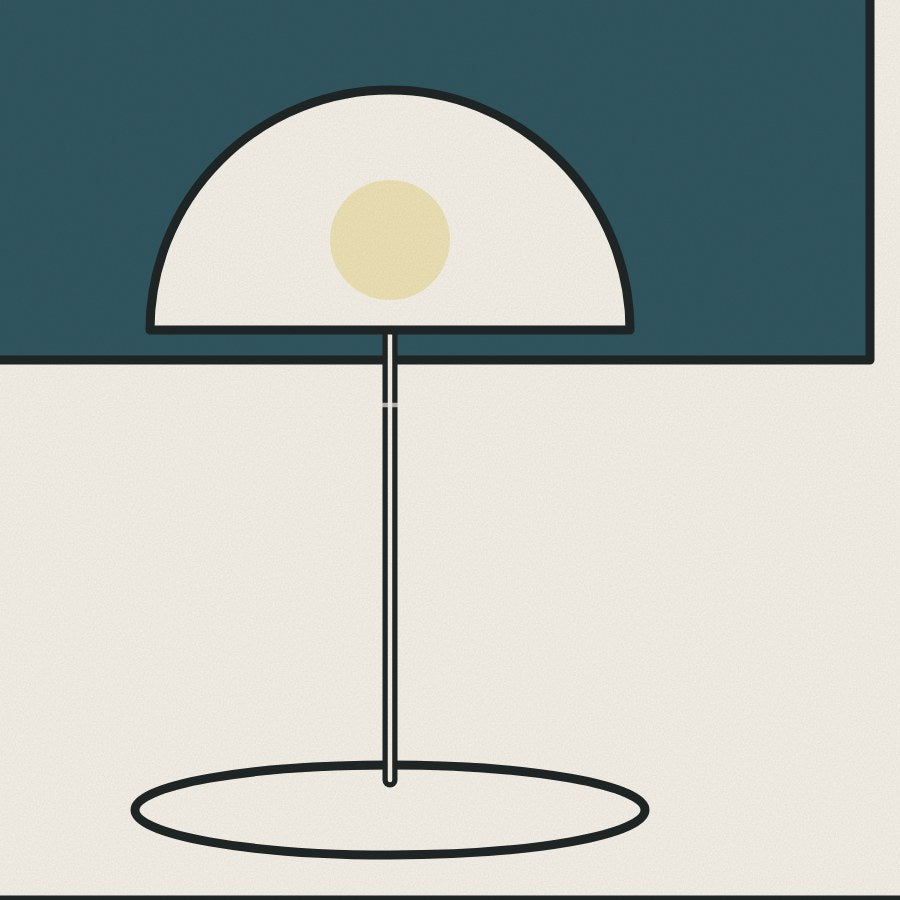
The Wagenfeld table lamp of 1924, with its glass shade and clear stem, is still made today. Marianne Brandt, one of the most gifted students in the metal workshop, designed tea infusers and ceiling lights that became models for mass-produced fittings. Marcel Breuer's tubular steel chairs introduced a new kind of furniture, light and strong.
Minimal does not mean bare
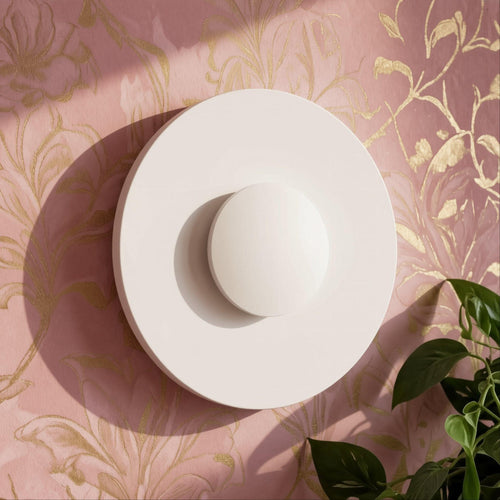
A minimal room still needs something for the eye to rest on. In a pared-back space, a simple ring or disc of plaster around a pendant adds shadow and depth without breaking the calm. Painting the piece the same colour as the ceiling keeps it quiet; a contrasting colour turns it into a single, deliberate accent. Explore our Modern Minimal collection.
Good to know
Common questions
What was the Bauhaus?
The Bauhaus was a German school of art, architecture and design that ran from 1919 to 1933, in Weimar, Dessau and finally Berlin. Founded by Walter Gropius, it brought art and craft together in workshops and designed objects for industrial production, using simple geometry and little or no applied ornament.
Why did the Bauhaus close?
The Bauhaus faced political hostility throughout its life. Dessau's city council closed the school in 1932, and Mies van der Rohe reopened it privately in Berlin. In April 1933 the Gestapo sealed the building, and in July 1933 the teachers voted to close it. Many staff and students then emigrated.
How does the Bauhaus influence minimalist interiors?
Modern minimalism inherits the Bauhaus ideas that form should follow function, that ornament should be removed rather than added, and that simple geometry is enough. A minimal room still benefits from one quiet focal point, such as a plain plaster ring or disc around a pendant, painted to match or contrast with the ceiling.
Sources
References and further reading
Harvard style. Web pages were checked on the access date shown.
- Droste, M. (2006) Bauhaus 1919–1933. Cologne: Taschen.
- Whitford, F. (1984) Bauhaus. London: Thames and Hudson.
- Stiftung Bauhaus Dessau (n.d.) Chronology. Available at: bauhaus-dessau.de/en/institution/chronology/ (Accessed: 8 October 2026).
How to cite this article
van Locke, J. (2026) ‘The Bauhaus and modern minimalism: why less became more’, The Flare Journal. Flare Studio UK. Available at: https://flarestudio.uk/blogs/journal/bauhaus-and-modern-minimalism (Accessed: 12 October 2026).
Shop the style