

1980s interiors: chintz, Memphis and the return of the ceiling rose


The 1980s pulled British homes in two directions at once. In Milan, a group of young designers made furniture in loud laminates and called it Memphis. In Britain, more people than ever owned their homes, and many of them chose chintz, swags and the look of an English country house. Between the two sat a quieter change: a turn back towards the cornices and ceiling roses that earlier decades had torn out. This guide covers the history, the colours, four real rooms and how to use the decade well today. It follows our 1970s interiors guide and leads into the 1990s.
Owning, improving and shopping
The Housing Act 1980 gave council tenants the Right to Buy. Tenants could receive up to 60 per cent off the market price, and around a million council homes were sold nationally within ten years. Most of them were houses rather than flats. A new generation of owners now had a reason to improve, extend and decorate rooms that were finally their own.
The shops followed. Laura Ashley added made-to-measure curtains and then blinds in 1980, which led to its first home furnishings catalogues. When the company floated in 1985, the offer was 34 times oversubscribed, and by 1987 it had 292 shops worldwide. In the same year IKEA opened its first British store, in Warrington. Flat-pack Swedish furniture and English floral fabric now sat side by side on the high street.
Inside older houses, a different kind of improvement was under way. In the 1960s and 1970s Victorian plaster decoration had become undesirable, and many cornices and ceiling roses were smashed and taken away. In the decades before 1980, the market for architectural salvage was almost non-existent. LASSCO, now one of the UK's largest reclamation businesses, dates from around 1980. Rescuing what earlier decades had thrown away was becoming a business.
Magazines spread the look. Homes & Gardens has since credited the bestselling Country Diary of an Edwardian Lady and the Laura Ashley effect with a boom in soft, decorative textiles, and printed regular guides to paint effects such as stippling and scumbling.
The 1980s palette
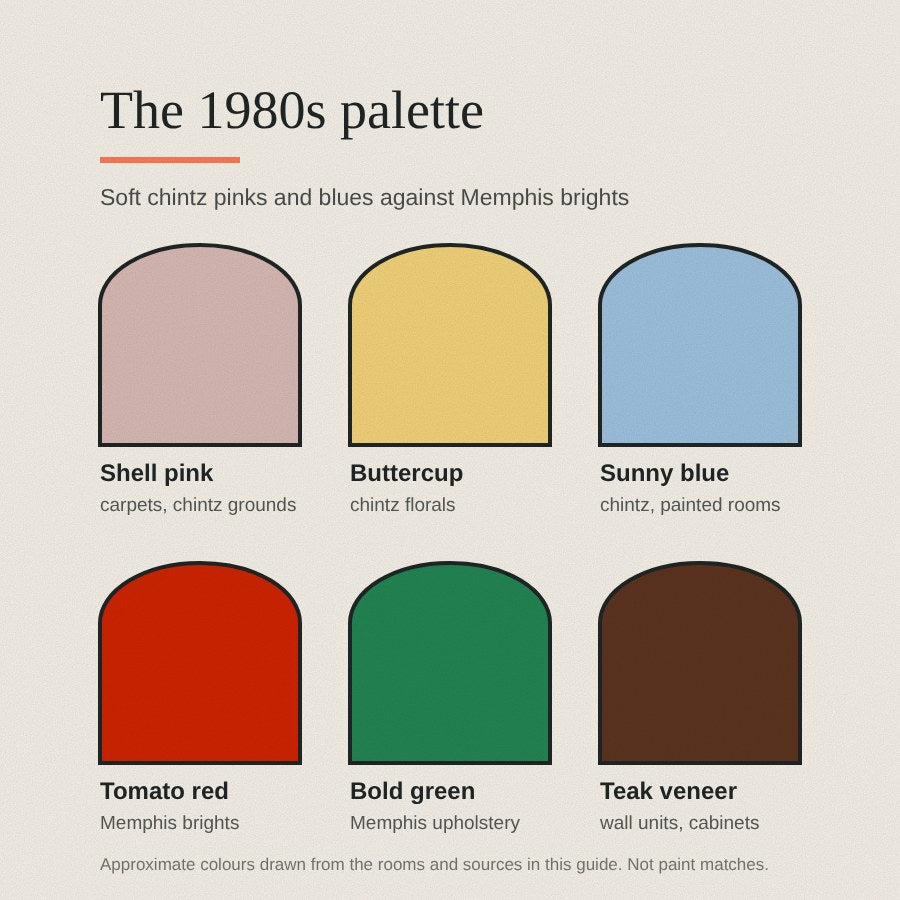
There were two palettes, and they rarely met. The country-house side was soft: chintz in pinks, buttercup yellows and blues, dusky walls and pale fitted carpets. Homes & Gardens recalls one proposed royal drawing room "in sunny blue and buttercup chintz". The Memphis side was the opposite. The Design Museum describes its furniture as made from "flashily coloured plastic laminates", often with geometric or leopard-skin patterns.
Most homes sat somewhere in between, with pale walls, warm wood-effect furniture and colour in the soft furnishings. The swatches on the card above come from the rooms later in this guide. Treat them as a starting point, not a paint match.
Postmodernism, Memphis and the country house
Postmodernism. When the V&A surveyed the movement in 2011, it described a style built on exuberant colour, bold pattern and artificial-looking surfaces, with history quoted, parodied and played with. For postmodernists, style was the point, not a side issue.
Memphis. The group took shape at a meeting in Ettore Sottsass's Milan flat in December 1980 and showed its first collection on 18 September 1981 at the Arc '74 showroom. The name came from a Bob Dylan song playing on Sottsass's record player. Members included Nathalie Du Pasquier, George Sowden, Michele De Lucchi and Martine Bedin, with Michael Graves among the later contributors. Sottsass announced he was leaving in 1985, and the group broke up in 1988.
Postmodernism in London. Britain's best-known postmodern interior is the Cosmic House in Holland Park, created between 1978 and 1983 by Charles and Maggie Jencks with the architect Terry Farrell. Michael Graves designed its fireplaces. The Jencks Foundation compares the house to Sir John Soane's, and its original furniture and fittings survive largely as designed.
The English country house. The look the decade loved had older roots. Sibyl Colefax started a decorating business after losing much of her fortune in 1929, and John Fowler joined her in 1938. The style mixed period furniture with humble pieces, and silks and damasks with faded chintz and worn leather. Fowler called the effect "pleasing decay". By 1984 it had travelled: a British decorator in Washington credited Colefax & Fowler with reviving the English country house look, and sold its chintzes and wallpapers to American clients.
The details that define a 1980s room
- Ceiling. In older houses, a reinstated cornice and ceiling rose. Our history of the Victorian ceiling rose explains what was there to begin with.
- Walls. A wallpaper border at dado or picture-rail height, small floral papers, and paint effects such as stippling and scumbling.
- Windows. Swags and tails, tie-backs, pelmets and made-to-measure blinds. Draping, swagging and ruching were everywhere.
- Floors. Fitted carpet from wall to wall, often in a pale colour, as in the first and third rooms below.
- Lighting. Vase-based table lamps with pale shades in traditional rooms. In postmodern ones, sculptural lamps in primary colours.
- Furniture. Patterned three-piece suites, wall units for the television and video, and flat-pack pieces that arrived home in a box.
Real 1980s rooms, annotated
Here are four rooms from the decade: a museum recreation, a Memphis showcase, a famous bedroom remodelled in 1981 and a rented room photographed in 1988. Each photograph is numbered with the features worth noticing. Where the colours are clear, the swatches are sampled from the photograph itself, so treat them as a guide.
1. The everyday living room
A 1980s living room recreated at the Summerlee Museum of Scottish Industrial Life in Lanarkshire, which describes it as the interior of a worker's home in Scotland in the 1980s. This is the decade as most families lived it: practical, comfortable and arranged around the television.

- Wallpaper border run round the room at dado height
- Framed print hung above the fire
- Wall unit with glazed cabinet, books and video tapes
- Electric fire set in a wood-effect surround
- Stacked hi-fi on its own stand
- Television on a low cabinet in the corner
- Patterned three-piece suite with show-wood arms
- Fitted carpet from wall to wall
Colours in this photo:
Pale grey wall #8B8B89Grey carpet #726562Wood-effect veneer #562712
Take from it: The border is the clever trick here. It breaks a plain wall into two and gives a modest room a sense of order. A picture rail or a dado rail does the same job with more permanence.
2. The Memphis room
A living room furnished almost entirely with Memphis pieces. Its Commons record identifies Ettore Sottsass's Casablanca bookcase and Ashoka lamp, both from 1981, and his Murmansk fruit dish of 1982. Notice the classical fireplace and panelled doors behind them.

- Casablanca bookcase by Ettore Sottsass, 1981, with arms reaching out like branches
- Ashoka table lamp by Sottsass, 1981, on the mantelpiece
- Murmansk fruit dish by Sottsass, 1982
- Display cabinet with a patterned surface
- Low sofa in blocks of clashing colour
- Armchair raised on a single red ball
- Classical white fireplace surround, left as it was
- Floor lamp with a bright half-moon head
Colours in this photo:
Royal blue #43518CBold green #228553Salmon pink #A85948Tomato red #CF2401Lavender grey #9893A5Honey floor #B1691F
Take from it: Memphis looks best against something calm and traditional. A plain white fireplace and a good ceiling let the colour read as a deliberate choice rather than noise.
3. The country-house bedroom
Ronald and Nancy Reagan in the newly remodelled family bedroom of the White House, photographed on 18 November 1981. It is an American room, but it shows the international reach of the traditional, layered look that British decorators had made famous.

- Wallpaper painted with birds and branches
- Oval gilt mirror over the mantel
- Crystal chandelier
- Swagged and pleated pelmet over the window
- White marble fireplace with brass fire irons
- Table lamps on vase bases with pale shades
- Pale pink fitted carpet
- Antique chest of drawers
Colours in this photo:
Painted paper ground #B2B7B3Shell-pink carpet #BAA3A1Mahogany #2D1B12White upholstery #CFD5D8
Take from it: Every surface is soft or decorated, but the colours stay close together. If you borrow the swagged window, keep the rest of the scheme quiet.
4. The rented room
A bedroom in Merchiston Place, Edinburgh, photographed by the person who lived there in November 1988. It is the honest end of the decade: tall Victorian proportions, furnished with whatever came to hand.

- Full-height curtains with a chevron weave
- Gallery exhibition poster
- Adjustable desk lamp in red
- Chair on splayed wooden legs
- Electric heater in front of the dressing table
- Teak-effect chest of drawers
- Floral duvet cover
- Dressing table with a tilting mirror
Take from it: The bones of the room do the work. High ceilings and a tall window carry almost any furniture. Restore the architecture first and the rest can change over time.
How to get the 1980s look
- Restore before you decorate. The decade's best legacy is the return of period features. If your cornice or ceiling rose was lost, it can be put back. Specialist plasterers recreate lost work with moulds and fibrous plaster. Our guide to choosing the right size of ceiling rose explains how to measure.
- Use chintz in one place. A pair of curtains, a single armchair or a run of cushions is enough. A whole room of it now reads as a set.
- Simplify the window. A single soft swag, or a plain pelmet with tie-backs, gives the country-house feel without the weight of full swags and tails.
- Add one postmodern object. A bright lamp, a terrazzo-effect side table or a sculptural vase brings the Memphis spirit in without taking over.
- Bring back the border, as a rail. A painted dado or picture rail does the job of the 1980s paper border and lets you change colour above and below.
- Keep the ceiling pale. With pattern on the walls and windows, a plain ceiling and a crisp rose give the eye somewhere to rest. Our heritage colour palettes are a good place to start.
Common mistakes to avoid
- Mixing the two 1980s at full volume. Chintz and Memphis can share a room, but only if one of them clearly leads.
- Choosing a ceiling rose that is too small. A reinstated rose should suit the height and size of the room, not just the light fitting.
- Stripping out what survives. If a house still has its original features, keep and repair them. Our guide to mixing period and modern shows how to work around them.
- Treating every effect as a must. Stippling, a border, swags and frilled blinds all at once will date a room fast. Pick one.
- Forgetting the architecture. Period features are easy to get wrong. Look at what survives in neighbouring houses before you choose a cornice or rose.
Where to see the 1980s in Britain
The Cosmic House, London. At 19 Lansdowne Walk in Holland Park, this house dates from the 1840s but was redesigned, mainly inside, from the late 1970s into the 1980s by the post-modern theorist Charles Jencks and his wife, the landscape architect Maggie Keswick, with help from Sir Terry Farrell. It has been Grade I listed since 2018 and opened to the public in 2021 as a private museum run by the Jencks Foundation. The original furniture and fittings remain. Visits have been by tour, and the building has four floors, 52 steps to the top and no lift, so check access and booking on the foundation's website first.
Summerlee Museum, Coatbridge. For an ordinary 1980s home, the museum's Miners' Row in North Lanarkshire has a 1980s living room among its period interiors, and it is the room in the first photograph above. Entry is free. It is the quieter counterpart to the Cosmic House: fitted carpet, a patterned suite and a television wall unit rather than a manifesto.
Tours of the Cosmic House are limited, so this eight-minute film is the easiest way to see how Jencks put post-modern ideas into rooms.
Video: Dezeen, "Dezeen explores postmodernist landmark The Cosmic House", via YouTube.
Shop the look
Pieces from our own range that suit this style, each designed and hand-cast in Shrewsbury.


Bringing the 1980s home with plaster
The quiet triumph of the 1980s was the ceiling rose going back up in Victorian and Edwardian houses that had lost it. A classical rose or cornice-style detail suits that story best, painted pale against a soft wall. The Regency Ceiling Rose and the smaller Windsor Ceiling Rose both fit that revival. Every piece in our Heritage Classical collection is designed and hand-cast in Shrewsbury, and arrives as natural plaster ready to leave raw or paint to suit your room.
Good to know
Common questions
What did a typical 1980s British living room look like?
The 1980s living room recreated at the Summerlee Museum of Scottish Industrial Life has fitted carpet, a patterned three-piece suite, a wall unit for the television and videos, an electric fire and a wallpaper border at dado height. Curtains in the decade were often swagged or tied back.
What was the Memphis Group?
A Milan design collective led by Ettore Sottsass. It showed its first collection in September 1981, used brightly coloured plastic laminates and bold patterns, and broke up in 1988.
Can I put a ceiling rose back in a Victorian house?
Yes. Many were removed in the 1960s and 1970s, and specialist plasterers can recreate lost work. Choose a size and style that suit the height and age of the room, and check surviving features in neighbouring houses.
Sources
References and further reading
Harvard style. Web pages were checked on the access date shown.
- 1stDibs Editors (2016) 'Decorators to Know: The Founders of Colefax and Fowler', The Study, 13 February. Available at: www.1stdibs.com/blogs/the-study/colefax-fowler (Accessed: 12 October 2026).
- alljengi (1988) My bedroom, Merchiston Place, Nov 1988 [Photograph]. Flickr, via Wikimedia Commons. CC BY-SA 2.0. Available at: commons.wikimedia.org/wiki/File:My_bedroom,_Merchiston_Pl... (Accessed: 12 October 2026).
- Batten, R. (2022) 'Meet the dealers championing reclamation and salvage yards', Homes & Antiques, 28 January. Available at: homesandantiques.com/antiques/history-reclamation-and-sal... (Accessed: 12 October 2026).
- Design Museum (n.d.) Memphis. Available at: designmuseum.org/memphis (Accessed: 12 October 2026).
- Dezeen (2011) 'Postmodernism: Style and Subversion 1970–1990 at the V&A', 26 September. Available at: www.dezeen.com/2011/09/26/postmodernism-style-and-subvers... (Accessed: 12 October 2026).
- Ebert, J. (2019) 'H&G in the 1980s and 1990s', Homes & Gardens, 26 March. Available at: www.homesandgardens.com/news/hg-1980s-1990s-198629 (Accessed: 12 October 2026).
- Grace's Guide to British Industrial History (n.d.) Laura Ashley. Available at: gracesguide.co.uk/Laura_Ashley (Accessed: 12 October 2026).
- Hoffman, M. (1984) ''English country house' look thrives in Georgetown', The Christian Science Monitor, 13 July. Available at: csmonitor.com/1984/0713/071316.html (Accessed: 12 October 2026).
- Jencks Foundation (n.d.) The Cosmic House: Architecture and Design. Available at: jencksfoundation.org/cosmic-house/about (Accessed: 12 October 2026).
- Kensington Society (n.d.) Cosmic House: a post-modern home. Available at: www.kensingtonsociety.org/portfolio-item/cosmic-house-a-p... (Accessed: 13 October 2026).
- Lancashire Evening Post (2018) 'The IKEA phenomenon: IKEA's long history with the North West', 18 May. Available at: www.lep.co.uk/business/ikea-phenomenon-ikeas-long-history... (Accessed: 12 October 2026).
- Moran, J. (2015) Early Cultures of Gentrification in London, 1955–1980. Available at: joemoran.net/academic-articles/early-cultures-of-gentrifi... (Accessed: 12 October 2026).
- Newtown Heritage Trail (n.d.) Laura Ashley (1925–1985). Available at: newtown.org.uk/discover-newtown/newtown-heritage-trail/la... (Accessed: 12 October 2026).
- St Clair, H. (n.d.) 'Home Help', The Lady. Available at: lady.co.uk/node/2031 (Accessed: 12 October 2026).
- Summerlee Museum of Scottish Industrial Life (2017) Summerlee Miners row 1980s Living Room [Photograph]. Wikimedia Commons. CC BY 3.0. Available at: commons.wikimedia.org/wiki/File:Summerlee_Miners_row_1980... (Accessed: 12 October 2026).
- University of the West of England (n.d.) The History of Council Housing: The impact of the 'Right to Buy'. Available at: fet.uwe.ac.uk/conweb/house_ages/council_housing/section8.htm (Accessed: 12 October 2026).
- White House Photographic Office (1981) President Ronald Reagan and Nancy Reagan in the Newly Remodeled First Family Bedroom [Photograph]. Ronald Reagan Presidential Library, via Wikimedia Commons. Public domain. Available at: commons.wikimedia.org/wiki/File:President_Ronald_Reagan_a... (Accessed: 12 October 2026).
- Wikipedia (n.d.) Summerlee Museum of Scottish Industrial Life. Available at: en.wikipedia.org/wiki/Summerlee_Museum_of_Scottish_Indust... (Accessed: 13 October 2026).
- Zanone (2011) Memphis-Milano Movement [Photograph]. Wikimedia Commons. CC BY-SA 3.0. Available at: commons.wikimedia.org/wiki/File:Memphis-Milano_Movement.jpg (Accessed: 12 October 2026).
How to cite this article
van Locke, J. (2026) ‘1980s interiors: chintz, Memphis and the return of the ceiling rose’, The Flare Journal. Flare Studio UK. Available at: https://flarestudio.uk/blogs/journal/1980s-interiors-guide (Accessed: 17 October 2026).
Shop the style






