1990s interiors: loft living, Changing Rooms and the minimal home


The 1990s home pulled in two directions at once. In the cities, a small number of people moved into converted warehouses with white walls, steel and glass, and a new word for the look: minimalism. In the suburbs, millions watched neighbours redecorate each other's rooms on television with MDF, stencils and sponged paint. Between them sat the decade's lasting change, the kitchen opening up into the living space. This guide covers the history, the colours, the details and four real rooms, and how to borrow the best of it today.
Lofts, television and the chintz backlash
Loft living arrived in London early in the decade. The developer Harry Handelsman, founder of the Manhattan Loft Corporation, began spending much more time in London in 1992 and bought a redundant building in Clerkenwell to convert into flats. By the late 1990s, mills and warehouses turned into apartments, with exposed brick and glass-block walls, had become a byword for urban style.
At the same time, decorating became mass entertainment. Changing Rooms ran on the BBC from 1996 to 2004. Two sets of neighbours swapped houses and each had a room redone by a designer, such as Linda Barker, Laurence Llewelyn-Bowen or Anna Ryder Richardson, on a budget of £500. It moved from BBC Two to BBC One after two years and drew almost 12 million viewers at its peak.
The furniture shop joined in. In 1996 IKEA launched its "Chuck out your chintz" campaign, written by Naresh Ramchandani at the agency St Luke's. It told British households to throw out fussy, traditional furnishings and buy clean, contemporary design instead. For how that look began, see the 1980s interiors guide.
The 1990s palette
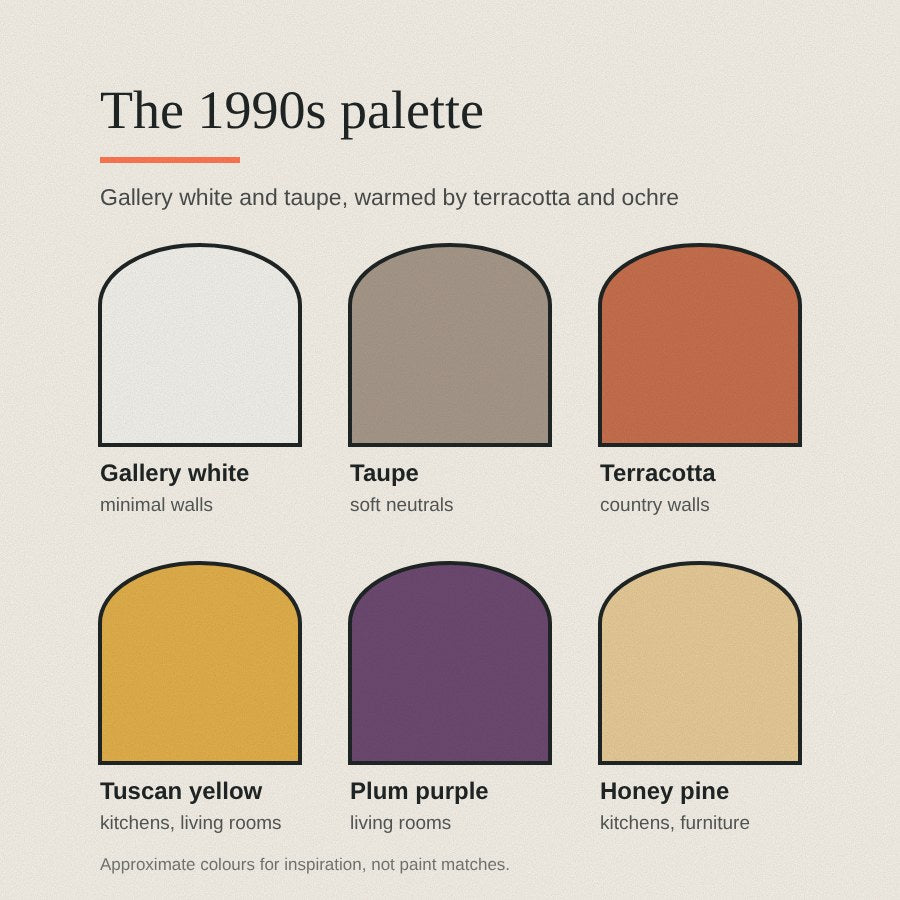
There were two palettes. The minimal one was white walls, pale wood and soft neutrals; the designer Kelly Hoppen made taupe her signature colour. The other was warm and earthy. Soft terracotta walls were a staple of country-style rooms, and sunny yellows went into the Tuscan-inspired kitchens and living rooms of the decade. Purple was one of the most popular colours for living rooms.
Wood carried as much colour as paint. Pale, honey-toned cabinets replaced the darker woods of the 1980s, and natural oak or pine was the go-to kitchen finish. The card below gives approximate colours, not paint matches.
Minimalism, makeover and Shaker
Minimalism. The architect John Pawson set up his practice in 1981, and his book Minimum, published by Phaidon in 1996, explored simplicity in art, architecture and design. From the mid-1990s his flagship stores for Calvin Klein turned the idea into white-walled shop interiors. The New York Times later called him "the father of modern architectural minimalism". In homes, the mid to late 1990s look meant clean lines, pale tones and glass furniture, with an influence from Japanese Zen design that our Japandi guide picks up. Its roots go back further, to the Bauhaus.
Makeover style. Changing Rooms was fond of MDF: one bedroom on the show had Greek nudes cut from it, and the designers performed "Why MDF?" for Children in Need in 1999. Stencilling, rag-rolling and sponge painting were popular DIY techniques, and the show is credited with bringing stencilling to a whole new generation.
Shaker. The Shakers, a religious movement, left Manchester for America in 1774. Their furniture is admired for simplicity, fine joinery and function, on the belief that beauty rests on utility. A plain panelled door made in that spirit became the basis of the British Shaker-style kitchen, a look that has since been copied hundreds of times. Harvey Jones, for example, has made its Shaker kitchen for more than 30 years.
Scandinavian and playful. IKEA had arrived in Britain in the 1980s, but the 1990s were when its pared-down Scandinavian style really took hold. Futons with slatted wooden frames, Mathmos lava lamps and Alessi's brightly coloured kitchenware supplied the fun.
The details that define a 1990s room
- Ceiling. In lofts, the structure was left on show: steel beams, high ceilings and mezzanines.
- Walls. Either white and bare, or textured with sponging, stippling, rag-rolling or colourwash, often finished with a stencilled border.
- Floors. Carpets came up and pale wood or laminate went down, as minimal schemes spread.
- Kitchen. Pale wood or painted Shaker doors, and, by the late 1990s, walls knocked through for open-plan living.
- Lighting. Wall-mounted spotlights and floor-standing uplighters bounced light off the walls and ceiling, as you can see in the rooms below.
- Furniture. Glass tables, leather armchairs, modular sofas, futons and flat-pack shelving. In bedrooms, pine or wrought iron.
Real 1990s rooms, annotated
Three views of the Museum of the Home's 1998 loft show the minimal, open-plan side of the decade, and a Danish museum room shows the warmer mainstream. Each photograph is numbered with the features worth noticing. The swatches are sampled from the photographs, so treat them as a guide, not a paint match.
1. The warehouse loft
A loft apartment furnished as it might have been in 1998, at the Museum of the Home in Hoxton, east London (formerly the Geffrye Museum). The museum's display linked lofts like this to the conversion of old industrial buildings in east London, and to the gentrification that followed.

- Sleeping platform on a steel mezzanine, open to the room below
- Stainless steel extractor hood and splashback
- Breakfast bar with steel-legged stools
- One wall painted strong yellow
- Open timber stair up to the mezzanine
- Rounded tan leather armchair
- Arched, steel-framed industrial window
- Glass coffee table
Colours in this photo:
Feature yellow #C2820ETan leather #975123Honey floor #89562E
Take from it: One big volume, a few strong pieces and one bold wall. The architecture does the decorating, so the furniture can be simple.
2. The open-plan kitchen and dining space
The other end of the same loft, photographed in December 2015 when the museum dressed its period rooms for Christmas. Here the kitchen, dining table and stair share one space, and the furniture, not walls, marks out each zone.

- Bed platform directly over the kitchen
- Stainless steel extractor hood
- Curved breakfast bar with a dark worktop
- Steel stools with wooden seats
- Yellow wall behind the stair
- White oval dining table on slim metal legs
- Moulded stacking chairs in mixed colours
- Row of framed prints in plain wooden frames
Colours in this photo:
Yellow wall #B1960CPink chair #EBA9BEOrange chair #E7976FPale grey wall #C0C0BE
Take from it: A breakfast bar is the simplest way to divide a kitchen from a living space without closing it off.
3. The pared-back sitting area
The living end of the loft. This is the minimal side of the decade: white walls, a pale wooden floor, glass and steel, and almost nothing on display.

- Arched steel window with small panes
- Wall-mounted spotlights washing light up the wall
- Slim radiator run low under the window
- Tan leather armchair
- Glass-topped table on curved steel legs
- Plain navy sofa
- Open shelving unit with a few objects
- One large, dark abstract canvas
Colours in this photo:
Navy sofa #282635Tan leather #884C29
Take from it: Light the walls rather than the middle of the room, and give each object space. Our guide to layered lighting covers the principle.
4. The warm, colourwashed family room
Most homes in the 1990s did not look like a loft. This recreated 1990s living room at Tidens Samling, a museum of everyday life in Odense, Denmark, shows the warmer, busier mainstream: textured yellow walls and honey-coloured wood.

- Walls in a mottled, colourwashed ochre
- Glazed display cabinet in honey-toned wood
- Matching open bookcase
- Spiral metal floor-standing uplighter
- Round extending table on a pedestal base
- Slatted chairs in pale wood
- Kilim-style rug in faded rose and grey
- Bright abstract print
Colours in this photo:
Ochre colourwash #EAB348Honey wood #79450A
Take from it: Broken-colour walls look best in warm, earthy shades. Keep the woodwork and ceiling plain so the texture reads.
How to get the 1990s look
- Open up, but zone it. If you knock through, use a breakfast bar, a rug or a dining table to mark out kitchen, dining and sitting areas.
- Choose one palette. Go minimal (white, taupe, pale wood) or warm (terracotta, ochre, honey pine). Mixing both can look busy.
- Use texture sparingly. A single colourwashed or limewashed wall gives the period feel without the full sponged effect.
- Keep the ceiling quiet. A plain, shallow ceiling rose painted the same colour as the ceiling suits a minimal room. Our guide to the ceiling rose in a modern home explains how, and our sizing guide helps you measure.
- Light the walls. Wall lights and uplighters that wash the wall, as in the loft above, still make a room feel bigger.
- Pick a Shaker door. It is the 1990s kitchen idea that has aged best, in pale wood or paint.
Common mistakes to avoid
- Stencilling everything. One border reads as a deliberate nod. Borders on every wall and piece of furniture read as a time capsule.
- Bare minimalism without warmth. White walls and glass need wood, leather or textiles, or the room feels cold.
- Open plan with no zones. One big room needs furniture, rugs and lighting to tell you where to cook, eat and sit.
- Too much yellow. Designers now warn that the all-in Tuscan yellow of the 1990s caused colour burnout. Use it in smaller doses.
- Ripping out older features. A 1990s look does not mean losing a cornice or fireplace you already have. Keep them, and read our guide to mixing period and modern.
John Pawson and the minimal 1990s
If one person stands for the 1990s white room, it is John Pawson. According to the Design Museum, he was born in Halifax in 1949, the youngest of five children, in a Methodist family that valued simplicity. He worked in his father's textile business, taught English in Japan from 1973, studied at the Architectural Association from 1979 and set up his own practice in 1981. His book Minimum followed in 1996.
His early work was about space, proportion, light and materials rather than style. The Design Museum lists Calvin Klein's first flagship store in Manhattan, which came from a 1993 meeting, and the Sackler Crossing at the Royal Botanic Gardens, Kew, among his notable buildings. It also lists the Design Museum's own permanent home in the former Commonwealth Institute in London, which is a good place to see the idea at civic scale. The lesson for a home is the same one: decide what each surface is for, and leave the rest empty.
Shop the look
Pieces from our own range that suit this style, each designed and hand-cast in Shrewsbury.


Bringing the 1990s home with plaster
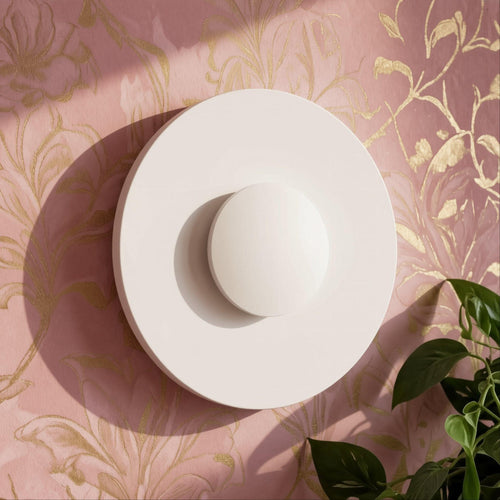
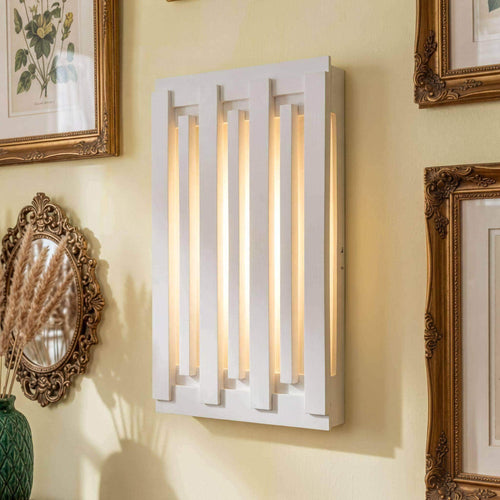
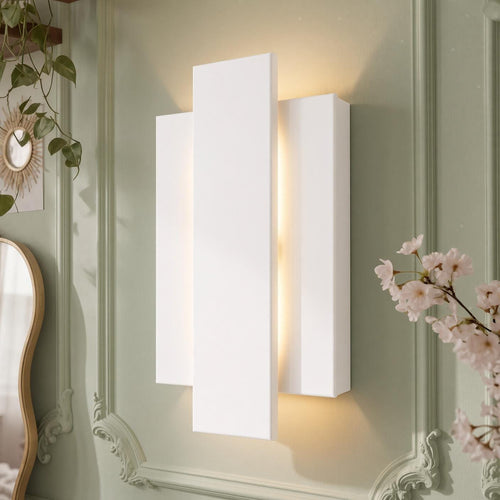
The best of the 1990s was calm: plain walls, good light and a few well-made shapes. A simple ceiling rose and a clean-lined wall light suit that mood, whether you paint them to match the wall or leave them raw. The Ring Ceiling Rose and the Warm Minimalist Wall Light are the kind of quiet shapes that suit that mood. When you are ready for the next decade, read the 2000s interiors guide. Every piece in our Modern Minimal collection is designed and hand-cast in Shrewsbury, and arrives as natural plaster ready to leave raw or paint to suit your room.
Good to know
Common questions
What colours were popular in 1990s interiors?
Two palettes ran side by side. Minimal homes used white walls, pale wood and soft neutrals such as taupe. Warmer homes used soft terracotta, sunny Tuscan-style yellows and purple, often with sponged or colourwashed paint and honey-toned pine or oak.
What was Changing Rooms?
A BBC makeover programme that ran from 1996 to 2004. Neighbours swapped houses and designers such as Laurence Llewelyn-Bowen and Linda Barker redecorated a room in each, on a £500 budget, often with MDF, stencils and paint effects.
How do I use a ceiling rose in a minimal 1990s-style room?
Choose a plain, shallow design and paint it the same colour as the ceiling, so it reads as part of the plaster rather than a decoration. In a large open-plan room, size it to the space and keep everything else on the ceiling simple.
Sources
References and further reading
Harvard style. Web pages were checked on the access date shown.
- Cmglee (2016) Cmglee London Geffrye Museum 1998 room [Photograph]. Wikimedia Commons. CC BY-SA 4.0. Available at: commons.wikimedia.org/wiki/File:Cmglee_London_Geffrye_Mus... (Accessed: 12 October 2026).
- Cooper, T. (2025) ‘5 ’90s paint colors that are making a comeback’, Better Homes & Gardens (via AOL), 8 October. Available at: www.aol.com/articles/5-90s-paint-colors-making-110000070.... (Accessed: 12 October 2026).
- Davies, N. (2025) ‘Remember 90s décor? 19 archive pictures that sum up home life in the nineties’, lovemoney, 8 September. Available at: www.lovemoney.com/gallerylist/493996/remember-90s-decor-1... (Accessed: 12 October 2026).
- Design Museum (n.d.) John Pawson. Available at: designmuseum.org/designers/john-pawson (Accessed: 13 October 2026).
- Dulux (n.d.) Let’s Colour podcast, episode 15: trends and colours of the 1990s. Available at: dulux.co.uk/en/lets-colour-podcast/all-episodes/015-trend... (Accessed: 12 October 2026).
- Etherington, R. (2010) ‘John Pawson: Plain Space at the Design Museum’, Dezeen, 16 September. Available at: www.dezeen.com/2010/09/16/john-pawson-plain-space-at-the-... (Accessed: 12 October 2026).
- Fairs, M. (2016) ‘IKEA’s “Chuck out your chintz” ads changed British taste, says the man who wrote the slogan’, Dezeen, 22 February. Available at: www.dezeen.com/2016/02/22/ikea-chuck-out-your-chintz-1996... (Accessed: 12 October 2026).
- Hachette Australia (n.d.) John Pawson [Phaidon book listing]. Available at: www.hachette.com.au/john-pawson-deyan-sudjic/john-pawson (Accessed: 12 October 2026).
- Harvey Jones (2012) The popularity of Shaker, 23 May. Available at: www.harveyjones.com/blog/news/the-popularity-of-shaker (Accessed: 12 October 2026).
- Homer, R. (2024) ‘1990s decorating trends: then and now’, lovemoney, 20 November. Available at: www.lovemoney.com/gallerylist/348079/1990s-decorating-tre... (Accessed: 12 October 2026).
- Homes & Antiques (2017) The 90s interiors trends we forgot we loved, 14 November (updated 2022). Available at: homesandantiques.com/interiors/decorating/trends/the-90s-... (Accessed: 12 October 2026).
- Ideal Home (n.d.) 6 things we miss about Changing Rooms. Available at: idealhome.co.uk/diy-and-decorating/6-things-we-miss-about... (Accessed: 12 October 2026).
- JRennocks (2017) 1990s interior design, Museum of the Home [Photograph]. Wikimedia Commons. CC BY 4.0. Available at: commons.wikimedia.org/wiki/File:1990s_interior_design,_Mu... (Accessed: 12 October 2026).
- Jørgensen, L. (2025) Tidens Samling - 1990s [Photograph]. Wikimedia Commons. CC BY-SA 4.0. Available at: commons.wikimedia.org/wiki/File:Tidens_Samling_-_1990s.jpg (Accessed: 12 October 2026).
- Kabat, J. (2011) ‘John Pawson: Design Museum’, frieze, 136. Available at: frieze.com/article/john-pawson (Accessed: 12 October 2026).
- Petts, J.E. (2015) 1990s period room [Photograph]. Wikimedia Commons. CC BY-SA 2.0. Available at: commons.wikimedia.org/wiki/File:1990s_period_room_-_23806... (Accessed: 12 October 2026).
- Something Curated (2016) ‘Harry Handelsman: the Chiltern Firehouse developer sets out to make Stratford sexy’, 11 March. Available at: somethingcurated.com/2016/03/11/harry-handelsman-the-chil... (Accessed: 12 October 2026).
- Tait, A. (2020) ‘“I mustn’t swear, I mustn’t swear”: life as a victim of a Changing Rooms makeover’, The Guardian, 18 September (syndicated by Yahoo Life UK). Available at: uk.style.yahoo.com/mustn-t-swear-mustn-t-113040977.html (Accessed: 12 October 2026).
- urban75 (n.d.) In photos: explore front rooms of the past at the Museum of the Home, east London. Available at: www.urban75.org/blog/in-photos-explore-front-rooms-of-the... (Accessed: 12 October 2026).
- Wonderglass (n.d.) John Pawson. Available at: www.wonderglass.com/creatives/john-pawson/ (Accessed: 12 October 2026).
- Youens, A. (2015) ‘Made in Britain: Mark Wilkinson Furniture’, Country Life, 13 January. Available at: www.countrylife.co.uk/interiors/made-britain-mark-wilkins... (Accessed: 12 October 2026).
How to cite this article
van Locke, J. (2026) ‘1990s interiors: loft living, Changing Rooms and the minimal home’, The Flare Journal. Flare Studio UK. Available at: https://flarestudio.uk/blogs/journal/1990s-interiors-guide (Accessed: 17 October 2026).
Shop the style