Odeon and the Art Deco picture palace


For most people in 1930s Britain, Art Deco was not something they owned. It was somewhere they went on a Saturday night. The Odeon chain, founded by Oscar Deutsch, built hundreds of cinemas in a recognisable house style: cream faience, a tall tower or fin, curved wings, neon after dark and, inside, smooth auditoria washed with light from hidden coves.
Many are gone, but a good number survive as cinemas, bingo halls, churches or shops. This guide covers how the style came about, how to read an Odeon front, five real cinemas annotated, and what the picture palace can teach a home today.
Oscar Deutsch and the Odeon chain
The first cinema to carry the Odeon name opened at Perry Barr, Birmingham, on 4 August 1930. It was not yet in the house style: its design, by Stanley Griffiths and Horace Bradley, was Moorish inside and out. Historic England's teaching notes repeat the slogan said to lie behind the name, "Oscar Deutsch Entertains Our Nation".
Growth was fast. The first five new Odeons opened in 1933, another seventeen in 1934, and by 1936 the circuit had 142 cinemas. Historic England describes Deutsch as a pioneer in using architecture to build a recognisable corporate image. Writing in Apollo in 2025, Stephen Patience counts 258 Odeons opened in eleven years.
The house architects were Harry Weedon's Birmingham practice, with Cecil Clavering and Robert Bullivant doing much of the design. Weedon is credited with over 150 cinemas for Deutsch between 1934 and 1939, with Leicester Square as his flagship. Andrew Mather and George Coles also designed for the chain.
How to read an Odeon front
No two Odeons were identical, but the family likeness is strong. Modernist Britain lists the recurring parts of Weedon's style: soaring towers and fins, curved canopies, faience fronts in black and buff with coloured horizontal bands, curved wings and plenty of neon. The diagram below labels them on the Odeon Kingstanding, using the features named in its Historic England list entry.
The trick is contrast: one vertical tower against long horizontal bands, glazed tile against plain brick, a dark plinth below and a light, rounded top.

Inside: coves, plaster and hidden light
Inside, Odeons were deliberately simple. Historic England describes their interiors as based on "an interplay of mouldings and extensive use of coved lighting", with the money spent on comfortable seats rather than ornament. Light came from troughs and coves rather than from chandeliers, so the plaster itself seemed to glow.
- Lighting troughs. At the Odeon Weston-super-Mare (1935), auditorium lighting is concealed in troughs across the ceiling, and the proscenium sits in three moulded recesses that were originally back-lit.
- Moulded ceilings. At Sutton Coldfield the original textured and moulded ceilings survive in the former circle.
- Relief and colour. The Leicester Square auditorium had coved lighting, rippled surfaces and relief figures, overseen by Raymond Britton Riviere as consultant for decoration and lighting.
Our guide to Art Deco ceilings and plasterwork looks at the domestic version, and fibrous plaster explained covers how such mouldings are made.
The other circuits: Granada and Gaumont
Odeon was not alone. The Granada Tooting, opened in 1931, went the opposite way. Cecil Masey adapted its entrance front from a design by Sir Giles Gilbert Scott, and the theatre designer Theodore Komisarjevsky gave it a Gothic interior of arcades and painted panels. In 2000 it became the first and only cinema listed Grade I. The critic Ian Nairn advised visitors to "miss the Tower of London if you have to, but don't miss this".
The Gaumont State in Kilburn, by George Coles, opened in December 1937 with 4,004 seats. Its Historic England entry calls it one of the largest and most impressive movie palaces ever built in Britain, with a cream faience Moderne front and a tower rising in three stages. It is listed Grade II*.
What happened to the picture palaces
- Bingo saved many. Kingstanding closed as a cinema in 1962 and became a bingo club. Perry Barr, the first Odeon, went to bingo in 1969 and became a banqueting suite in 2002. The Granada Tooting and the Gaumont State both turned to bingo, and the Gaumont State is now a church.
- Subdivision changed the rest. Harrogate was split into three screens in 1972. At Leicester Square a 1967 refit stripped nearly all the original decoration, including the etched-glass entrance doors.
- Demolition took many more. Only eight of Andrew Mather's 25 Odeons survive, and about 90 per cent of George Coles's cinemas have been demolished or closed.
- Listing protects the best. The Cinema Theatre Association, which studies cinema buildings rather than films, keeps a directory of over 340 listed cinema records. Historic England calls the Odeon Woolwich (1937, by Coles) one of the best surviving examples of the Odeon style, and the former Odeon in Morecambe, now a home store, was listed Grade II in April 2026.
For more surviving buildings you can visit, see Art Deco Britain: buildings to visit.
Where to watch a film in a 1930s cinema today
Reading about picture palaces is no substitute for sitting in one with the lights going down. These two independents show what a careful restoration can do, and both still show films.
The Plaza, Stockport. The Plaza Super Cinema and Variety Theatre opened on 7 October 1932. Like so many, it went through years as a bingo hall and a nightclub, then a period of dereliction, before a long restoration brought it back to what its owners describe as its opening day condition. Today it mixes live shows with classic films presented in their correct ratio and format, and its Compton organ is still played. The Plaza also runs regular behind-the-scenes tours, which are the best way to see the building closely.
The Rex, Berkhamsted. The Rex opened on 9 May 1938 with Shirley Temple in Heidi. In the early 1970s the circle was split into two small screens and the main auditorium turned over to bingo, and the cinema closed on 28 February 1988. After more than sixteen years of neglect and the threat of demolition, it reopened on 5 December 2004 with one large screen set in its 1938 Art Deco proscenium.

What to look for when you go: where the light comes from (coves, troughs and wall lights rather than a central fitting), how the walls and ceiling frame the screen, and how few colours are used. Those three things transfer to a sitting room more easily than any amount of gilt.
Odeons and picture palaces, annotated
Here are five real cinemas: four Odeons and one Granada for comparison. Each photograph is numbered with the features worth noticing. Where the swatches appear, they are sampled from the photograph itself, so treat them as a guide rather than a paint match.
1. Odeon Kingstanding, Birmingham (1935)
Designed by J. Cecil Clavering and Robert Bullivant of Harry Weedon's practice, Kingstanding was built as the focal point of a new housing estate. Historic England listed it Grade II in 1980. It closed as a cinema in 1962 and is now a Mecca bingo hall, which is why it survives so complete.

- Central tower of three faience fins
- Stepped brick parapet either side of the tower
- Brown brick main body, plain and slightly stepped back
- Curved wings with horizontal banding
- Bowed sign board, now carrying the bingo name
- Cantilevered canopy over the entrance
- Columns at the entrance (the central ones have been reclad)
- Dark tiled plinth at street level
Colours in this photo:
Brown brick #39302A
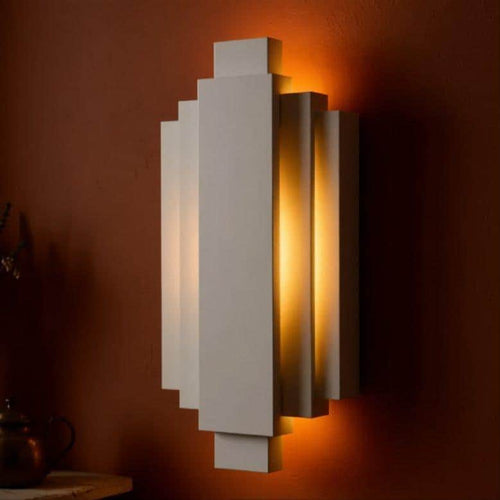
Take from it: One strong vertical against long horizontal lines is the whole trick. A fluted or stepped wall light, such as our Stepped Geometric Wall Light, between two plain walls does the same job indoors.
2. Odeon Sutton Coldfield (1935 to 1936)
Historic England calls this Clavering design the first purpose-built Odeon in the mature house style, and arguably the most important single cinema in its development. It spawned copies at York, Harrogate and Scarborough. In this 2010 photograph it trades as the Empire.

- Faience-clad fin, its top now cut down
- Brick staircase tower
- Horizontal brick banding
- Thin green bands along the faience
- Curved corner block in square faience tiles
- Tall metal windows with square panes
- Projecting curved canopy
- Double doors on the curved corner
Colours in this photo:
Buff faience #B1A59BBrown brick #735A46
Take from it: Notice how few materials there are: buff tile, brown brick and one thin green line. A restrained palette is easier to live with than a busy one.
3. Odeon Harrogate (1936)
A near copy of Sutton Coldfield by William Calder Robson of the Weedon practice, listed Grade II in 1988. It was split into three screens in 1972 and is still run by Odeon, one of the few to stay with the company for its whole life.

- Tall faience fin, lettered CINEMA in red
- Brick tower that sandwiches the fin
- Thin green bands across the cream north block
- Curved corner wing in faience tiles
- Green banding on the low curved drum
- Canopy over the corner entrance
- Tall strip windows to the stair
- Black plinth beneath the windows
Colours in this photo:
Cream faience #C5B89EBrown brick #7A6753
Take from it: Cream with a fine green line is an easy scheme for a hallway.
4. Odeon Leicester Square, London (1937)
The flagship, by Harry Weedon with Andrew Mather, opened on 2 November 1937. Its front and tower, about 120 feet high, are clad in black granite. The photograph dates from 2014, before the 2018 remodel.

- Tower carrying the name
- Flat, unbroken top to the main block
- Black cladding over the whole front
- Large framed panel for the film poster
- Entrance at the base of the black wall
- Victorian neighbour, for contrast
Colours in this photo:
Black granite #1E1F21
Take from it: Black works here because the shapes are simple. Indoors, keep it to one surface, such as a fire surround or a door.
5. Granada Tooting, London (1931)
Not an Odeon, and not Art Deco inside: Komisarjevsky's interior is Gothic. It closed as a cinema in 1973 and has been a bingo hall since the mid-1970s.

- Stepped, geometric glass light fitting
- Circular ceiling panel with a moulded rim
- Curved balcony front with a stepped moulding
- Painted ceiling panels between carved beams
- Gothic arcading high on the wall
- Painted figures in arched panels
- Pointed Gothic arch
Colours in this photo:
Ceiling plaster #9F7A43
Take from it: The light fittings are pure 1930s even in a Gothic room. A geometric fitting and one moulded ceiling feature can carry a period look on their own.
How to bring the picture palace home
- Light the ceiling, not the room. Uplighters and wall lights that wash a pale ceiling give the soft, even glow of a cinema cove. Our guide to slip shades and Art Deco lighting covers period fittings. Mains wiring must be done by a qualified electrician; in England and Wales notifiable work falls under Part P of the Building Regulations.
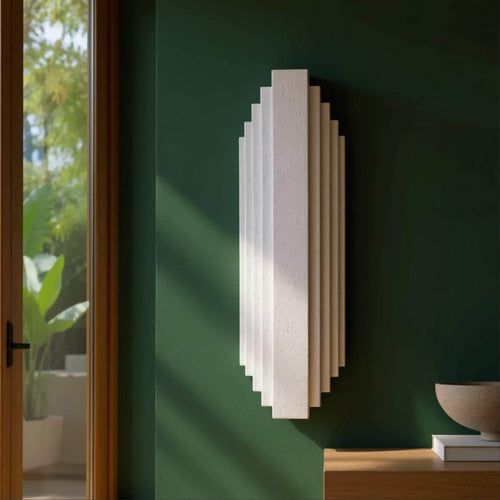
- Use one stepped or fluted shape. A tower of fins on a cinema front becomes a fluted wall light or a stepped ceiling rose at home, such as the tiered Cosmos Ceiling Rose.
- Borrow the palette. Cream, buff, black and a thin line of green or red come straight from the faience. Our Stepped Wall Light arrives as natural plaster ready to paint, so you can pick out one of those colours. Our British 1930s interiors guide shows how the same colours appeared in ordinary homes.
- Add a curve. Curved corners and bands are the Streamline side of the style, explained in Streamline Moderne.
Common mistakes to avoid
- Too much at once. A cinema could carry neon, gilt and murals because it was a night out. A sitting room needs one or two strong moments.
- Bright overhead light. A single bare pendant flattens moulded plaster. Light from the side or from below brings out the relief.
- Ignoring the building. If you live in or work on a listed former cinema, speak to the local conservation officer and a specialist before changing anything.
Shop the look
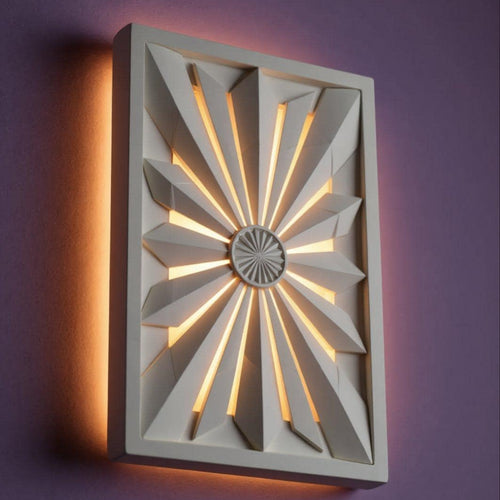
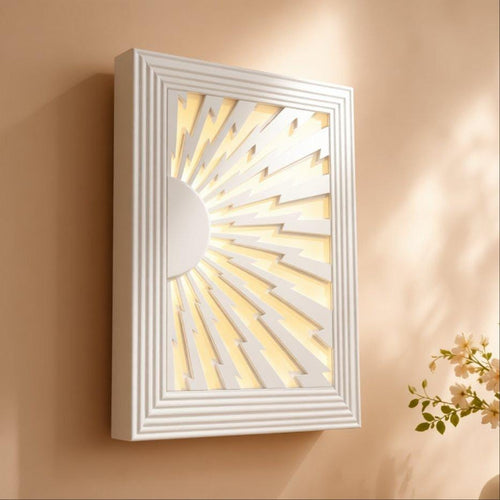
Stepped and fanned plaster pieces that borrow the picture palace look, each designed and hand-cast in Shrewsbury.


Bringing the picture palace home with plaster
A fluted wall light that throws its glow up the wall, or a stepped ceiling rose under a plain ceiling, borrows the cinema's best idea: let light and moulding do the decorating. Browse our wall lights and ceiling roses to start. Every piece in our Art Deco collection is designed and hand-cast in Shrewsbury, and arrives as natural plaster ready to leave raw or paint to suit your room.
Good to know
Common questions
What does Odeon stand for?
Historic England's teaching notes give the slogan "Oscar Deutsch Entertains Our Nation" as the source of the name. Oscar Deutsch founded the chain, and the first cinema called Odeon opened at Perry Barr, Birmingham, in 1930.
What is the Odeon style?
A 1930s cinema house style developed mainly by Harry Weedon's practice. Typical features are towers and fins, curved canopies and wings, faience fronts in buff, cream or black with coloured horizontal bands, neon, and simple interiors lit from concealed coves.
Which Art Deco Odeons can you still see?
Good surviving examples include Kingstanding in Birmingham (now bingo), Sutton Coldfield, Harrogate (still an Odeon), Woolwich (now a church) and the black granite flagship in Leicester Square. Kingstanding, Sutton Coldfield, Harrogate and Woolwich are all listed Grade II.
Can I still watch a film in a 1930s Art Deco cinema?
Yes. Restored independents such as the Plaza in Stockport (opened 1932) and the Rex in Berkhamsted (opened 1938) still show films, and some 1930s Odeons, including Harrogate, are still cinemas. Check each venue's own listings before you travel.
Sources
References and further reading
Harvard style. Web pages were checked on the access date shown.
- Beyond Radio (2026) Morecambe cinema turned DIY store gains listed building status. Available at: www.beyond.radio/news/local-news/morecambe-cinema-turned-... (Accessed: 13 October 2026).
- Cinema Theatre Association (n.d.) Home. Available at: cinema-theatre.org.uk/ (Accessed: 13 October 2026).
- Cinema Theatre Association (n.d.) UK listed cinemas directory. Available at: ukcinemas.org/listed/ (Accessed: 13 October 2026).
- Cinema Treasures (n.d.) Odeon Luxe London Leicester Square. Available at: cinematreasures.org/theaters/841 (Accessed: 13 October 2026).
- Cinema Treasures (n.d.) Odeon Perry Barr. Available at: cinematreasures.org/theaters/15735 (Accessed: 13 October 2026).
- Hisgett, T. (2010) Odeon Cinema Kingstanding (1) [Photograph]. Wikimedia Commons. CC BY 2.0. Available at: commons.wikimedia.org/wiki/File:Odeon_Cinema_Kingstanding... (Accessed: 13 October 2026).
- Hisgett, T. (2010) Odeon Cinema Sutton Coldfield 2 [Photograph]. Wikimedia Commons. CC BY 2.0. Available at: commons.wikimedia.org/wiki/File:Odeon_Cinema_Sutton_Coldf... (Accessed: 13 October 2026).
- Historic England (n.d.) Mecca Bingo (formerly Gaumont State Cinema), List Entry 1078889. Available at: historicengland.org.uk/listing/the-list/list-entry/1078889 (Accessed: 13 October 2026).
- Historic England (n.d.) New Wine Church (Former Odeon Cinema), Woolwich, List Entry 1212649. Available at: historicengland.org.uk/listing/the-list/list-entry/1212649 (Accessed: 13 October 2026).
- Historic England (n.d.) Odeon Cinema, Birmingham Road, Sutton Coldfield, List Entry 1271848. Available at: historicengland.org.uk/listing/the-list/list-entry/1271848 (Accessed: 13 October 2026).
- Historic England (n.d.) Odeon Cinema, Hanley, Stoke on Trent [Educational image]. Available at: historicengland.org.uk/education/schools-resources/educat... (Accessed: 13 October 2026).
- Historic England (n.d.) Odeon Cinema, Harrogate, List Entry 1203754. Available at: britishlistedbuildings.co.uk/101203754-odeon-cinema-harro... (Accessed: 13 October 2026).
- Historic England (n.d.) Top Rank Club (formerly the Odeon Cinema), Kingstanding, List Entry 1076275. Available at: historicengland.org.uk/listing/the-list/list-entry/1076275 (Accessed: 13 October 2026).
- Historic England (n.d.) Weston-super-Mare Odeon Cinema, List Entry 1311970. Available at: historicengland.org.uk/listing/the-list/list-entry/1311970 (Accessed: 13 October 2026).
- Manchester Victorian Architects (n.d.) Harold (Harry) William Weedon. Available at: www.manchestervictorianarchitects.org.uk/architects/harol... (Accessed: 13 October 2026).
- Modernism in Metro-land (n.d.) Gaumont State Kilburn. Available at: www.modernism-in-metroland.co.uk/gaumont-state-kilburn.html (Accessed: 13 October 2026).
- Modernism in Metro-land (n.d.) Granada Tooting. Available at: www.modernism-in-metroland.co.uk/granada-tooting.html (Accessed: 13 October 2026).
- Modernism in Metro-land (n.d.) Odeon Woolwich. Available at: www.modernism-in-metroland.co.uk/odeon-woolwich.html (Accessed: 13 October 2026).
- Modernist Britain (n.d.) Odeon Cinema Harrogate. Available at: www.modernistbritain.co.uk/post/building/Odeon+Cinema+Har... (Accessed: 13 October 2026).
- Modernist Britain (n.d.) Odeon Cinema Kingstanding. Available at: www.modernistbritain.co.uk/post/building/Odeon+Cinema+Kin... (Accessed: 13 October 2026).
- Modernist Britain (n.d.) Odeon Cinema York. Available at: www.modernistbritain.co.uk/post/building/Odeon+Cinema+York/ (Accessed: 13 October 2026).
- oatsy40 (2014) Odeon Leicester Square [Photograph]. Wikimedia Commons. CC BY 2.0. Available at: commons.wikimedia.org/wiki/File:Odeon_Leicester_Square_(1... (Accessed: 13 October 2026).
- Open House Festival (n.d.) Granada Tooting. Available at: programme.openhouse.org.uk/listings/498 (Accessed: 13 October 2026).
- Patience, S. (2025) 'When art deco went to the movies', Apollo, 26 May. Available at: apollo-magazine.com/?p=1024897 (Accessed: 13 October 2026).
- Paul the Archivist (2017) Gala Bingo (former Granada Cinema), Tooting 19 [Photograph]. Wikimedia Commons. CC BY-SA 4.0. Available at: commons.wikimedia.org/wiki/File:Gala_Bingo_(former_Granad... (Accessed: 13 October 2026).
- RIBApix (n.d.) Odeon cinema, Kettlehouse Road, Kingstanding, Birmingham: the entrance foyer. Available at: www.architecture.com/image-library/ribapix/image-informat... (Accessed: 13 October 2026).
- Robson, G. (2020) Odeon Cinema, Harrogate [Photograph]. Geograph, via Wikimedia Commons. CC BY-SA 2.0. Available at: commons.wikimedia.org/wiki/File:Odeon_Cinema,_Harrogate_-... (Accessed: 13 October 2026).
- SAVE Britain's Heritage (2019) SAVE publishes new photos of 1936 Odeon cinema interiors under threat from demolition, 16 September. Available at: www.savebritainsheritage.org/news/save-publishes-new-phot... (Accessed: 13 October 2026).
- Stockport Plaza (n.d.) About the Plaza. Available at: stockportplaza.co.uk/about-the-plaza/ (Accessed: 13 October 2026).
- Stockport Plaza (n.d.) Heritage & Restoration. Available at: stockportplaza.co.uk/heritage-restoration/ (Accessed: 13 October 2026).
- The Rex Berkhamsted (n.d.) History. Available at: therexberkhamsted.com/history/ (Accessed: 13 October 2026).
- Theatres Trust (n.d.) Odeon Leicester Square. Theatres Database. Available at: database.theatrestrust.org.uk/resources/theatres/show/2070 (Accessed: 13 October 2026).
- Tooting History Group (2025) THG news 2025. Available at: tootinghistory.org.uk/thg_news_2025/ (Accessed: 13 October 2026).
- Wikidwitch (2011) Berkhamsted Rex auditorium1 [Photograph]. Wikimedia Commons. CC BY-SA 3.0. Available at: commons.wikimedia.org/wiki/File:Berkhamsted_Rex_auditoriu... (Accessed: 13 October 2026).
- Yorkshire Post (2022) 'Harrogate Odeon Cinema: historic picture palace which dates back to the 1930s put up for sale for £7m', 25 April. Available at: www.yorkshirepost.co.uk/business/consumer/harrogate-odeon... (Accessed: 13 October 2026).
How to cite this article
van Locke, J. (2026) ‘Odeon and the Art Deco picture palace’, The Flare Journal. Flare Studio UK. Available at: https://flarestudio.uk/blogs/journal/odeon-art-deco-cinemas (Accessed: 17 October 2026).
Shop the style