

Edwardian interiors: lighter rooms, picture rails and plasterwork


Edwardian interiors are lighter, simpler and airier than Victorian ones. Edward VII reigned from 1901 to 1910, but the style is usually stretched to cover the years up to the First World War in 1914. Its signs are pale colours, picture rails, deep friezes, lighter plasterwork and the influence of both the Arts and Crafts movement and Art Nouveau.
If your house has a tiled front path, a stained-glass panel in the front door, a picture rail about a foot or so below the ceiling and a generous hall, there is a good chance it was built in this period. Thousands of Edwardian terraces and semis survive in British towns, and many still keep some of their original features.
Lighter colours and cleaner rooms
The Victorians favoured rich, deep colours and crowded rooms. The Edwardians opened the curtains. Fashionable schemes used creams, soft greens, eau de nil, pale blues and primrose yellow, with woodwork more often painted white or ivory rather than grained to look like oak. Furniture was lighter in scale and rooms were less cluttered.
Part of this was practical. Electric light was spreading in wealthier homes, and new ideas about health and fresh air encouraged rooms that were easy to clean and full of daylight. For a fuller picture of how colour changed across the eras, see our guide to heritage colour palettes.
The picture rail and the frieze
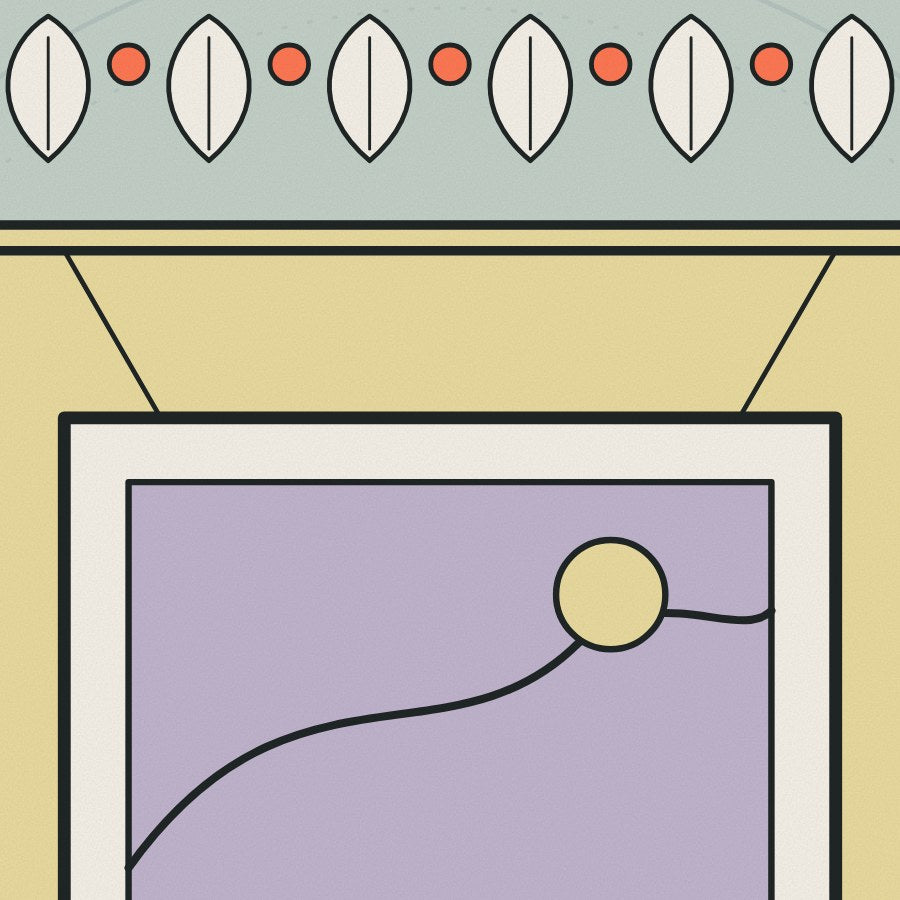
- Picture rail. A moulded timber rail fixed around the room, usually somewhere between 30 and 50 centimetres below the ceiling. Pictures hung from hooks on the rail by cord or chain, so walls did not need to be drilled.
- Frieze. The band of wall between the picture rail and the cornice. Edwardians often treated it as a separate field, papered with a stencilled or printed border of flowers, birds or landscape, or simply painted the same colour as the ceiling.
- Dado. The dado rail of Victorian halls was still used, especially with a hard-wearing embossed paper such as Lincrusta or Anaglypta below it.
The Edwardian room lifted its eyes. The interest moved upwards, to the frieze, the cornice and the ceiling.
Arts and Crafts and Art Nouveau
Two movements shaped the Edwardian look. The first was Arts and Crafts, led in spirit by William Morris, which valued honest materials, handwork and patterns taken from English gardens and hedgerows. Architects such as C. F. A. Voysey and M. H. Baillie Scott carried those ideas into whole houses, with plain walls, oak, simple fireplaces and built-in settles. You can read more in our piece on William Morris and Arts and Crafts.
The second was Art Nouveau, which reached many British homes in a gentle form through shops such as Liberty & Co. It shows up in the curving stems of fireplace tiles, the tulips and lilies of door glass, and the sinuous lines of cast-iron grates. Elsewhere, a revival of Georgian and Adam taste, sometimes called Neo-Georgian, brought back garlands, urns and fine classical detail.
For a sense of the period at full scale, visit the planned garden communities of Letchworth Garden City, begun in 1903, and Hampstead Garden Suburb in north London, begun in 1907. Their houses show the cottage-like, Arts and Crafts side of Edwardian building.
Edwardian plasterwork
Plaster ceilings were lighter in feeling than Victorian ones. Cornices were often shallower, and enrichment might be a delicate run of leaves, ribbons or fruit rather than heavy, deeply undercut ornament. Fibrous plaster, cast in moulds and reinforced with hessian, was by now widely used, which made fine detail affordable for ordinary houses. Ceiling roses remained common, especially in front rooms and halls, and their designs leaned towards garlands, flowers and Adam-style patterns.
In simpler homes, the ceiling might be plain, with the decoration concentrated in the cornice and the picture rail. That balance is worth respecting when you restore: an over-elaborate rose can look Victorian rather than Edwardian.
How to restore an Edwardian interior
- Keep the picture rail. It is part of the room's proportions. If it has been removed, a shadow line or old paint edge on the wall may show where it ran.
- Repair before replacing. Original cornices can often be cleaned of paint build-up and repaired by a specialist plasterer.
- Respect the walls. Most Edwardian houses were plastered in lime on timber laths or on solid brick. Take advice before stripping or re-plastering, and avoid sealing old walls with materials that trap moisture.
- Choose the right scale. Match any new ceiling rose to the room, and keep the detail light and floral or classical. Our guide to choosing a ceiling rose size helps here.
- Paint warm and soft. Creams, stone and pale greens on walls, with the frieze and ceiling a shade lighter.
If you are adding a new rose or a decorative light in a period room, any mains wiring should be done by a qualified electrician, under Part P of the Building Regulations in England and Wales where the work is notifiable.
Finding the right pieces
Our ceiling roses and mouldings are hand-cast to order in Shrewsbury and arrive as natural plaster, so you can paint them to match an Edwardian scheme. Browse the garlands and leaves of the Heritage & Classical collection, or the softer curves of Botanical & Art Nouveau.
Good to know
Common questions
What are the main features of an Edwardian house?
Typical features include a tiled front path, stained glass in the front door, a generous hall, a picture rail with a frieze above, lighter plaster cornices and ceiling roses, and pale, airy colour schemes. Interiors show the influence of the Arts and Crafts movement and a gentle form of Art Nouveau.
How high should a picture rail be in an Edwardian room?
Edwardian picture rails were usually fixed somewhere between 30 and 50 centimetres below the ceiling, leaving a band of wall called the frieze. If an original rail has been removed, a shadow line or old paint edge on the wall can often show exactly where it ran.
What colours did Edwardians paint their rooms?
Edwardians moved away from deep Victorian colours towards lighter schemes: creams, soft greens, eau de nil, pale blues and primrose yellow. Woodwork was more often painted white or ivory than grained, and the frieze and ceiling were commonly kept a shade lighter than the walls.
Sources
References and further reading
Harvard style. Web pages were checked on the access date shown.
- Long, H.C. (1993) The Edwardian House: The Middle-Class Home in Britain 1880–1914. Manchester: Manchester University Press.
- English Heritage (2011) Practical Building Conservation: Mortars, Renders and Plasters. Edited by A. Henry and J. Stewart. Farnham: Ashgate.
- Letchworth Garden City Heritage Foundation (n.d.) Our History. Available at: www.letchworth.com/about-us/our-history/ (Accessed: 8 October 2026).
- Hampstead Garden Suburb (n.d.) Historical context. Available at: hgs.org.uk/history/h00010000.html (Accessed: 8 October 2026).
- Ministry of Housing, Communities and Local Government (2013) Electrical safety: Approved Document P. Available at: www.gov.uk/government/publications/electrical-safety-appr... (Accessed: 8 October 2026).
How to cite this article
van Locke, J. (2026) ‘Edwardian interiors: lighter rooms, picture rails and plasterwork’, The Flare Journal. Flare Studio UK. Available at: https://flarestudio.uk/blogs/journal/edwardian-interiors-guide (Accessed: 12 October 2026).
Shop the style






