

How to Clean a Plaster Ceiling Rose Without Damaging It


Start dry
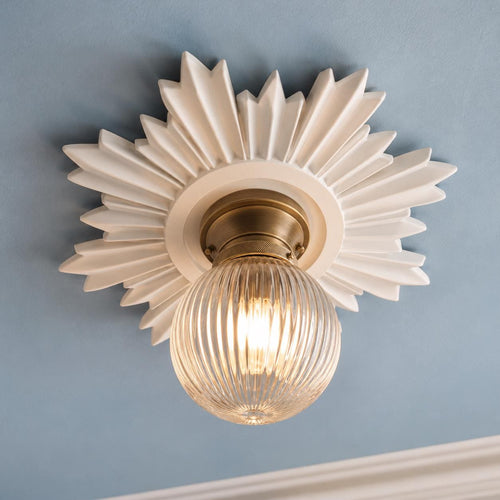
Most dirt on a rose is dust. Use a soft dry paintbrush or a vacuum with a brush attachment, working from the centre outward. Conservators take the same approach, removing residue from plaster with nothing more than a gentle dusting with a soft bristle brush[1]. Use a ladder safely and wear eye protection. If the rose looks loose, cracked or stained from a leak, do not clean it but have it checked: defects in hidden ceiling structures can develop unnoticed for years before failure[2].
For marks and grease
In a kitchen, a rose can pick up a thin film. Wipe with a microfibre cloth wrung out almost dry, then let it air dry. Never let water pool in the detail: water-soluble finishes such as distemper can be damaged by water[1].
What not to use
- Abrasive cleaners or scouring pads
- Steam cleaners
- Soaking or spraying heavily
- Pressure from stiff brushes
Conservation specialists note that heat and steam generally lack the control needed for delicate historic plaster[1]. The Georgian Group describes gentle steam and a palette knife as a way to remove built-up emulsion from mouldings[3], but that is careful paint removal, not routine cleaning.
If the detail is clogged
Many coats of paint can fill the detail. If stripping is ever justified, the Victorian Society suggests proprietary paint strippers used to the manufacturer's instructions with protective clothing, gloves and goggles, or steam to soften old finishes so they can be lifted out by hand[4]. But old paint can contain lead or, in textured coatings, asbestos, so do not sand or scrape unless it has been tested. The Health and Safety Executive lists textured decorative coatings, once sold under trade names such as Artex, among the materials in which asbestos is found[5], and publishes task sheets for work on them by people trained to recognise and work safely with asbestos[6]. Lead pigments were taken out of decorative paints by the early 1980s; the British Coatings Federation advises testing painted surfaces in houses more than 40 years old, avoiding dry sanding, and overcoating sound paint rather than removing it[7]. Period ornament may also be lime plaster, gypsum plaster or, in some cast mouldings, papier mâché[8], so seek professional advice for heavily coated period plaster.
When to repaint
If cleaning does not lift marks, repaint with thin coats of matt paint after priming; the Georgian Group likewise favours flat finishes on mouldings[3]. See how to paint a plaster ceiling rose.
Shop the look


Frequently asked questions
How do I clean a plaster ceiling rose?
Dust with a soft brush or vacuum brush attachment, then wipe marks with a barely damp microfibre cloth.
Can I wash a plaster ceiling rose?
Not with water in quantity. Plaster is porous, so use a barely damp cloth only.
How often should I dust it?
A few times a year, or when you dust the room.
Is it safe to scrape old paint from a rose?
Only if the paint has been tested for lead and asbestos-containing coatings ruled out.
Sources
References and further reading
Harvard style. Web pages were checked on the access date shown.
- Ireland, R. (2005) ‘Cleaning decorative plaster’, The Building Conservation Directory. Available at: buildingconservation.com/articles/cleandecplast/cleandecp... (Accessed: 27 October 2026).
- Clark, K. (2021) ‘Structural assessment of historic plaster ceilings’, The Building Conservation Directory. Available at: buildingconservation.com/articles/plaster-ceilings/plaste... (Accessed: 27 October 2026).
- The Georgian Group (n.d.) The Georgian Group Guides N4: Paint colour. London: The Georgian Group. Available at: georgiangroup.org.uk/wp-content/uploads/2018/05/The_Georg... (Accessed: 27 October 2026).
- The Victorian Society (2024) Victorian and Edwardian plaster mouldings, cornices, coving and dado rails. The Victorian Society. Available at: www.victoriansociety.org.uk/advice/plaster-mouldings-and-... (Accessed: 27 October 2026).
- Health and Safety Executive (n.d.) Locations of asbestos and taking the right action. Health and Safety Executive. Available at: www.hse.gov.uk/asbestos/location-materials.htm (Accessed: 27 October 2026).
- Health and Safety Executive (n.d.) Asbestos essentials. Health and Safety Executive. Available at: www.hse.gov.uk/asbestos/essentials/index.htm (Accessed: 27 October 2026).
- British Coatings Federation (2015) Lead in painted surfaces: repainting and removal. Guide for the general public (HS 032). British Coatings Federation. Available at: paintingdecoratingassociation.co.uk/wp-content/uploads/20... (Accessed: 27 October 2026).
- Cadw (n.d.) Floors and ceilings. Cardiff: Welsh Government. Available at: cadw.gov.wales/floors-and-ceilings (Accessed: 27 October 2026).
How to cite this article
Tire, G. (2026) ‘How to Clean a Plaster Ceiling Rose Without Damaging It’, The Flare Journal. Flare Studio UK. Available at: https://flarestudio.uk/blogs/journal/how-to-clean-a-plaster-ceiling-rose (Accessed: 12 November 2026).
Shop the style










Conversation
Join the conversation
Questions about the history, a room you are planning, or a piece you have seen in the wild? Leave a comment and Joseph will reply.