

How to Hang Curtains: Pole Height, Width and Length

The short answer
Fit the pole at least 15 cm above the window and let it extend 15–30 cm beyond each side, then buy curtains with a total fabric width of about twice the pole width and a drop that stops 1 cm above the floor. That is the consensus, but the sources disagree in the detail: Morris & Co puts the pole 8 cm above the window soffit and extends it at least 15 cm each side[1], Vanessa Arbuthnott wants at least 15 cm above and at least 30 cm beyond[2], Screwfix says 6–12 inches each side[3] and Dunelm allows 20 cm each side[4].
Fullness, the ratio of fabric width to pole width, runs from 1.5× for a flat, minimalist look to 2.5× for a luxurious one[3][4][5]. Length options are sill, apron, floor and puddle[4].
The guide below gives the numbers, a worked example you can copy, and the checks to make before you drill.
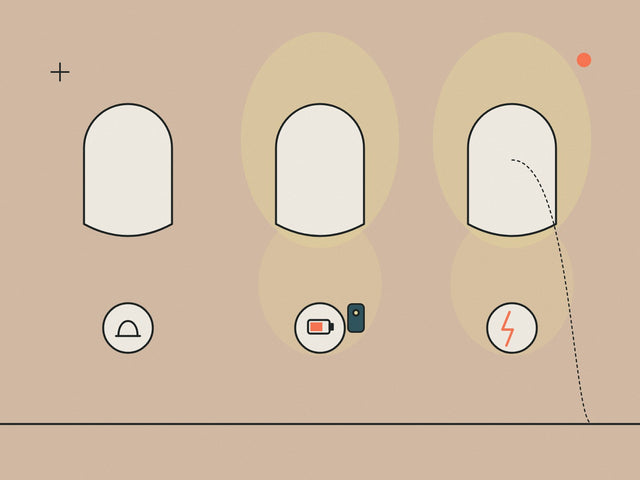
What you need
- Tape measure (a metal one), pencil and spirit level.
- The pole or track and its brackets, rings or glides, and finials.
- Drill and fixings that suit the wall, plus a cable and pipe detector. Our guide to hanging pictures covers wall types and detectors.
- A stepladder and a second pair of hands.
- The curtains, measured as shown below.
Pole height and width
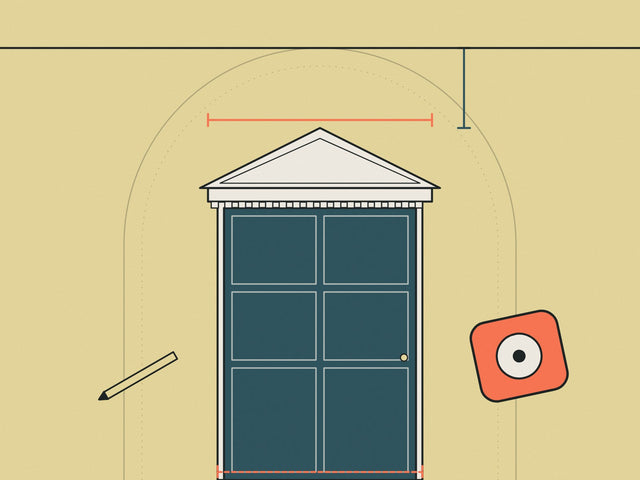
The pole decides how the whole window looks, so fit it before you measure the curtains. Three questions: how high, how wide and how far it sits from the wall.
How high
Morris & Co says the pole should sit about 8 cm above the window soffit, the underside of the lintel or window head[1]. Vanessa Arbuthnott says at least 15 cm above the window[2]. In our reading they are not strictly in conflict: 8 cm is a minimum that works where space is tight, and 15 cm or more lifts the eye, makes the window look taller and lets more daylight in over the top. If there is a cornice, picture rail or low ceiling, you may have to fit the pole to the space.
How wide
The extension past the window on each side is where the open curtain rests, so the glass stays clear. The sources give different minimums: Morris & Co says at least 15 cm[1]; Vanessa Arbuthnott says at least 30 cm[2]; Screwfix says 6–12 inches (15–30 cm)[3]; and Dunelm says to add 20 cm each side where there is no pole yet, to allow for brackets and finials[4]. For a track, Dunelm says add 10 cm each side[4]. Morris adds that you should measure the pole to where it stops, before the finials[6].
The wider the pole, the more fabric you need, so a wider pole costs more in curtains. If wall space is limited, stay near 15 cm; if you want the glass fully clear, go for 30 cm.
Standard lengths
Dunelm names four lengths: sill length stops 1 cm above the sill, apron length drops 15 cm below the sill, floor length stops 1 cm above the floor and puddle length goes 2–7 cm below the floor[4]. Screwfix gives the same floor-length gap of about 1 cm and the same 2–7 cm for puddling[3]. Vanessa Arbuthnott lists sill, just above the floor, touching the floor and puddling[2].
Which length? Sill and apron suit windows with a radiator or window seat beneath, because the curtain stays clear. Floor length is the tidy default for most rooms. Puddling is a style choice, not a necessity, and it collects dust. These are our observations, not sourced rules. If you have no pole fitted yet, Dunelm says to add 10 cm to the drop to allow for it[4]. For a patio or front door, Dunelm gives a drop of 213 cm[4].
How much fabric (fullness)
Fullness is the width of the fabric divided by the width of the pole. A curtain that is 1× is flat and looks stretched; more fabric gives the folds that make a curtain look good. Screwfix says 1.5× is minimalist, 2× standard and 2.5× luxurious[3]. Dunelm says 2× for standard and 2.5× for luxury[4]. Vanessa Arbuthnott says 2.2–2.5 times the pole width[2].
| Heading | Fullness | Source |
|---|---|---|
| Stage or front of house | 1.5× | Direct Fabrics[5] |
| Pencil pleat | 2× | Direct Fabrics[5] |
| Eyelet | 2× | Direct Fabrics[5] |
| Wave | 2.2× | Direct Fabrics[5] |
| Pinch pleat | 2.5× | Direct Fabrics[5] |
The same heading can appear in several guides with different ratios, so check the maker’s instructions for your own curtains. Where two panels meet in the middle, Screwfix says to allow an overlap of 2.5–5 cm per panel[3].
Choosing a heading
The heading is the top of the curtain and decides how it hangs. Morris & Co lists pencil pleat, pinch pleat, double pleat, eyelet and wave[6]; Dunelm lists eyelet, pencil pleat, tab top, slot top, pinch pleat and wave[4]. In brief: pencil pleats give a tight, formal gather; pinch pleats suit heavy, lined fabric; eyelets are modern and slide on a pole; waves are soft and need a track. That summary is general knowledge; Morris says that the measuring details differ by heading, for example adding 3.5 cm to the drop for eyelet curtains[6], and Screwfix says eyelet fabric sits about 3 cm above the pole[3].
Step by step: measure and hang
- Fit the pole first. Check for cables and pipes, then mark the bracket positions with a spirit level. Morris & Co places the pole 8 cm above the window soffit[1]; use 15 cm if you have room[2].
- Measure the pole to where it stops, before the finials[6].
- Measure the drop from the pole to your chosen length, in three places, and use the largest[6].
- Calculate the fabric width with your fullness multiplier.
- Hang the curtains on rings, hooks or glides and check the hem is level.
- Dress the folds by hand, and leave them tied overnight so they settle.
Worked example: a 120 cm window
Window 120 cm wide and 120 cm high, sill 90 cm above the floor, ceiling 250 cm.
- Pole height: 90 + 120 = 210 cm to the top of the window; pole at 210 + 15 = 225 cm (Arbuthnott)[2]. Morris’s 8 cm rule gives 218 cm[1].
- Pole width: 120 + 2 × 30 = 180 cm[2]. With Morris’s minimum 15 cm each side it would be 150 cm[1]; with Dunelm’s 20 cm it would be 160 cm[4].
- Fabric width: 180 cm × 2.2 = 396 cm for a wave heading, 360 cm for pencil pleat or eyelet, 450 cm for pinch pleat[5]. For two panels, 198 cm each at 2.2×.
- Floor length drop: 225 − 1 = 224 cm[4].
- Sill length drop: 225 − (90 + 1) = 134 cm. Apron: 225 − (90 − 15) = 150 cm.
- Puddle: 224 + 2–7 cm more than the floor length, so 227–232 cm[4].
Drops are measured from the pole line for simplicity; for rings or hooks, measure from where the fabric attaches and follow the maker’s guide.
Windows, warmth and insulation
Curtains also keep heat in. Historic England says that about a fifth of heating is lost through windows, mostly through air gaps, and that shutters or thick curtains can help reduce heat loss[7]. In our experience, lined, floor-length curtains that close tight at the sides help most. Draught-proof first, because the gaps matter more than the fabric[7].
Cord safety
If you choose blinds, or have cords on a track, read the safety guidance. The GOV.UK blind-cord leaflet says looped blind cords and chains can strangle babies and young children. It tells you to fit a cord tidy or tensioner, to fit a cleat at least 1.5 m from the floor, and to move cots and beds away from windows[8]. The leaflet is about blinds and does not mention curtain cords; treating any looped cord near a child as a hazard is our inference.
Common mistakes
- Fitting the pole after measuring. Fit it first, then measure from it[6].
- Measuring once. Floors and ceilings are rarely level; measure three times[6].
- Too little fabric. Under 2× looks flat; check your heading[5].
- A pole barely wider than the window. The curtain then covers the glass when open[2].
- Forgetting the finials. Measure to where the pole stops, not the finial[6].
- Hems that hover. Either clear the floor by about 1 cm or puddle on purpose[4].
- Ignoring radiators and sills. Floor length over a radiator blocks heat.
- Leaving cords in reach of children[8].
Quick reference
| Measure | Rule | Source |
|---|---|---|
| Pole above window | 8 cm (soffit) to 15 cm or more | Morris; Arbuthnott |
| Extension each side | 15 cm minimum; 15–30 cm; 20 cm | Morris; Screwfix; Dunelm |
| Track | +10 cm each side | Dunelm |
| Fullness | 1.5× to 2.5×; 2× standard | Screwfix; Dunelm; Direct Fabrics |
| Floor length | About 1 cm above the floor | Dunelm; Screwfix |
| Sill / apron | 1 cm above / 15 cm below the sill | Dunelm |
| Puddle | 2–7 cm extra | Dunelm; Screwfix |
| Panel overlap | 2.5–5 cm per panel | Screwfix |
Glossary
- Soffit
- The underside of a lintel or window head.
- Drop
- The length of the curtain from heading to hem.
- Fullness
- Fabric width divided by pole or track width.
- Heading
- The top of a curtain: pencil pleat, eyelet, wave and so on.
- Finial
- The decorative end cap on a pole.
- Stack-back
- The space beside the window where open curtains rest.
What to do next
- Measure your window, pole position and floor in three places.
- Choose a heading and a fullness, and do the sums in the worked example.
- Check for cables, then fit the pole.
- Plan the floor: how to choose a rug size.
- Light the wall: wall light height and spacing.
Keep reading
- How to choose a rug size and where to place it
- How to hang pictures and plan a gallery wall
- Wall light height and spacing
- Colour drenching guide
- Mixing period and modern
Frequently asked questions
How high above the window should a curtain pole go?
Morris & Co says about 8 cm above the window soffit; Vanessa Arbuthnott says at least 15 cm above the window. More height makes the window look taller.
How far should a curtain pole extend beyond the window?
Sources differ: at least 15 cm each side (Morris & Co), 6-12 inches (Screwfix), 20 cm (Dunelm) and at least 30 cm (Vanessa Arbuthnott). Go wider if you want the glass fully clear.
How wide should curtains be?
Fabric about twice the pole width for a standard look, 1.5 times for minimalist and 2.5 times for luxurious. Vanessa Arbuthnott gives 2.2-2.5 times the pole width.
How long should curtains be?
Floor length, about 1 cm above the floor, is the default. Sill length stops 1 cm above the sill, apron length 15 cm below it, and a puddle adds 2-7 cm on the floor.
Which heading needs the most fabric?
Direct Fabrics gives pinch pleat 2.5 times, wave 2.2 times, pencil pleat and eyelet 2 times and stage 1.5 times the track width.
Do curtains reduce heat loss?
Historic England says about a fifth of heating is lost through windows, mostly via air gaps, and that shutters or thick curtains can help. Draught-proof the gaps first.
Do I measure from the pole or the window?
Fit the pole first and measure from it. Morris & Co says to measure in three places and to measure the pole to where it stops, before the finials.
Are blind cords dangerous?
Yes. The GOV.UK leaflet says looped blind cords can strangle babies and young children, and advises cord tidies, cleats at least 1.5 m high and moving cots away from windows.
Sources
References and further reading
Harvard style. Web pages were checked on the access date shown.
- Morris & Co (2024) How to hang curtains (29 July 2024), Morris & Co. Available at: wmorrisandco.com/uk/journal/how-to-hang-curtains (Accessed: 27 October 2026).
- Arbuthnott, V. (2023) How to measure for curtains (14 July 2023), Vanessa Arbuthnott. Available at: vanessaarbuthnott.co.uk/blogs/guides-care-advice/how-to-m... (Accessed: 27 October 2026).
- Screwfix (2026) How to measure for curtains, Screwfix. Available at: www.screwfix.com/guides/building-doors/windows/how-to-mea... (Accessed: 27 October 2026).
- Dunelm (n.d.) How to measure for curtains, Dunelm. Available at: www.dunelm.com/info/buying-guides/how-to-measure-for-curt... (Accessed: 27 October 2026).
- Direct Fabrics (n.d.) What is curtain fullness?, Direct Fabrics. Available at: www.direct-fabrics.co.uk/understanding-curtain-fullness (Accessed: 27 October 2026).
- Morris & Co (2024) Curtain measuring guide (29 July 2024), Morris & Co. Available at: wmorrisandco.com/uk/journal/curtain-measuring-guide (Accessed: 27 October 2026).
- Historic England (2018) Draught-proofing (17 September 2018), Historic England. Available at: historicengland.org.uk/advice/your-home/energy-efficiency... (Accessed: 27 October 2026).
- GOV.UK (n.d.) Blind cord safety campaign leaflet (A5; the page does not name its publisher), GOV.UK. Available at: assets.publishing.service.gov.uk/government/uploads/syste... (Accessed: 27 October 2026).
How to cite this article
Tire, G. (2026) ‘How to Hang Curtains: Pole Height, Width and Length’, The Flare Journal. Flare Studio UK. Available at: https://flarestudio.uk/blogs/journal/how-to-hang-curtains-pole-height-width-length (Accessed: 12 November 2026).
Shop the style



Conversation
Join the conversation
Questions about the history, a room you are planning, or a piece you have seen in the wild? Leave a comment and Joseph will reply.