

Living room ideas that add character (without starting again)


Quick answer
A living room gets its character from a focal point, layered lighting and a few architectural details rather than from expensive furniture. Give the room one clear focal point (fireplace, art or bookcase), light it with wall and table lamps as well as a ceiling light, add a cornice, picture rail or ceiling rose where they are missing, and collect objects slowly [1][3][4][5].
Plenty of living rooms are perfectly pleasant and still have no personality: a grey sofa facing a TV under a single ceiling light. These ideas are about adding the qualities that make a room feel like it belongs to you and to the house: a focus, warmth, depth, and some detail for the eye to rest on.
1. Decide what the room is looking at
Every good living room has a focal point. In period houses it is usually the fireplace; in modern rooms it may be a window, a big piece of art or a bookcase. Arrange seating to face it, keep the TV secondary if you can, and light it. A strong colour or wallpaper on the focal wall can help in rooms without a fireplace [1][2]. See how to arrange living room furniture.
2. Layer the light
The biggest single change in most living rooms is to stop relying on one ceiling light. Lighting designers talk about three layers: ambient (general) light, task light for reading, and accent light for pictures and objects [3]. In practice that means wall lights at about eye level, two or three table or floor lamps, and a dimmer on the ceiling light.
- Wall lights either side of a fireplace, chimney breast or sofa. See lighting a chimney breast and alcoves.
- A reading lamp behind every chair.
- A picture light or uplight on the focal point.
- All bulbs warm white and dimmable where possible.
3. Put back the architecture
Cornices, picture rails, skirting boards, ceiling roses and panelled doors are what made period rooms feel finished [4]. Many were removed in the twentieth century, and new builds never had them. Adding even one restores a sense of proportion: a picture rail lowers a tall ceiling visually, a cornice softens the junction between wall and ceiling, and a ceiling rose centres the room.
4. Use colour with intention
Character rarely comes from white walls. Try a mid-tone colour on the walls and a tint of it on the ceiling, or a darker shade on built-in shelving. Designers are moving colour off the single feature wall and onto joinery and whole rooms [5].
5. Add texture and age
Wood with a visible grain, linen, wool, plaster relief, old frames and second-hand finds give a room depth that new, smooth surfaces do not. The 2027 trend for 'found luxury', collecting meaningful pieces over time, is really an old idea with a new name [5].
6. Books, pictures and things you love
Bookshelves are character in physical form. Painted shelves look built-in and give a plain alcove purpose [5]. Hang pictures with the centre at about 145 to 150cm from the floor, and group small ones; see how to hang pictures.
7. Add a curve
Rooms full of rectangles (sofas, TVs, rugs, windows) feel hard. A round mirror, a curved chair, an arched alcove or a round wall light softens the geometry [5].
The Georgian drawing room
Proportion, panelling, a central chimneypiece and candlelight. Furniture stood against the walls when not in use [4].
The Victorian parlour
Rich colour, pattern, a large ceiling rose for the gasolier and a crowded, collected look [4].
The lounge
Tiled fireplaces, electric wall lights and three-piece suites in new suburban semis [4].
Open plan arrives
Through-lounges, fireplaces blocked up and period detail removed in many homes.
Ideas for new builds with no features
| Problem | Character fix |
|---|---|
| No fireplace | Make the focal point a bookcase, a large piece of art or a console with a pair of wall lights. |
| Flat ceiling | Add a ceiling rose around the pendant and a simple cornice. |
| Plain doors | Add architrave, panel moulding or an overdoor pediment. |
| Low ceilings | Use uplighting wall lights and hang curtains from just below the ceiling. |
| Builder-grade switches | Fit plaster switch surrounds over the existing plates. |
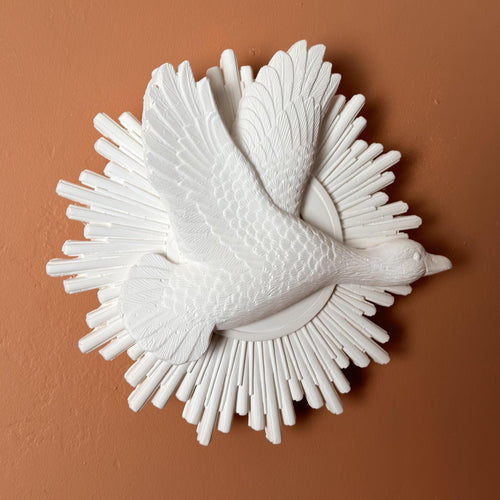
 Leaf ceiling rose
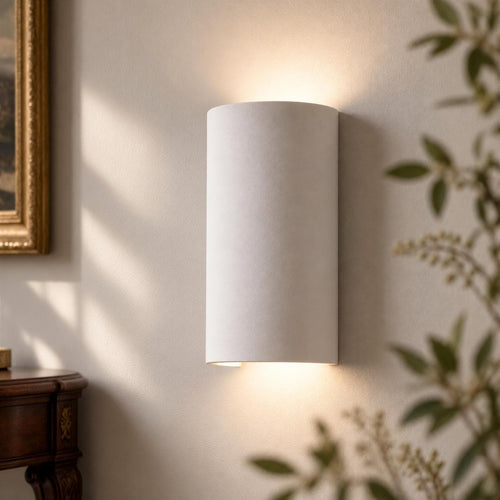
 Botanical leaf wall light
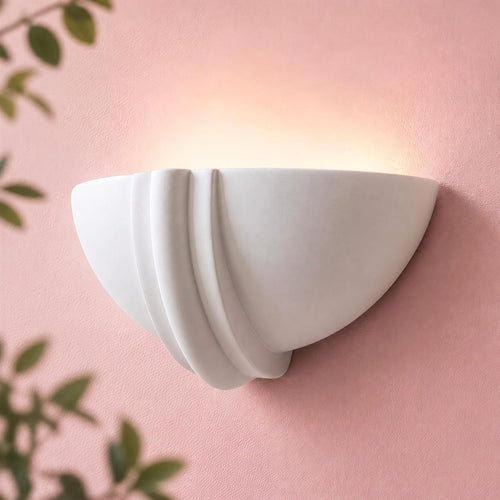
 Fluted wall light for a chimney breast
 Cambridge overdoor pediment
Plaster pieces for living rooms, classic and modern.


Designer Reynard Lowell shows how to add character to rooms with no original features [6].
Video: Reynard Lowell, “How To Decorate A New Build or Builder Grade Home & Apartment With No Features”, via YouTube.
Good to know
Common questions
How do I add character to my living room?
Create a focal point, layer the lighting, add architectural details such as a ceiling rose or cornice, use colour on walls and joinery, and collect objects slowly.
How do I make a new-build living room feel less boring?
Add a ceiling rose, simple cornice, panel moulding, wall lights and painted shelves.
Where should wall lights go in a living room?
Either side of a fireplace, chimney breast, window or sofa, at around eye level.
What size ceiling rose for a living room?
Roughly a tenth of the room's longest dimension is a good starting point.
Sources
References and further reading
Harvard style. Web pages were checked on the access date shown.
- Homes & Gardens (n.d.) How can I make my living room look expensive? 9 high style designs for less. Available at: www.homesandgardens.com/interior-design/living-rooms/how-... (Accessed: 14 November 2026).
- Ideal Home (n.d.) Living room feature wall ideas: 21 ways to create a standout focal point in your lounge. Available at: www.idealhome.co.uk/living-room/living-room-ideas/living-... (Accessed: 14 November 2026).
- Society of Light and Lighting (2018) SLL Lighting Handbook. London: CIBSE.
- Calloway, S. and Cromley, E. (eds) (1996) The elements of style: a practical encyclopedia of interior architectural details from 1485 to the present. Rev. edn. London: Mitchell Beazley.
- Richardson, E. (2026) The 10 biggest interior design trends of 2027 for a more considered, authentic home. Homes & Gardens, 2 October. Available at: www.homesandgardens.com/decor/interior-design-trends-2027 (Accessed: 14 November 2026).
- Reynard Lowell (n.d.) How to decorate a new build or builder grade home and apartment with no features [Video]. YouTube. Available at: www.youtube.com/watch?v=4r2Co09uj_8 (Accessed: 14 November 2026).
How to cite this article
van Locke, J. (2026) ‘Living room ideas that add character (without starting again)’, The Flare Journal. Flare Studio UK. Available at: https://flarestudio.uk/blogs/journal/living-room-ideas-that-add-character (Accessed: 15 November 2026).
Shop the style



Conversation
Join the conversation
Questions about the history, a room you are planning, or a piece you have seen in the wild? Leave a comment and Joseph will reply.