

Why British hand-cast plaster is different


Quick answer
British hand-cast plaster is different because it comes from a living craft tradition that goes back more than five hundred years: the Worshipful Company of Plaisterers received its royal charter in 1501 [1]. Real plaster takes finer detail than polyurethane, has a soft matte surface that takes paint beautifully, and each piece carries the small variations of being poured and finished by hand [2][3].
Most ceiling medallions and moldings sold in America today are cast in polyurethane or resin [5]. They are light and cheap, and they look it. Plaster is heavier and harder to make, which is exactly why it looks and feels different. This is the story of the material, the craft, and how we make our pieces in Shrewsbury, England.
A royal charter
Henry VII granted the Worshipful Company of Plaisterers its first royal charter on 10 March 1501 [1].
Wren’s hall
After the Great Fire, the Company’s second hall was built to a design by Christopher Wren [1].
Adam ceilings
Robert Adam’s neoclassical ceilings made decorative plaster a national style [4].
The craft written down
William Millar’s Plastering, Plain and Decorative recorded the trade’s methods [2].
Hand-cast in Shrewsbury
Every Flare piece is drawn, moulded, poured and finished by hand in our studio.
A craft with a royal charter
Plastering in Britain was organised as a trade in the Middle Ages, and in 1501 Henry VII granted the London plasterers' guild, the Worshipful Company of Plaisterers, its first royal charter [1]. The Company still exists. Its second hall, built after the Great Fire of 1666, was designed by Christopher Wren [1]. Over the following centuries British plasterers produced some of the most celebrated ceilings in the world, from Jacobean strapwork to Robert Adam's neoclassical rooms [4].
Plaster versus polyurethane
| Hand-cast plaster | Polyurethane / resin | |
|---|---|---|
| Detail | Very crisp; captures fine relief | Softer edges |
| Surface | Matte, mineral, takes paint like a wall | Smooth, slightly plastic sheen |
| Weight | Heavier: needs adhesive plus screws | Light |
| Feel | Cool, solid, authentic | Hollow |
| Repair | Can be filled and sanded like a wall | Harder to repair invisibly |
| History | The original material for medallions [5] | A modern substitute |
Van Dyke's notes that medallions were once made of heavy plaster and that most modern versions are wood, polyurethane or resin because they are lighter and cheaper [5]. That trade-off is real. But for a room where the ceiling matters, nothing replaces the depth of real plaster relief.
How we make each piece
- Drawn. Proportions are worked out on paper first, as plasterers have done for centuries.
- Master. A master pattern is made and refined until the detail is right.
- Mould. A flexible mould is taken from the master.
- Poured. Plaster is mixed and poured into the mould by hand.
- Set. It is left to cure, then eased from the mould.
- Finished. Every edge is fettled, checked in raking light, and left natural, primed or painted.
Why it matters in an American home
- Old houses: plaster suits pre-war homes with plaster walls and ceilings.
- New homes: one real plaster medallion gives a drywall ceiling a sense of age and craft.
- Paint: plaster takes flat and eggshell paints exactly like your walls.
- Longevity: properly fixed, plaster lasts as long as the house.
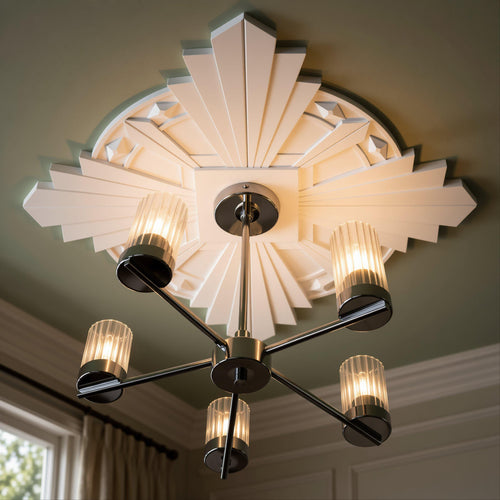
 Radiance: deep relief only plaster can hold
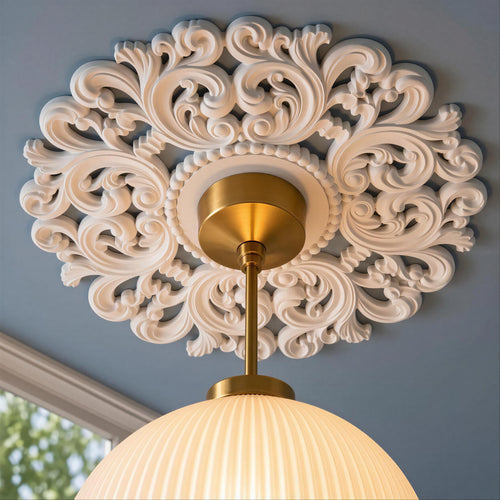
 Duchess: Victorian floral
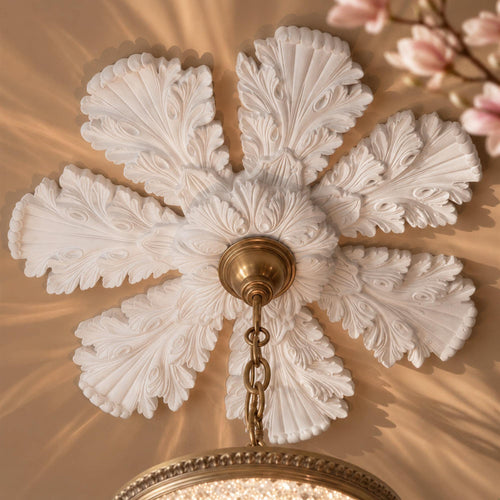
 Acanthus: hand-finished leaf
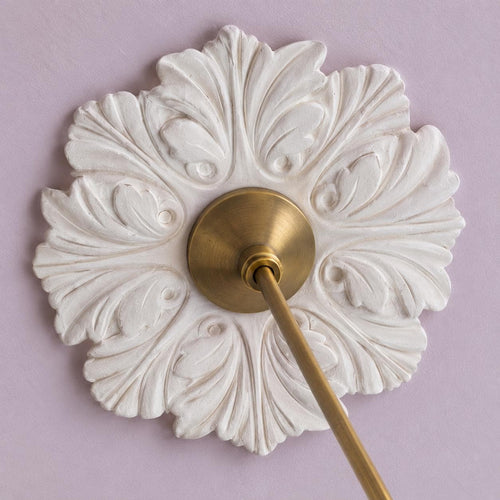
 Grand Laureate pediment
See traditional fibrous plaster being made by British craftspeople [6].
Video: FLETCHER'S RENOVATION GROUP, “Fibrous plastering”, via YouTube.
Good to know
Common questions
Is plaster better than polyurethane for ceiling medallions?
Plaster gives crisper detail and a matte, paintable surface; polyurethane is lighter and cheaper.
How old is British plastering as a craft?
It was organised as a trade in the Middle Ages; the London Plaisterers' Company was chartered in 1501.
Can plaster medallions be shipped to the US?
Yes. Flare ships hand-cast plaster pieces to the US.
Is plaster heavy?
Heavier than foam or polyurethane, so it is fixed with adhesive and screws into joists.
Sources
References and further reading
Harvard style. Web pages were checked on the access date shown.
- Worshipful Company of Plaisterers (n.d.) History. Available at: plaistererslivery.co.uk/about/history/ (Accessed: 14 November 2026).
- Millar, W. (1897) Plastering, plain and decorative. London: B.T. Batsford.
- English Heritage (2011) Practical building conservation: mortars, renders and plasters. Farnham: Ashgate.
- Calloway, S. and Cromley, E. (eds) (1996) The elements of style: a practical encyclopedia of interior architectural details from 1485 to the present. Rev. edn. London: Mitchell Beazley.
- Van Dyke's Restorers (n.d.) Dress up your lights with decorative ceiling medallions. Available at: www.vandykes.com/dress-up-your-lights-with-decorative-cei... (Accessed: 14 November 2026).
- FLETCHER’S RENOVATION GROUP (n.d.) Fibrous plastering [Video]. YouTube. Available at: www.youtube.com/watch?v=xEZitbJUcTM (Accessed: 14 November 2026).
How to cite this article
van Locke, J. (2026) ‘Why British hand-cast plaster is different’, The Flare Journal. Flare Studio UK. Available at: https://flarestudio.uk/blogs/journal/why-british-hand-cast-plaster-is-different (Accessed: 15 November 2026).
Shop the style




Conversation
Join the conversation
Questions about the history, a room you are planning, or a piece you have seen in the wild? Leave a comment and Joseph will reply.