

How to make your house look more expensive: 7 designer tricks


Quick answer
Homes look expensive because of good light, considered proportion and a few well-made details, not because of what they cost. Use warm, layered lighting instead of one ceiling bulb, hang curtains high and wide, choose fewer and larger pieces, add architectural details such as cornices, ceiling roses and overdoors, upgrade small touchpoints like switches and handles, and edit out clutter [1][2][3].
Ask an interior designer what makes a room look expensive and the answer is rarely 'expensive things'. It is how light falls, how the eye travels, how well the room is finished at its edges, and how calm it feels [1]. The good news is that almost all of these can be improved cheaply.
1. Fix the lighting first
Nothing makes a home look cheaper than a single, bright, cool ceiling light. Designers layer light at different heights: wall lights, table lamps, floor lamps and picture lights, all warm white and ideally dimmable [2][4]. A room lit from several low points has shadows and depth, which is exactly what expensive hotel rooms and restaurants do.
2. Think about proportion
Proportion is the quiet language of expensive rooms. Classical architecture has always used ratios to make rooms feel right [5], and simple rules follow from it: rugs big enough for all the front legs of the furniture, curtains from just below the ceiling to the floor, art large enough for the wall, and lamps that are not too small. See room proportions and the golden ratio.
3. Finish the edges of the room
Expensive rooms are finished at their edges: the junction of wall and ceiling, the frame of a door, the skirting at the floor [3]. Cornices, picture rails, deep skirting boards, overdoor pediments and ceiling roses are the details that most new-build and modernised homes lack, and adding them is far cheaper than new furniture.
4. Upgrade the touchpoints
Homes & Gardens' list of designer tricks includes coordinating door handles, drawer pulls and switches in the same material and finish [1]. Door handles, light switches, sockets and radiator covers are touched and seen every day. Plaster switch surrounds, metal switch plates and solid handles cost little and change the feel of every room.
5. Fewer, bigger, better
- One large mirror or painting instead of six small frames.
- A few objects grouped on a tray rather than spread along a shelf.
- Fewer cushions, better fabrics.
- Natural materials: wood, linen, wool, stone, plaster, brass [1].
6. Use colour with confidence
A considered colour throughout a room looks more expensive than white walls with a feature wall. Paint woodwork and ceilings in tones of the wall colour, and repeat colours between rooms. The 2027 move towards tonal, layered schemes is essentially a designer trick made mainstream [6].
7. Edit, then edit again
Clutter makes any room look cheaper. Clear surfaces, hide cables and remove the things you keep out of habit rather than love [1][2].
What makes a home look cheap
| Cheap tell | Why |
|---|---|
| One bright ceiling light | Flat, shadowless light [2][4]. |
| Short or small curtains | Make windows and ceilings look smaller. |
| Small rugs | Make rooms feel bitty. |
| Plain plastic switches everywhere | Cheap touchpoints [1]. |
| Matching furniture sets | Look like the first thing chosen from a catalogue [2]. |
| Too many small accessories | Visual clutter. |
 A large rose makes a ceiling look finished
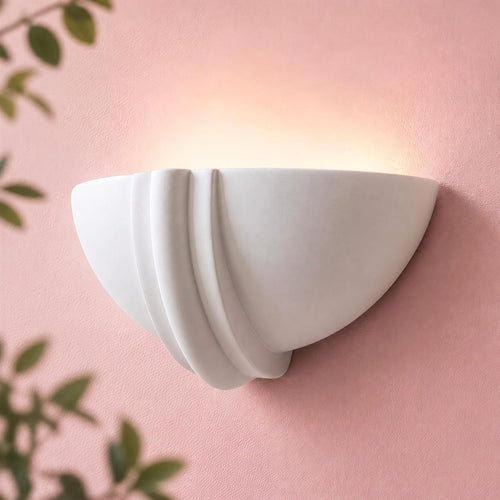
 Stepped Art Deco wall light
 Versailles pediment
 Aster switch surround
More designer tricks, explained in ten minutes [7].
Video: Reynard Lowell, “10 Design Tips To Make Your Home Look EXPENSIVE - Tricks Designers Use”, via YouTube.
Good to know
Common questions
How can I make my house look expensive on a budget?
Improve the lighting, hang curtains high and wide, add cornices or a ceiling rose, upgrade switches and handles, and declutter.
What makes a house look cheap?
A single bright ceiling light, small rugs and curtains, plastic fittings and too many small accessories.
Do ceiling roses make a room look expensive?
Yes. They finish the ceiling and make a pendant look intentional.
What colour makes a room look expensive?
Considered, tonal schemes in warm, complex colours usually look more expensive than plain white with a feature wall.
Sources
References and further reading
Harvard style. Web pages were checked on the access date shown.
- Homes & Gardens (n.d.) What makes a home look expensive? 15 tricks designers use, indoors and out. Available at: www.homesandgardens.com/interior-design/what-makes-a-home... (Accessed: 14 November 2026).
- Livingetc (n.d.) 6 things that are making your home look 'cheap'. Available at: www.livingetc.com/advice/things-making-your-home-look-che... (Accessed: 14 November 2026).
- Calloway, S. and Cromley, E. (eds) (1996) The elements of style: a practical encyclopedia of interior architectural details from 1485 to the present. Rev. edn. London: Mitchell Beazley.
- Society of Light and Lighting (2018) SLL Lighting Handbook. London: CIBSE.
- Ching, F.D.K. (2014) Architecture: form, space, and order. 4th edn. Hoboken, NJ: Wiley.
- Richardson, E. (2026) The 10 biggest interior design trends of 2027 for a more considered, authentic home. Homes & Gardens, 2 October. Available at: www.homesandgardens.com/decor/interior-design-trends-2027 (Accessed: 14 November 2026).
- Reynard Lowell (n.d.) 10 design tips to make your home look expensive: tricks designers use [Video]. YouTube. Available at: www.youtube.com/watch?v=RrXOD7JJk_A (Accessed: 14 November 2026).
How to cite this article
van Locke, J. (2026) ‘How to make your house look more expensive: 7 designer tricks’, The Flare Journal. Flare Studio UK. Available at: https://flarestudio.uk/blogs/journal/how-to-make-your-house-look-expensive (Accessed: 15 November 2026).
Shop the style


Conversation
Join the conversation
Questions about the history, a room you are planning, or a piece you have seen in the wild? Leave a comment and Joseph will reply.