

How to paint a plaster wall light (and match it to your wall)


Quick answer
To paint a plaster wall light: switch it off and remove the bulb or battery unit, dust it, seal raw plaster with a diluted mist coat or a primer, then apply two thin coats of matt or eggshell emulsion with a soft brush, working paint into the relief without letting it pool [1][2]. Let it dry fully before refitting. Flare wall lights can also be ordered White Primed (ready to paint) or painted in the studio.
Plaster is one of the best materials to paint. It is porous and breathable, which is why old plaster walls should be painted with breathable paints [3], and why raw plaster needs sealing before a modern emulsion. It takes colour evenly, the relief catches the light, and you can match a wall light exactly to your room, or choose a contrasting colour so it becomes the feature. This guide covers what you need, step-by-step instructions, paint choices and a few designer ideas.
Before you start: safety
- Switch off at the wall and, for a hardwired light, at the consumer unit. If the light must come off the wall, an electrician should disconnect and reconnect it [4].
- Remove the bulb or battery LED unit before painting.
- Never paint over a bulb holder, cable or electrical label.
- LEDs run cool, which is one reason they suit painted plaster shades [5].
What you need
- Soft dusting brush or clean cloth.
- Fine sanding sponge (240 grit or finer).
- Primer, or matt emulsion to thin for a mist coat.
- Your chosen emulsion: a sample pot is usually enough for one wall light.
- A 12mm to 25mm soft synthetic brush and a small artist's brush for the detail.
- Dust sheet and masking tape.
Step by step
- Prepare. Unplug or isolate, remove the bulb or battery unit, and lay the light on a dust sheet if it is off the wall.
- Clean. Brush off dust. If there is any rough casting edge, smooth it gently with a fine sanding sponge, then dust again.
- Seal. Raw plaster is very absorbent. Dulux and Crown both advise sealing new plaster first, either with a 'mist coat' of watered-down matt emulsion or a suitable primer [1][2]. If you ordered White Primed, skip this step.
- First coat. Apply a thin coat of emulsion, working it into the relief with the tip of the brush. Do not overload the brush; paint that pools in the grooves softens the detail.
- Second coat. Once the first is dry (check the tin), apply a second thin coat. Use the small brush for edges and deep recesses.
- Dry and refit. Leave it for at least 24 hours before refitting the bulb or battery unit.
Choosing the colour
- Match the wall for a calm, architectural look, especially in tonal or colour-drenched rooms.
- Match the woodwork so lights read as part of the joinery.
- Contrast (white on dark, coral on blue) to make the light the focal point.
- Metallic accents: a gilded edge on an Art Deco light can be beautiful, but keep it to the outer edge.
The finishes you can order
If you would rather not paint, every Flare wall light can be ordered Natural White (raw plaster, ready for your own paint), White Primed (sealed and ready to paint), Primed and Matte White, or in one of our studio colours. Choose under 'Choose Your Finish' on any piece.
Common problems
| Problem | Fix |
|---|---|
| Paint soaking in patchily | The plaster was not sealed. Apply a mist coat or primer, then repaint [1][2]. |
| Detail looks blurred | Too much paint. Use thinner coats and a smaller brush. |
| Brush marks | Use matt paint and a soft brush; lay off in one direction. |
| Chalky residue on hands | Raw plaster left unsealed. Seal it. |
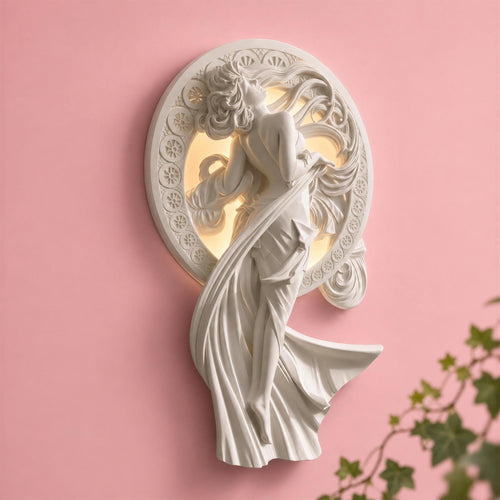
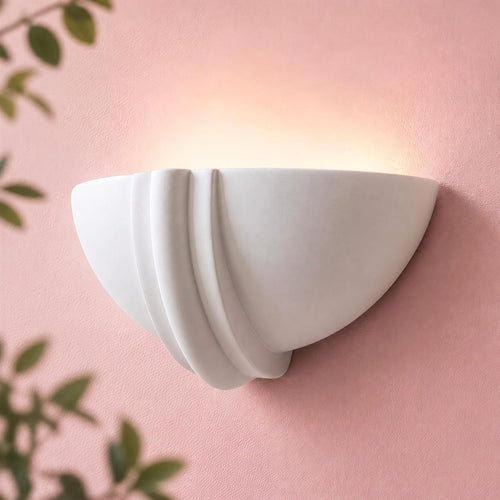
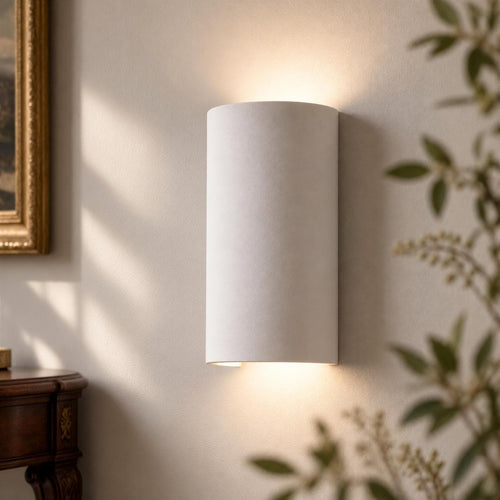
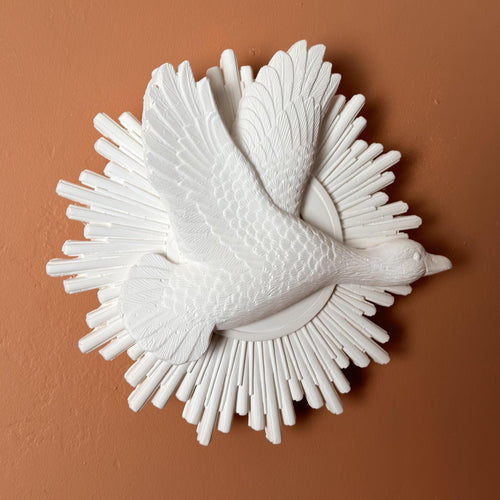
Wall lights that take paint beautifully, from crisp Art Deco ribs to soft organic curves.


The same principles apply to painting new plaster walls: this guide explains mist coats clearly [6].
Video: Charlie DIYte, “How to Paint New Plaster - a Complete Guide”, via YouTube.
Good to know
Common questions
Can you paint a plaster wall light?
Yes. Seal it with a mist coat or primer, then apply two thin coats of matt or eggshell emulsion.
What paint should I use on a plaster sconce?
Ordinary water-based wall emulsion, matt or eggshell, over a mist coat or primer.
Do I need to prime plaster before painting?
Raw plaster is absorbent, so seal it first with a mist coat or primer unless it was supplied primed.
Should a wall light match the wall colour?
Matching gives a calm, architectural look; contrasting makes the light a feature.
Sources
References and further reading
Harvard style. Web pages were checked on the access date shown.
- Dulux (n.d.) Dr Dulux: painting on new plaster. Available at: dulux.co.uk/en/expert-help/dr-dulux-painting-on-new-plaster (Accessed: 14 November 2026).
- Crown Paints (n.d.) Q&A: how to paint new plaster. Available at: www.crownpaints.com/ie/inspiration-advice/how-to-paint-ne... (Accessed: 14 November 2026).
- Society for the Protection of Ancient Buildings (n.d.) Breathability and old buildings. Available at: www.spab.org.uk/node/484 (Accessed: 14 November 2026).
- Ministry of Housing, Communities and Local Government (2013) Electrical safety: Approved Document P. Available at: www.gov.uk/government/publications/electrical-safety-appr... (Accessed: 8 October 2026).
- Energy Saving Trust (n.d.) Energy saving light bulbs and lighting. Available at: energysavingtrust.org.uk/advice/lighting/ (Accessed: 8 October 2026).
- Charlie DIYte (n.d.) How to paint new plaster: a complete guide [Video]. YouTube. Available at: www.youtube.com/watch?v=jTjlaAU1NzY (Accessed: 14 November 2026).
How to cite this article
van Locke, J. (2026) ‘How to paint a plaster wall light (and match it to your wall)’, The Flare Journal. Flare Studio UK. Available at: https://flarestudio.uk/blogs/journal/how-to-paint-a-plaster-wall-light (Accessed: 15 November 2026).
Shop the style



Conversation
Join the conversation
Questions about the history, a room you are planning, or a piece you have seen in the wild? Leave a comment and Joseph will reply.