

Nursery Wall Lights: Gentle, Safe Lighting for a Baby's Room

What a nursery light has to do
A nursery light has two jobs that pull in opposite directions. At 3 am you need enough light to feed, change and settle a baby without waking everyone fully. During the day or at bedtime you may want something that makes the room feel calm. A single bright ceiling light does neither well.
A wall light is a good fit because it is low, local and soft. It can be dimmed or switched on its own, it throws light up and down the wall rather than straight into a face, and it can be placed where you sit rather than where the cot is. It also keeps floor and surface space free, which matters in a small room.
This guide covers how to choose and place one sensibly. It is general guidance, not a safety standard, and it never replaces the instructions that come with a product or the advice of a qualified electrician.
The ground rules, in one table
| Question | Sensible default | Why |
|---|---|---|
| Where relative to the cot? | Well away, out of reach, never directly over it | A baby can grow into reaching distance sooner than you expect, and anything that can fall should not be above the cot |
| Cables? | None trailing; fixed wiring or a battery light | Loose flex is a hazard for small children; keep cords and cables out of reach |
| Batteries? | Compartment fastened, spares locked away | Button batteries can cause serious harm if swallowed |
| Mains wiring? | Qualified electrician | Adding to or altering a circuit is notifiable work under Approved Document P[8] |
| Light colour? | Warm white, dimmable | Gentler at night than a bright cool light |
| Room temperature? | Lullaby Trust: 16 to 20°C | Keep the cot away from heat sources, including strong direct light fittings |
Everything below expands on these six lines.
Where to put the light
Think about two zones: where the baby sleeps, and where you sit.
- The cot zone. Keep lights, cables, shelves, mobiles on strings and hanging decorations out of reach of the cot. That means not just the cot as it is now, but the cot as the baby grows and sits, stands and reaches. As a safe default, treat the wall and surfaces around the cot as a keep-clear area.
- The feeding or changing zone. This is where a light earns its place. A wall light beside the nursing chair or above the changing area lets you see what you are doing with a soft pool of light, and leaves the cot side of the room in shadow.
- The route. A low, dim light near the door or along the route you walk at night makes it easier to move without switching on the main light.
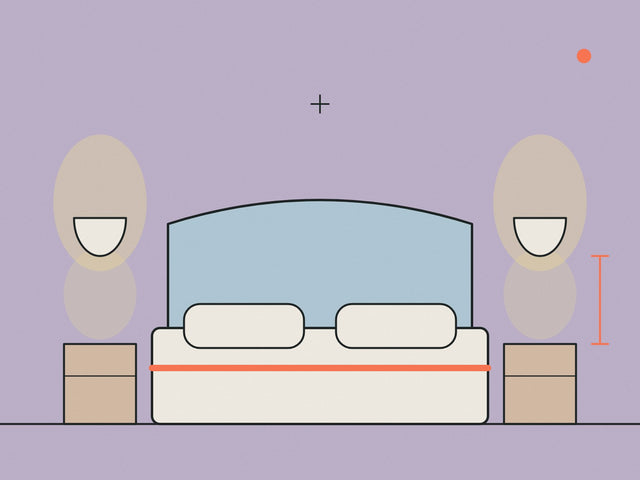
Height depends on the room. A common aim is eye level or a little above for a seated feeder, so the light is not shining into your eyes. Try the position with the product held in place or marked on the wall before you drill. If you can, check how the light looks from the cot too: you do not want a bright source in the baby’s line of sight when you are trying to settle them.
The cot, the window and what hangs above it
Lighting and furniture decisions overlap in a nursery, so settle the layout first and the lights second.
- Keep the cot away from windows. RoSPA advises against placing a child's cot, bed or playpen near a window, partly because of blind and curtain cords. It gives no fixed distance, so judge it by what a child could reach as they grow.[1]
- Nothing suspended above the cot. RoSPA lists suspended toys and mobiles above cots and beds as a hazard. The same logic applies to any hanging decoration, and it is one more reason not to site a pendant or wall light over the cot.[1]
- Keep the cot itself clear. The Lullaby Trust advises a clear cot: no bumpers, soft toys, pillows or duvets, and nothing that could cover a baby’s face.[9] Its page does not mention mobiles; for those, see RoSPA above.
- Plan for growth. A newborn does not reach; a toddler stands, climbs and pulls. Place lights and cords for the child the room will hold in two years, not the one it holds today.
Cables, cords and blinds
Cables and cords are the most avoidable hazard in a nursery, and the one with the clearest published guidance.
- No trailing flex. A plug-in wall light has a lead. If you use one, keep the lead and the socket well out of reach, fixed neatly along the wall, and never routed near the cot.
- Hardwired is tidiest. Fixed wiring means no loose lead, but it must be done by a qualified electrician.
- USB-charged lights have cables too. A rechargeable light is cable-free in use, but the charging lead is a loose cord when it is plugged in. Charge it elsewhere or put the lead away afterwards.
Blind and curtain cords. They are not a lighting issue, but a wall light near a window draws attention to them, so check them when you plan the room. The Royal Society for the Prevention of Accidents (RoSPA) advises choosing blinds that are safe by design, meaning no looped cords, and cordless blinds where possible, especially in a child's bedroom.[1] Where cords exist, keep them short and secured out of reach with cleats, cord tidies, clips or ties. RoSPA is also clear that you should never cut a blind cord, because that can make the blind more dangerous. It reports that looped blind cords have been involved in at least 35 UK deaths since 2001, mostly of children around one and a half to two years old, and mostly in bedrooms.[1]
Check the whole room at a baby's eye level, then again from the cot, for anything that dangles.
Battery, plug-in or hardwired
| Option | Good for | Watch for |
|---|---|---|
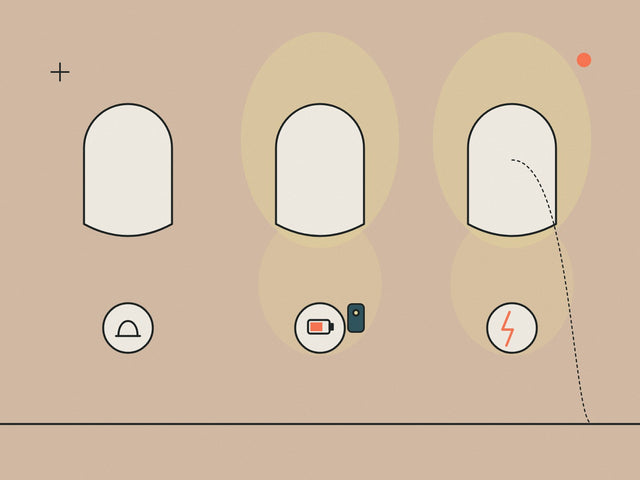
| Battery | Renting, no wiring, easy to reposition, no flex | Compartment must be fastened; button batteries are dangerous if swallowed; batteries need replacing. See our guide to battery wall lights that look hardwired |
| Plug-in with lead | Simple, no electrician for the light itself | The lead and plug; keep both well out of reach and tidy |
| Hardwired | Cleanest result, no flex, switched at the wall | Needs a qualified electrician; plan the position carefully before the work |
There is no single best answer. If you rent, battery or plug-in is often the practical choice. If you are redecorating a room you own, hardwired gives the tidiest and lowest-clutter result. Either way, follow the manufacturer’s instructions for fixing and use.
Button batteries: the one to take seriously
Many battery lights, remote controls and toys use small coin or button cells. The Office for Product Safety and Standards has warned that button batteries can kill a child if swallowed.[2] Advice from the UK’s trading standards campaign includes:
- Keep spare batteries in a secure place that young children cannot reach, not loose in drawers or on surfaces.
- If a battery compartment is not fastened with a screw, keep that item away from small children.[2]
- Dead batteries are still dangerous: remove them straight away and store them securely until they can be recycled.
- If you think a child has swallowed a button battery, go to A&E immediately even if they seem fine, and do not try to make them vomit.[2] On food and drink, sources differ: the 2019 campaign and Great Ormond Street say to give nothing to eat or drink,[2][4] while Alder Hey advises 2 teaspoons of honey every 10 minutes, only for a child over 12 months, and nothing else.[5] Follow current NHS 111 or 999 advice on the day.
When you choose a battery light for a nursery, look for a compartment that needs a tool or screw to open and a design that keeps the cells inside. If you cannot tell, ask the maker before you buy.
If a button battery is swallowed
Speed matters, so it is worth knowing the steps before you need them. This draws on advice from the UK's Office for Product Safety and Standards and Trading Standards campaigns[2], Great Ormond Street Hospital[4] and Alder Hey Children's Hospital,[5] which differ on honey (see the step on food and drink). It is general advice, not a substitute for medical guidance.
Bulbs, colour and brightness
Warm light is gentler at night than a bright cool one (our rule of thumb). Harvard Health reports that light of any kind can suppress melatonin, that blue light does so more strongly than green, and that LEDs give off a fair amount of blue; it suggests dim red light for night lights.[6] That is research on light and sleep in general, not on babies. Colour temperature is measured in kelvin: the Energy Saving Trust gives 2700 to 3000K as warm white and about 2700K as very warm white, which it says suits living areas and bedrooms.[7] For more on choosing a lamp, see what bulb to use in a plaster wall light.
- Dimmable is worth paying for. A full-brightness bulb is useful for changing a nappy, and unwelcome at 3 am. Check the bulb and dimmer are compatible: the Energy Saving Trust warns that not every LED works with a dimmer.[7]
- Avoid glare. Choose a light with a diffused or shaded output rather than a bare bright point.
- Think about heat. Modern LED bulbs run cooler than old filament ones, but keep any light fitting away from fabrics, and follow the maker’s maximum wattage.
There is no single correct brightness. Aim for the lowest level that lets you see what you are doing.
Heat and room temperature
The Lullaby Trust recommends a room temperature of 16 to 20°C for a baby's sleeping space and advises using a room thermometer rather than guessing. It also advises keeping the cot or Moses basket away from radiators, heaters and direct sunlight, and, if the heating is left on overnight, keeping it on a low setting no higher than 20°C.[3]
For lighting that means: a wall light is not a heat source, but do not place a cot beside a hot fitting, and do not use a light to "warm" a room. If the room is too cold, adjust the heating or add a layer of clothing rather than relying on a lamp.
Plaster wall lights in a nursery
Plaster wall lights suit a nursery because the finish is matt and soft, so there is no shiny glare, and they can be painted to match the wall. A few practical points:
- Fix them securely. A plaster light is hard and can be heavy. Use the fixings and method the maker specifies, and fix into a sound wall. Never leave a heavy fitting held only by adhesive over a cot or changing area unless the maker says that is what it is designed for.
- Keep it away from the cot. Even a well-fixed light belongs on a wall away from where the baby sleeps.
- Check the paint. If you paint it, use a paint suitable for a nursery, and let it dry and air before the baby moves in.
For style ideas by room, see how to style a plaster wall light by room.
A simple night-feed setup
A little preparation makes night feeds calmer. Set up the room so the light does one thing: let you see enough, and no more.
- Put the wall light beside the chair, not over the cot.
- Set it to the dimmest level that still lets you see.
- Keep a second switch or remote within reach of the chair so you do not need to walk across the room.
- Leave the main ceiling light off.
- Have a room thermometer where you can read it without turning on a bright light.
Before the baby arrives: a quick check
Go round the room with a fresh eye. If something fails the check, fix it or move it before the room is used.
Notes on figures and advice
- Room temperature, cot position and button battery steps are drawn from the Lullaby Trust, RoSPA, Trading Standards, Great Ormond Street Hospital and Alder Hey guidance cited above. The Great Ormond Street page was last reviewed in October 2018 and is the oldest source here; Alder Hey (reviewed August 2023) is the newest, and the two differ on honey, so follow current NHS advice. Standards for products may have moved on since the 2019 button battery campaign, so check the maker's information too.
- Colour temperature figures and the dimmer warning come from the Energy Saving Trust, and the melatonin point from Harvard Health, a general-population source. Brightness, glare and heat advice is general lighting practice, not a regulation, and is not cited because no single published source covers it.
- Mains wiring should always be done by a qualified electrician.
Keep reading
- Battery wall lights that look hardwired
- What bulb for a plaster wall light?
- How to style a plaster wall light by room
- Choosing a plaster wall light
- Bedroom wall lights guide
Shop the look


Frequently asked questions
What kind of light is best in a nursery?
A warm white (around 2700K or lower), dimmable light that is fixed away from the cot and out of reach, with no trailing cables.
Are battery wall lights safe in a nursery?
They can be, if the battery compartment is securely fastened (ideally with a screw), spare batteries are locked away, and you follow the maker’s instructions. Button batteries are dangerous if swallowed.
Where should a nursery wall light go?
Beside the feeding chair or changing area, not over the cot. Keep lights, cables and shelves out of reach of the cot.
Do I need an electrician for a nursery wall light?
For mains or fixed wiring, yes: use a qualified electrician. A battery light needs no wiring.
What room temperature should a nursery be?
The Lullaby Trust recommends 16 to 20°C, with a room thermometer in the sleeping room. Keep the cot away from radiators, heaters and direct sun.
What should I do if a child swallows a button battery?
Go to A&E straight away, even if they seem fine. Do not try to make them vomit. Sources differ on food and drink: Alder Hey advises honey for children over 12 months, while others say nothing to eat or drink, so follow current NHS 111 or 999 advice.
How bright should a nursery light be at night?
Use the lowest level that lets you see what you are doing. A dimmable light gives you a softer setting for night feeds and a brighter one for nappy changes.
Sources
References and further reading
Harvard style. Web pages were checked on the access date shown.
- Royal Society for the Prevention of Accidents (RoSPA) (n.d.) Strangulation and asphyxiation, RoSPA Keeping Kids Safe Hub. Available at: rospa.com/Keeping-Kids-Safe-Hub/Strangulation-and-asphyxi... (Accessed: 27 October 2026).
- Chartered Trading Standards Institute (2019) Button batteries: potential death risk to children, warns Office for Product Safety and Standards, Trading Standards. Available at: www.tradingstandards.uk/news-policy-campaigns/news-room/2... (Accessed: 27 October 2026).
- The Lullaby Trust (n.d.) What is the ideal baby room temperature?, The Lullaby Trust. Available at: www.lullabytrust.org.uk/safer-sleep-advice/room-temperature/ (Accessed: 27 October 2026).
- Great Ormond Street Hospital for Children NHS Foundation Trust (2018) Button batteries – using them safely, GOSH, page last reviewed 1 October 2018. Available at: www.gosh.nhs.uk/conditions-and-treatments/conditions-we-t... (Accessed: 27 October 2026).
- Alder Hey Children's NHS Foundation Trust (2023) What to do if your child swallows a button battery, Alder Hey, page last reviewed 29 August 2023. Available at: www.alderhey.nhs.uk/what-to-do-if-your-child-swallows-a-b... (Accessed: 27 October 2026).
- Harvard Health Publishing (2024) Blue light has a dark side, Harvard Medical School, last modified 24 July 2024. Available at: www.health.harvard.edu/staying-healthy/blue-light-has-a-d... (Accessed: 27 October 2026).
- Energy Saving Trust (2025) Lighting, Energy Saving Trust, last updated 28 August 2025. Available at: energysavingtrust.org.uk/advice/lighting/ (Accessed: 27 October 2026).
- Department for Communities and Local Government (2013) Approved Document P: Electrical safety, dwellings (2013 edition). Available at: www.gov.uk/government/publications/electrical-safety-appr... (Accessed: 27 October 2026).
- The Lullaby Trust (n.d.) The safest cot is a clear cot, The Lullaby Trust. Available at: www.lullabytrust.org.uk/clear-cot (Accessed: 27 October 2026).
How to cite this article
Tire, G. (2026) ‘Nursery Wall Lights: Gentle, Safe Lighting for a Baby's Room’, The Flare Journal. Flare Studio UK. Available at: https://flarestudio.uk/blogs/journal/nursery-wall-lights-safe-gentle-lighting (Accessed: 12 November 2026).
Shop the style






Conversation
Join the conversation
Questions about the history, a room you are planning, or a piece you have seen in the wild? Leave a comment and Joseph will reply.