

What Bulb for a Plaster Wall Light? E14, Warm White and Brightness

Check the holder first
The bulb has to fit the lamp-holder. The cap on the bulb is described by a letter and a number: the letter is the style (E for Edison screw, B for bayonet, G for pins) and the number is a size in millimetres. For Edison screw caps it is the thread diameter, so E14 is 14 mm and E27 is 27 mm, as set out in the lamp-cap standard IEC 60061-1;[1] for pin caps it is the spacing between the pins (general convention). A small screw fitting called E14 (small Edison screw, SES) is common on compact wall lights, but check the product page or the fitting itself rather than assuming. If the listing does not say, ask us through the enquiries page before you order bulbs.
| Cap code | Name | Usually found on |
|---|---|---|
| E14 | Small Edison screw (SES) | Compact wall lights, candle bulbs, small lamps |
| E27 | Edison screw (ES) | Standard pendants and table lamps |
| B22 | Bayonet cap | Older UK ceiling and table fittings |
| B15 | Small bayonet cap | Small UK fittings |
| G9 | Two-pin cap | Small capsule bulbs |
| GU10 | Two-pin twist-lock | Spotlights and downlights |
Match the cap exactly; do not force a bulb that does not thread in smoothly.

LED, not halogen
For a plaster surface, choose an LED. LEDs run far cooler than halogen bulbs, which matters when a bulb sits inside a small enclosed shade against a painted decorative surface. The Energy Saving Trust says halogen bulbs can run at a higher temperature than other types and that LEDs use 80% less electricity for the same light and can last up to 20 times longer in many cases;[2] a 2021 government press release put LEDs at five times longer than traditional halogens, with up to 80% less power.[3] Halogen has also been phased out of general sale in Great Britain. A June 2021 government press release said most halogen bulbs for general household use could no longer be sold from 1 September 2021, with some types, such as R7 linear halogens, staying available.[3] The 2021 lighting regulations gave the small pin-base capsule types (G9, G4 and GY6.35) longer: the efficacy table gives them a lower threshold only for the period before 1 September 2023,[4] and a January 2023 government consultation document says those types would have been removed from 1 September 2023 under the 2021 regulations (it prints the third type as GY5.35).[5] So LED is what you will mostly find in shops now. Which halogen types a shop may still sell depends on the lamp, so check before you rely on halogen.
| LED | Halogen | |
|---|---|---|
| Heat from the bulb | Low | High |
| Power use | Low | Higher |
| Availability in GB | Widely sold | Most general-use types off sale in GB from September 2021; pin-base capsules followed from September 2023 |
| Dimming | Needs a dimmable bulb and a compatible dimmer | Dimmed easily on older dimmers |
| Suits plaster wall lights | Yes | Not recommended |
Always check the maximum wattage in the product listing, because that limit exists to keep the fitting safe, and the LED's "equivalent" wattage on the pack is not its real power draw.
Colour: warm white around 2700K
Colour temperature is measured in kelvin (K). A lower number is warmer and more yellow; a higher number is cooler and bluer. For plaster choose warm white, usually sold as 2700K. It makes the surface look soft and creamy. Cool white at 4000K or above looks harsh on plaster and makes it look grey. Packs often say "warm white", "soft white" or give the number; 2700K to 3000K is the sensible range for a living room or bedroom: the Energy Saving Trust describes warm white as roughly 2700 to 3000K and says about 2700K suits living areas and bedrooms.[2]
If you also have downlights or lamps in the room, try to match their colour, because mixing 2700K and 4000K in one room looks patchy.
How bright?
A wall light is for atmosphere, not task lighting, so choose a lower brightness. Brightness is measured in lumens, not watts. Watts are how much power the bulb uses; lumens are how much light it gives. ENERGY STAR, the US efficiency scheme, gives the minimum brightness an LED needs to replace an older incandescent bulb as 450 lumens for 40W, 800 for 60W, 1,100 for 75W and 1,600 for 100W.[6]
For a wall light, you are normally at the very bottom of that scale. The Energy Saving Trust likewise equates a 60W incandescent bulb with an LED of about 800 lumens.[2] ENERGY STAR's table has no row below 40W, so for a smaller "25W equivalent" candle we are extrapolating: it will be under the 450 lumens given for 40W, which in practice means low hundreds of lumens and a soft glow from inside a shade. Packs vary, so read the lumen figure on the box. Start low; you can always go up a step. Check the maximum wattage in the listing and never exceed it. See wall light height and spacing for how the position changes what you see.
Reading a bulb pack
The pack tells you everything if you know the code. A typical LED candle might read "4.5W (40W), 470lm, 2700K, E14, dimmable, CRI 80+".
| On the pack | What it means | What to look for |
|---|---|---|
| 4.5W (40W) | Real power draw, with the old-bulb equivalent in brackets | Stay within the light's maximum wattage using the real figure |
| 470lm | Light output | Low for wall lights: roughly 100 to 470 |
| 2700K | Colour temperature | Warm white for plaster |
| E14 | Cap type | Must match the lamp-holder |
| Dimmable | Can be used on a compatible dimmer | Only if you will dim it |
| CRI 80+ or 90+ | How faithfully colours are shown | Higher looks more natural, 90+ is best for warm plaster |
| Enclosed fittings | Whether it is rated to sit inside a closed shade | Check if the bulb is inside glass or a shade |
Keep a spare bulb of the same type so the light always matches when one fails.
Shape and finish: candle, globe, clear or frosted
- Candle (C35 and similar): the classic shape for E14 wall lights, narrow enough to fit a small shade.
- Small globe (G45): rounder and softer; check it fits inside the shade.
- Frosted or opal: hides the filament and spreads the light, which is usually best against plaster.
- Clear: shows a bright point and sharper shadows, which can look good when the shade is dense or you want sparkle.
Check the physical size against the listing, because a bulb a few millimetres too long can touch the shade or not seat properly.
Dimming
If you want to dim the light, you need two compatible things: a dimmable bulb (the pack will say so) and a dimmer designed for LED. Older dimmers meant for incandescent or halogen bulbs can make LEDs flicker, buzz or cut out at low levels. The Energy Saving Trust warns that not all LEDs work with dimmers and that a dimmer not designed for LEDs probably will not work properly,[2] and the lighting regulations require packaging to carry a warning where a light source can be dimmed only with specific dimmers.[4] Check the bulb maker's compatibility advice and ask an electrician to fit or change the dimmer; wiring is for a qualified electrician. See plug-in, battery and hardwired wall lights.
Changing the bulb safely
- Switch the light off at the switch; for a plug-in light, unplug it. Do not rely on the switch alone for any work on the wiring.
- Let the old bulb cool if it has been on.
- Hold the base, not the glass, and unscrew or release it.
- Fit the new bulb straight, firmly but without forcing it.
- Check the shade or cover sits correctly and turn it on.
Wiring, replacing the holder or anything involving mains cable is a job for a qualified electrician.
Troubleshooting
| Problem | Likely cause | What to try |
|---|---|---|
| Bulb does not fit | Wrong cap type or size | Check the listing; E14 is not E27 |
| Light looks harsh | Colour too cool or bulb too bright | Warm white 2700K, lower lumens |
| Flickering or buzzing | Dimmer incompatible with the bulb | Use a dimmable LED and an LED dimmer |
| Glare from the opening | Clear bulb in an open shade | Switch to a frosted or opal bulb |
| Dies quickly | Poor-quality bulb, wrong rating for an enclosed shade | Choose one rated for enclosed fittings |
| Too dim | Very low-lumen bulb | Step up one level, within the maximum wattage |
Getting the best glow on plaster
Plaster is matt, slightly porous and usually pale, so it scatters light gently instead of reflecting it as a glare. A warm, low, frosted bulb lets the surface itself glow, and a nearby wall or ceiling then catches the spill. A harsh, bright, clear bulb does the opposite: it throws a hot spot and sharp shadows that flatter nothing.
Three habits help. Keep every light in a room the same colour temperature. Use two low lights rather than one bright one, which is the reason wall lights work best in pairs; see how to style a plaster wall light by room. And judge the effect in the evening, when the light is doing its real job, not in daylight.
If you are renting and cannot rewire, a plug-in or battery light avoids the work; check the product listing for which bulb, if any, it takes. See wall lights for rented flats.
Worked example: a pair of bedside wall lights
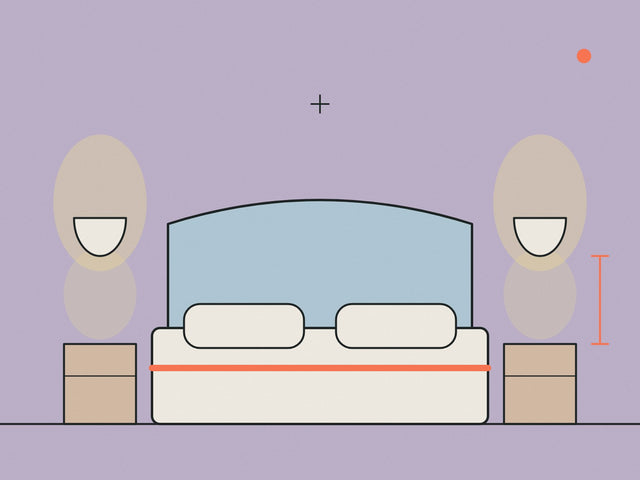
Say you have two plaster wall lights either side of a bed, each with an E14 holder and a stated maximum of 25W (check your own listing). Here is the chain of decisions.
- Cap. E14, as the listing says, so you shop for small Edison screw candle LEDs.
- Wattage. A candle LED rated 3W to 5W is far inside a 25W limit. Use the real wattage on the pack, not the "equivalent" in brackets.
- Colour. 2700K, so the plaster looks soft and creamy at night.
- Brightness. Two lights give a gentle spread; a low-hundreds lumen candle each is enough for reading beside you without glare on the wall.
- Finish. Frosted or opal, so you never see a bright filament.
- Dimming. If you want it, buy two dimmable bulbs and fit an LED-rated dimmer; keep a spare bulb of the same batch.
The same logic works for any pair: cap, wattage limit, colour, brightness, finish, dimming. The details change; the order does not.
Myths about wall-light bulbs
- "A higher-wattage bulb is better." For a wall light the opposite is often true. The maximum wattage is a limit on the fitting, not a target.
- "All LEDs dim." Only dimmable ones do, and only on a compatible dimmer.
- "Warm white means dim." Colour and brightness are separate: 2700K tells you how warm the light looks, lumens tell you how much of it there is.
- "Clear is brighter than frosted." The lumens can be identical; frosted spreads them, clear concentrates them into a point.
- "The bulb is the problem." If a light flickers on a dimmer, the dimmer is often the cause, and replacing it is a job for a qualified electrician.
Heat, colour rendering and wiring: what the published guidance says
A few points about bulbs are covered by official or industry guidance. They are collected here so you can see where each comes from.
Enclosed shades and heat
A manufacturer's technical article on downlights explains that when an LED fitting is covered, heat from the luminaire cannot dissipate, which raises the LED's junction temperature and shortens its life, and it advises checking with the manufacturer.[7] That article is about recessed downlights in insulated ceilings, not wall lights, so applying it to a small closed glass shade is our inference. It is the reason a bulb pack that says it is rated for enclosed fittings is worth choosing for a shade. The article is from 2015, so check current requirements.
Colour rendering
Schedule 3 of the 2021 lighting regulations includes a colour-rendering requirement of CRI 80 or more, with exceptions.[4] That makes 80+ the floor on ordinary packs rather than a premium. That 90+ looks better on pale, warm plaster is a rule of thumb rather than a published standard.
Wiring and who does it
Changing a bulb is not electrical installation work. In England, Approved Document P treats installing a new circuit as notifiable work and says other electrical work should still follow BS 7671,[8] and we recommend an electrician for a new wall-light supply or a replacement dimmer. NICEIC, a certification body with an interest in registration, notes that the trade has no official regulator and anybody can call themselves an electrician, so ask for proof of registration.[9]
Keep reading
- Wall light height and spacing
- Plug-in, battery and hardwired wall lights
- How to style a plaster wall light by room
- Wall lights for rented flats
Shop the look


Frequently asked questions
What bulb does a plaster wall light take?
It depends on the light. Many small wall lights use an E14 (small Edison screw) holder, but check the product listing or ask us before buying bulbs.
What colour bulb is best for plaster?
Warm white, around 2700K. It makes plaster look soft and creamy; cool white looks harsh.
Can I use an LED bulb in a plaster wall light?
Yes, and it is the better choice because it runs cooler than a halogen bulb. Check the maximum wattage in the listing.
How bright should a wall light bulb be?
Low. A wall light gives ambient light, not task light. A small candle LED around a 25W equivalent is usually plenty inside a shade.
What is the difference between watts and lumens?
Watts are the power the bulb uses; lumens are the light it gives out. Buy by lumens and keep within the maximum watts the light allows.
Can I dim a plaster wall light?
Only with a dimmable bulb and a dimmer that is compatible with LEDs. Have an electrician fit or change the dimmer.
Why is my LED bulb flickering?
Usually the dimmer is not compatible with the bulb. Try a dimmable LED designed for your dimmer, or replace the dimmer with an LED-rated one.
Can I use a halogen bulb in a plaster wall light?
It is not recommended: halogens run hot, and most halogen bulbs for general household use were taken off sale in Great Britain from September 2021. Use an LED.
Sources
References and further reading
Harvard style. Web pages were checked on the access date shown.
- Wikipedia contributors (n.d.) Edison screw, Wikipedia. Available at: en.wikipedia.org/wiki/Edison_screw (Accessed: 27 October 2026). Used only for the cap-naming convention, which it attributes to IEC 60061-1; no better free source was found.
- Energy Saving Trust (2026) Energy saving light bulbs and lighting, Energy Saving Trust. Available at: energysavingtrust.org.uk/advice/lighting/ (Accessed: 27 October 2026). Page last updated 6 October 2026.
- Department for Business, Energy & Industrial Strategy (2021) End of halogen light bulbs spells brighter and cleaner future, GOV.UK. Available at: www.gov.uk/government/news/end-of-halogen-light-bulbs-spe... (Accessed: 27 October 2026). Press release, 9 June 2021.
- UK Government (2021) The Ecodesign for Energy-Related Products and Energy Information (Lighting Products) Regulations 2021 (SI 2021/1095), Schedule 3: ecodesign requirements for light sources and separate control gears, legislation.gov.uk. Available at: www.legislation.gov.uk/uksi/2021/1095/schedule/3 (Accessed: 27 October 2026). Table 2 (threshold efficacy) and Table 5 (colour rendering) were read for this guide.
- Department for Business, Energy & Industrial Strategy (2023) New ecodesign requirements for lighting products, GOV.UK. Available at: assets.publishing.service.gov.uk/media/63d3c39c8fa8f51881... (Accessed: 27 October 2026). Consultation document issued 10 January 2023.
- ENERGY STAR (n.d.) Learn about brightness, ENERGY STAR (US Environmental Protection Agency and Department of Energy). Available at: www.energystar.gov/products/lighting_fans/light_bulbs/lea... (Accessed: 27 October 2026). US scheme; the page has no row below 40W.
- Bettson, S. (2015) Downlights and fire safety, Voltimum UK (Scolmore Group). Available at: www.voltimum.co.uk/news/downlights-and-fire-safety (Accessed: 27 October 2026). Manufacturer technical article published 30 September 2015, written against the wiring regulations of that time; check current requirements.
- Ministry of Housing, Communities and Local Government (2013) Electrical safety: Approved Document P, GOV.UK. Available at: www.gov.uk/government/publications/electrical-safety-appr... (Accessed: 27 October 2026). Published 1 January 2013; the page links the PDF "Approved Document P: electrical safety, dwellings" (2013 edition, for use in England), whose Section 2 covers notifiable work.
- NICEIC (2025) What you need to know about choosing an electrician, NICEIC. Available at: niceic.com/views/everything-you-need-to-know-about-choosi... (Accessed: 27 October 2026). Published 21 November 2025. NICEIC is an electrical certification body, so it has an interest in registration.
How to cite this article
Tire, G. (2026) ‘What Bulb for a Plaster Wall Light? E14, Warm White and Brightness’, The Flare Journal. Flare Studio UK. Available at: https://flarestudio.uk/blogs/journal/what-bulb-for-a-plaster-wall-light (Accessed: 12 November 2026).
Shop the style




Conversation
Join the conversation
Questions about the history, a room you are planning, or a piece you have seen in the wild? Leave a comment and Joseph will reply.