

Plaster vs metal vs glass wall lights: which is best?


Quick answer
Plaster wall lights give the softest light: the shade is opaque and matt, so it hides the bulb and washes light up the wall, and it can be painted any colour. Metal gives a crisper, more directional light with highlights and suits industrial and Art Deco rooms. Glass glows all over and adds sparkle, but can cause glare if the bulb is bright. Choose by the light you want, then by style.
The material of a wall light shade decides how the light leaves it. That matters more than most people think: two lights of the same shape, one plaster and one glass, light a room very differently. Lighting designers describe this in terms of how a fitting distributes and diffuses light, covered in guidance such as the SLL Lighting Handbook [5]. Here is how the three main materials compare.
How do plaster, metal and glass shades differ?
| Material | How it behaves |
|---|---|
| Plaster | Opaque, matt, soft wash of light; hides the bulb; paintable; suits period and modern rooms; handle with care. |
| Metal | Opaque, often reflective; crisper beam and highlights; durable; suits industrial, Art Deco and mid-century rooms. |
| Glass | Translucent or clear; glows or sparkles; decorative; can dazzle with a bright bulb; needs cleaning. |
What is a plaster wall light made of?
Most plaster wall lights are cast from gypsum plaster, also called plaster of Paris. CAMEO, the Museum of Fine Arts Boston's materials encyclopedia, describes it as calcium sulfate hemihydrate, made by heating gypsum to drive off part of its water; mixed with water again, it sets quickly into a hard solid, and it has been used for moulds and castings since antiquity [1]. That is how our shades are made: poured into moulds by hand in our Shrewsbury studio. Our article on how plaster pieces are cast shows the process.
- 1The shade: solid gypsum plaster, cast in a mould.
- 2An open top lets light escape upwards to wash the wall.
- 3The bulb sits hidden inside, so there is no glare.
- 4The bulb holder and fitting.
- 5The wall plate, fixed to the wall or to a battery unit.
Why choose plaster?
- The softest, most glare-free light of the three.
- It can be painted to match or contrast with the wall; see the best paint for plaster details.
- It sits naturally beside cornices, ceiling roses and panelling.
- It is matt, so it does not show fingerprints or reflections.
The trade-off is that plaster is more fragile than metal and should be handled carefully. Compared with resin, it is heavier and more natural in feel; see plaster vs resin wall lights.
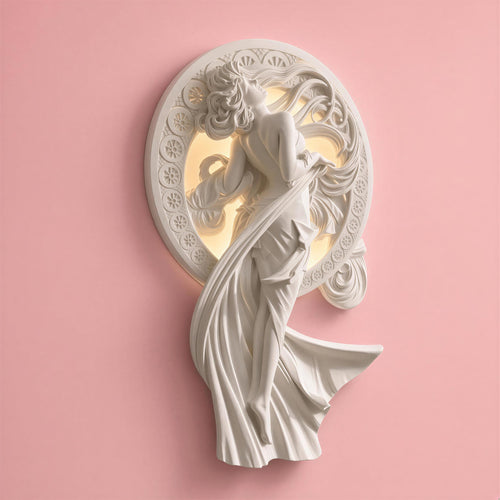
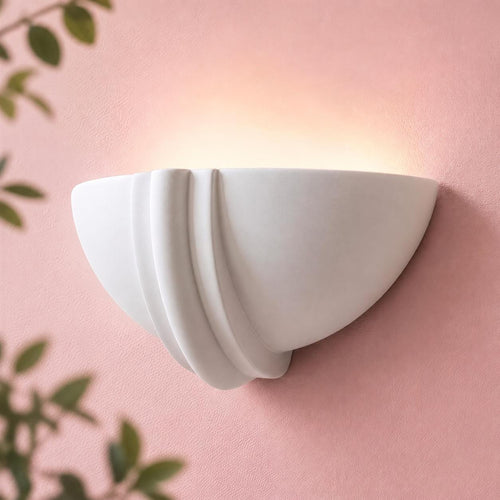
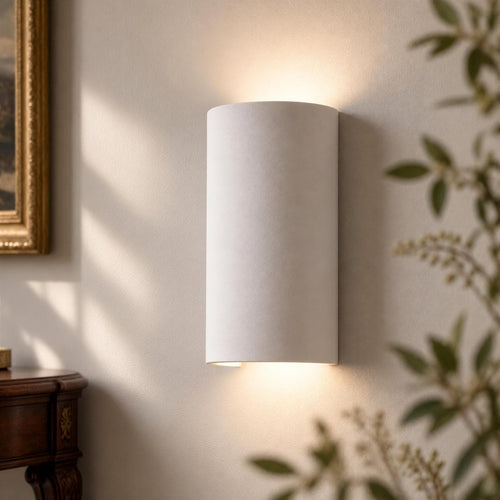
Hand-cast plaster wall lights from our Shrewsbury studio. Each comes as shade only, battery LED with a remote, or UK mains hardwired.


When is metal or glass a better choice?
Choose metal for a crisp, practical look, or when a light must be tough, such as in a busy hall or outdoors; see our industrial wall lights guide. Choose glass when you want the fitting itself to glow, as with Art Nouveau and some Art Deco designs; see Art Nouveau wall lights. In a bathroom, the material matters less than the IP rating; see bathroom lighting zones and IP ratings.
Glass shades are made very differently from plaster ones. This film follows the making of a glass shade from molten glass to finished form, which helps explain why glass glows so differently from plaster [4].
Video: DOMO, “Watch the fascinating making process of a glass lamp shade”, via YouTube.
Do some materials get too hot?
With LED bulbs, heat is rarely a problem for any of the three, because LEDs use far less energy than old incandescent bulbs [2], so much less is wasted as heat. Always check the maximum wattage for a fitting, and use a registered electrician for new hardwired lights, as some work falls under Part P [3].
Period
A period room with cornice and ceiling rose? Plaster suits it.
Paint
Want to match the wall exactly? Plaster can be painted.
Shine
Want sparkle and reflection? Metal or glass.
Wet
A bathroom? Choose a fitting with the right IP rating.
Good to know
Common questions
Which wall light material gives the softest light?
Plaster. It is opaque and matt, so it hides the bulb and spreads light gently over the wall.
Can plaster wall lights be painted?
Yes. Use a breathable paint suitable for plaster to match or contrast with your walls.
Are plaster wall lights fragile?
More than metal. Handle them carefully when fitting, but once on the wall they are stable.
Do glass wall lights cause glare?
They can, especially clear glass with a bright bulb. Frosted glass and lower-lumen bulbs help.
Sources
References and further reading
Harvard style. Web pages were checked on the access date shown.
- Museum of Fine Arts, Boston (n.d.) Gypsum plaster. CAMEO: Conservation and Art Materials Encyclopedia Online. Available at: cameo.mfa.org/wiki/Gypsum_plaster (Accessed: 8 October 2026).
- Energy Saving Trust (n.d.) Energy saving light bulbs and lighting. Available at: energysavingtrust.org.uk/advice/lighting/ (Accessed: 8 October 2026).
- Ministry of Housing, Communities and Local Government (2013) Electrical safety: Approved Document P. Available at: www.gov.uk/government/publications/electrical-safety-appr... (Accessed: 8 October 2026).
- DOMO (n.d.) Watch the fascinating making process of a glass lamp shade [Video]. YouTube. Available at: www.youtube.com/watch?v=RnD4zB_O13M (Accessed: 10 November 2026).
- Society of Light and Lighting (2018) SLL Lighting Handbook. London: CIBSE.
How to cite this article
van Locke, J. (2026) ‘Plaster vs metal vs glass wall lights: which is best?’, The Flare Journal. Flare Studio UK. Available at: https://flarestudio.uk/blogs/journal/plaster-vs-metal-vs-glass-wall-lights (Accessed: 12 November 2026).
Shop the style


Conversation
Join the conversation
Questions about the history, a room you are planning, or a piece you have seen in the wild? Leave a comment and Joseph will reply.