

Uplighter or downlighter? Choosing wall light direction


Quick answer
An uplighter throws light up onto the wall and ceiling, which bounces it back as soft, even, glare-free light; it makes rooms feel taller and shows off cornices. A downlighter throws light down into a brighter pool for reading or to highlight a surface. For most living rooms, bedrooms and halls, uplighters give the nicer mood light; add downlight where you need to see detail.
The direction a wall light points changes a room more than its shape or colour. Lighting designers talk about direct light, which shines straight onto the surface you want to see, and indirect light, which reaches you after bouncing off another surface; both are covered in professional guidance such as the SLL Lighting Handbook [3]. This guide explains when each works best at home.
What is the difference between an uplighter and a downlighter?
An uplighter is open at the top, so most of its light goes upwards. The wall and ceiling become large, soft light sources. A downlighter is open at the bottom, so its light falls in a cone onto the floor, a table or a chair. Some wall lights do both.
When should you choose an uplighter?
- When you want soft, calm mood light without glare.
- When the ceiling is high, or you want a low ceiling to feel higher.
- When there is a cornice or ceiling rose worth showing off; Victorian and Edwardian houses often have fine plaster mouldings [2].
- In bedrooms, halls and living rooms, where you mostly relax rather than work.
Uplighting is not new. In 1931 Art Deco bronze uplighters, believed to be by the architect Charles Holden, were fitted at Holborn Underground station; they projected light onto the curved ceiling of the escalator shaft [1]. The effect was attractive, though the London Transport Museum notes it was dim, and most were later replaced [1]. Modern LED bulbs make uplighting far brighter for the same energy.
- 1Uplight picks out the cornice, the best plasterwork in the room.
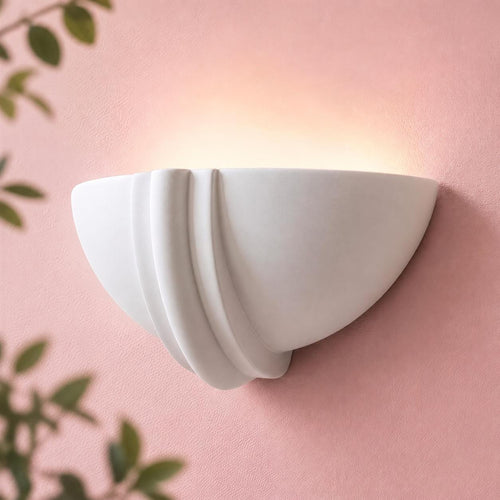
- 2Open-topped plaster uplighters: no glare, soft light.
- 3A painting between two uplighters is lit gently from the walls around it.
- 4A downward reading light over the chair, for a task.
- 5The reading chair: downlight where you need to see detail.
When should you choose a downlighter?
- Over a reading chair, desk or bedside, where you need to see detail.
- To light a worktop, shelf or table top.
- In a very dark-ceilinged room, where uplight would be absorbed.
- Outdoors, to keep light from spilling into the sky.
Which is better for a period home?
Usually the uplighter. It flatters plaster, lights the cornice, and hides the bulb, all of which suit older rooms. Our Victorian wall lights and Georgian wall lights guides explain the history. If you need task light too, add a lamp or a downward reading light rather than giving up the soft glow.
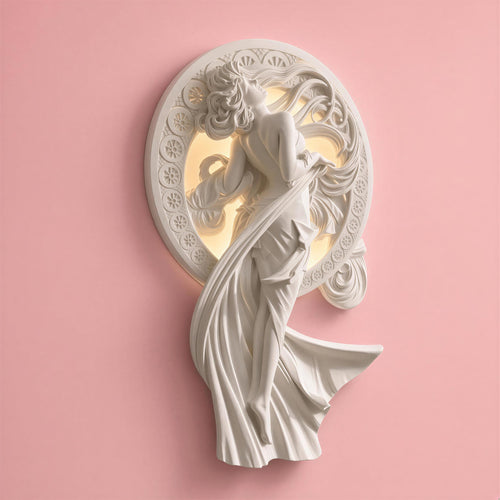
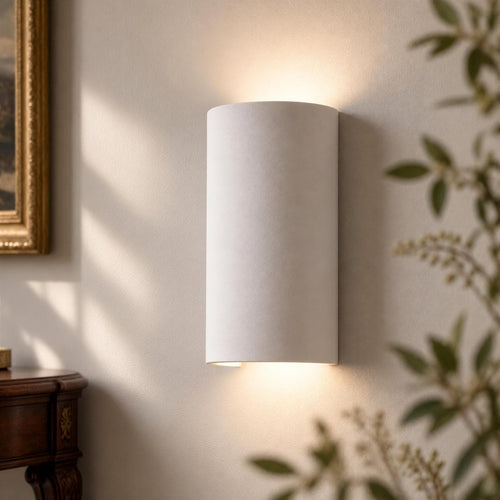
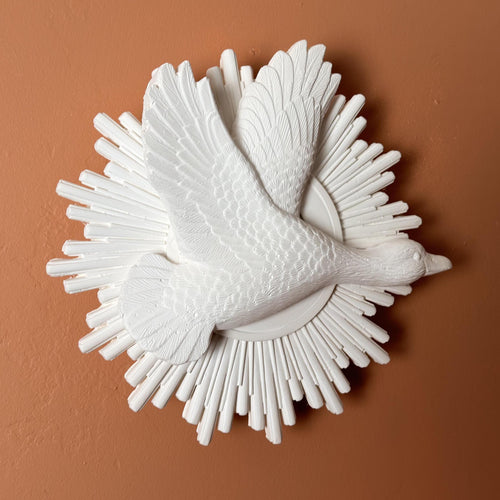
These plaster designs from our Shrewsbury studio wash the wall with soft light. Each comes as shade only, battery LED with a remote, or UK mains hardwired.


Cove lighting is pure indirect light: the source is hidden and the ceiling does the work. This build shows how much bouncing light off a ceiling changes the feel of a room, which is exactly what a wall uplighter does on a smaller scale [6].
Video: Jackson Casimiro, “I Made Cove Lighting for My Apartment”, via YouTube.
How bright should an uplighter be?
Because uplight bounces off the ceiling before it reaches you, an uplighter needs more lumens than a downlighter to make a room feel equally bright, especially if the ceiling is not white. Choose bulbs by lumens and colour temperature, as the Energy Saving Trust explains [4]; warm white of about 2700K suits most homes. New hardwired lights should be fitted by a registered electrician under Part P [5]. See lumens and colour temperature for each room and which bulb for a plaster wall light.
Holborn
Bronze uplighters at Holborn station light the curved ceiling of the escalator shaft [1].
Ceiling
Is your ceiling high, pale or decorated? Choose uplight.
Task
Do you need to read or work there? Add downlight.
Glare
Will people look at the light? Choose a shade that hides the bulb.
Both
Need flexibility? An up-and-down light, or one of each.
| Term | What it means |
|---|---|
| Uplighter | A light that sends most of its output upwards. |
| Downlighter | A light that sends most of its output downwards. |
| Indirect light | Light that reaches you after bouncing off another surface [3]. |
| Glare | Discomfort from a bright source in your line of sight. |
| Cornice | The moulding where wall meets ceiling [2]. |
Good to know
Common questions
Are uplighters or downlighters better?
Uplighters are better for soft mood light and period rooms; downlighters are better for reading and tasks. Many rooms benefit from both.
Do uplighters make a room look bigger?
Yes. Lighting the ceiling makes it feel higher and the room more open.
Are uplighters bright enough?
They can be, with enough lumens. Because the light bounces, choose a brighter bulb than you would for a downlighter.
Can I use uplighters with a low ceiling?
Yes, and they help a low ceiling feel higher, but keep the fitting shallow so it does not create a hot spot just above it.
Sources
References and further reading
Harvard style. Web pages were checked on the access date shown.
- London Transport Museum (n.d.) Light fitting; Bronze uplighter from escalator at Holborn Underground station, 1931. Available at: www.ltmuseum.co.uk/collections/collections-online/infrast... (Accessed: 13 October 2026).
- The Victorian Society (2024) Victorian and Edwardian plaster mouldings, cornices, coving and dado rails. The Victorian Society. Available at: www.victoriansociety.org.uk/advice/plaster-mouldings-and-... (Accessed: 27 October 2026).
- Society of Light and Lighting (2018) SLL Lighting Handbook. London: CIBSE.
- Energy Saving Trust (n.d.) Energy saving light bulbs and lighting. Available at: energysavingtrust.org.uk/advice/lighting/ (Accessed: 8 October 2026).
- Ministry of Housing, Communities and Local Government (2013) Electrical safety: Approved Document P. Available at: www.gov.uk/government/publications/electrical-safety-appr... (Accessed: 8 October 2026).
- Jackson Casimiro (n.d.) I Made Cove Lighting for My Apartment [Video]. YouTube. Available at: www.youtube.com/watch?v=plYKRrcz0ME (Accessed: 10 November 2026).
How to cite this article
van Locke, J. (2026) ‘Uplighter or downlighter? Choosing wall light direction’, The Flare Journal. Flare Studio UK. Available at: https://flarestudio.uk/blogs/journal/uplighter-or-downlighter-wall-lights (Accessed: 12 November 2026).
Shop the style


Conversation
Join the conversation
Questions about the history, a room you are planning, or a piece you have seen in the wild? Leave a comment and Joseph will reply.