

Renovating an old house: where to start and the right order of works


Quick answer
Start an old house renovation with a full building survey and a few months of living in it, then fix the building in this order: roof and water first, then structure, then services (wiring, plumbing, heating), then plastering, then kitchens and bathrooms, and decoration last [1][6]. Check whether you need planning permission or listed building consent before any work, and keep 10 to 20 per cent of the budget as contingency [3][4].
Renovating an old house is exciting and occasionally terrifying. The most expensive mistakes are almost always about order: a beautiful kitchen fitted before the damp was solved, new plaster cut open for rewiring, or a decorated room ruined by a leaking gutter. This guide sets out a sensible order of works, how to budget, what needs permission, and how to keep the character that made you buy the house.
Step 1: Understand the house before you change it
Commission a Level 3 building survey for any older or altered house; RICS recommends the fullest survey for older, larger or unusual properties [6]. Then, if you can, live with the house for a season. You will learn where the light falls, which rooms you use, where it is cold and where water collects. The writer Stewart Brand argued that buildings 'learn' and adapt over time; good renovations work with that history rather than erasing it [7].
Step 2: Permissions, professionals and budget
- Listed? Search the National Heritage List for England. Listed building consent is needed for works that affect the character of a listed building, inside and out, and carrying out works without it is a criminal offence [4].
- Conservation area? Ask your council; some external changes such as windows and doors may need permission [3].
- Planning and building regulations: the Planning Portal's common projects guide explains what usually needs permission [3].
- Electrical work: new circuits and work in some locations are notifiable under Part P and should be done by a registered electrician [5].
- Budget: keep 10 to 20 per cent aside for surprises. Old houses always have them.
Step 3: Keep the water out
Water is the enemy of every old building. Roofs, gutters, downpipes, drains and ground levels come first, because most damp in old houses comes from water getting in from outside or being trapped by modern materials [2]. SPAB advises that traditional solid walls need to 'breathe': cement renders, plastic paints and impermeable plasters can trap moisture and cause damage [1].
Step 4: Structure, windows and floors
Once the building is dry, deal with structural issues, rotten timbers and windows. Repairing original sash windows is often possible and keeps character; see sash windows: repair, draught-proof or replace.
Step 5: First fix services
Wiring, plumbing and heating pipes go in before any new plaster. This is the time to plan where wall lights, switches and sockets will go, because it is far cheaper to run a cable now than to chase it into finished walls later [5]. Mark wall light positions at around 1.6 to 1.8m above the floor; see wall light height and spacing.
Step 6: Plaster and repairs
In older houses, repair lime plaster with lime where possible; it is more compatible with breathable walls [1]. See lime vs gypsum plaster. This is also the moment to repair or reinstate cornices and ceiling roses before decorating; see repairing cracked plaster cornice.
Step 7: Kitchens and bathrooms
Second fix (sockets, switches, sanitaryware) and fitted kitchens come after plastering. Protect floors and finished surfaces from this point on.
Step 8: Decorate and add the details
Decoration is last, and so are the finishing details that make the house feel complete: ceiling roses, overdoors, switch surrounds and wall lights. Choose them room by room once you know how you live in the house.
Mistakes to avoid
| Mistake | Why it matters |
|---|---|
| Decorating first | Everything gets damaged or redone after services work. |
| Sealing old walls | Cement and plastic coatings can trap moisture [1][2]. |
| Ripping out original features | They are expensive to replace and add value. |
| No contingency | Old houses always reveal surprises. |
| Ignoring permissions | Unconsented works to a listed building are a criminal offence [4]. |
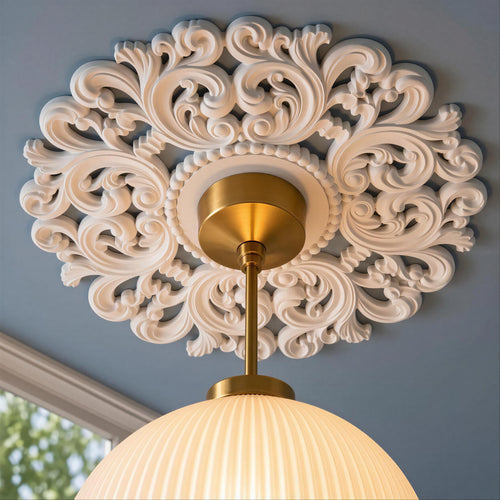
Finishing details for the last stage of a renovation, hand-cast in plaster.


UK renovator and designer Fifi McGee on planning a renovation to avoid expensive mistakes [8].
Video: Fifi McGee, “5 renovation steps to prevent thousands in mistakes - I WISH I Knew This”, via YouTube.
Good to know
Common questions
Where do you start when renovating an old house?
With a full building survey, then roof and water, then structure, then services, plastering, kitchens and bathrooms, and decoration last.
What order should renovation work be done in?
Survey and permissions, roof and damp, structure and windows, first fix services, plastering, second fix and fitted rooms, then decorating.
Do I need permission to renovate an old house?
Listed buildings need listed building consent for works affecting their character; some works in conservation areas need planning permission.
How much contingency should I allow?
10-20% of the budget is a common allowance for old houses.
Sources
References and further reading
Harvard style. Web pages were checked on the access date shown.
- Society for the Protection of Ancient Buildings (n.d.) Breathability and old buildings. Available at: www.spab.org.uk/node/484 (Accessed: 14 November 2026).
- Society for the Protection of Ancient Buildings (n.d.) Control of dampness [Technical advice note]. Available at: www.spab.org.uk/sites/default/files/SPAB%20Technical%20ad... (Accessed: 14 November 2026).
- Planning Portal (n.d.) Common projects. Available at: www.planningportal.co.uk/permission/common-projects/ (Accessed: 14 November 2026).
- Homebuilding & Renovating (n.d.) Listed building consent: a guide to all you need to know. Available at: www.homebuilding.co.uk/advice/listed-building-consent (Accessed: 14 November 2026).
- Ministry of Housing, Communities and Local Government (2013) Electrical safety: Approved Document P. Available at: www.gov.uk/government/publications/electrical-safety-appr... (Accessed: 8 October 2026).
- RICS (n.d.) Home surveys. Available at: www.rics.org/profession-standards/rics-standards-and-guid... (Accessed: 14 November 2026).
- Brand, S. (1994) How buildings learn: what happens after they're built. New York: Viking.
- Fifi McGee (n.d.) 5 renovation steps to prevent thousands in mistakes: I wish I knew this [Video]. YouTube. Available at: www.youtube.com/watch?v=WeCxoEbBkRA (Accessed: 14 November 2026).
How to cite this article
van Locke, J. (2026) ‘Renovating an old house: where to start and the right order of works’, The Flare Journal. Flare Studio UK. Available at: https://flarestudio.uk/blogs/journal/renovating-an-old-house-where-to-start (Accessed: 15 November 2026).
Shop the style








Conversation
Join the conversation
Questions about the history, a room you are planning, or a piece you have seen in the wild? Leave a comment and Joseph will reply.