

Decorating a Rental Without Losing Your Deposit: What to Ask and What to Change

What you need before you start
Making a rented home feel like yours is possible. The risk is the deposit. This guide to decorating a rental in England shows how deposits are protected, what landlords can and cannot deduct, what to ask in writing, and which changes you can undo. It uses Shelter, GOV.UK and Citizens Advice.
You need your tenancy agreement, any check-in inventory, your phone for photos and a pen. If you cannot find the agreement, ask the landlord or agent for a copy now.
This is general information, not legal advice. The tenancy agreement, the deposit scheme and the courts decide disputes. The rules here are for England; Wales, Scotland and Northern Ireland differ.
Tenancy rules in England changed on 1 May 2026. GOV.UK says most existing assured shorthold tenancies became assured periodic tenancies that day, running on a rolling basis with no fixed end date, and new private tenancies take that form.[1] That does not change the basic deposit and decorating advice below, but check your own paperwork.
How your deposit works
GOV.UK says that for an assured periodic tenancy your landlord must put your deposit in a government-approved scheme, which in England and Wales means the Deposit Protection Service, MyDeposits or the Tenancy Deposit Scheme. The landlord or agent must protect it within 30 days of receiving it, and must return it within 10 days of you both agreeing how much you will get back. The deposit stays protected while a dispute is unresolved.[2]
There is also a cap. The government’s tenant guidance says that where the annual rent is below £50,000 the maximum deposit is up to 5 weeks’ rent, between £50,000 and £100,000 it is up to 6 weeks, and the maximum holding deposit is 1 week’s rent.[3]
The deposit exists to cover unpaid rent and damage beyond normal use. Citizens Advice says deductions are allowed only for a good reason, such as unpaid rent, damage beyond normal use, or lost or broken inventory items.[4] Keep that sentence in mind: everything below is about staying on the right side of it.
Fair wear and tear versus damage
Shelter defines fair wear and tear as normal changes in your home caused by everyday living and stresses that wear and tear does not mean damage. Its examples include a carpet thinning with use, weather peeling window-frame paint, small wall scuffs, minor plaster cracks and faded paint or wallpaper.[5] Shelter says your landlord should not keep money from your deposit for fair wear and tear.[5]
Citizens Advice makes the same point: reasonable wear and tear cannot be deducted, which covers gradual deterioration such as worn paintwork, and a landlord cannot charge you to redecorate a whole room because of a few scuff marks that appeared during your tenancy.[4] Shelter adds that a landlord cannot withhold your deposit just because it is time to redecorate.[6]
Damage is different. Shelter gives accidental damage you cause as an example: tell the landlord, and with their agreement you can arrange repairs yourself and keep receipts, because if you leave without fixing it, the landlord could deduct from the deposit.[5] The comparison below sets the two side by side.
What counts as a change that needs permission
Shelter says that you may lose part of your deposit if you redecorate or make significant changes without the landlord’s consent, and its examples include painting walls a different colour, installing a cat flap, removing a gas fire, and changing locks, meters, flooring, furniture or appliances. To avoid deductions, Shelter says to return the property to the condition it was in when you moved in, even if you believe your changes were improvements.[6]
On improvements generally, Shelter’s advice is not to make them without the landlord’s permission and to get the agreement in writing, to check the tenancy agreement because even small changes may need consent, and to speak to the landlord directly, because agents usually cannot agree improvements on their behalf.[7] Shelter also says some landlords will agree if you restore the property to its original state when you leave.[7] Shelter’s page also says you usually do not need permission to decorate but may have to pay for materials, which sits awkwardly with its deposit page listing a colour change among changes that can cost you your deposit. The sources differ, so for a private rental assume you must ask.[7]
Step 1: read your agreement and photograph everything
- Read the clauses on decorating, fixings, alterations and returning the property. Citizens Advice says an agreement can only normally be changed if both you and the landlord agree, and agreed changes should be recorded in writing.[8]
- Find your check-in inventory. Citizens Advice mentions check-in and check-out inventories as evidence in deposit disputes.[4]
- Photograph every room and wall in daylight with the date visible, including existing marks and the colour of each wall.
- Send the photos to the landlord or agent by email so there is a time-stamped record.
The photos are your best defence. They show what was there when you moved in, so you are not charged for it later.
Step 2: ask the landlord in writing
Ask before you do anything that is not clearly reversible. Citizens Advice says verbal changes can be proved with an email or text, but a clear written yes is far safer.[8] The mydeposits adjudication service says permission does not legally need to be in writing, but written permission is best practice, and that the parties should agree in writing which areas may be redecorated and what colour they must be at the end of the tenancy.[9]
What to include in your email:
- What. Paint a bedroom, hang shelves, change a light fitting.
- Where. Which rooms or walls.
- How. Colour name and brand, finish, and fixing type.
- Who pays and who does the work.
- The end of the tenancy. Whether you will restore the original colour or leave the new one.
- A reply in writing. Ask them to reply to the email.
If your landlord agrees, keep the reply with your tenancy papers. If they refuse, you have lost nothing and can use the reversible options below.
Step 3: choose reversible changes
These are our rules of thumb, not a legal list. Check each against your agreement.
- Plug-in and battery lights. They need no wiring and no fixed fitting. Battery wall lights need only a small hook. Our guides to wall lights for rented flats and plug-in, battery or hardwired wall lights explain how.
- Shades and lamps. Change the shade on a ceiling pendant or add table and floor lamps, and keep the original shade to put back.
- Rugs, curtains and cushions. Move colour and texture into things that leave with you. See how to hang curtains and how to choose a rug size.
- Art and shelves. Lean large frames on the floor or use picture rails where they exist; if you need nails, ask first and fill the holes when you leave. See how to hang pictures and plan a gallery wall.
- Paint, with consent. If the landlord agrees, use a neutral or the original colour. The mydeposits case study says that if a tenant redecorates to a good standard in neutral colours, or within the original palette, and returns the property in the same or better condition, a landlord’s redecoration claim is likely to fail.[9] See paint colours for different aspects.
Do not touch wiring, and take care with old surfaces
Wiring. Swapping a ceiling rose, hardwiring a wall light or moving a switch is mains work and is the landlord’s business. GOV.UK says landlords must have the electrics in rented properties checked at least every five years by a properly qualified person and must give tenants proof.[10] If you want a different fitting, ask the landlord, who will use a qualified electrician.
Textured ceilings. A council guide from Lambeth says Artex put up before 1999 is likely to contain asbestos, that it is safest to assume it does, that drilling, hammering nails into it or removing it can release fibres, and that you should only paint it if it is sealed and undamaged, with a soft roller and normal emulsion.[11] Do not drill or scrape a textured ceiling; tell your landlord if it is damaged.
Worked example: a two-bedroom flat
The figures are invented. The rent is £9,600 a year (£800 a month), the deposit is the maximum allowed and the tenant wants to paint the living room.
- Deposit. Weekly rent is £9,600 ÷ 52, about £184.62, so the 5-week cap is about £923.[3]
- Photos. The tenant photographs all walls on day one and emails them.
- Ask. An email asks to paint the living room in a named off-white and to restore the existing magnolia on leaving. The landlord replies “yes” in writing.[9]
- Paint. The tenant paints, keeps the tin, and photographs the finished walls.
- Leaving. The tenant repaints in the agreed colour, fills nail holes, takes check-out photos and asks for a signed check-out inventory.[4]
- If there is a dispute. The deposit stays protected and the scheme’s dispute service can decide.[12]
For a sense of what can go wrong, mydeposits describes a case where a deposit of £1,237 was disputed after a tenant painted without written permission. The adjudicator found the tenant responsible for returning the living room and two bedrooms to a neutral colour, after allowing for normal use, and split the money about £495 to the tenant and £742 to the landlord.[9] The adjudicator allowed for reasonable wear and tear even so.
Step 4: when you leave
- Clean and clear the property, and fix anything you agreed to fix.
- Take dated photos of every room, floors, walls, fittings and meter readings.
- Ask the landlord to sign a check-out inventory if possible.[4]
- Ask for the deposit back in writing, by email.[4]
- If there are deductions, ask for the reasons in writing and how the amount was calculated; for replacement costs, ask for a quote.[4]
If there is a dispute
GOV.UK says the deposit scheme offers a free dispute service if you and your landlord disagree about how much should be returned, and that it needs both sides to provide evidence. It says you can raise a dispute with the scheme if you cannot contact your landlord, and that if the deposit was never protected you may be able to apply to the county court.[12] Citizens Advice says that if your deposit is protected you should use the scheme’s free alternative dispute resolution service, usually applying within 3 months of moving out, and that if the deposit should have been protected but was not, you may be able to claim 1 to 3 times the deposit as compensation through a court claim.[4] The two pages describe the process slightly differently, so check the current rules with your scheme.
Common mistakes
- Painting without asking. Shelter lists painting walls a different colour among changes that can cost you part of your deposit.[6]
- Relying on a phone call. Get it in writing.[7][9]
- Asking the agent only. Agents usually cannot agree improvements for the landlord.[7]
- No move-in photos. Evidence is everything.[4]
- Leaving a bright colour behind. Restore a neutral if you agreed to.[9]
- Drilling a textured ceiling. Asbestos risk.[11]
- Touching the wiring. Ask the landlord.[10]
Quick-reference table
A summary of the sources.
| Question | Answer | Source |
|---|---|---|
| When must the deposit be protected? | Within 30 days | GOV.UK |
| How fast must it be returned? | Within 10 days of agreeing the amount | GOV.UK |
| Deposit cap | 5 weeks (rent under £50,000) | GOV.UK tenant fees guidance |
| Can landlord deduct for wear and tear? | No | Shelter; Citizens Advice |
| Can landlord deduct because it is time to redecorate? | No | Shelter |
| Is written permission essential? | Best practice, not always a legal rule | mydeposits |
| Free dispute route | Scheme dispute service | GOV.UK; Citizens Advice |
Glossary
Terms used in this guide.
| Term | Meaning |
|---|---|
| Assured periodic tenancy | A rolling tenancy with no fixed end date, the main form from 1 May 2026 |
| Tenancy deposit scheme | A government-approved scheme that holds the deposit |
| Fair wear and tear | Normal changes from everyday living |
| Inventory | A record of the property’s condition at check-in and check-out |
| Adjudication | A decision by the scheme’s dispute service |
| Holding deposit | A payment to reserve a property, capped at one week’s rent |
| Reversible change | One you can fully undo when you leave |
What to do next
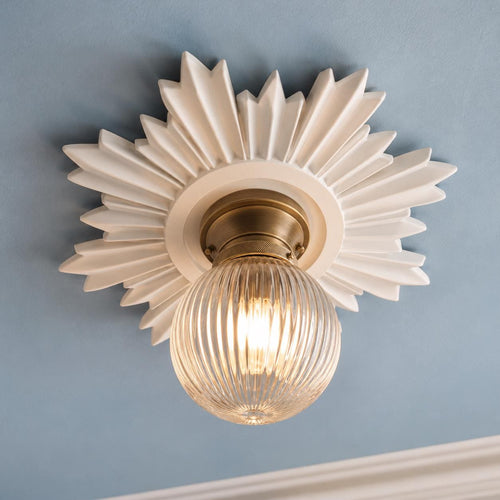
Photograph, read, then ask. Start with the lights and soft furnishings, since they leave with you. For colour planning use the 60-30-10 rule, and for the order of work if you do get permission to paint see how to paint a room in the right order. If you want a handmade plaster wall light with a battery option, see the pieces below.
Keep reading
- Wall lights for rented flats
- Plug-in, battery or hardwired wall lights
- Battery wall lights that look hardwired
- How to hang pictures and plan a gallery wall
- The 60-30-10 rule
- How to paint a room in the right order
Shop the look


Frequently asked questions
Can a landlord keep my deposit for wear and tear?
No. Shelter and Citizens Advice both say a landlord cannot deduct for reasonable or fair wear and tear, such as small scuffs, faded paint or a thinning carpet.
Can I paint a rented flat?
Ask your landlord in writing first. Shelter says painting walls a different colour without consent can cost you part of your deposit. If they agree, agree the colour you will restore at the end.
Does permission to decorate have to be in writing?
Not always as a legal rule, but written permission is best practice, according to mydeposits. Agree in writing which areas may be redecorated and what colour they must be when you leave.
How much can a landlord charge for a deposit?
The government tenant guidance says up to 5 weeks’ rent if the annual rent is below £50,000, up to 6 weeks if it is £50,000 to £100,000, and a holding deposit of up to 1 week’s rent.
What can I do if my landlord and I disagree about my deposit?
Use the free dispute service of your deposit protection scheme, and provide evidence. Citizens Advice says you usually need to apply within 3 months of moving out. If the deposit was not protected, you may be able to go to court.
Can I hang pictures or shelves in a rental?
Check your tenancy agreement, ask first, and fill the holes when you leave. Citizens Advice says a landlord cannot charge you to redecorate a whole room because of a few scuff marks.
Can I change a light fitting in a rental?
Ask the landlord. Fixed wiring is mains work for a qualified electrician and is the landlord’s decision. Plug-in and battery lights need no wiring and are the usual rental choice.
Do the 2026 tenancy changes affect decorating?
GOV.UK says most tenancies became assured periodic tenancies on 1 May 2026. The overview we read does not mention decorating permissions, so check your agreement and ask in writing.
Sources
References and further reading
Harvard style. Web pages were checked on the access date shown.
- Ministry of Housing, Communities and Local Government (2026) Renters’ Rights Act overview for tenants (1 May 2026), GOV.UK. Available at: www.gov.uk/guidance/renters-rights-act-overview-for-tenants (Accessed: 27 October 2026).
- GOV.UK (n.d.) Tenancy deposit protection, GOV.UK. Available at: www.gov.uk/tenancy-deposit-protection (Accessed: 27 October 2026).
- Ministry of Housing, Communities and Local Government (2026) Tenant Fees Act 2019: guidance for tenants (updated 7 July 2026), GOV.UK. Available at: www.gov.uk/guidance/tenant-fees-act-2019-guidance-for-ten... (Accessed: 27 October 2026).
- Citizens Advice (n.d.) Getting your tenancy deposit back if you rent privately, Citizens Advice. Available at: www.citizensadvice.org.uk/housing/deposits/getting-your-t... (Accessed: 27 October 2026).
- Shelter England (n.d.) Damage to your rented home, Shelter. Available at: england.shelter.org.uk/housing_advice/repairs/damage_or_w... (Accessed: 27 October 2026).
- Shelter England (2024) Can landlords charge for cleaning and gardening? (Cleaning, gardening or decorating; updated 6 May 2024), Shelter. Available at: england.shelter.org.uk/housing_advice/tenancy_deposits/wh... (Accessed: 27 October 2026).
- Shelter England (n.d.) Making improvements to your rented home, Shelter. Available at: england.shelter.org.uk/housing_advice/repairs/making_impr... (Accessed: 27 October 2026).
- Citizens Advice (n.d.) Understanding your tenancy agreement in England, Citizens Advice. Available at: www.citizensadvice.org.uk/housing/tenancy-agreements/ (Accessed: 27 October 2026).
- mydeposits (n.d.) Adjudication case study: redecoration, fair wear and tear, mydeposits. Available at: www.mydeposits.co.uk/content-hub/adjudication-case-study-... (Accessed: 27 October 2026).
- Ministry of Housing, Communities and Local Government (2025) Electrical safety standards in the private and social rented sectors: guidance (1 November 2025), GOV.UK. Available at: www.gov.uk/government/publications/electrical-safety-stan... (Accessed: 27 October 2026).
- London Borough of Lambeth (2023) Guide to decorative coatings (Artex and asbestos), Lambeth Council. Available at: www.lambeth.gov.uk/sites/default/files/2023-04/Guide%20to... (Accessed: 27 October 2026).
- GOV.UK (n.d.) Tenancy deposit protection: disputes and problems, GOV.UK. Available at: www.gov.uk/tenancy-deposit-protection/disputes-and-problems (Accessed: 27 October 2026).
How to cite this article
Tire, G. (2026) ‘Decorating a Rental Without Losing Your Deposit: What to Ask and What to Change’, The Flare Journal. Flare Studio UK. Available at: https://flarestudio.uk/blogs/journal/decorating-a-rental-without-losing-your-deposit (Accessed: 12 November 2026).
Shop the style








Conversation
Join the conversation
Questions about the history, a room you are planning, or a piece you have seen in the wild? Leave a comment and Joseph will reply.