

A Short History of the Ceiling Rose: From Plaster Ceilings to Today


Before the rose
Decorated plaster ceilings have a long history in England, from patterned Tudor ceilings to the grander schemes of later houses. Historic England's guidance on plasterwork says that casting low-relief lime decoration in moulds began in the sixteenth century.[1] The story that roses have represented secrecy since Roman times, or that a rose over a table under Henry VIII signified confidentiality, is presented by Designing Buildings as legend, and that source gives no firm date for the first ceiling rose.[2] Read a short history of plaster.
Georgian refinement
Classical design shaped ceiling ornament in the 1700s: the V&A describes Palladianism as fashionable in Britain between 1715 and 1760.[3] The work of designers such as Robert Adam showed how plaster could carry delicate classical motifs. Adam had been commissioned to modernise Osterley by 1761,[4] and the Metropolitan Museum of Art describes the compartmented ceiling of his Lansdowne House dining room (1766 to 1769) as a tour de force of neoclassical stucco executed by Joseph Rose.[5] By the end of the eighteenth century casting in gypsum had become common,[1] and in the Regency period decoration became more restrained while the rose stayed a fixture of many rooms.[2]

The Victorian rose
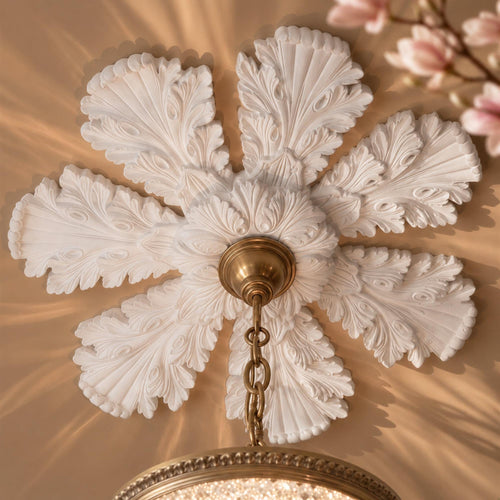
In the 1800s the ceiling rose became common in many homes, though not every room had one: bedrooms, attic rooms and servants' quarters usually received the minimum of architectural decoration.[7] The rose is traditionally where the cable for the central light comes through the ceiling.[2] Fibrous plaster, which is plaster of Paris reinforced with hessian and timber laths, was patented in the UK by Leonard Desachy in 1856; Jacksons bought the patent in 1864 and it expired in 1870. From 1880 to 1910 it became popular, and single enrichments were sold for fixing to lime plaster and lath in more modest houses.[1] Historic England also describes mid-Victorian villa interiors with rich plasterwork that were "opulent, if standardised".[8] Read the history of the Victorian ceiling rose, and fibrous plaster explained for how it was made at scale.
Twentieth century to now
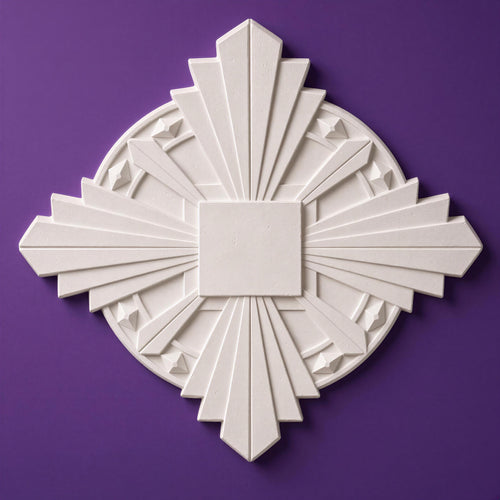
Simpler forms followed in some Edwardian and Art Deco homes, but this is a generalisation: Historic England describes some designs either side of 1900 as "subtle and undemonstrative", while the best houses of the early twentieth century were opulent.[8] The National Trust notes that Art Deco later rejected the opulence and ornament of Victorian and Edwardian designs.[9] After the Second World War, lightweight gypsum plasters and plasterboard contributed to the decline of lime plaster and fibrous work, which helps explain the plain ceilings of the mid-century, yet fibrous work was still being used to make cornices and ceiling roses for the domestic and restoration markets.[1] Today interest in handmade detail has brought the rose back, in period and modern forms (our observation). See ceiling roses in a modern home.

Choosing a rose today
See which ceiling rose suits your home and ceiling rose patterns by period.
Shop the look


Frequently asked questions
When were ceiling roses first used?
No source we found gives a firm date for the first ceiling rose. Decorated plaster ceilings have a long English tradition, and the rose became common in many Georgian and Victorian houses.
Why do old houses have ceiling roses?
They decorated the ceiling around a light fitting and were a fashionable feature.
Are ceiling roses still made by hand?
Yes. Many are cast by hand in plaster, as ours are in Shrewsbury.
Is the ceiling rose making a comeback?
Interest in handmade period detail has grown, in both period and modern homes.
Sources
References and further reading
Harvard style. Web pages were checked on the access date shown.
- Historic England (2019) Historic Fibrous Plaster in the UK: Guidance on its Care and Management. Swindon: Historic England. Available at: cadw.gov.wales/sites/default/files/2019-07/Historic%20Fib... (Accessed: 27 October 2026).
- Designing Buildings (no date) Ceiling rose. Available at: www.designingbuildings.co.uk/wiki/Ceiling_rose (Accessed: 27 October 2026).
- Victoria and Albert Museum (no date) Palladianism: an introduction. London: V&A. Available at: www.vam.ac.uk/articles/palladianism-an-introduction (Accessed: 27 October 2026).
- National Trust (no date) The history of Osterley Park. Available at: www.nationaltrust.org.uk/visit/london/osterley-park-and-h... (Accessed: 27 October 2026).
- The Metropolitan Museum of Art (no date) The Lansdowne Dining Room, London. Available at: www.metmuseum.org/essays/the-lansdowne-dining-room-london (Accessed: 27 October 2026).
- Haddon Hall (no date) History. Available at: www.haddonhall.co.uk/history/ (Accessed: 27 October 2026).
- The Victorian Society (no date) Victorian and Edwardian plaster mouldings, cornices, coving and dado rails. Available at: www.victoriansociety.org.uk/advice/plaster-mouldings-and-... (Accessed: 27 October 2026).
- Historic England (no date) Listing Selection Guide: Domestic 3: Suburban and Country Houses. Available at: historicengland.org.uk/images-books/publications/dlsg-sub... (Accessed: 27 October 2026).
- National Trust (no date) Architecture through the ages. Available at: www.nationaltrust.org.uk/discover/history/architecture/hi... (Accessed: 27 October 2026).
How to cite this article
Tire, G. (2026) ‘A Short History of the Ceiling Rose: From Plaster Ceilings to Today’, The Flare Journal. Flare Studio UK. Available at: https://flarestudio.uk/blogs/journal/history-of-the-ceiling-rose (Accessed: 12 November 2026).
Shop the style







Conversation
Join the conversation
Questions about the history, a room you are planning, or a piece you have seen in the wild? Leave a comment and Joseph will reply.