

How Much Weight Can a Ceiling Rose Hold?

Two things are called a ceiling rose
Before weights make sense, it helps to separate two different objects that share a name.
- The electrical ceiling rose is the small plastic or ceramic fitting where a pendant's flex connects to the lighting circuit. It is a wiring accessory and it has terminals inside.
- The decorative ceiling rose (also called a medallion or centrepiece) is the plaster ornament around it. It is what we make. Its job is to dress the ceiling and hide the junction, not to hold anything up.
Most confusion about weight comes from mixing the two up. A decorative plaster rose is a cast ornament stuck to the ceiling. An electrical rose is a connector with limits set by its maker. Neither is automatically the right thing to hang a chandelier from.
What a decorative rose is for
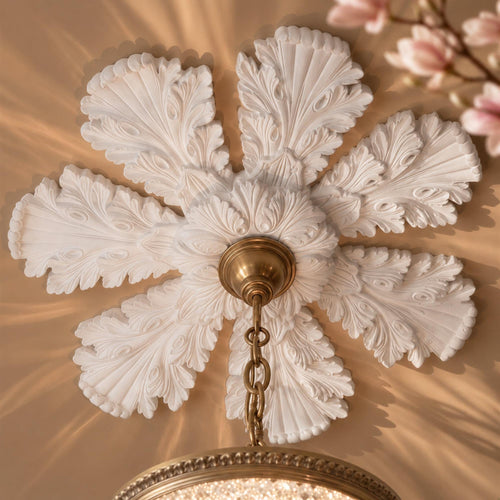
A plaster rose does three things: it adds a focal point, it hides the patch and the screw holes where a light meets the ceiling, and it gives a pendant a finished base. It is designed to carry its own weight, held to the ceiling with adhesive (and screws for larger pieces) as set out in the product fitting and painting guide. It is not designed to be the anchor a light hangs from, unless the maker says otherwise for a specific piece.
Plaster itself is brittle in tension. It resists being squashed, but it does not like being pulled or levered, which is exactly what a hanging weight does. That is why the load has to bypass the rose and go straight into the structure above it.
What actually carries the weight
In most houses the ceiling is a skin hung beneath timber joists. The skin might be plasterboard in a modern or renovated room, or lath and plaster in an older house. Neither is a good place to hang something heavy on its own.
The support for a pendant or chandelier normally comes from one of these:
- A ceiling hook or plate screwed into a joist. The simplest and strongest for a pendant, because the screws bite into solid timber.
- A bracket or noggin fixed between joists where the light has to sit away from a joist. An electrician or carpenter fits a timber crosspiece (a noggin) to screw into.
- A proper fixing rated for the load where the ceiling is concrete, as in many flats. The right anchor depends on the slab and the weight, so this is a job for a professional.
Whatever is used, the principle is the same: the load goes into something structural, and the rose goes around the fixing.
Know your ceiling
What the ceiling is made of changes the answer. Check this before you buy a light, not after.
| Ceiling type | Where you find it | What to know |
|---|---|---|
| Plasterboard on joists | Most modern houses, renovated rooms | Fine for a rose. The board alone is not a fixing for a heavy light: go into the joist. |
| Lath and plaster | Many pre-1930s houses | Brittle, keyed to timber strips. Do not load it. Fix into the joist, and be gentle: vibration can shake plaster off the laths. RICS lists extra weight and vibration among the things that can damage the nibs that key the plaster to the laths.[6] |
| Concrete slab | Many flats and extensions | Very strong, but needs the right anchor. Check with a professional. |
| Suspended or grid ceiling | Some kitchens and commercial-style rooms | Not designed to carry anything heavy from the tiles. The fixing has to go to the structure above. |
| Artex or textured finish | 1970s and 1980s houses | Some contain asbestos, which the HSE says may be part of any home built or refurbished before 2000.[8] Do not drill or sand it until you know. Get it tested before any work.[1] |
If you are not sure what you have, a small inspection hole or a look from the loft usually answers it. Where the ceiling is old, cracked, stained, or sags, treat it as suspect: see "Signs to stop" below.
Light, medium or heavy?
Fittings vary a great deal, and manufacturers state the weight of their own lights. The reliable way to judge a fitting is to look at that stated weight and compare it with what the fixing you plan to use is rated for. If the maker of the fitting gives a ceiling support recommendation, follow it.
A practical way to think about it, in order of seriousness:
- Lightweight shades and small pendants. A joist hook is usually enough.
- Larger glass or metal pendants. Get a joist or bracket fixing, not a plaster or board fixing.
- Chandeliers and anything many-armed or glass-heavy. Treat as heavy, and have the fixing assessed. Weigh it first.
If you cannot find a stated weight, put the fitting on bathroom scales (holding it, then subtracting your own weight) or ask the seller, and add the shade and bulbs. For the look rather than the load of a chandelier, see how to size a ceiling rose for a chandelier.
A worked example: weigh it before you decide
The weight that matters is the whole fitting as it hangs, not the figure on the box for the bare frame. Here is how the sum works, using an invented pendant so you can follow the method with your own numbers.
| Part | Example weight | Where to find it |
|---|---|---|
| Fitting body and arms | 2.5 kg | Maker's specification, or weigh it |
| Shade or glass | 0.8 kg | Weigh it, or ask the seller |
| Bulbs | 0.1 kg | Weight on the bulb packaging, or estimate |
| Chain, rod or flex | 0.2 kg | Weigh it with the fitting |
| Total hanging weight | 3.6 kg | Add everything up |
These figures are illustrative, not a recommendation for any particular product. The point is the habit: add up everything that hangs, compare the total with the rating of the fixing you plan to use, and leave a margin. If you cannot find a rating, do not guess. Ask the maker of the fixing or an electrician.
Remember that a light which swings, is bumped or has a child pulling on it can load a fixing much harder than its resting weight suggests. That is another reason to over-specify the fixing and to stay well away from the limit.
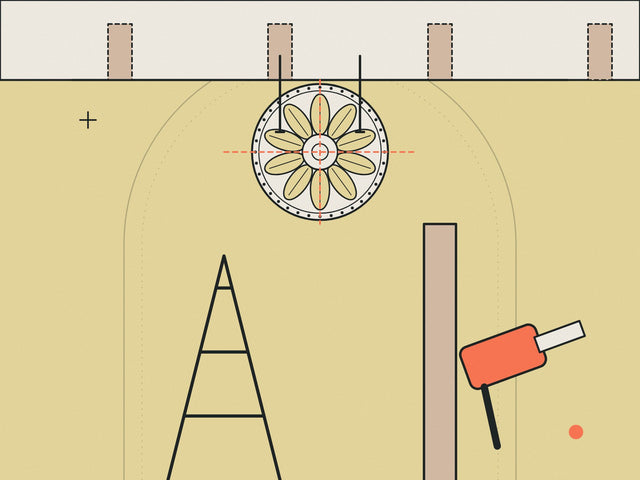
Different ceilings, different fixings: a quick decision guide
The right place to take the load depends on what is above the plaster. Use the diagram as a prompt for the conversation with your electrician, not as an instruction.
Fixing the rose itself
The rose has its own weight, and plaster is dense. Good practice:
- Fix it to a sound, clean ceiling surface using the adhesive and any screws in the product instructions.
- Support it while the adhesive sets. Props or tape are better than trusting the first grab.
- Fill and caulk the joint, then paint.
Follow the fitting and painting guide for the exact method, and see how to fit a plaster ceiling rose for the step-by-step. Cost and who to hire are in ceiling rose fitting cost in the UK.
How a pendant passes through a rose
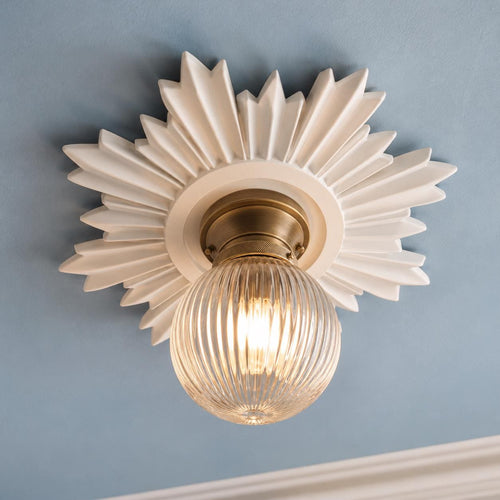
With a pendant, the flex (and a chain or rod if there is one) passes through a hole at the centre of the rose. The support hook or plate sits behind the rose, fixed into the joist. The rose can then be fixed to the ceiling around it. This keeps the load on the structure and the rose purely decorative. For the sequence, see how to hang a pendant from a plaster ceiling rose.
Wiring is not a DIY job unless you are competent and qualified to do it. Any electrical work to a lighting circuit should be done or checked by a qualified electrician.[2] Approved Document P to the Building Regulations says that adding to or altering circuits is notifiable work, whereas simple replacements and repairs are not, so swapping a light on an existing circuit is a different job from moving or adding one; ask your electrician which applies.[7]
Questions to ask your electrician
A good electrician will answer these without fuss, and the answers tell you whether you have found the right person.
- What is my ceiling made of, and how did you check?
- Where are the joists, and does the light sit over one?
- What fixing will you use, and what is it rated to carry?
- Will the support sit behind the rose, so the rose stays decorative?
- What will you do if the ceiling turns out to be weaker than expected?
- Will you certify the electrical work? Ask what paperwork you will receive.
If you are working on an old ceiling, our guide to fitting a ceiling rose to Artex, plasterboard and lath-and-plaster goes through each surface in turn, and how to remove an old ceiling rose explains what to expect if you are replacing one.
Signs to stop and get advice
Do not hang anything from a ceiling that shows:
- Cracks that are widening, or a crack running right across the ceiling.
- Sagging, bulges or a ceiling that moves when you press it.
- Brown stains or damp, which suggest a leak. Wet plaster is weak.
- Old lath and plaster that sounds hollow or has come away from the laths.
- A history of leaks above (bathroom, roof, pipes).
Have a builder or surveyor look at it first. Fixing a ceiling is cheaper than repairing the damage from a light that comes down. For old plaster ceilings, conservation guidance goes further: Clark advises that assessment should involve a plaster conservation specialist working with a structural engineer,[5] and Historic England's fibrous plaster guidance warns that one failed hessian wad adds to the load on its neighbours, risking progressive collapse.[4] Neither document covers hanging a domestic light, so treat them as reasons for caution, not as rules. If you only want to cover an old hole or mark, our guide to using a rose to cover a hole or old light mark explains what a rose can and cannot do.
Common mistakes
| Mistake | Better approach |
|---|---|
| Hanging the light from the rose | Hang it from a hook or bracket fixed into a joist; let the rose surround it |
| Using a plasterboard fixing for a heavy light | Go into the joist, or add a noggin, or get professional advice |
| Guessing the weight | Weigh the fitting with shade and bulbs, check the maker's figure |
| Hanging anything from lath and plaster | Fix through it into the timber, gently |
| Drilling Artex without checking | Test for asbestos first; if in doubt, leave it alone |
| Doing wiring yourself | Use a qualified electrician |
A checklist for you and your electrician
Before you book, have this to hand. It saves time and makes a quote more accurate.
- The weight of the light with shade and bulbs.
- The ceiling type and condition, with a photo.
- Where the joists run, if you know (a loft check helps).
- The height of the ceiling and where the light should hang.
- The rose size and its fitting instructions.
Notes on figures and advice
- This guide deliberately gives no universal weight limit. A decorative rose is not a load-bearing fixing, and a safe figure depends on the ceiling, the fixing and the fitting. Follow the maker's instructions and your electrician's advice.
- The advice on joists, hooks, noggins and ceiling types is general building knowledge, not drawn from a single published source. Ask a qualified electrician or builder about your own ceiling.
- The weights in the worked example are invented for illustration.
- Asbestos: the Health and Safety Executive lists textured decorative coatings, which have had trade names such as Artex, among materials that may contain asbestos, and tells anyone who thinks they have found it to stop work and follow its guidance.[1] Its textured-coatings page classes work on them as low-risk for workers trained in asbestos safety, but its FAQs tell householders not to try to repair or remove asbestos materials themselves, and say asbestos may be part of any home built or refurbished before 2000.[8]
- Electrical Safety First recommends using an electrician registered with a government-approved scheme.[2]
- Older ceilings and historic homes: Historic England publishes free advice for owners.[3]
- The conservation sources on plaster ceilings (Historic England, RICS, Clark) are written for historic and theatre buildings. They describe how plaster ceilings fail under extra load, but give no weight limits for domestic lights, which is why this guide gives none either.
Keep reading
- How to hang a pendant from a plaster ceiling rose
- Ceiling rose size for a chandelier
- How to fit a plaster ceiling rose
- Ceiling rose fitting cost in the UK
- Ceiling rose ideas by room
- Fitting a ceiling rose to Artex, plasterboard and lath and plaster
- How to remove an old ceiling rose
Shop the look


Frequently asked questions
Can a ceiling rose hold a chandelier?
Treat the rose as decoration. The chandelier should be supported by a proper fixing into the ceiling structure, such as a joist or a rated bracket, fitted by a qualified electrician.
How much weight can a plaster ceiling rose hold?
There is no safe universal figure, because a decorative rose is not designed as the support for a light. Plaster is brittle when pulled. Take the load into the joist and use the rose as the surround.
Should a pendant hang from the ceiling rose?
The flex passes through the rose, but the support should come from a hook or bracket fixed into the ceiling structure behind it.
Can I hang a light from plasterboard alone?
Not a heavy one. Plasterboard fixings have limits. For anything beyond a light shade, fix into a joist or add a timber noggin, and ask an electrician if you are unsure.
What if my ceiling is old lath and plaster?
Fix into the joists rather than the plaster, be gentle, and have the ceiling checked first if it is cracked, sagging or stained.
How do I find a joist?
A stud finder helps, as does checking from the loft or noting which way the floorboards above run. An electrician will normally do this as part of the job.
Is the electrical ceiling rose the same as the decorative one?
No. The electrical ceiling rose is a wiring connector. The decorative rose is the plaster ornament around it.
Who should fit a heavy light?
A qualified electrician. Wiring and the support for a heavy fitting should not be a guess.
Sources
References and further reading
Harvard style. Web pages were checked on the access date shown.
- Health and Safety Executive (n.d.) Locations of asbestos and taking the right action, HSE. Available at: www.hse.gov.uk/asbestos/location-materials.htm (Accessed: 27 October 2026).
- Electrical Safety First (n.d.) Find a UK-certified electrician, Electrical Safety First. Available at: www.electricalsafetyfirst.org.uk/ (Accessed: 27 October 2026).
- Historic England (n.d.) Your Home: advice on maintaining, repairing and improving older homes, Historic England. Available at: historicengland.org.uk/advice/your-home/ (Accessed: 27 October 2026).
- Historic England et al. (2019) Historic fibrous plaster in the UK: guidance on its care and management (Historic England guidance HEAG269, with Historic Environment Scotland, Cadw, the Welsh Government and the Historic Environment Division, Northern Ireland). Available at: cadw.gov.wales/sites/default/files/2019-07/Historic%20Fib... (Accessed: 27 October 2026).
- Clark, K. (2021) Structural assessment of historic plaster ceilings, Building Conservation Directory. Available at: buildingconservation.com/articles/plaster-ceilings/plaste... (Accessed: 27 October 2026).
- Napier, W. (2025) How to retain and repair traditional plasterwork, RICS Built Environment Journal, updated 12 December. Available at: ww3.rics.org/uk/en/journals/built-environment-journal/how... (Accessed: 27 October 2026).
- Department for Communities and Local Government (2013) Approved Document P: Electrical safety, dwellings (2013 edition). Available at: www.gov.uk/government/publications/electrical-safety-appr... (Accessed: 27 October 2026).
- Health and Safety Executive (n.d.) Asbestos: FAQs, HSE. Available at: www.hse.gov.uk/asbestos/faq.htm (Accessed: 27 October 2026).
How to cite this article
Tire, G. (2026) ‘How Much Weight Can a Ceiling Rose Hold?’, The Flare Journal. Flare Studio UK. Available at: https://flarestudio.uk/blogs/journal/how-much-weight-can-a-ceiling-rose-hold (Accessed: 12 November 2026).
Shop the style






Conversation
Join the conversation
Questions about the history, a room you are planning, or a piece you have seen in the wild? Leave a comment and Joseph will reply.