

Ceiling Rose Ideas by Room: Living Room, Bedroom, Hall, Kitchen and More

Start with proportion, not preference
People usually choose a ceiling rose by looking at a picture. The room chooses it for you if you work in the right order. Three things decide what looks right, and they are worth settling before you look at a single design:
- Ceiling height. A tall ceiling can carry a large, deep rose. A low ceiling needs a shallow, small one, or the rose looks like it is pressing down on the room.
- What hangs from it. A rose sits behind a light, so its diameter should relate to the fitting. A big chandelier on a tiny rose looks top-heavy; a tiny flush light in the middle of a huge rose looks lost.
- The age and character of the house. A Georgian drawing room and a 1990s new build want different things. Our guide to which ceiling rose suits your home covers the period matching in detail.
The sizes in this guide are starting points from our own experience of what looks balanced, not a rule you can measure against. When you are between two sizes, cut a circle out of cardboard or lining paper at each, tape it to the ceiling and stand back. Two minutes with a pencil and paper beats a return. For the full method, see how to choose a ceiling rose size.
Test before you buy: the template method
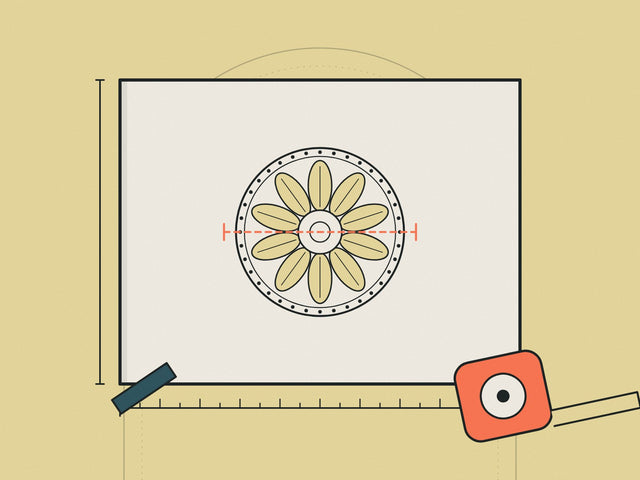
The most reliable way to choose a size is to look at it on your own ceiling. It costs a sheet of lining paper and ten minutes, and it settles most arguments before any money is spent.
- Cut two circles from card or lining paper: one at the size you think you want, one a step smaller.
- Tape one up centred on the light position, using low-tack tape so you do not mark the paint.
- Stand in the doorway and then in the far corner. A rose is seen from across the room, not from underneath.
- Switch the light on if you can, or hold the fitting up, so you judge rose and light together.
- Swap to the other circle and compare. If you cannot decide, the smaller one is usually the safer choice, because a rose that is slightly modest looks restrained and a rose that is too big looks forced.
Photograph each version from the doorway. It is easier to compare two photographs side by side than two memories.
Living room
The living room is the room that can take the biggest and most decorative rose in the house. It usually has the highest footfall, the best ceiling height on the ground floor and the most generous light fitting. A rose of roughly 16 to 24 inches (40 to 60 cm) is a sensible range, going to the top of it if the ceiling is above about 2.6 m or you are hanging a substantial pendant.
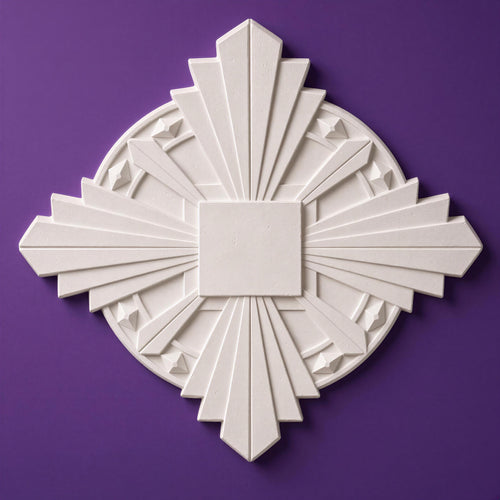
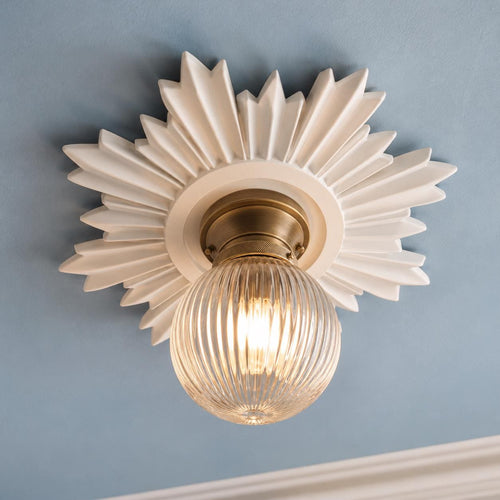
What works: a classical acanthus or floral rose in a Georgian or Victorian room; a simpler, rounder design in a 1930s semi; a statement sunburst for a mid-century or art-deco scheme. Look at the width of the room too: in a narrow terraced front room, a very large rose can crowd the cornice, so leave a visible band of plain ceiling around it.
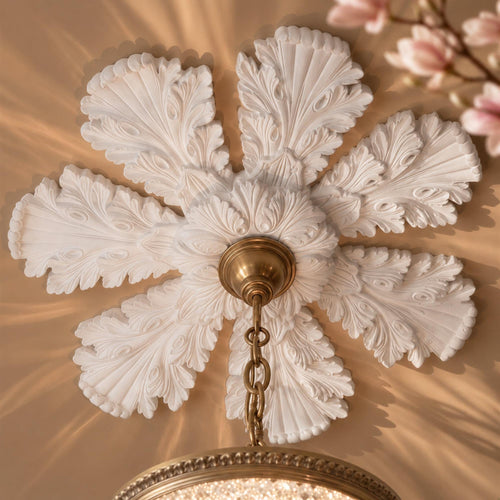
What to hang: a pendant, a chandelier or a simple flush light. For chandeliers, read how to size a rose for a chandelier and, before you hang anything heavy, how much weight a ceiling rose can hold: the decorative rose is not the fixing.
Dining room
A dining room has a natural centre: the table. Centre the rose over the table, not over the room, if they differ. A rose helps a dining room feel formal in the good sense, because the eye lands on a deliberate focal point above the meal. Go for the same size band as a living room if the ceiling allows, or one step down if the room is small. A rose with a clear, crisp outline suits a pendant over a table, because the shadows it throws in warm evening light are part of the effect.
Open-plan rooms, long rooms and awkward ceilings
Not every room has one obvious centre. Three cases come up again and again.
- Open-plan living and dining. Treat each zone as its own room. A rose over the dining table and a different one over the seating area can look deliberate if they share a style, but two very different designs fight each other. Keep the family resemblance: the same period, the same level of ornament, perhaps different sizes.
- Long, narrow rooms. One large rose in the middle of a long room can look like a dot on a ruler. Two matching roses of moderate size, spaced along the length, often suit the proportions better. Position each over a light, not just over a measurement.
- Off-centre lights. If the existing light sits away from the middle of the room, the rose belongs behind the light. Moving the electrics is a bigger job; see ceiling rose fitting cost in the UK before you decide.
For sloping or vaulted ceilings, a flat rose needs careful thought: see ceiling roses on sloping or vaulted ceilings before ordering.
Bedroom
Bedrooms suit a medium rose of around 12 to 18 inches (30 to 45 cm) with soft detail: floral, ribbon or shell designs rather than hard geometric ones. A rose is a good way to give a plain bedroom ceiling a focal point without making a statement you will be staring at when you wake.
Position matters here. If a bed sits under a light, a very deep rose directly above you feels heavy. Where the ceiling light is over the middle of the room rather than the bed, you can go slightly bolder. A simple shade or small pendant works better than a large chandelier in most bedrooms.
Hall, stairs and landing
Halls and landings are often the lowest and narrowest ceilings in the house, and they are where people walk under the light every day. Go smaller, roughly 10 to 16 inches (25 to 40 cm), and choose a flatter relief.
On a staircase, remember the ceiling can be much higher over the stairwell than over the landing. Measure each position separately. In a narrow hall, a rose that is nearly as wide as the corridor looks cramped; leave generous plain ceiling on each side. If your ceiling is low anywhere in the house, read ceiling roses for low ceilings. For lighting a hall, wall lights are often a better partner for a rose than a pendant: see how to light a hallway with wall lights.
Kitchen
Kitchens are hard on plaster. Steam, grease and cleaning products all act on a porous surface. A rose in a kitchen is perfectly possible, but choose a plain, simple design of roughly 10 to 14 inches (25 to 35 cm) with shallow detail that is easy to wipe, paint it with a washable finish, and keep it clear of direct steam above the hob. Approved Document F sets minimum intermittent extract rates of 30 litres per second for a kitchen with a cooker hood venting to outside and 60 litres per second otherwise, so check the extraction before you add plaster above a cooker.[5] A kitchen-diner is a better candidate than a working galley: put the rose over the dining end rather than over the cooker.
The detail, including how to seal and paint, is in ceiling roses in bathrooms and kitchens.
Bathroom
Bathrooms add one more rule: the electrics. Light fittings in bathrooms have to meet specific requirements for how close they can be to water, which depends on the position in the room and the fitting's protection rating. One published guide gives IP67 for zone 0 (inside the bath or shower), at least IP44 in zones 1 and 2, and recommends IP65 in zone 1.[4] Under Approved Document P, adding to or altering circuits around a bath or shower is notifiable work, whereas replacements and repairs are not, and the document points to BS 7671 for the wiring rules.[3] Fitting is a job for a qualified electrician, and the rules limit the lights you can hang under a rose. The rose itself is decorative, so a small, plain one around an appropriately rated fitting is usually the safest approach. Good ventilation is the other half: an extractor fan that works keeps moisture off the plaster and the paint. Approved Document F lists an intermittent extract rate of 15 litres per second for a bathroom.[5] See ceiling roses in bathrooms and kitchens before you commit.
Nursery and children's rooms
A small, simple rose over a nursery ceiling light adds softness without clutter. Keep the design gentle and the scale small, and make sure whatever hangs from it is secure and out of reach. The lighting side of a nursery matters more than the ceiling detail, so see nursery wall lights: gentle, safe lighting for the practical points.
Home office, snug and small rooms
Small rooms can carry a rose, and it can make them feel intentional rather than leftover. Choose a small to medium size, keep the relief shallow, and use a simple flush or semi-flush light. In a small room a rose that is too large starts to dominate; err on the small side and let the colour (see below) do the work.
Rose, cornice and light: getting the three to agree
A rose rarely works alone. It sits in a room that may have a cornice, a picture rail and a light fitting, and it looks best when they all speak the same language.
- With a cornice. Match the level of ornament. A deep, decorative cornice suits a decorative rose; a plain coved edge suits a simple one. See our cornice, coving and mouldings glossary if the terms are unfamiliar.
- With the light. The fitting should look as if it belongs under the rose. A bold pendant on a delicate rose looks top-heavy; a tiny fitting on a grand rose looks lost. Our guide to sizing a rose for a chandelier covers the heavier end.
- With the walls. Wall lights and a rose complement each other. See how to style a plaster wall light by room for the wall half of the conversation.
When in doubt, simplify. A well-proportioned simple rose with a matching simple light looks better than two ornate pieces that have not been introduced.
Choosing by period of home
| Home | What tends to suit | Avoid |
|---|---|---|
| Georgian | Restrained classical designs: acanthus, laurel, beading. Medium to large. | Heavy, fussy Victorian ornament |
| Victorian | Fuller floral and leaf designs, deeper relief | Very plain flat discs, which look unfinished |
| Edwardian | Lighter, more delicate garlands and ribbons | Very heavy designs |
| 1930s | Simple rounded designs, sunbursts, stepped Art Deco forms | Over-elaborate period copies |
| 1950s to 1970s | Small, plain or sunburst-style designs | Large baroque roses that fight the style |
| New build | A modest, simple rose to add a focal point | Oversized roses on very low flat ceilings |
The table is our guidance, not a standard. For background on materials, Historic England notes that fibrous plaster was widely used for cornices and ceiling roses and is still made for domestic and restoration work,[6] and RICS says lime plaster was common until the early-to-mid 20th century.[7] If an old ceiling looks sagging or cracked, a Building Conservation Directory article on assessing historic plaster ceilings is worth reading before you fix anything to it.[8]
If you are not sure what your house is, identifying the period of your house from plasterwork will help.
Quick reference
| Room | Size idea | Style |
|---|---|---|
| Living room | 16 to 24 in (40 to 60 cm) | Decorative |
| Dining room | 14 to 22 in (35 to 55 cm) | Crisp, formal |
| Bedroom | 12 to 18 in (30 to 45 cm) | Soft, floral |
| Hall and landing | 10 to 16 in (25 to 40 cm) | Simple, shallow |
| Kitchen | 10 to 14 in (25 to 35 cm) | Plain, easy to wipe |
| Bathroom | Small, plain | Sealed and well ventilated |
These are starting points. See how to choose a ceiling rose size and, for how to fit and finish, how to fit a plaster ceiling rose and ceiling rose paint colours.
Common mistakes
- Choosing from a photo without a template. Cut a card circle and tape it up first.
- Ignoring the ceiling height. A deep rose on a 2.2 m ceiling will dominate the room.
- Centring on the room, not the table or the light. The rose belongs behind the fitting.
- Hanging something heavy from the rose. It is decoration. Use a proper fixing. See how much weight a ceiling rose can hold.
- Painting it a different white from the ceiling by accident. Colour guidance is in our paint guide.
- Forgetting the cost of fitting. See ceiling rose fitting cost in the UK for realistic numbers.
Notes on figures and advice
- Rose sizes in this guide are Flare Studio starting points from our own experience of what looks balanced. They are not an industry standard or a regulation, and they are not cited because no published standard exists.
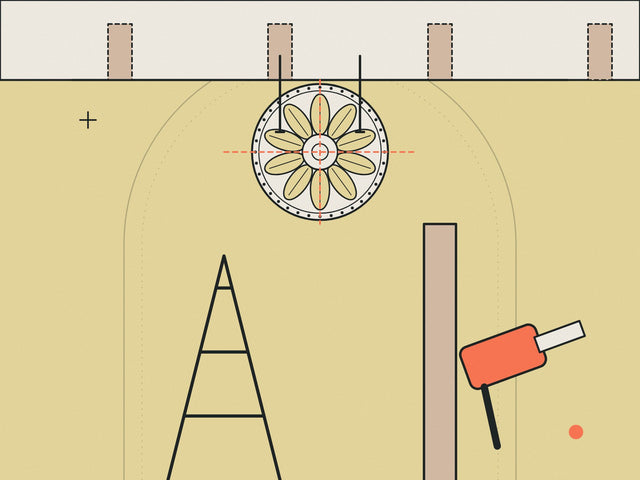
- The 2.1 m clearance in the side-view diagram is a commonly quoted rule of thumb for walkways, not a legal requirement. Check the maker's instructions for any light you buy.
- Electrical work, including anything in a bathroom, should be done by a qualified electrician. Electrical Safety First recommends using an electrician registered with a government-approved scheme.[1] Approved Document P to the Building Regulations explains which electrical jobs in a home are notifiable.[3]
- If your home is older or listed, Historic England publishes free advice for owners on maintaining and altering period homes.[2]
Keep reading
- Which ceiling rose is right for your home?
- How to choose a ceiling rose size
- Ceiling roses for low ceilings
- How to fit a plaster ceiling rose
- Ceiling rose paint colours
- Ceiling rose fitting cost in the UK
Shop the look


Frequently asked questions
Which ceiling rose suits a living room?
A larger, decorative rose in proportion to the room and the light fitting, roughly 16 to 24 inches as a starting point. Go to the top of the range with a high ceiling or a substantial pendant.
Which ceiling rose suits a bedroom?
A medium rose, roughly 12 to 18 inches, with soft floral or ribbon detail. Keep it modest if the bed sits directly under the light.
Can I put a ceiling rose in a kitchen?
Yes, but choose a plain design, seal and paint it with a washable finish, keep it away from direct steam above the hob and make sure the room is ventilated.
Can I put a ceiling rose in a bathroom?
A small, plain rose is possible. Bathroom light fittings have electrical zone requirements, so have a qualified electrician choose and fit the light, and keep the room ventilated.
What size ceiling rose for a hallway?
Smaller and flatter: roughly 10 to 16 inches. Hall and landing ceilings are often low, so measure the height at each position.
How do I choose a size?
Start with ceiling height and the light you will hang, then cut a card circle at two sizes and tape each to the ceiling. See our sizing guide.
Should the rose match the age of my house?
It helps. Restrained classical designs suit Georgian rooms, fuller floral designs suit Victorian ones, and simple rounded or sunburst designs suit the 1930s.
Can a ceiling rose hold a heavy light?
Treat the rose as decoration. The light should be supported by a proper fixing into the ceiling structure, fitted by a qualified electrician.
Sources
References and further reading
Harvard style. Web pages were checked on the access date shown.
- Electrical Safety First (n.d.) Find a UK-certified electrician, Electrical Safety First. Available at: www.electricalsafetyfirst.org.uk/ (Accessed: 27 October 2026).
- Historic England (n.d.) Your Home: advice on maintaining, repairing and improving older homes, Historic England. Available at: historicengland.org.uk/advice/your-home/ (Accessed: 27 October 2026).
- Department for Communities and Local Government (2013) Approved Document P: Electrical safety, dwellings (2013 edition). Available at: www.gov.uk/government/publications/electrical-safety-appr... (Accessed: 27 October 2026).
- Stevenson, M. (2025) Bathroom lighting regulations, Homebuilding & Renovating, 23 November. Available at: www.homebuilding.co.uk/rooms/bathroom/bathroom-lighting-r... (Accessed: 27 October 2026).
- Ministry of Housing, Communities and Local Government (2021) Approved Document F: Ventilation, Volume 1: Dwellings (2021 edition). Available at: assets.publishing.service.gov.uk/media/61deba42d3bf7f054f... (Accessed: 27 October 2026).
- Historic England et al. (2019) Historic fibrous plaster in the UK: guidance on its care and management (Historic England guidance HEAG269, with Historic Environment Scotland, Cadw, the Welsh Government and the Historic Environment Division, Northern Ireland). Available at: cadw.gov.wales/sites/default/files/2019-07/Historic%20Fib... (Accessed: 27 October 2026).
- Napier, W. (2025) How to retain and repair traditional plasterwork, RICS Built Environment Journal, updated 12 December. Available at: ww3.rics.org/uk/en/journals/built-environment-journal/how... (Accessed: 27 October 2026).
- Clark, K. (2021) Structural assessment of historic plaster ceilings, Building Conservation Directory. Available at: buildingconservation.com/articles/plaster-ceilings/plaste... (Accessed: 27 October 2026).
How to cite this article
Tire, G. (2026) ‘Ceiling Rose Ideas by Room: Living Room, Bedroom, Hall, Kitchen and More’, The Flare Journal. Flare Studio UK. Available at: https://flarestudio.uk/blogs/journal/ceiling-rose-ideas-by-room (Accessed: 12 November 2026).
Shop the style


Conversation
Join the conversation
Questions about the history, a room you are planning, or a piece you have seen in the wild? Leave a comment and Joseph will reply.