

Luis Barragán: What a Mexican Master Teaches Us About Colour and Plaster

Who was Barragán?
Luis Barragán was born on 9 March 1902 in Guadalajara, Jalisco, and died on 22 November 1988 in Mexico City.[1] He trained as an engineer in Guadalajara, but sources disagree on when he graduated: Wikipedia gives 1923 (from the Escuela Libre de Ingenieros), the Pritzker Prize biography says he took his degree at 23 and taught himself architecture, and the Mexican culture ministry’s 2022 press release says he graduated as a civil engineer and architect in 1925, which fits the Pritzker age.[1][2][7] He practised in Guadalajara from 1927 to 1936 and then in Mexico City, where he lived and worked until his death.[2] In 1931 he was in France, where he briefly met Le Corbusier, and he had become aware of the writings of the writer-designer Ferdinand Bac; the Pritzker biography adds that he attended Le Corbusier’s lectures in Paris that year.[1][2] He strove for what he called an “emotional architecture”.[1]
His best-known works include the El Pedregal housing development on a lava field in Mexico City (1945–50 in MoMA’s dating), his own house and studio in Tacubaya (built 1947–48 according to UNESCO), the Towers of Satellite City with the sculptor Mathias Goeritz (1957), the riding-stable developments Las Arboledas and Los Clubes, and the San Cristóbal stables, horse pool, swimming pool and house (1967–68).[3][4] Wikipedia’s list adds the Capuchinas Sacramentarias chapel in Tlalpan and Casa Gilardi (1975–77).[1] He won the Pritzker Architecture Prize in 1980, when the jury called his work “a sublime act of the poetic imagination” and praised his “metaphysical landscapes for meditation and companionship”.[2] The same press release records the 1976 MoMA exhibition and the 1987 Premio Nacional de Arquitectura.[7]

The MoMA exhibition that made him known abroad
Much of Barragán’s international reputation rests on a New York show. The Architecture of Luis Barragán opened at the Museum of Modern Art on 4 June 1976 and ran to 7 September 1976. It was organised by the museum’s curator of design, Emilio Ambasz, who also wrote the accompanying book. It was a colour slide show, the first in a new MoMA series of slide exhibitions on contemporary architects, made available to architecture schools.[3] MoMA’s press release describes his brilliant colours as softening the austerity of his architecture, and says water was a recurring element, especially at Las Arboledas, where fountains and reflecting pools appear throughout.[3]
For a home, that is a useful reminder that colour in his work was never alone: it sat next to water, planting and stone.
Emotional architecture
Barragán rejected functionalism. Wikipedia quotes him as saying that any architecture that does not express serenity is a mistake.[1] The Pritzker jury’s own wording points the same way: “metaphysical landscapes for meditation and companionship”.[2] In other words, buildings were meant to offer refuge from noise, from the street and from the pressure of modern life.
This is useful for anyone designing a home, because it tells you what colour and plaster are for in his work. They are not decoration. They are tools for making a place feel calm, enclosed and slightly mysterious. A pink wall in a Barragán garden is a plane of colour, held in light, that makes the space feel intentional. That reading is our interpretation of the published descriptions, not a quotation from him. JSTOR Daily goes further, describing the house as “a sort of church for Mexican Modernism”, with saints among the books, cross-like mullions in the garden window and a dressing room known as the “cuarto del Cristo”, and linking his Catholicism and the influence of monasteries to the private rooms.[8]
Colour on plain plaster
Barragán’s walls are plain, plastered and then painted in strong colour. At his house in Tacubaya, a published room-by-room description records a vestibule with yellow light and one fuchsia wall, a dining area with a fuchsia wall, white walls in the living room, and high roof-terrace walls in blood red, dark brownish grey and white.[5] On the street front, plastered concrete is left in its natural colour and roughness on most of the exterior, with yellow and orange planes forming a corner at upper left and a white water tower on the roofline.[6] The walls have been repainted over the decades, so treat any single shade as a description, not a paint reference. Accounts differ: JSTOR Daily describes a bright yellow entryway, a bright pink wall in the staircase room, a gold-leaf painting on the landing and orange and pink rooftop walls, and says there is no green inside the house, while EBSCO describes grey, white and red rooftop walls and rough cement exterior walls.[8][9]
Cuadra San Cristóbal (San Cristóbal, 1967–68 in MoMA’s dating) was a stable, horse pool, swimming pool and house in Mexico City.[3] It is known for a long pink wall beside a courtyard and pool, a description widely repeated in popular accounts rather than in the sources we consulted for this article, so we do not rely on it for any detail.
| What Barragán did | What it means for a home |
|---|---|
| Strong colour on a plain plane | Fill and skim the wall properly: the surface is the point |
| White rooms between coloured ones | Use white or sand to rest the eye between strong colours |
| Matt, chalky finishes | Use matt paint or limewash; gloss shows every flaw |
| Colour met with water, sky or planting | Place colour near a window, garden or a mirror |
| Little furniture | Leave empty space: it is part of the composition |
The table is design guidance drawn from the descriptions above, not a record of what he said.

Light is the second material
The house in Tacubaya was designed so that, apart from the breakfast nook, it needs no artificial light during the day. The street façade has only a few small windows, the main living-room window overlooks the garden, and the upper floor has thick wooden shutters.[5] The street front also has a translucent, reticulated library window that projects from the façade.[6] UNESCO records the house as a ground floor and two upper storeys of 1,161 m².[4] JSTOR Daily adds that the entryway gets only a small rectangle of natural light through a filtered window above the door, and that the guest-bedroom shutters, left slightly open, form a cross of light.[8]
The lesson is that colour is never fixed: it is a conversation between pigment and light. A saturated wall looks different in cool morning light, bright midday light and warm late sun, which is why the swatches and the pink-wall diagram in this article are illustrations, not measurements.
Mexican roots, not just modernism
Barragán’s architecture is often presented as pure modernism, but UNESCO describes the house as a regional adaptation of the International Modern Movement that blends modern design with traditional Mexican vernacular elements, and as an influence on contemporary garden design through its use of water and fountains.[4] MoMA’s press release likewise says his work drew on Mexico’s cultural and religious traditions.[3]
That is why strong colour feels natural in his rooms: it sits in a Mexican tradition of building and garden-making, not in a design-magazine trend.
Materials
Published descriptions record concrete with a plaster rendering, volcanic stone floors in the entry, pine plank floors and wooden beam ceilings in the living room, parchment screens, and stone stairs without railings.[5] These are plain, rough materials chosen for texture and temperature, set against flat planes of colour.
It is the combination that matters: a smooth, painted plane against rough stone and timber. In your own home the equivalent is a plain painted wall next to oak, stone, linen or hand-finished plaster.
Lessons for a home
The points below are design guidance, drawn from the sources above and general practice; they are not claims about Barragán’s own methods.
- Choose one confident colour and use it on a whole wall. Half-measures make it look timid.
- Keep ornament minimal. One plaster piece is enough.
- Choose by light, not by chart. View samples at morning, midday and evening, and under your evening bulbs.
- Pair colour with simple, rounded forms. A smooth plaster light or a plain rose suits a saturated wall.
- Leave space. Empty wall is part of the effect.
| Wall colour | Plaster piece | Light |
|---|---|---|
| Fuchsia or deep pink | Cream or the same pink | Warm white bulb, low |
| Yellow or ochre | Cream or white | Warm bulb; avoid cool white |
| Coral or terracotta | Cream, or the same coral | Warm bulb, dimmed |
| Deep red | White, for contrast | Warm, low, from the side |
Common mistakes when borrowing the look
- Colouring every wall. The living room at Casa Barragán is white; the effect depends on quiet rooms next to loud ones.[5]
- Gloss or silk on a bumpy wall. Sheen shows every flaw. Fill, skim and use a matt finish (general decorating guidance).
- Choosing from a chip under shop lighting. Paint a large sample and look at it in morning, midday and evening light before you commit.
- Adding lots of accessories. The point is empty space and one considered object.
- Copying “the” colour. Published descriptions disagree on exact shades and the walls have been repainted. Treat the palette as a direction, not a formula.
- Ignoring the ceiling and floor. The house uses volcanic stone and pine floors and timber-beam ceilings; strong walls need calm, natural surfaces around them.[5]
Plaster pieces that suit
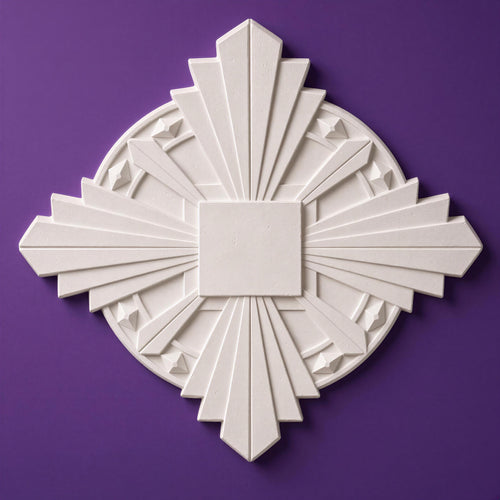
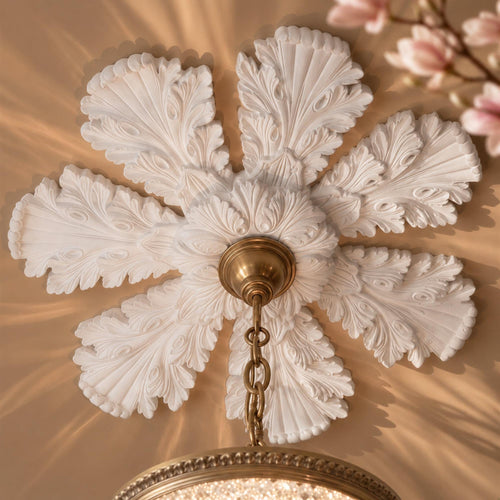
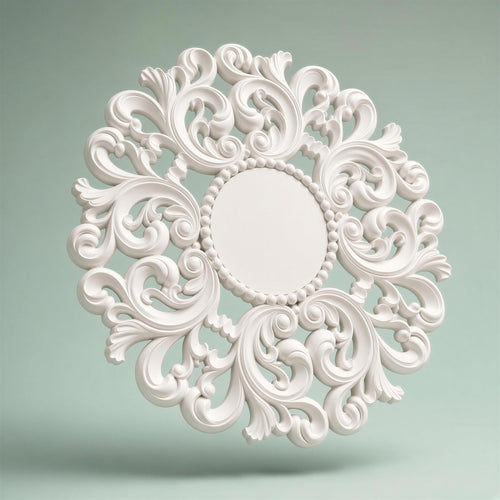
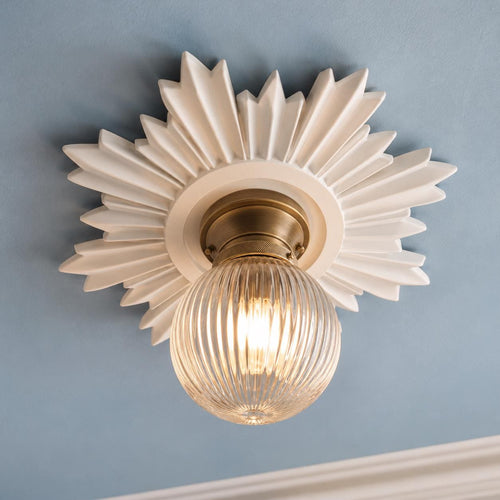
A simple wall light or a plain ceiling rose suits a strong wall colour. Paint it the same colour as the wall for a quiet effect, or in cream for contrast. For wall lights, see how to style a plaster wall light and wall light height and spacing; for painting plaster, see how to paint a plaster ceiling rose. If you are choosing a colour for a ceiling rose against a strong ceiling, ceiling rose paint colours has examples.
Seeing his work
The Luis Barragán House and Studio in Tacubaya, Mexico City, was inscribed on the UNESCO World Heritage List in 2004 under criteria (i) and (ii): a masterpiece of the Modern Movement that also blends modern and traditional Mexican influences. UNESCO gives the built dates as 1947–48.[4] Other accounts say it was built in 1948 (INBAL and JSTOR Daily) or that work ran from 1948 to 1952 (EBSCO), so treat the exact dates as approximate.[7][8][9] Wikipedia records that Barragán moved there in 1948 and lived there until his death in 1988, that the state of Jalisco and the Arquitectura Tapatía Luis Barragán Foundation acquired the house in 1993, and that it opened as a museum in 1994.[5] Visits are by appointment, so check current arrangements before travelling.
Keep reading
- How to style a plaster wall light by room
- Ceiling rose paint colours
- Can you paint a plaster ceiling rose?
- Wabi-sabi and limewash
- Japandi style guide
- Syrie Maugham and white-on-white interiors
Shop the look


Frequently asked questions
Who was Luis Barragán?
A Mexican architect (1902 to 1988) who won the Pritzker Prize in 1980, known for emotional architecture, strong colour on plain plastered walls and the use of natural light.
What is Barragán’s style?
Plain planes of strong colour on plastered walls, rough natural materials, simple geometry and carefully shaped natural light, aimed at serenity.
What colours did Barragán use?
Fuchsia, pink, yellow, blood red, white and dark brownish grey are named in descriptions of his house, though accounts differ and walls have been repainted.
Can I use strong colour on plaster?
Yes. Strong colour works best on a smooth, plain plastered surface with little ornament, in a matt finish. Test large samples first.
Which plaster pieces suit a strong wall colour?
Simple forms, painted the same colour as the wall or in cream.
Where is Casa Barragán?
In Tacubaya, Mexico City. It is a museum and a UNESCO World Heritage Site (inscribed 2004); visits are by appointment.
What is emotional architecture?
Barragán’s term for architecture intended to encourage meditation and quiet. He said buildings that do not express serenity are a mistake.
How does light affect wall colour?
Strongly. The same paint looks deeper in low cool light and warmer in late sun, which is why Barragán designed openings to shape how colour is seen.
Sources
References and further reading
Harvard style. Web pages were checked on the access date shown.
- Wikipedia (2026) Luis Barragán, Wikipedia, The Free Encyclopedia. Available at: en.wikipedia.org/wiki/Luis_Barrag%C3%A1n (Accessed: 27 October 2026).
- Pritzker Architecture Prize (n.d.) Luis Barragán: 1980 laureate, The Pritzker Architecture Prize. Available at: www.pritzkerprize.com/laureates/1980 (Accessed: 27 October 2026).
- Museum of Modern Art (1976) The Architecture of Luis Barragán [press release], MoMA. Available at: www.moma.org/documents/moma_press-release_326999.pdf (Accessed: 27 October 2026).
- UNESCO World Heritage Centre (n.d.) Luis Barragán House and Studio, UNESCO World Heritage List. Available at: whc.unesco.org/en/list/1136 (Accessed: 27 October 2026).
- Wikipedia (2026) Luis Barragán House and Studio, Wikipedia, The Free Encyclopedia. Available at: en.wikipedia.org/wiki/Luis_Barrag%C3%A1n_House_and_Studio (Accessed: 27 October 2026).
- Casa Luis Barragán (n.d.) The house: façade, Casa Luis Barragán. Available at: casaluisbarragan.org/eng/en_lacasa.html (Accessed: 27 October 2026).
- Secretaría de Cultura and Instituto Nacional de Bellas Artes y Literatura (2022) Luis Barragán, arquitecto apasionado de la naturaleza y el color (Boletín núm. 902). Available at: inba.gob.mx/multimedia/prensa/galerias/17019/17019-bol._9... (Accessed: 27 October 2026).
- Garbutt, L. (2018) Casa Luis Barragán: sacred space of Mexican modernism, JSTOR Daily, 19 September. Available at: daily.jstor.org/casa-luis-barragan-sacred-space-of-mexica... (Accessed: 27 October 2026).
- Purdy, E.R. (2016) Luis Barragán House and Studio, EBSCO Research Starters. Available at: www.ebsco.com/research-starters/history/luis-barragan-hou... (Accessed: 27 October 2026).
How to cite this article
Tire, G. (2026) ‘Luis Barragán: What a Mexican Master Teaches Us About Colour and Plaster’, The Flare Journal. Flare Studio UK. Available at: https://flarestudio.uk/blogs/journal/luis-barragan-colour-and-plaster-walls (Accessed: 12 November 2026).
Shop the style



Conversation
Join the conversation
Questions about the history, a room you are planning, or a piece you have seen in the wild? Leave a comment and Joseph will reply.