

Victorian Shrewsbury: The Railway Station, Signal Box and the Buildings That Changed the Town

What Victorian architecture looks like in Shrewsbury
As general background (not cited), the Victorians did not build in one style. They borrowed freely: Tudor for railway stations and schools, Italianate for market halls, Gothic for churches, and bare engineering for pumps and bridges. The sites below illustrate several of these, and together they show a county town building for railways, drains and markets (our reading).
This guide covers five Victorian sites: the railway station, the signal box, the lost Corn Exchange, the Abbey restoration and Coleham Pumping Station. It sits alongside our guides to Shrewsbury’s Tudor timber-framed buildings, Georgian Shrewsbury and the Flaxmill Maltings, which together cover the town’s buildings from the Tudor period to the early 1900s.
The sites at a glance
| Site | Date | Designer or maker | Style or type |
|---|---|---|---|
| Shrewsbury railway station | 1848 (the listing text says 1849); extended 1899-1903[1][2] | Penson of Oswestry (full name differs between sources, see below)[1][2] | Imitation Tudor / “Tudor Gothic”[1][2] |
| Severn Bridge Junction signal box | From 1902 (the listing says 1903)[3][4] | Built jointly by the GWR and LNWR[3] | Enlarged standard LNWR design[3] |
| Corn Exchange and Market (demolished) | Opened 29 September 1869[5] | Robert Griffiths[5] | Italianate[5] |
| Shrewsbury Abbey, east end | Restoration 1886-94[6] | J. L. Pearson[6] | Gothic Revival |
| Coleham Pumping Station | Engines 1897-98; house 1900; opened 1901[7] | Beam engines by Renshaw’s of Stoke-on-Trent[7] | Industrial |
Sources are numbered in the text. Where they differ, as for the date of the station, we say so. The style labels for the Abbey and Coleham are our own classification.
Shrewsbury railway station
The railway station on Castle Foregate opened in 1848 for the county’s first railway, the Shrewsbury to Chester line.[1] The Historic England listing text dates the building to 1849.[2] Wikipedia names the architect as Thomas Mainwaring Penson of Oswestry and describes an imitation Tudor style, with Tudor-style carved heads around the window frames, matching the nearby Tudor building of Shrewsbury School.[1] The listing calls the architect Thomas Penson Junior of Oswestry and the style “Tudor Gothic”, and describes ashlar facing, a four-storey entrance tower with an oriel window and a clock, and mullioned and transomed windows.[2] The station is Grade II listed (first listed 30 May 1969).[2]
It was heavily altered between 1899 and 1903, when the station was rebuilt and extended: a new floor was built underneath the original building, and the platforms were extended over the River Severn.[1] The listing adds that the building was originally two storeys and that a lower ground floor was inserted later to give tunnel access to the platforms.[2] The station was formerly known as Shrewsbury General and was jointly operated by the Great Western Railway and the London and North Western Railway; the Welsh Marches, Wolverhampton, Chester and Cambrian lines meet here.[1]
Wikipedia’s article on the Black-and-white Revival lists “Penson’s Eastgate Street restorations” (1852-58) in Chester among its examples, but gives only the surname, so we do not assume it is the same man.[8] For the real Tudor timber-framing that Victorian architects were imitating, see our guide to timber-framed Shrewsbury.
Severn Bridge Junction signal box
Next to the station is the Severn Bridge Junction signal box. Wikipedia says it was constructed jointly by the Great Western and London and North Western railways from 1902, to an enlarged standard LNWR design of 1876, and that it houses a 180-lever interlocked frame.[3] The listing dates it to 1903, describes a brick building with a glazed timber upper storey, and says it forms a group with the station and Crewe Junction signal box, built as a single improvement scheme for Shrewsbury station.[4] It is Grade II listed (first listed 23 January 1991).[4]
It became the largest mechanical signal box in the world in 2011, when the box at Spencer Street in Melbourne closed. It is still in use, with two signallers working it around the clock and about half of the levers in use, and mechanical signalling is expected to remain here until at least 2030.[3] In plain terms (general background, not cited): a signaller pulls a lever, and a system of rods and wires moves points and signals out on the track, while the interlocking prevents two conflicting routes being set at once.

The lost Corn Exchange and Market Hall
One Victorian building in the town centre is one you can no longer see. The New Corn Exchange and Market opened on 29 September 1869 on the Mardol site.[5] It was designed by Robert Griffiths in an Italianate style, in white, blue and black brick, and cost nearly £70,000.[5] It was 313 feet long and had a 150-foot tower topped by a spire and four clock faces.[5] It was demolished in the early 1960s.[5]
The current Market Hall, designed by David Aberdeen, opened on 16 September 1965 (trading began on 21 November 1964) at a cost of £1 million, and sits on Claremont Street.[5] As general background (not cited), the loss of Victorian buildings in the 1960s changed the look of many English towns.
Shrewsbury Abbey and the Victorian Gothic Revival
The Abbey was founded in 1083 by Roger de Montgomery as a Benedictine monastery and was dissolved in January 1540.[6] The western part, including the nave, survived as a parish church.[6] Around 1836 Telford’s road (now the A5) was driven through the abbey grounds.[6] In 1886-94 the architect J. L. Pearson carried out restoration work that included a redesign of the east end (we class this as Gothic Revival).[6] It is Grade I listed (10 January 1953).[6] The Abbey is also the setting of Ellis Peters’ Cadfael chronicles and has a First World War memorial tablet that includes the name of Wilfred Owen.[6]
Coleham Pumping Station
Not every Victorian landmark is grand. Coleham Pumping Station was built as part of a major upgrade to Shrewsbury’s sewerage system at the end of the 19th century.[7] Its two steam beam engines were made by Renshaw’s of Stoke-on-Trent in 1897-98, the brick engine house was finished in 1900, and it was opened in 1901 by the mayoress of Shrewsbury.[7] Steam pumps ran until 1970, when electric pumps replaced them.[7] The borough council took it over in 1974 and it is now a museum run by Shropshire Museums.[7] The Shrewsbury Steam Trust, founded in 1992, restored the engines and the two coal-fired Cornish boilers, and the engines run together on several open days each year.[7] Check the current dates before visiting.
A Victorian walk
The Victorian sites are spread out, so plan a route rather than a loop. Start at the station and signal box on Castle Foregate, then walk into the centre to Mardol, where the Corn Exchange stood, and on to the Abbey across the English Bridge. Coleham Pumping Station is across the river and is best visited on one of its steam days; check the dates first. Most of these are working places or museums, so treat opening times as something to confirm in advance. The route is our suggestion, not an official trail.
Real Tudor or Tudor Revival? How to tell
Because the Victorians loved Tudor details, a timber-framed or gabled building in Shrewsbury is not always Tudor. Some general pointers (background, not cited): Victorian copies are often more regular and symmetrical, use machine-made brick and sawn timber, and add decoration in a repeated pattern, while genuine Tudor frames are usually irregular, lean slightly and show the marks of hand tools. Historic England listing text is the most reliable way to check a particular building, since it states the date and notes later alterations. The station is a good test case: it looks Tudor but opened in 1848.[1]
Terms used in this article
| Term | Meaning |
|---|---|
| Tudor Revival | A 19th-century style that copied Tudor buildings |
| Italianate | A style copying Italian Renaissance buildings: round-arched windows, towers, coloured brick |
| Gothic Revival | A 19th-century revival of medieval Gothic: pointed arches, tracery |
| Interlocking | A mechanism that prevents conflicting signals and points being set at the same time |
| Beam engine | A steam engine with a large rocking beam at the top, used for pumping |
| Cornish boiler | A type of steam boiler with a single large flue tube, used to power engines |
| Mechanical signal box | A signal box in which levers move points and signals through rods and wires |
Common misunderstandings
- “The station is Tudor.” It is Victorian (1848), designed in an imitation Tudor style.[1]
- “Mechanical signalling is obsolete.” It is rare, but the Severn Bridge Junction box is still operational, and mechanical signalling is expected to remain there until at least 2030.[3]
- “Victorian buildings are all dark and Gothic.” The 1869 Corn Exchange was Italianate and built in white, blue and black brick.[5]
How to recognise Victorian styles
| Style | Clues | Shrewsbury example |
|---|---|---|
| Tudor Revival | Gables, mullioned windows, carved heads, chimneys | The railway station |
| Italianate | Round-arched windows, towers, coloured brick | The lost Corn Exchange |
| Gothic Revival | Pointed arches, tracery, steep roofs | The Abbey east end |
| Industrial | Exposed brick, engines and boilers, big windows | Coleham Pumping Station |
The style clues in the table are general background and are not cited. Our guide to identifying the period of a house from its plasterwork applies the same eye to interiors.
Victorian interiors and plaster at home
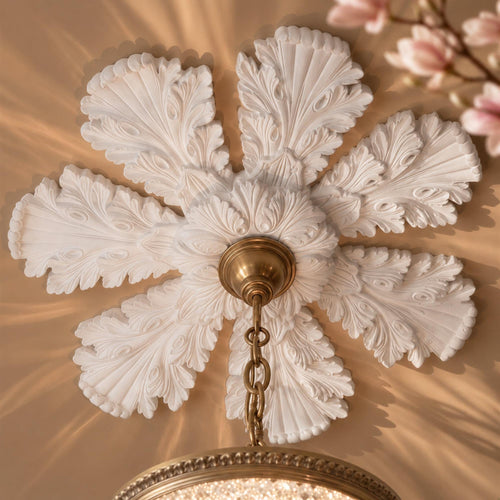
As general background (not cited), Victorian houses often added decoration inside: deep cornices, big ceiling roses, picture rails and decorated doorways. If you live in a Victorian house, our guide to Georgian, Victorian and Edwardian ceiling roses and cornice explains what to look for, and which ceiling rose suits your home gives sizes. A handmade Flare plaster ceiling rose and an overdoor pediment are simple ways to add period detail without a tradesperson.
Keep reading
- Brother Cadfael's Shrewsbury: the Abbey and the medieval town
- Shrewsbury timber-framed buildings
- Georgian Shrewsbury
- Shrewsbury Flaxmill Maltings
- Georgian, Victorian and Edwardian ceiling roses and cornice
- Identify the period of your house from its plasterwork
Shop the look


Frequently asked questions
When did Shrewsbury railway station open?
It opened in 1848 according to Wikipedia; the Historic England listing text dates the building to 1849. It is in an imitation Tudor style and was rebuilt and extended between 1899 and 1903.
Who designed Shrewsbury railway station?
Penson of Oswestry: Wikipedia names him Thomas Mainwaring Penson and the Historic England listing calls him Thomas Penson Junior. Wikipedia describes an imitation Tudor style with carved heads around the windows; the listing calls it Tudor Gothic.
What is special about the Severn Bridge Junction signal box?
It is the largest surviving mechanical signal box in the world, with a 180-lever frame. It was built jointly by the GWR and LNWR from 1902, is Grade II listed and is still in use.
What happened to Shrewsbury's Victorian Corn Exchange?
The Corn Exchange and Market, designed by Robert Griffiths and opened on 29 September 1869, was demolished in the early 1960s. The current Market Hall, designed by David Aberdeen, opened in 1965.
Who restored Shrewsbury Abbey in the Victorian period?
The architect J. L. Pearson carried out restoration work in 1886-94, including a redesign of the east end.
Can you visit Coleham Pumping Station?
Yes, it is a museum run by Shropshire Museums, and its steam engines are run on several open days each year. Check current dates before travelling.
Is Shrewsbury railway station listed?
Yes. The main building on Castle Foregate is Grade II listed, first listed on 30 May 1969.
What is Tudor Revival architecture?
A Victorian style that imitated Tudor buildings, with gables, mullioned windows and chimneys. Shrewsbury railway station is an example.
Sources
References and further reading
Harvard style. Web pages were checked on the access date shown.
- Wikipedia contributors (n.d.) 'Shrewsbury railway station', Wikipedia, The Free Encyclopedia. Available at: en.wikipedia.org/wiki/Shrewsbury_railway_station (Accessed: 27 October 2026).
- Historic England (n.d.) 'Shrewsbury Station, Shrewsbury (Grade II listing)', British Listed Buildings (reproducing the Historic England listing text). Available at: britishlistedbuildings.co.uk/101246546-shrewsbury-station... (Accessed: 27 October 2026).
- Wikipedia contributors (n.d.) 'Severn Bridge Junction signal box', Wikipedia, The Free Encyclopedia. Available at: en.wikipedia.org/wiki/Severn_Bridge_Junction_signal_box (Accessed: 27 October 2026).
- Historic England (n.d.) 'Severn Bridge Junction Signal Box at SJ 496 126, Shrewsbury (Grade II listing)', British Listed Buildings (reproducing the Historic England listing text). Available at: britishlistedbuildings.co.uk/101271480-severn-bridge-junc... (Accessed: 27 October 2026).
- Wikipedia contributors (n.d.) 'Shrewsbury Market Hall', Wikipedia, The Free Encyclopedia. Available at: en.wikipedia.org/wiki/Shrewsbury_Market_Hall (Accessed: 27 October 2026).
- Wikipedia contributors (n.d.) 'Shrewsbury Abbey', Wikipedia, The Free Encyclopedia. Available at: en.wikipedia.org/wiki/Shrewsbury_Abbey (Accessed: 27 October 2026).
- Wikipedia contributors (n.d.) 'Coleham Pumping Station', Wikipedia, The Free Encyclopedia. Available at: en.wikipedia.org/wiki/Coleham_Pumping_Station (Accessed: 27 October 2026).
- Wikipedia contributors (n.d.) 'Black-and-white Revival architecture', Wikipedia, The Free Encyclopedia. Available at: en.wikipedia.org/wiki/Black-and-white_Revival_architecture (Accessed: 27 October 2026).
How to cite this article
Tire, G. (2026) ‘Victorian Shrewsbury: The Railway Station, Signal Box and the Buildings That Changed the Town’, The Flare Journal. Flare Studio UK. Available at: https://flarestudio.uk/blogs/journal/victorian-shrewsbury-railway-station-landmarks (Accessed: 12 November 2026).
Shop the style






Conversation
Join the conversation
Questions about the history, a room you are planning, or a piece you have seen in the wild? Leave a comment and Joseph will reply.