

Art Deco Ceiling Roses: Geometric, Sunburst and Stepped Designs


What defines the style
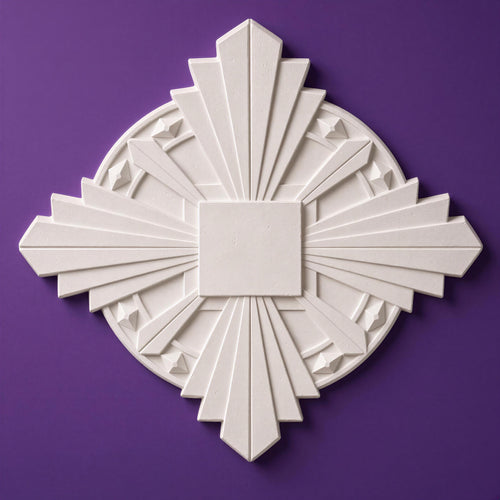
Where Victorian ornament is naturalistic, Art Deco is geometric and stylised: repeated lines, stepped edges and symmetrical patterns. Britannica describes Art Deco as a movement that originated in the 1920s and took its name from the 1925 Paris exposition, with geometric or stylised ornament, sun rays among its conventionalised motifs, and a taste for simplicity, symmetry and repetition.[1] The V&A calls that exhibition a pivotal event in the style's development, and notes that British contributions were dismissed by critics as "conservative".[2] The National Trust, by contrast, dates the start of sleek Art Deco styles to just before the First World War,[3] so dates differ by source. Plaster was part of the wider interwar toolkit: Historic England notes that much cinema decoration of the period was fibrous plaster.[4] For background read what is Art Deco, the Art Deco motifs glossary and Art Deco ceilings and plasterwork.
Choosing a pattern
| Design | Look | Suits |
|---|---|---|
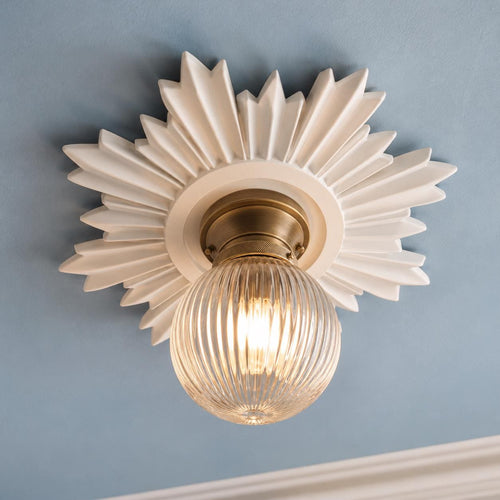
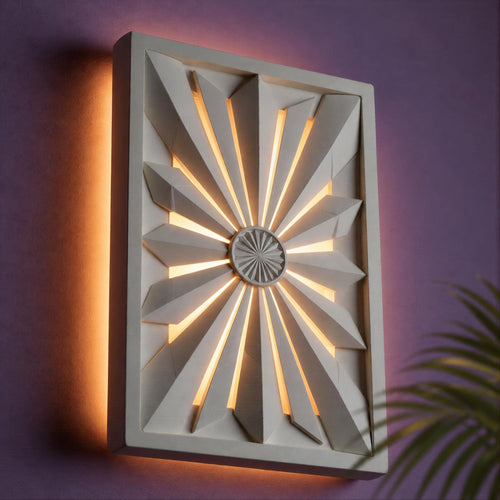
| Sunburst | Radiating lines from the centre | Hallways, bedrooms, dining rooms |
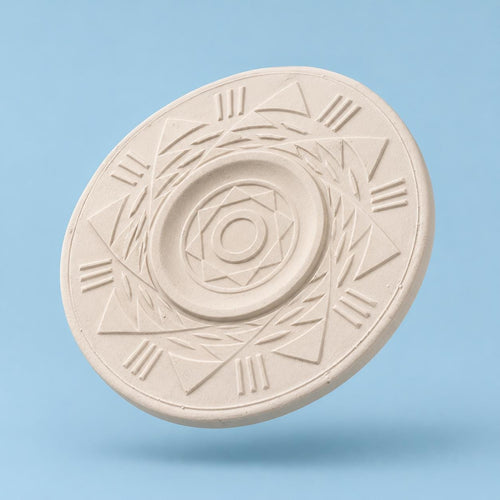
| Stepped geometric | Layered, architectural rings | Living rooms, modern flats |
| Fan or shell | Soft geometric curves | Bedrooms, bathrooms |

Painting
Matt white or a soft colour lets the geometry read as shadow. A dry-brushed gold or bronze on the raised edges gives a period touch (our suggestion; the V&A notes that chromed steel, aluminium, mirror and coloured glass became favoured materials of the 1930s, which is the logic of a metallic accent).[2] For a period-accurate ceiling, the Victorian Society notes that distemper, a matt finish, was widely used on plaster ceilings and that "Brilliant White" was not available until after the Second World War; its advice for Victorian and Edwardian houses is an off-white or cream, and we would apply the same logic to a 1930s room.[5] See ceiling rose paint colours.
In a modern home
Because the style is geometric, Art Deco roses sit comfortably in modern rooms, as covered in ceiling roses in a modern home.

Restoring a 1930s house
Not every 1930s house was Art Deco: Historic England notes that suburban architecture also fell under the spell of neo-Georgian and neo-Tudor styles, and that speculative estates sometimes skimped on materials.[6] In the best inter-war and later houses, Historic England says, internal finishes and built-in fittings are often of high quality, and candidates for listing should survive reasonably intact, so check whether your house is listed before altering original plaster.[7] The Twentieth Century Society's note on a 1934 building for Sir Stewart Duke-Elder, listed Grade II in 2009, describes Art Deco features in both the exterior and interior design and surviving custom fittings that were relatively rare for the type, style and age.[8] National Trust houses with Art Deco decoration include Coleton Fishacre in Devon, designed in the 1920s, and Upton House in Warwickshire, remodelled in 1927 to 1929.[9] Read restoring an Art Deco home for the wider picture.
Shop the look


Frequently asked questions
What is an Art Deco ceiling rose?
A ceiling ornament with geometric forms such as sunbursts, stepped rings or fans.
Which rooms suit Art Deco roses?
Hallways, living rooms, bedrooms and dining rooms in 1920s and 1930s homes, and modern rooms too.
Can I paint an Art Deco rose gold?
Yes, using metallic paint or wax on the raised detail over a base colour. This is our suggestion rather than a documented period practice.
What size should I choose?
Use the sizing guide and consider ceiling height.
Sources
References and further reading
Harvard style. Web pages were checked on the access date shown.
- Encyclopaedia Britannica (no date) Art Deco. Available at: www.britannica.com/art/Art-Deco (Accessed: 27 October 2026).
- Victoria and Albert Museum (no date) Art Deco in the home. London: V&A. Available at: www.vam.ac.uk/articles/art-deco-in-the-home (Accessed: 27 October 2026).
- National Trust (no date) Architecture through the ages. Available at: www.nationaltrust.org.uk/discover/history/architecture/hi... (Accessed: 27 October 2026).
- Historic England (2019) Historic Fibrous Plaster in the UK: Guidance on its Care and Management. Swindon: Historic England. Available at: cadw.gov.wales/sites/default/files/2019-07/Historic%20Fib... (Accessed: 27 October 2026).
- The Victorian Society (no date) Victorian and Edwardian paint colours and finishes. Available at: www.victoriansociety.org.uk/advice/paint-colours-and-fini... (Accessed: 27 October 2026).
- Historic England (no date) Listing Selection Guide: Domestic 3: Suburban and Country Houses. Available at: historicengland.org.uk/images-books/publications/dlsg-sub... (Accessed: 27 October 2026).
- Historic England (no date) Listing Selection Guide: Domestic 4: Modern Houses and Housing. Available at: historicengland.org.uk/images-books/publications/dlsg-mod... (Accessed: 27 October 2026).
- Twentieth Century Society (2009) Remarkable 1930s survival listed at Grade II. Available at: c20society.org.uk/news/remarkable-1930s-survival-listed-a... (Accessed: 27 October 2026).
- National Trust (no date) Interior design through the ages. Available at: www.nationaltrust.org.uk/discover/history/architecture/in... (Accessed: 27 October 2026).
How to cite this article
Tire, G. (2026) ‘Art Deco Ceiling Roses: Geometric, Sunburst and Stepped Designs’, The Flare Journal. Flare Studio UK. Available at: https://flarestudio.uk/blogs/journal/art-deco-ceiling-roses-and-plasterwork (Accessed: 12 November 2026).
Shop the style






Conversation
Join the conversation
Questions about the history, a room you are planning, or a piece you have seen in the wild? Leave a comment and Joseph will reply.