Art Deco motifs: a visual glossary of sunbursts, chevrons and ziggurats


Art Deco has a small, recognisable vocabulary. Sunbursts and fans, chevrons and zigzags, stepped ziggurats and skyscraper setbacks, speed lines, frozen fountains, stylised flowers and baskets, shells, roundels, leaping deer and the Egyptian lotus: learn these twelve shapes and you can date a shopfront, a fireplace or a ceiling rose at a glance.
This glossary takes each motif in turn: what it looks like, where it came from, and where you can see it in Britain. It finishes with four real buildings, annotated, where several motifs appear together. For the bigger picture of the style itself, start with our guide What is Art Deco?
Where the motifs came from
The V&A describes Art Deco as a style that borrowed widely: from historic European movements and folk art, from the avant garde, from the arts of Africa and East Asia, from the Russian ballets and from the urban imagery of the machine age. Designers lumped Fauvism, Cubism, Futurism and Constructivism together as "Cubism" and used them to capture the dynamism of the modern world. Art Nouveau's plant forms were not thrown out. They were tidied up and stylised.
Archaeology added more. The excavation of Tutankhamun's tomb in 1922 triggered a wave of Egyptian imagery, and discoveries in the early 1920s also fed a fascination with Mesoamerica. In New York, the 1916 Zoning Resolution required tall buildings to step back as they rose, and the Skyscraper Museum describes the resulting stepped massing as a ziggurat. The 1925 Paris exhibition then gave the whole mix a stage: our article on Paris 1925 tells that story.
British and American critics had their own names for the look, including "Zigzag Moderne" and "Jazz Moderne". The term Art Deco itself was only coined in the 1960s. Later, the sharper motifs were joined by the curves of Streamline Moderne, which is why a glossary like this mixes rays and zigzags with horizontal bands and rounded corners.
The motifs at a glance
The card below shows all twelve motifs as simple line drawings. Use it as a key: each one is described in more detail in the sections that follow, with a source for where it came from and a British example where we could find one.
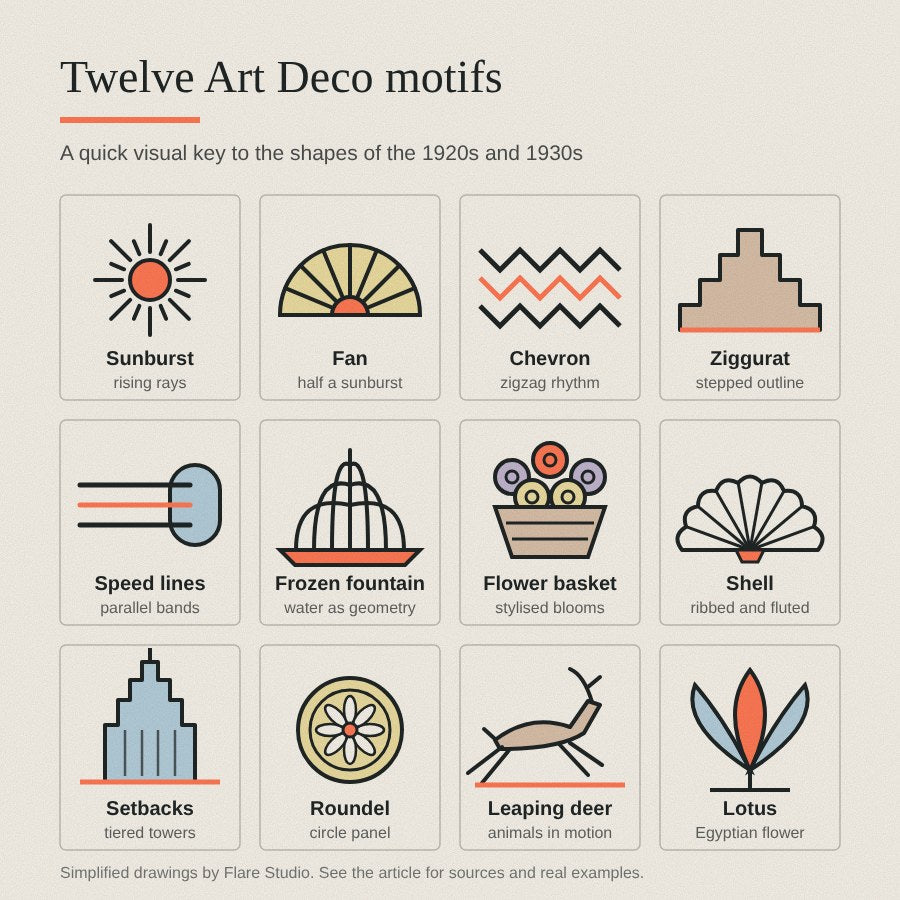
Rays and steps: sunburst, fan, chevron, ziggurat and setbacks
- Sunburst. Straight rays spreading from a centre, sometimes from a full circle, often from a half circle rising off a base line. It turned up everywhere in Britain, from shopfronts to floor mats: the V&A holds 1937 designs for coir doormats with sunbursts, made for the London firm Stavers & Anderson for manufacture in India. On Kew Road in Richmond, Matthiae's bakery still has a leaded sunburst panel in blue, clear and frosted glass.
- Fan. Half a sunburst, with the rays pleated like a folding fan. It suits anything with a flat edge: a fanlight over a door, a wall light, the top of a mirror. Historic England's listing for Matthiae's records entrance doors with etched glazing in a fan design.
- Chevron and zigzag. Repeated V shapes, stacked or running in a band. They gave the style its period nickname of Zigzag Moderne. The V&A has a woven furnishing fabric called 'Chevron', made by Ruth Vaughan Lodge in Britain around 1925, with a broad chevron-striped band.
- Ziggurat and stepped forms. An outline that steps in, layer by layer, to a flat top. It echoes the stepped skyscraper, described under setbacks below. In a house it appears as a stepped fire surround, mirror or cornice. In a street, look for stepped window heads and fascias, like the shop front in Walsall annotated below.
- Setbacks. The ziggurat at the scale of a whole building. New York's 1916 rules made towers step back above a set height to keep light and air on the street. In London, Historic England describes the Daily Express Building on Fleet Street as four main storeys plus three stepped back.
Movement and water: speed lines, frozen fountain and shell
- Speed lines. Three or more parallel bands, often ending in a rounded corner. The Wolfsonian museum explains that horizontal bands and curved forms were used to convey speed. They are the signature of the later, streamlined phase that the French called style paquebot, after the ocean liner. The Midland Hotel in Morecambe, built in 1933, is one of the best-known British examples.
- Frozen fountain. A central jet with arcs of water falling either side, drawn as stiff, stepped lines, as if the water had set solid. The Wolfsonian says the motif was introduced at the 1925 Paris exposition. René Lalique did much to popularise it: his fountain for that exhibition had a 15-metre pyramidal element of 17 octagonal stages carrying 128 figures, according to the Musée Lalique.
- Geometric shell. A scallop reduced to a fan of straight ribs with a scalloped edge. Water and the sea were never far away: the 128 figures on Lalique's fountain were associated with fish, shells, water lilies and reeds. The shell also bridges Art Deco and the classical tradition, which our article on the scallop shell in design explores.
Nature, stylised: flowers, baskets, deer, lotus and roundels
- Stylised flowers and baskets. Flowers flattened into discs, spirals and petals, often spilling from a basket, urn or vase. The V&A cites the stylised fabrics of Atelier Martine in Paris from 1919, and around 1916 Jacques-Émile Ruhlmann inlaid a corner cabinet with stylised flowers cascading from an urn, now in the Art Institute of Chicago. The V&A notes that stylised baskets of flowers were popular motifs for brooches during the 1920s, and Pierre Turin's official medal for the 1925 exhibition shows a figure holding a basket of flowers.
- Leaping deer and stags. Animals at full stretch, all legs and curved horns. Robert Bonfils' poster for the 1925 exhibition shows a woman carrying a basket of flowers, with a black leaping stag beside her. In Britain, John Skeaping designed a group of axis deer in full chase for Wedgwood in 1927, one of fourteen animal models. The V&A calls it very early for an Art Deco object in Great Britain. By 1931 leaping deer were printed on British furnishing linen by W. Foxton.
- Egyptian lotus. A fan of upright petals on a straight stem, often in a repeating band. The V&A lists lotus flowers alongside scarabs, hieroglyphics, pylons and pyramids among the Egyptian motifs that followed 1922. In London, look at the Carreras cigarette factory at Mornington Crescent, built in 1926 to 1928, with Egyptian-style capitals and two bronze statues of the cat goddess Bastet. Our article on Egyptomania covers it in detail.
- Roundels. A circle used as a frame: a medallion, a rosette, a carved disc set into a wall or ceiling. At Carreras, reliefs of Bastet's face sit in circular recesses. At the Midland Hotel, a round ceiling panel carved by Eric Gill crowns the staircase. The ceiling rose is the domestic version, which is why it fits an Art Deco room so naturally.
Art Deco motifs in British buildings, annotated
Motifs rarely appear alone. Here are four real British examples, from a suburban bakery to a hotel staircase, each numbered with the motifs worth spotting. Where the photo has useful colours, the swatches are sampled from the photograph itself, so treat them as a guide rather than a paint match.
1. Sunburst, fan and steps on a Richmond shopfront
Matthiae's Café and Bakery on Kew Road, Richmond, is a row of late Victorian houses heavily remodelled in the late 1930s. Historic England lists it at Grade II and calls it a rare surviving Art Deco shop frontage, in a deep blue, white and silver scheme.

- Stepped fascia: the listing describes white Vitrolite with a blue top border
- Leaded sunburst glazing in blue, clear and frosted glass
- Serif lettering set into the sunburst panel: Pastry cooks, Maids of Honour, Confectioners
- Entrance doors with etched glazing in a fan design
- Fluted band between the upper floors
- Canopy with chrome fluting over the café entrance
- A second sunburst panel over the Catering Department window
- Metal-framed leaded casement windows
Colours in this photo:
Fascia blue #1043A3Cream render #D9D5CA
Take from it: Three motifs, one colour scheme. The sunburst, the fan and the step all repeat across the front, and the blue and white hold them together.
2. Chevrons and ziggurats on a high street
An interwar front on Park Street, Walsall, now shared by a bank and a discount shop. The photographer dates it to Walsall's Jazz Age and notes that it was apparently a Woolworths. It is a good example of how much of the glossary could fit on one ordinary shop.

- Stepped, ziggurat-shaped head to the central window
- Raised central bay with a reeded parapet
- Chevron panels under the windows
- Small roundel, carved as a rosette
- Sawtooth band, a zigzag in relief
- Stylised capitals at the top of the piers
- Diagonal incised lines along the parapet
- Reeded strips running up the central bay
Colours in this photo:
Taupe #AE9880Faience white #FFF7E6
Take from it: Look at the panels, not just the outline. Chevrons and roundels at this scale translate well to a fire surround, a frieze or a switch plate.
3. Rays, flowers and shells in a Fleet Street lobby
The former Daily Express Building at 120 Fleet Street, London, built in 1932 and listed Grade II*. Robert Atkinson designed the lobby, and the British sculptor Eric Aumonier made its two plaster reliefs, titled Britain and Empire. This is one of them.

- Gold rays spreading behind the central figure: a sunburst
- Central figure in a stepped, pleated robe
- Stylised flowers, simplified to discs of petals
- Fluted, scalloped bowl light at the base
- Fan-shaped pleats at the hem
- Deep gilded frame, stepped in several layers
- Gear wheel: the machine age in relief
- Modern industry and flight on the right-hand side
- Stepped ceiling recess above the panel
Colours in this photo:
Gold #DCCAB2Silver #BAB5BC
Take from it: Gold rays on a darker ground are the sunburst at its grandest. At home, a single gilded or pale ceiling rose against a deep ceiling colour does the same job.
4. A roundel on a ceiling in Morecambe
The Midland Hotel in Morecambe, built in 1932 to 1933 by Oliver Hill and listed Grade II*. Its cantilevered circular staircase rises beneath a ceiling panel carved in low relief by Eric Gill and painted by Denis Tegetmeier. Looking straight up, the whole stair becomes a set of rings around one roundel.

- Eric Gill's round ceiling panel, with lettering around its edge
- Cantilevered circular staircase
- Horizontal rails following the curve, like speed lines
- Red handrail picking out each turn
- Wall lights set into the stairwell
- Concentric rings framing the roundel
- Smooth, plain plaster walls and soffits
Take from it: A roundel works best with space around it. One decorated circle on a plain ceiling is exactly what a good ceiling rose does.
Motifs around the house: a quick key
The glossary above follows each motif through buildings. This table turns it round: where each one tends to work in an ordinary house, based on the places the examples above use them, and a piece from our range that carries it.
| Motif | Where it sits best in a home | A plaster piece to try |
|---|---|---|
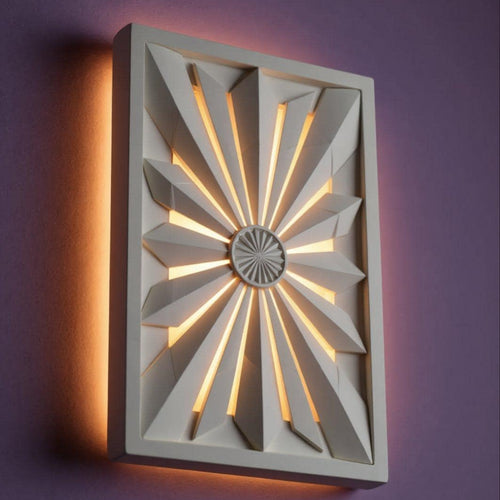
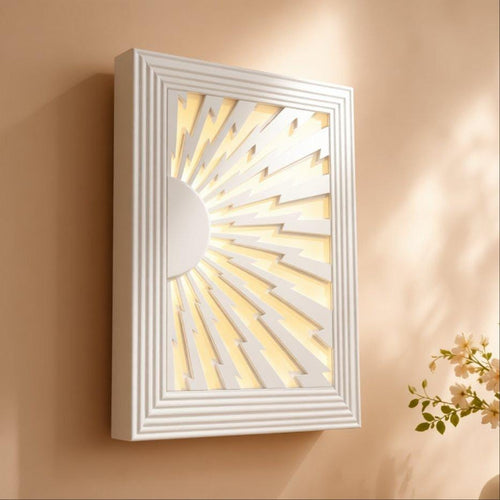
| Sunburst | The centre of a ceiling, above a bed or a fireplace, a garden gate | Sunburst Ceiling Rose, Neo Deco Sunburst Wall Light |
| Fan | Anywhere with a flat edge: over a door, the base of a wall light, the top of a mirror | Fan Wall Light, Neo-Deco Wall Light |
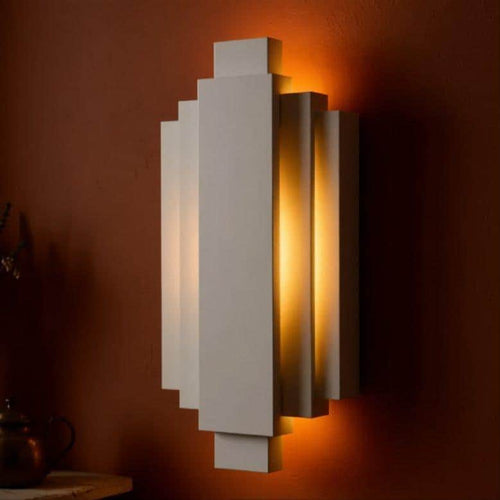
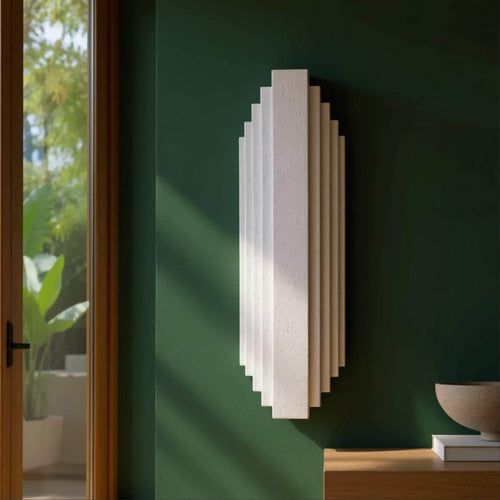
| Ziggurat and steps | Fire surrounds, overdoors, mirror frames, wall lights | Stepped Geometric Wall Light, Aurora Ceiling Rose |
| Shell | Bathrooms, alcoves and wall lights in pairs | Scallop Wall Light |
| Roundel | A plain ceiling with space around it, or a single panel on a wall | Cosmos Ceiling Rose, Pluto Ceiling Rose |
| Chevron and zigzag | Tiles, friezes, rugs and fabrics rather than solid pieces | Pair a plain plaster piece with a chevron textile |
Three rules of thumb. Pick the motif that matches the shape of the place: rays and roundels for a centre point, fans for a flat edge, steps for a frame. Keep to one or two motifs per room, repeated. And let the scale follow the room: a small rose or a single pair of wall lights is often enough in a 1930s semi, where the original detail was usually modest.
How to bring the motifs home
- Choose one lead motif. A sunburst, a fan or a step. Repeat it two or three times in a room rather than mixing all twelve.
- Look up first. A sunburst or roundel ceiling rose, such as our Pluto Ceiling Rose, sets the period on its own. Our guide to choosing the right size of ceiling rose explains how to measure, and our article on Art Deco ceilings shows what sat around it.
- Use fans where there is a flat edge. Over a door, at the base of a wall light, at the top of a mirror. Our sunburst ceiling roses and fan-shaped pieces, such as the Fan Wall Light, draw directly on these motifs.
- Let colour follow the motif. Gold or cream rays on a deep ground, as in the Fleet Street lobby, or blue and white, as at Matthiae's.
- Keep the background plain. The Midland Hotel staircase is mostly smooth plaster. That is what makes the roundel sing.
Common mistakes to avoid
- Confusing Deco with Nouveau. Whiplash curves and naturalistic lilies belong to Art Nouveau. Deco flowers are flatter and more geometric. See Art Deco vs Art Nouveau.
- Using every motif at once. The buildings above use three or four motifs each, and they repeat them.
- Ignoring symmetry. Almost every example here is balanced around a centre line. A sunburst set off-centre looks like a mistake.
- Removing original detail. If you have a 1930s sunburst gate, leaded fanlight or stepped fire surround, repair it before you replace it. For listed buildings, take specialist advice first.
Shop the look
Sunbursts, roundels, fans and steps from the glossary, hand-cast in plaster.


Art Deco motifs in plaster
Sunbursts, fans, steps and roundels were made for plaster: crisp edges catch the light, and a pale surface shows the shadows. Browse our ceiling roses for sunburst and stepped designs, or see our guide to Art Deco buildings to visit in Britain for more real examples. Every piece in our Art Deco collection is designed and hand-cast in Shrewsbury, and arrives as natural plaster ready to leave raw or paint to suit your room.
Good to know
Common questions
What are the main Art Deco motifs?
The most common are the sunburst and fan, chevrons and zigzags, ziggurats and stepped setbacks, speed lines, the frozen fountain, stylised flowers and baskets, geometric shells, roundels, leaping deer and Egyptian motifs such as the lotus. Most are drawn with straight lines and arranged symmetrically.
Where did Art Deco motifs come from?
From many places at once: Cubism and the avant garde, the Russian ballets, the machine age, Art Nouveau plant forms simplified into geometry, and archaeology, especially the excavation of Tutankhamun's tomb in 1922 and interest in Mesoamerica. New York's stepped skyscrapers added the setback.
Where can I see Art Deco motifs in Britain?
Look at 1930s shopfronts, cinemas and front doors. Good examples include Matthiae's bakery in Richmond, the lobby of the former Daily Express Building on Fleet Street, the Midland Hotel in Morecambe and the former Carreras factory at Mornington Crescent.
Sources
References and further reading
Harvard style. Web pages were checked on the access date shown.
- Anderson, M. (2013) Staircase and Ceiling Art, Midland Hotel [Photograph]. Geograph, via Wikimedia Commons. CC BY-SA 2.0. Available at: commons.wikimedia.org/wiki/File:Staircase_and_Ceiling_Art... (Accessed: 13 October 2026).
- Art Institute of Chicago (n.d.) Corner Cabinet, Jacques-Émile Ruhlmann. Available at: www.artic.edu/artworks/148412/corner-cabinet (Accessed: 13 October 2026).
- Cadman, S. (2007) Lobby, (former) Daily Express Building [Photograph]. Wikimedia Commons. CC BY-SA 2.0. Available at: commons.wikimedia.org/wiki/File:Lobby,_(former)_Daily_Exp... (Accessed: 13 October 2026).
- Francis Frith (n.d.) Art Deco architecture in Britain. Available at: www.francisfrith.com/blog/art-deco-architecture-in-britain (Accessed: 13 October 2026).
- Henryrothery (2022) London Borough of Richmond upon Thames, Matthiae's Cafe And Bakery [Photograph]. Wikimedia Commons. CC BY-SA 4.0. Available at: commons.wikimedia.org/wiki/File:London_Borough_of_Richmon... (Accessed: 13 October 2026).
- Historic England (n.d.) Matthiae's Cafe and Bakery, List Entry 1391660. Available at: historicengland.org.uk/listing/the-list/list-entry/1391660 (Accessed: 13 October 2026).
- Historic England (n.d.) Midland Hotel, Morecambe, List Entry 1208988. Available at: historicengland.org.uk/listing/the-list/list-entry/1208988 (Accessed: 13 October 2026).
- Historic England (n.d.) The Daily Express Building, List Entry 1064659. Available at: historicengland.org.uk/listing/the-list/list-entry/1064659 (Accessed: 13 October 2026).
- Jio Institute (n.d.) Frozen Fountain motif, Court View. Art Deco Ensembles of Mumbai. Available at: exhibits.jioinstitute.edu.in/spotlight/art-deco-ensembles... (Accessed: 13 October 2026).
- Modernist Britain (n.d.) Arcadia Works, London. Available at: www.modernistbritain.co.uk/post/building/Arcadia+Works/ (Accessed: 13 October 2026).
- Modernist Britain (n.d.) Daily Express Building, London. Available at: www.modernistbritain.co.uk/post/building/Daily+Express+Bu... (Accessed: 13 October 2026).
- Musée Lalique (2025) Statuettes Sources de France. Available at: www.musee-lalique.com/en/discover/temporary-exhibitions/2... (Accessed: 13 October 2026).
- Paxton, A.J. (2026) Art deco front on Park Street, Walsall [Photograph]. Geograph, via Wikimedia Commons. CC BY-SA 2.0. Available at: commons.wikimedia.org/wiki/File:Art_deco_front_on_Park_St... (Accessed: 13 October 2026).
- Paxton, A.J. (2026) Art deco front on Park Street, Walsall [Photograph]. Geograph. Available at: www.geograph.org.uk/photo/8309168 (Accessed: 13 October 2026).
- Skyscraper Museum (n.d.) Skyline: the 1916 Zoning Resolution. Available at: skyscraper.org/skyline/?p=193 (Accessed: 13 October 2026).
- The Wolfsonian, Florida International University (n.d.) Miami Beach Deco Walk. Available at: wolfsonian.org/_assets/docs/miami-beach-deco-walk.pdf (Accessed: 13 October 2026).
- Victoria and Albert Museum (n.d.) An introduction to Art Deco. Available at: www.vam.ac.uk/articles/an-introduction-to-art-deco (Accessed: 13 October 2026).
- Victoria and Albert Museum (n.d.) Brooch, France, about 1925. Available at: collections.vam.ac.uk/item/O153322/ (Accessed: 13 October 2026).
- Victoria and Albert Museum (n.d.) Doormat design, Stavers & Anderson Ltd, 1937. Available at: collections.vam.ac.uk/item/O1264129/ (Accessed: 13 October 2026).
- Victoria and Albert Museum (n.d.) Figure group, axis deer, John Skeaping for Wedgwood. Available at: collections.vam.ac.uk/item/O22889/ (Accessed: 13 October 2026).
- Victoria and Albert Museum (n.d.) Furnishing fabric 'Chevron', Ruth Vaughan Lodge. Available at: collections.vam.ac.uk/item/O258348/ (Accessed: 13 October 2026).
- Victoria and Albert Museum (n.d.) Furnishing fabric, F. Gregory Brown for W. Foxton Ltd. Available at: collections.vam.ac.uk/item/O68414/ (Accessed: 13 October 2026).
- Victoria and Albert Museum (n.d.) Medal, Pierre Turin, 1925. Available at: collections.vam.ac.uk/item/O102799/ (Accessed: 13 October 2026).
- Victoria and Albert Museum (n.d.) Poster, Paris 1925 Exposition Internationale des Arts Décoratifs, Robert Bonfils. Available at: collections.vam.ac.uk/item/O175840/ (Accessed: 13 October 2026).
How to cite this article
van Locke, J. (2026) ‘Art Deco motifs: a visual glossary of sunbursts, chevrons and ziggurats’, The Flare Journal. Flare Studio UK. Available at: https://flarestudio.uk/blogs/journal/art-deco-motifs-glossary (Accessed: 17 October 2026).
Shop the style