Egyptomania: how Tutankhamun's tomb shaped Art Deco


Egyptomania was the craze for ancient Egyptian design that followed the discovery of Tutankhamun's tomb in November 1922. Within a few years, scarabs, papyrus columns, sun discs and bright faience colours were turning up on jewellery, clothes, cinemas and factories, and they became one of the ingredients of Art Deco.
In Britain the craze left some of the most cheerful buildings of the period. The Carreras cigarette factory at Mornington Crescent wears painted papyrus columns and a pair of black cats, the Hoover Building in Perivale has an entrance in what Historic England calls an Egyptian Art Deco manner, and suburban cinemas such as the Capitol in Forest Hill dressed up in blue and gold.
The discovery that started it
Howard Carter had been digging in the Valley of the Kings since 1917 with little to show, and in 1922 he persuaded the 5th Earl of Carnarvon to fund one more season. On 4 November 1922 Egyptian workers on his team uncovered a step, the top of a staircase cut into the rock. The next day Carter noted in his pocket diary that he had found a tomb with its seals intact. The diary is now held by the Griffith Institute in Oxford, which keeps Carter's full excavation records.
On 26 November Carter and Carnarvon looked inside for the first time. Asked whether he could see anything, Carter later wrote that he answered "Yes, wonderful things", although his journal records a plainer reply. It proved to be the only intact royal burial found in the Valley of the Kings. Clearing and recording it took ten years, and Carter recorded more than 5,000 objects. The photographer Harry Burton made over 3,000 images of the work, and in October 1925 the gold mask was photographed in place on the king's mummy.
The press frenzy was immediate. In early 1923 Carnarvon gave The Times exclusive rights to stories and photographs, which other papers resented. Early reports credited Carnarvon and cast Carter as his helper, and the Egyptian foremen and workmen went largely unnamed. When Carnarvon died in April 1923, stories of a curse ran for years. Fan mail arrived, including letters from children, and commercial ventures followed, among them a board game called Tutoom. A 2012 English Heritage exhibition summed it up as an "epidemic of Egyptomania".
Egyptian motifs at a glance
Egyptian ornament was not new in 1922. Cartier was already making Egyptian-style jewels in the 1910s, and Britain already had Egyptian-style buildings such as Egyptian Avenue in Highgate Cemetery and Marshall's Mill in Leeds. What changed was scale and speed. The V&A notes that the find sparked enormous popular interest, and scarabs, hieroglyphics and pyramids spread onto clothing and cinema facades. These six are the ones you will meet most often:
- Papyrus column. A tall shaft topped by a flared capital like a bundle of papyrus flowers, often painted. Carreras has a long row of them.
- Sun disc. The disc of the sun god Ra. Carreras had one on its front, and it sits easily beside the Art Deco sunburst.
- Sacred cat. The goddess Bastet, shown as a seated cat. Carreras used her as a brand symbol.
- Scarab. The sacred beetle, a favourite of jewellers. Cartier London made a Scarab brooch in 1924.
- Hieroglyphs and pyramids. Used as pattern rather than text, on clothing and cinema fronts.
- Faience colour. Glazed colour, like the ancient blue-glazed faience Cartier set into jewels. On buildings it became coloured tiles and faience, as at the Capitol.

From the tomb to the high street
Jewellery. Cartier made two kinds of Egyptian piece: jewels decorated with Egyptian-style ornament drawn from reference books, and pieces built around a genuine ancient fragment, such as a piece of blue-glazed faience. After 1922, the Museo Thyssen's Cartier exhibition notes, Egypt was back at the centre of artistic attention.
Fashion. The V&A holds a hand-beaded lamé evening jacket made in Paris in 1923, which it calls a prime example of Egyptian-inspired styling.
Factories. Industry used Egypt as advertising. At Carreras the architects consulted the British Museum, and the front, around 550 feet long, carried ten cat faces and a solar disc to Ra, which has since disappeared. At Hoover, the decoration of the main block draws on Egyptian themes, with references to the deities Amun and Mut and paving shaped like the eye of Horus.
Cinemas. Picture houses were built to feel like an escape, and Egypt was an obvious theme. The Capitol in Forest Hill is a good London survivor. For the wider story of the cinema boom, read our guide to Odeon and the Art Deco picture palace.
How Egypt fitted into Art Deco
Egypt suited the new style because ancient Egyptian ornament was already flat, symmetrical and repetitive. A row of papyrus columns is close kin to a row of fluted pilasters, a sun disc with rays is close to a sunburst, and the stepped outline of a temple gate echoes the ziggurat.
It was one influence among several. The 1925 Paris exhibition gave the style its name and its polish, as our article on Paris 1925 explains, and later the curves of streamlining took over. Our visual glossary of Art Deco motifs shows how the Egyptian shapes sit beside sunbursts, chevrons and fans, and our introduction, What is Art Deco?, puts it all in context.
Egyptian Art Deco in Britain, annotated
Here are four real buildings, two views of one factory, one factory entrance and one cinema. Each photograph is numbered with the features worth noticing. Where we show swatches, they are sampled from the photograph itself, so treat them as a guide rather than a paint match.
1. The Carreras factory front
The former Carreras cigarette factory faces Mornington Crescent station in Camden. It was built in 1926 to 1928, with the Egyptian facade designed by M. E. and O. H. Collins and the main structure planned by A. G. Porri. It became offices in the 1960s, when much of the Egyptian decoration was removed, and much of it was recreated in a restoration that began in 1996.

- Deep cornice striped in red and blue
- Papyrus-cluster capital, painted blue
- Coloured bands below the capital
- CARRERAS spelt out in letters set into the wall
- Cat-face roundel, one of a row along the front
- Entrance surround edged with a banded roll moulding
- Large metal-framed factory windows
- Columns and walls in white cement
Colours in this photo:
Capital blue #7489BF
Take from it: Notice how much of the effect comes from a white background. The colour is kept to the capitals and the cornice, so it reads as decoration rather than noise.
2. The Black Cat entrance
A nickname, the Black Cat Shop, gave Carreras its brand symbol: a black cat. At the entrance the company placed a pair of cats modelled on the Egyptian cat goddess Bastet. The bronze originals were moved away when the factory closed, and the cats here are the replicas set on plinths in 1998. In early 2026 the owners removed them for refurbishment, and they are due to return.

- Black cats on the model of Bastet (replicas of the originals)
- Papyrus capitals in bright blue
- Painted leaf forms at the foot of each column
- Banded neck below each capital
- Door surround with a striped roll moulding
- Plinths for the replica cats, installed in 1998
- Smooth white column shafts
Colours in this photo:
Papyrus blue #718ED2Leaf green #71795E
Take from it: One strong emblem, repeated, does more than a dozen small ones. The cats, the cat roundels and the brand all tell the same story.
3. The Hoover Building entrance
The Hoover factory on Western Avenue in Perivale was designed by Wallis, Gilbert and Partners and opened on 2 May 1933. Historic England lists the main block at Grade II* and describes its recessed entrance as being in an Egyptian Art Deco manner, with an elaborate coloured tympanum over the doors.

- Recessed central entrance with green doors
- Coloured tympanum, fanning out over the doors
- Stylised gold motifs in the glazing
- Orange and blue tile bands framing the tympanum
- Tall piers flanking the entrance, with red accents
- Metal gates with a sunray pattern
- Green-framed metal windows
- Dark blue tiled band at the base
Colours in this photo:
Window green #A9CCAATympanum orange #F66302Plinth blue #373B61Stone cream #F6EBD0
Take from it: Here Egypt is a mood, not a copy. The fan shape, the stepped edges and the jewel colours borrow the feeling of a temple gate without a single literal column.
4. The Capitol cinema, Forest Hill
The Capitol in Forest Hill, south-east London, was built in 1928 to 1929 to designs by J. Stanley Beard and opened on 11 February 1929. Historic England lists it at Grade II, calls the style Art Deco Egyptian and notes blue and yellow faience on a white tiled front. The photograph dates from 2009, when it was a pub.

- Bands of blue faience across the attic
- Acroterion ornament at the corner of the attic
- Torch decoration on a full-height pier
- Gilded brackets below the cornice
- Row of round-arched windows
- Canopy carrying the Capitol name
- Large arched window in the side bay
Colours in this photo:
Faience blue #46527D
Take from it: Cinemas used Egypt for glamour, not accuracy. Gold and blue on white tile was enough to turn a high street building into an occasion.
Where to see Egyptian Art Deco today
All three buildings above can be seen from the street, though none is open as it was in the 1930s. Here is what to expect, and how to get closer to the tomb itself.
- Carreras, Mornington Crescent. The front faces Mornington Crescent Underground station in Camden and is best seen from across the road. The replica cats were taken away for refurbishment in early 2026, so check before you go if they are the reason for your visit.
- The Hoover Building, Perivale. Listed Grade II* since 10 October 1980, it stands on Western Avenue. Modernism in Metro-land records that after Hoover left in the 1980s, Tesco took over the buildings, converting the rear into a supermarket, and that the main block has since been converted into apartments. With the main block now homes, the Egyptian entrance is best admired from the pavement.
- The Capitol, Forest Hill. Cinema Treasures records a long afterlife: renamed ABC in 1968, closed as a cinema in 1973, a bingo club from 1978 and a J.D. Wetherspoon pub from 2001, which closed permanently on 15 October 2023. The faience front is still there to see from the street.
- The tomb, from home. The Griffith Institute in Oxford publishes Carter's complete excavation records online, free to use, including Harry Burton's photographs, the object cards and Carter's journals and diaries. It is the best way to see the objects that set off the craze.
This short BBC clip on the Hoover Building, whose entrance is annotated above, is under three minutes long.
Video: BBC Studios, "The Hoover building - Dreamspaces - BBC", via YouTube.
How to bring it home
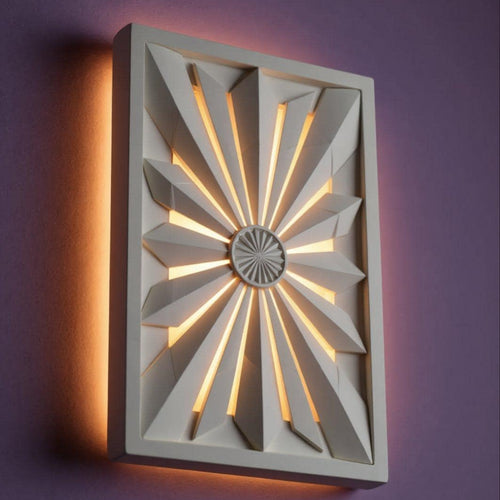
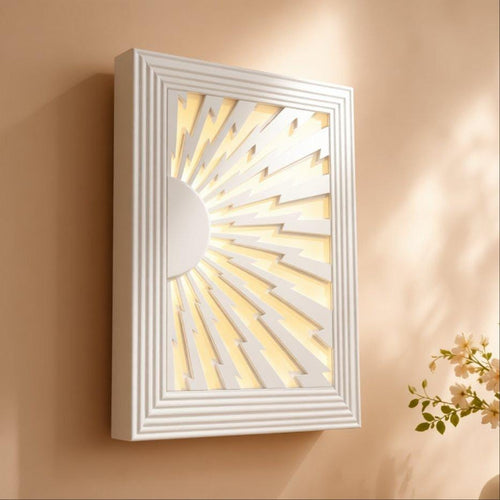
- Choose one motif. A sun disc, a fan or a papyrus-like flare is enough. Our Sunburst Ceiling Rose and Fan Wall Light are simple places to start.
- Start from a pale ground. Every building above relies on white or cream walls so the colour can sing. A warm off-white plaster ceiling does the same job indoors.
- Use faience colours as accents. Lapis blue, turquoise, terracotta red and a touch of gold work best on small things: a painted ceiling rose, a door, tiles behind a basin. Our guide to heritage colour palettes has more on period schemes.
- Paint in bands. The coloured neck bands on the Carreras columns are a useful trick on a plaster piece: pick out one or two rings in a contrast colour, for example the centre ring of our Pluto Ceiling Rose. Our guide to painting a plaster ceiling rose explains how.
- Wall lights. If you add wall lights, have the mains wiring done by a qualified electrician. In England and Wales, notifiable electrical work falls under Part P of the Building Regulations.
Common mistakes to avoid
- Turning a room into a film set. Pharaoh heads, hieroglyph wallpaper and gold everywhere tip into pastiche. The best 1920s and 1930s examples abstract Egypt rather than copy it.
- Stripping original detail. If you own a 1920s or 1930s building with Egyptian touches, keep and repair them. Our guide to restoring a 1930s Art Deco home covers what to keep.
Shop the look
Sun discs, fans and banded rings, ready to leave as natural plaster or paint in faience colours.


Bringing Egyptian Art Deco home with plaster
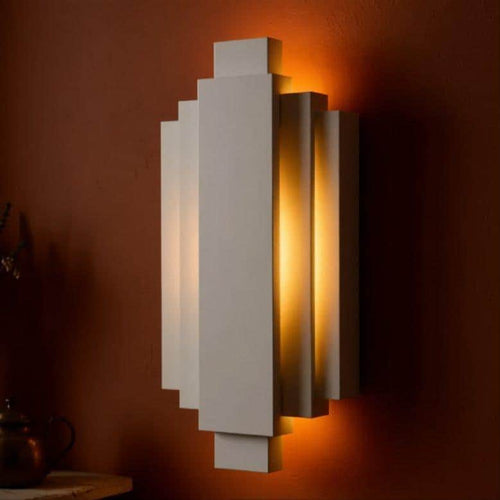
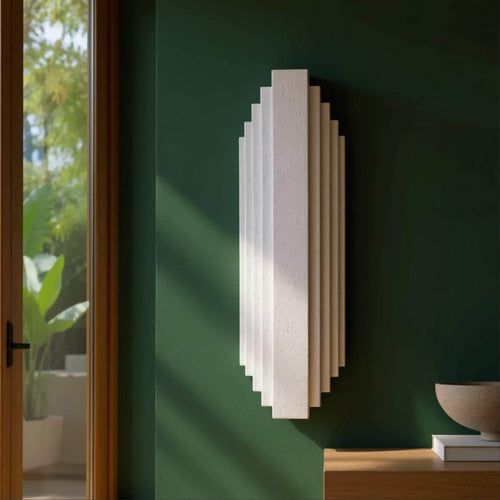
Plaster is a natural fit for the Egyptian side of Art Deco: crisp, pale and ready for a band of lapis blue or gold. A sunburst ceiling rose from our ceiling roses, a fan-shaped piece from our wall lights or a stepped overdoor from our door toppers picks up the temple-gate geometry without the pastiche. Every piece in our Art Deco collection is designed and hand-cast in Shrewsbury, and arrives as natural plaster ready to leave raw or paint to suit your room.
Good to know
Common questions
Why did Tutankhamun influence Art Deco?
The discovery of the tomb in November 1922 caused a worldwide sensation. Ancient Egyptian ornament was already flat, symmetrical and geometric, so designers could fold scarabs, papyrus columns, sun discs and faience colours into the new style with little change.
Where can I see Egyptian Art Deco in Britain?
In London, the former Carreras factory at Mornington Crescent, the Hoover Building on Western Avenue in Perivale and the former Capitol cinema in Forest Hill are all good examples you can see from the street.
How can I use Egyptian Art Deco at home without it looking like a film set?
Pick one motif, such as a sun disc or a fan, keep the walls pale, and use lapis blue, turquoise, terracotta or gold only as accents on a few pieces, such as a ceiling rose, a door or a set of tiles.
Can you visit the Carreras and Hoover buildings?
Both can be seen from the street. Carreras faces Mornington Crescent station in Camden. The Hoover Building on Western Avenue in Perivale is listed Grade II*; Tesco took over the site after Hoover left in the 1980s, and the main block has since been converted into apartments, so the Egyptian entrance is best admired from outside.
Sources
References and further reading
Harvard style. Web pages were checked on the access date shown.
- Bodleian Libraries (2022) Tutankhamun: Excavating the Archive [exhibition]. Available at: visit.bodleian.ox.ac.uk/tutankhamun (Accessed: 13 October 2026).
- Camden New Journal (2026) 'Have you seen this moggy? CNJ asks what’s happened to Mornington Crescent's famous black cats'. Available at: www.camdennewjournal.co.uk/article/have-you-seen-this-mog... (Accessed: 13 October 2026).
- Cinema Treasures (n.d.) ABC Forest Hill. Available at: cinematreasures.org/theaters/2428 (Accessed: 13 October 2026).
- Current Archaeology (2012) 'Egypt in England opens at Wellington Arch'. Available at: archaeology.co.uk/articles/news/egypt-in-england-opens-at... (Accessed: 13 October 2026).
- English Heritage (n.d.) Past Lives: Howard Carter. Available at: www.english-heritage.org.uk/members-area/past-lives/howar... (Accessed: 13 October 2026).
- Griffith Institute, University of Oxford (n.d.) Tutankhamun: Anatomy of an Excavation. Available at: www.griffith.ox.ac.uk/discoveringTut/ (Accessed: 13 October 2026).
- Hisgett, T. (2010) Greater London House 9 [Photograph]. Wikimedia Commons. CC BY 2.0. Available at: commons.wikimedia.org/wiki/File:Greater_London_House_9_(5... (Accessed: 13 October 2026).
- Historic England (n.d.) Main Front Block to Hoover Factory, List Entry 1079353. Available at: historicengland.org.uk/listing/the-list/list-entry/1079353 (Accessed: 13 October 2026).
- Historic England (n.d.) The Capitol (formerly Capitol Cinema), List Entry 1253032. Available at: historicengland.org.uk/listing/the-list/list-entry/1253032 (Accessed: 13 October 2026).
- Historic England Archive (2011) Greater London House, Hampstead Road, DP103856 [Photograph, Egypt in England series]. Available at: historicengland.org.uk/images-books/photos/item/DP103856 (Accessed: 13 October 2026).
- Manchester History (n.d.) Greater London House (Former Carreras Tobacco Factory). Available at: manchesterhistory.net/architecture/1920/greaterlondon.html (Accessed: 13 October 2026).
- Modernism in Metro-land (n.d.) Carreras Factory. Available at: www.modernism-in-metroland.co.uk/carreras-factory.html (Accessed: 13 October 2026).
- Modernism in Metro-land (n.d.) Cleaning up: the opening of the Hoover Factory. Available at: www.modernism-in-metroland.co.uk/blog/cleaning-up-the-ope... (Accessed: 13 October 2026).
- Munro, E. (2009) Capitol, Forest Hill, SE23 [Photograph]. Wikimedia Commons. CC BY-SA 2.0. Available at: commons.wikimedia.org/wiki/File:Capitol,_Forest_Hill,_SE2... (Accessed: 13 October 2026).
- Museo Thyssen-Bornemisza (2012) The Art of Cartier: Oriental influences. Available at: static.museothyssen.org/microsites/exposiciones/2012/cart... (Accessed: 13 October 2026).
- Osley, J. (2023) Perivale: entrance, Hoover Building [Photograph]. Geograph, via Wikimedia Commons. CC BY-SA 2.0. Available at: commons.wikimedia.org/wiki/File:Perivale_,_entrance,_Hoov... (Accessed: 13 October 2026).
- R/DV/RS (2008) Carreras [Photograph]. Wikimedia Commons. CC BY 2.0. Available at: commons.wikimedia.org/wiki/File:Carreras_-_2655975315.jpg (Accessed: 13 October 2026).
- The Past (2022) 'Tutankhamun: Excavating the Archive' [review]. Available at: the-past.com/review/whats-on/tutankhamun-excavating-the-a... (Accessed: 13 October 2026).
- TORCH, University of Oxford (n.d.) “Can you see anything?”. Available at: torch.ox.ac.uk/node/731196 (Accessed: 13 October 2026).
- Victoria and Albert Museum (n.d.) Art Deco: global influences. Available at: www.vam.ac.uk/articles/art-deco-global-influences (Accessed: 13 October 2026).
How to cite this article
van Locke, J. (2026) ‘Egyptomania: how Tutankhamun's tomb shaped Art Deco’, The Flare Journal. Flare Studio UK. Available at: https://flarestudio.uk/blogs/journal/egyptomania-tutankhamun-art-deco (Accessed: 17 October 2026).
Shop the style