Paris 1925: the exhibition that gave Art Deco its name


Art Deco takes its name from a single event: the Exposition internationale des Arts décoratifs et industriels modernes, held in Paris from April to October 1925. It brought together around 15,000 exhibits from about 20 countries, and some 15 to 16 million people came to see them. France used it to show the world that it still led in design and taste after the First World War.
Yet nobody in 1925 called the style Art Deco. People spoke of the modern or "moderne" style. The short name came forty years later, when a 1966 exhibition in Paris and a 1968 book by the British writer Bevis Hillier looked back at the period and gave it a label. This guide covers why it was held, where it stood, the pavilions that mattered, how Britain fared, and five images from 1925 annotated.
Why France held the exhibition
The idea is older than the style. In 1912 the French government voted to sponsor an international exhibition of decorative arts, meant to reaffirm French leadership in the field. It was scheduled for 1915, and the First World War put an end to that.
When it finally opened, the purpose had sharpened. France had suffered heavy losses and an unsteady economy, and a fair of new design was a way to signal confidence. The rules were strict: exhibits had to be modern, and work based on historical styles was not allowed. That one rule shaped everything that followed.
Germany did not take part, and the United States stayed away, partly because too few American designers had work that met the no-historical-styles rule. Most foreign pavilions came from elsewhere in Europe, with Japan among those from further afield.
The 1925 timeline
The exhibition opened on 28 April 1925, under the direction of the architect Charles Plumet, and ran until October. It was the end of a plan more than a decade old, and the start of a style that would only be named forty years later.
The card below sets out the key dates. Visitor figures vary: the V&A gives around 15 million, the Metropolitan Museum of Art more than 16 million.

Where it stood: the Grand Palais to the Invalides
The exhibition did not have a separate park. It ran through the middle of Paris, from the Esplanade des Invalides on the Left Bank, across the Pont Alexandre III, to the Grand Palais and Petit Palais on the Right Bank. About two-thirds of the ground went to French pavilions, many of them built by towns and department stores.
Almost all of it was temporary, which is why the exhibition is known today mostly through postcards, posters and surviving furniture. Visitors came in through grand gateways such as the Porte d’Honneur by the Grand Palais, and at night they could see René Lalique’s Luminous Fountain, a glass structure about 15 metres tall.
For a fuller picture of the site and its pavilions, this archive film on the 1925 exhibition, number 11 in the A305 series and shared by the Canadian Centre for Architecture, is worth its 25 minutes.
Video: CCAchannel (Canadian Centre for Architecture), "A305/11: The International Exhibition of Decorative Arts Paris 1925", via YouTube.
The pavilions that mattered
- The Collector’s pavilion. The most admired building on the site was the pavilion of a collector’s house, known as the Hôtel du Collectionneur or simply the Ruhlmann pavilion. Pierre Patout designed the building, and the furniture designer Jacques-Émile Ruhlmann coordinated nearly fifty artists to fit it out. It had an oval grand salon and a stepped exterior, and its two-colour damask was woven in Lyon by Cornille frères.
- The department stores. Paris’s big stores had set up their own design studios between 1912 and 1922: Primavera at Printemps, Pomone at Le Bon Marché, La Maîtrise at Galeries Lafayette and Studium Louvre at the Grands Magasins du Louvre. Each had its own pavilion in 1925, filled with furnished rooms. Their idea was original design in small series at sensible prices, and their façades carried stylised flowers, stepped forms, sunbursts and zigzags.
- Sèvres. The national porcelain factory showed in a pavilion by Pierre Patout and André Ventre, set in a formal garden by Henri Rapin.
- The Soviet pavilion. Konstantin Melnikov’s red-and-white pavilion of wood and glass was a Constructivist statement and received the Grand Prix. Dezeen calls it the most popular building at the exposition.
- The Pavillon de l’Esprit Nouveau. Le Corbusier and Pierre Jeanneret built a model flat with no applied ornament at all. The organisers disliked it and tried to screen it from view with a fence. It was demolished in 1926, and a replica was built in Bologna in 1977.
So "1925" was never one look: luxury craft, shop-made furniture and stark machine-age architecture stood side by side. Our visual glossary of Art Deco motifs picks out the shapes that carried on into the 1930s.
Britain in Paris
Britain’s main building was the British Government Pavilion by the London architects Easton & Robertson, a more restrained take on the new style. Henry Wilson decorated its interior. A 1927 report on the exhibition judged that "diversity appeared to be the key-note of the British exhibits".
Some British makers did well. Gordon Russell won a gold medal for an English walnut inlaid cabinet and stand, and Carter, Stabler & Adams of Poole showed a dish designed by Truda Adams.
The exhibition also travelled home in quieter ways. Frank Pick of the Underground Electric Railways Company of London gave the V&A a copy of Robert Bonfils’ official poster. Within a few years, stepped forms like those in Paris were appearing on British cinemas, factories and front doors, as told in our guide to British 1930s interiors and in Art Deco Britain: buildings to visit.
How "Art Deco" got its name
Through the 1920s and 1930s the style had plenty of names: modernistic, moderne, jazz-modern and zig-zag among them. Art Deco is a later label, taken from the "arts décoratifs" in the exhibition’s title.
In 1966 the Musée des Arts Décoratifs in Paris marked the exhibition with a large show, Les Années 25, which helped popularise the term. Two years later Bevis Hillier published Art Deco of the 20s and 30s, and the name stuck. Hillier is often credited with coining it, though he noted that it had already appeared in the 1966 exhibition and in an article in The Times that year. Our introduction, What is Art Deco?, picks up the story from there.
Paris 1925, annotated
Here are five images from 1925 itself: four postcards sold at the exhibition and one of its official posters. Each is numbered with the features worth noticing. The postcards are black and white, so only the poster has colour swatches, sampled from the scan. Treat them as a guide rather than a paint match.
1. The Porte d’Honneur
The main ceremonial gateway, designed by Henri Favier and André Ventre, was one of twelve entrances to the site. This postcard looks across it to the Grand Palais, which shows how close the exhibition sat to the old monuments of Paris.

- Stepped pylon, tiered like a ziggurat
- Ironwork grilles in a fountain-like pattern; the card credits E. Brandt as ironworker
- The glass dome of the Grand Palais
- The Eiffel Tower and a tall white tower beyond the trees
- The same stepped finials repeated down the side wings
- A motor car on the avenue, for scale
- The card’s credit to Favier and Ventre as architects
Take from it: Stepping and repetition do most of the work here. A ceiling rose or overdoor with tiered edges, such as our Cosmos Ceiling Rose, reads as 1925 straight away.
2. The Bon Marché pavilion
Le Bon Marché’s pavilion was designed by Louis-Hippolyte Boileau and housed the store’s Pomone studio. Notice how the decoration is concentrated over the door.

- A set-back upper storey
- Zigzag frieze under the cornice
- A large panel of arcs and rays over the entrance
- Stepped tower with a tall window strip
- Planting along the roof terrace
- Glazed entrance doors
- A broad flight of steps
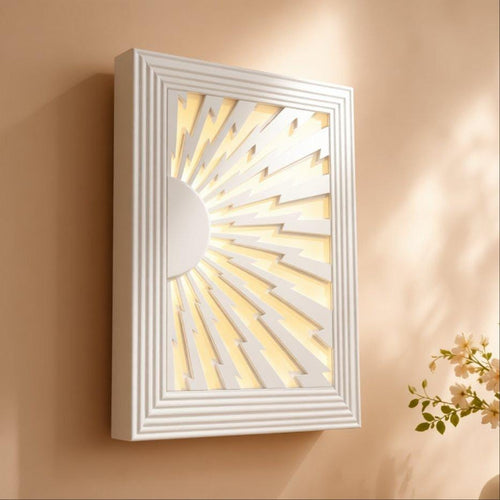
Take from it: One rich focal point against plain walls. In a room, that might be a single decorative ceiling rose, such as our Sunburst Ceiling Rose, on a smooth ceiling.
3. The Printemps pavilion
Printemps showed the work of its Primavera studio in a pavilion with a great conical roof. Rounded forms and planting were part of the 1925 look too.

- Conical roof studded with rounded inserts
- Planted tops to the columns
- A fluted round column
- An open, deep entrance porch
- Primavera lettering, naming the Printemps studio
- A large jar by the entrance
- Low planters along the base
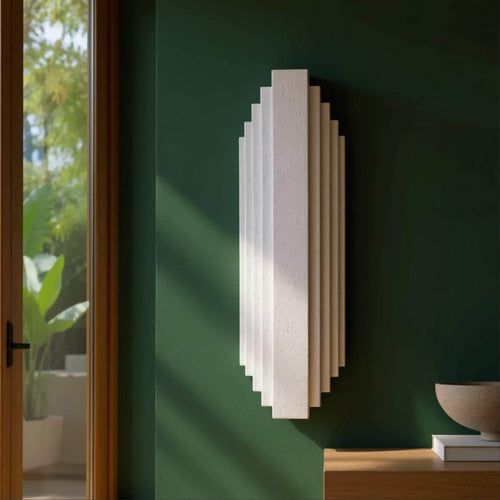
Take from it: Fluting and rounded forms are as much a part of 1925 as zigzags. A fluted wall light is the domestic version of these columns.
4. The Soviet pavilion
Konstantin Melnikov’s pavilion for the USSR was built of wood and glass and won a Grand Prix. It shows the other direction available in 1925: no ornament at all, just structure, glass and a dramatic stair.

- Open lattice tower
- A large grid of glazing
- A plain, flat wall panel
- An open staircase cutting through the building
- Sloping roof slabs over the stair
- Hammer and sickle emblem
- The card’s credit to Melnikov as architect
Take from it: Not everything shown in 1925 was decorative. If you prefer clean lines, the grid and the diagonal are your motifs.
5. The official poster
The sculptor Antoine Bourdelle designed one of the four official posters, printed by Crété. The other three went to younger graphic designers, including Robert Bonfils and Charles Loupot.

- Issued by the Ministry of Commerce and Industry
- A winged archer
- A charging bull
- The motto, “by labour and by genius”
- The full title of the exhibition
- Paris, April to October 1925
- A brown frame around the image
Colours in this photo:
Poster cream #DBD6C1Deep umber #221D12Copper brown #71452ALight bronze #8F6244Band grey #635A4E
Take from it: Warm browns and cream are a good reminder that 1925 colour could be earthy rather than bright. They suit bare plaster well.
Where to see 1925 in Britain
Almost nothing on the exhibition site was built to last, but work by its leading names is held in British collections, and a Cotswold museum tells the story of a British medal winner.
- The V&A, London. Besides Bourdelle's and Bonfils' official posters, the V&A holds a dressing table by Jacques-Émile Ruhlmann of 1919 to 1923 (museum number W.14:1 to 6-1980) and René Lalique's Ceylan vase of 1924 (CIRC.755-1969). Its introduction to Art Deco names Ruhlmann and Lalique among the designers at the exhibition and calls them "prominent promoters of the early Art Deco movement". Not everything is on display at once, so check the online collection before you travel to see a particular piece.
- Gordon Russell Design Museum, Broadway. The museum at 15 Russell Square in Broadway, Worcestershire, celebrates Gordon Russell and the company that bore his name. Its website lists a "Paris Cabinet, 1925" among his designs, a good starting point for Russell's year of the gold medal.
What to look for: compare Ruhlmann's furniture with Lalique's moulded glass. The V&A says both put their own modern spin on traditional craftsmanship, which is the same balance a hand-cast plaster piece aims for.
How to bring 1925 home
- Start with one stepped shape. The tiered pylons of the Porte d’Honneur are the simplest way into the style. A stepped overdoor or ceiling rose does the same job in a hallway.
- Concentrate the decoration. The best pavilions kept walls plain and put the ornament in one place. Choose a single focal point per room.
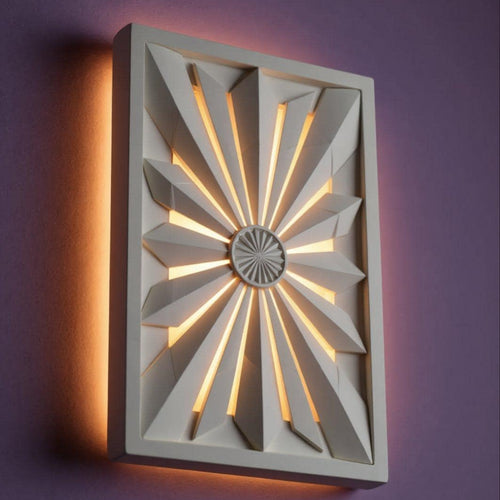
- Use fans and fountains. Stylised fountains, sprays and fans were everywhere in 1925, from Lalique’s glass to the ironwork gates. A fan-shaped wall light, such as our Fan Wall Light, picks this up.
- Keep the palette calm. Cream, warm browns and a little gilt, as on Bourdelle’s poster, are as true to 1925 as black and gold. Our guide to heritage colour palettes has more ideas.
Common mistakes to avoid
- Calling it Art Deco in period documents. If you are dating an object or a catalogue, remember the term is from the 1960s. A 1925 advert will say modern or moderne.
- Assuming it was all glamour. The department-store studios offered original designs in small series at more accessible prices, and some of the most famous buildings had no ornament at all.
- Mixing it up with Art Nouveau. The 1925 rules banned historical styles, and the flowing whiplash lines of the 1900s had given way to geometry. Our Art Deco vs Art Nouveau guide explains the difference.
Shop the look
Stepped, rayed and fluted shapes from 1925, cast in plaster in Shrewsbury.


Bringing 1925 home with plaster
The stepped pylons, fan-shaped grilles and sunbursts of the 1925 exhibition translate naturally into plaster: a tiered ceiling rose, a fan wall light or a stepped overdoor. For more on how these shapes moved onto British ceilings, read Art Deco ceilings: plasterwork, coves and ceiling roses between the wars. Every piece in our Art Deco collection is designed and hand-cast in Shrewsbury, and arrives as natural plaster ready to leave raw or paint to suit your room.
Good to know
Common questions
Why is it called Art Deco?
The name comes from the 1925 Exposition internationale des Arts décoratifs et industriels modernes in Paris. It was applied in the 1960s, helped by the 1966 exhibition Les Années 25 at the Musée des Arts Décoratifs and Bevis Hillier's 1968 book Art Deco of the 20s and 30s. In the 1920s people simply called the style modern or moderne.
Where was the 1925 Paris exhibition held?
In the centre of Paris, from the Esplanade des Invalides across the Pont Alexandre III to the Grand Palais and Petit Palais. It opened on 28 April 1925 and ran until October. Almost all the pavilions were temporary.
Did Britain take part in the 1925 exhibition?
Yes. The British Government Pavilion was designed by Easton & Robertson, with an interior decorated by Henry Wilson. Gordon Russell won a gold medal for a walnut inlaid cabinet, and Carter, Stabler & Adams of Poole showed work by Truda Adams.
Where can I see objects from the 1925 Paris exhibition in Britain?
The V&A in London holds the official posters by Antoine Bourdelle and Robert Bonfils, along with work by Jacques-Émile Ruhlmann and René Lalique, two of the exhibition's leading names. The Gordon Russell Design Museum in Broadway, Worcestershire, tells the story of Gordon Russell, who won a gold medal in 1925. Check online before visiting, as not every object is on display.
Sources
References and further reading
Harvard style. Web pages were checked on the access date shown.
- Apollo (2025) '1925–2025: One Hundred Years of Art Deco', Apollo Magazine, 17 October. Available at: apollo-magazine.com/?p=1032476 (Accessed: 13 October 2026).
- Barker, N. (2025) 'A really quick guide to art deco', Dezeen, 3 March. Available at: www.dezeen.com/2025/03/03/art-deco-guide/ (Accessed: 13 October 2026).
- Bourdelle, A. (1925) Exposition internationale des arts décoratifs et industriels modernes [Poster]. Bibliothèque nationale de France, via Wikimedia Commons. Public domain. Available at: commons.wikimedia.org/wiki/File:Minist%C3%A8re_du_commerc... (Accessed: 13 October 2026).
- Cité de l'architecture et du patrimoine (2025) Paris 1925: Art Deco and Its Architects. Available at: www.citedelarchitecture.fr/en/agenda/exhibition/paris-192... (Accessed: 13 October 2026).
- Crook, L. (2025) 'Ten art deco structures that encapsulate the 1925 Paris Exposition', Dezeen, 31 March. Available at: www.dezeen.com/2025/03/31/1925-paris-exposition-roundup-a... (Accessed: 13 October 2026).
- Fiederer, L. (2016) 'The Exhibition That Started An International Style: Art Deco', Metropolis, 24 August. Available at: metropolismag.com/projects/exhibition-started-internation... (Accessed: 13 October 2026).
- Fondation Le Corbusier (n.d.) Les bâtiments de Le Corbusier ouverts à la visite dans le monde. Available at: fondationlecorbusier.fr/en/?p=15319 (Accessed: 13 October 2026).
- Gordon Russell Design Museum (n.d.) Gordon Russell Design Museum. Available at: gordonrusselldesignmuseum.org/ (Accessed: 13 October 2026).
- Goss, J. (2010) 'French Art Deco', in Heilbrunn Timeline of Art History. New York: The Metropolitan Museum of Art. Available at: www.metmuseum.org/en/essays/french-art-deco (Accessed: 13 October 2026).
- Grace's Guide (n.d.) Sydney Gordon Russell. Available at: gracesguide.co.uk/Sydney_Gordon_Russell (Accessed: 13 October 2026).
- Maurano, S. (2013) 'Review of Garrido, G., Melnikov en París, 1925', SLOVO, 25(2), pp. 37–38. Available at: student-journals.ucl.ac.uk/slovo/article/611/galley/1589/... (Accessed: 13 October 2026).
- Musée des Arts Décoratifs (2025) Ruhlmann décorateur [press release]. Available at: ph.madparis.fr/IMG/pdf/cp-ruhlmann-decorateur-fr.pdf (Accessed: 13 October 2026).
- RIBA Collections (n.d.) Pavillon de Sèvres by night, Exposition Internationale des Arts Décoratifs et Industriels Modernes, Paris 1925. Available at: www.architecture.com/image-library/ribapix/image-informat... (Accessed: 13 October 2026).
- University of Glasgow Library (n.d.) 1925: selling Art Deco to the world. Available at: www.gla.ac.uk/myglasgow/library/files/special/teach/centu... (Accessed: 13 October 2026).
- University of Pennsylvania Libraries (n.d.) Les Années 25, Musée des arts décoratifs, 1966 [catalogue record]. Available at: find.library.upenn.edu/catalog/998183423503681 (Accessed: 13 October 2026).
- Unknown photographer (1925) La Porte d'Honneur, Exposition des Arts Décoratifs [Photograph postcard]. Rijksmuseum, via Wikimedia Commons. CC0. Available at: commons.wikimedia.org/wiki/File:Gezicht_op_de_Erepoort_va... (Accessed: 13 October 2026).
- Unknown photographer (1925) Le Pavillon du Bon Marché [Postcard]. Wikimedia Commons. Public domain. Available at: commons.wikimedia.org/wiki/File:Paris-FR-75-Expo_1925_Art... (Accessed: 13 October 2026).
- Unknown photographer (1925) Le Pavillon du Printemps [Postcard]. Wikimedia Commons. Public domain. Available at: commons.wikimedia.org/wiki/File:Paris-FR-75-Expo_1925_Art... (Accessed: 13 October 2026).
- Unknown photographer (1925) Pavillon des Républiques Soviétiques, Exposition des Arts Décoratifs [Photograph postcard]. Rijksmuseum, via Wikimedia Commons. CC0. Available at: commons.wikimedia.org/wiki/File:Exterieur_van_het_paviljo... (Accessed: 13 October 2026).
- Victoria and Albert Museum (n.d.) An introduction to Art Deco. Available at: www.vam.ac.uk/articles/an-introduction-to-art-deco (Accessed: 13 October 2026).
- Victoria and Albert Museum (n.d.) Exposition Internationale des Arts Décoratifs, Paris, 1925 [poster by Antoine Bourdelle, E.1199-1925]. Available at: collections.vam.ac.uk/item/O1103503 (Accessed: 13 October 2026).
- Victoria and Albert Museum (n.d.) Paris, 1925: Exposition Internationale des Arts Décoratifs [poster by Robert Bonfils, E.1200-1925]. Available at: collections.vam.ac.uk/item/O175840 (Accessed: 13 October 2026).
- Ville de Paris (2026) Les Ateliers d'art des grands magasins, vitrines de l'Art déco. Available at: www.paris.fr/evenements/expo-les-ateliers-d-art-des-grand... (Accessed: 13 October 2026).
How to cite this article
van Locke, J. (2026) ‘Paris 1925: the exhibition that gave Art Deco its name’, The Flare Journal. Flare Studio UK. Available at: https://flarestudio.uk/blogs/journal/paris-1925-exposition-art-deco (Accessed: 17 October 2026).
Shop the style