

Can you have a ceiling rose without a light? Decorative roses explained


Quick answer
Yes, you can have a ceiling rose without a light. Purely decorative roses are fixed with adhesive (and temporary screws while it sets) and need no wiring at all. They are used to centre a ceiling, balance a room with an off-centre light, cover a patch or old fitting mark, or as a feature in a room lit by wall lights and lamps [1][5]. Choose a rose with no centre hole for a seamless look.
We are often asked whether a ceiling rose has to have a light in the middle. Historically most did, but the rose is a decorative element first. This guide explains when a decorative-only rose makes sense, how to fit one, how to deal with an old light point you no longer use, and how to choose the right design.
Why ceiling roses had lights in the first place
Ornamental ceiling centrepieces existed long before electric light, but the Victorian ceiling rose became standard partly because of gas lighting: the rose framed the gasolier and its decoration helped disguise the soot that collected above the flame [1][2]. Electric pendants simply took over the same position.
Five reasons to fit a rose without a light
- To centre a room. If the light is off-centre, a decorative rose in the true centre restores symmetry.
- To balance a long room. Two matching roses in a through-lounge, each with or without a light, divide the space.
- To cover a patch. A rose hides an old fitting, a patched crack or a filled hole; see covering a hole or old light mark.
- Rooms lit by wall lights. Many people now light living rooms and bedrooms with wall lights and lamps, but a plain ceiling looks unfinished.
- As art. A large, detailed rose painted in a contrast colour is a feature in itself.
Wire hole or no wire hole?
| Option | Use it when |
|---|---|
| 50mm wire hole | A pendant cable will pass through the rose, now or in future. |
| No wire hole | The rose is purely decorative and you want a solid, uninterrupted centre. |
Our ceiling roses can be ordered with a 50mm wire hole or with no wire hole; choose under 'Centre Hole Option' on any rose.
How to fit a decorative rose
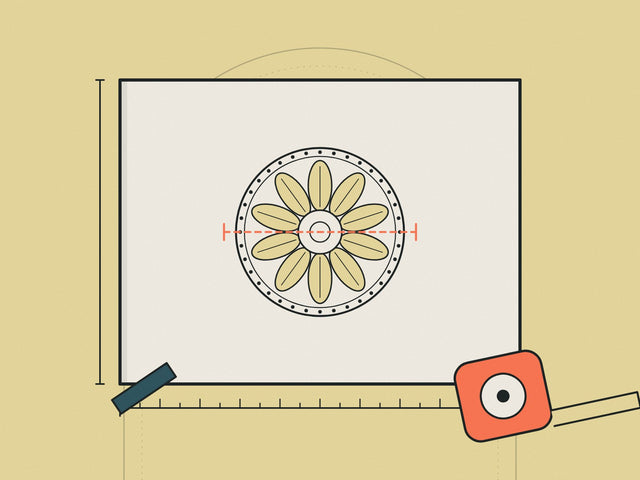
- Find the position: measure diagonals to find the true centre, or set out the spacing for a pair.
- Check the ceiling is sound; lightly sand old paint for a key.
- Apply grab adhesive to the back of the rose.
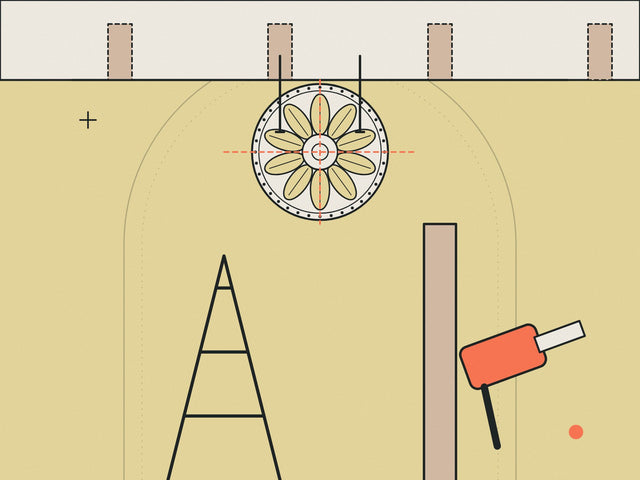
- Press it up and support it with a few screws or nails into the ceiling (into a joist where possible) while the adhesive sets.
- Fill the screw holes and the edge seam, sand when dry and paint [5][6].
What if there is an old light point?
If you are removing a light and fitting a decorative rose over the old position, the old cable must be properly disconnected or made safe. Electrical work must meet the IET Wiring Regulations, and some work is notifiable under Part P, so ask a registered electrician to deal with the cable before you fix the rose [3][4].
Choosing the design
- Match the period: see ceiling rose patterns by period.
- Size it to the room: see ceiling rose size chart.
- For a pair, choose a simpler design so the ceiling does not feel busy.
- With no light to look at, the relief matters more, so a deeper casting reads better.


A step-by-step guide to fixing a plaster rose [6].
Video: The Bald Builders, “How to Fit a Plaster Ceiling Rose Properly | Step-by-Step DIY Guide”, via YouTube.
Good to know
Common questions
Can you put a ceiling rose without a light?
Yes. Decorative roses are fixed with adhesive and need no wiring.
Why did Victorian houses have ceiling roses?
They framed gas lights and helped disguise soot, as well as being decorative.
Should a decorative ceiling rose have a hole?
Choose no wire hole for a solid centre if no cable will ever pass through it.
Can I cover an old light fitting with a ceiling rose?
Yes, once an electrician has made the old cable safe.
Sources
References and further reading
Harvard style. Web pages were checked on the access date shown.
- Calloway, S. and Cromley, E. (eds) (1996) The elements of style: a practical encyclopedia of interior architectural details from 1485 to the present. Rev. edn. London: Mitchell Beazley.
- Muthesius, S. (1982) The English terraced house. New Haven and London: Yale University Press.
- Ministry of Housing, Communities and Local Government (2013) Electrical safety: Approved Document P. Available at: www.gov.uk/government/publications/electrical-safety-appr... (Accessed: 8 October 2026).
- Institution of Engineering and Technology (2022) BS 7671:2018+A2:2022 Requirements for electrical installations (IET Wiring Regulations). 18th edn. London: IET.
- Van Dyke's Restorers (n.d.) Dress up your lights with decorative ceiling medallions. Available at: www.vandykes.com/dress-up-your-lights-with-decorative-cei... (Accessed: 14 November 2026).
- The Bald Builders (n.d.) How to fit a plaster ceiling rose properly: step-by-step DIY guide [Video]. YouTube. Available at: www.youtube.com/watch?v=DI8_h1r7JtY (Accessed: 14 November 2026).
How to cite this article
van Locke, J. (2026) ‘Can you have a ceiling rose without a light? Decorative roses explained’, The Flare Journal. Flare Studio UK. Available at: https://flarestudio.uk/blogs/journal/ceiling-rose-without-a-light (Accessed: 15 November 2026).
Shop the style



Conversation
Join the conversation
Questions about the history, a room you are planning, or a piece you have seen in the wild? Leave a comment and Joseph will reply.