

Charles and Ray Eames: plywood, play and the modern home


Charles Eames (1907 to 1978) and Ray Eames (1912 to 1988) were an American husband-and-wife design partnership. From a small office in Los Angeles they moulded plywood into chairs, built a steel-and-glass house from catalogue parts, made fibreglass furniture for ordinary homes and produced films, including Powers of Ten. The Barbican called them two of the most influential designers of the 20th century.[1]
They matter because they made modern design friendly. Their furniture was light, comfortable and made in large numbers, and their home showed that a modern house could be full of collected things. Modern did not have to mean empty.
Who were Charles and Ray Eames?
Charles was born in St. Louis, Missouri, in 1907. Ray was born Bernice Alexandra Kaiser in Sacramento, California, in 1912.[2] Ray trained as a painter with Hans Hofmann and was a founding member of American Abstract Artists in 1936.[2] She met Charles at the Cranbrook Academy of Art in Michigan; they married in 1941 and moved to Los Angeles.[2]
They worked as partners from 1941 until Charles died in 1978. Charles had the higher public profile, partly because offices then credited the person at their head, but he insisted on Ray's central part in the work, and she worked full time in the office.[2] Between 1942 and 1947 she also designed 26 covers for Arts & Architecture magazine, using collage and bold, organic shapes.[2] Ray died in 1988, ten years to the day after Charles.
That is why this article says "Charles and Ray" throughout. As a designer, I find it a useful reminder that a good piece rarely has one parent.
What are Charles and Ray Eames's key works?
The card below sets out the main moments, from a wartime splint to a film about the scale of the universe.
- Leg splint (1943). During the Second World War, standard metal splints vibrated in transport and could make injuries worse.[5] The Eameses moulded a plywood splint, using a bending device they built themselves, the Kazam! machine, and Charles's own leg as the model.[5] The V&A notes that the US Navy asked for it.[7][5] An estimated 150,000 were made.[5]
- LCW and DCW (1945 to 1946). The wartime work led straight to furniture. The LCW (Lounge Chair Wood) was developed in 1945 and shown at the Museum of Modern Art in 1946.[7] Its sister, the DCW (Dining Chair Wood), dates from around 1946. Time magazine later called the LCW "the chair of the century". The first chairs were made by Evans Products in Los Angeles, and from 1946 by Herman Miller of Zeeland, Michigan.
- Fibreglass shell chairs (1950). Herman Miller balked at an $80,000 steel press, so the Eameses turned to fibreglass, made with Zenith Plastics. The chairs launched in Chicago in January 1950 in greige, elephant hide grey and parchment.

What ideas lie behind the Eameses' work?
- Learn by making. The Barbican describes them as tireless experimenters who embraced trial and error.[1] The plywood chairs grew out of wartime experiments, not a single sketch.
- Get the most from the least. For their own house they reused steel parts ordered for an earlier scheme, plus one extra beam, aiming to maximise volume from minimal materials.
- Details matter. Herman Miller quotes Charles: "The details are not details. They make the product." The rubber shock mounts that fix the legs to the early fibreglass shells are a good example.
- Comfort counts. For the 1956 Lounge Chair, which the couple presented on US television, Charles wanted a "modern version of an English club chair": three plywood shells, leather cushions filled with feathers and down, and a swivelling aluminium base.
- Light comes first. The Eames House is largely glass in a thin steel grid, with a double-height living room. Trees outside filter the sun, so the light and the shadows of leaves take the place of ornament.
- Objects bring a room to life. The couple displayed their furniture alongside art, design and ephemera collected from around the world, and the interior remains very much as they left it.
What is the Eames House?
The house was one of about two dozen built for the Case Study House Program, led by John Entenza, editor and owner of Arts & Architecture.[4] Charles and Eero Saarinen drew a first scheme in 1945, the "Bridge House", from prefabricated catalogue parts, but wartime shortages held up the steel until late 1948.[4]
By then Charles and Ray had rethought it. They split it into two two-storey buildings, a residence and a studio joined by a courtyard, and turned the plan through 90 degrees to keep the meadow open.[4] The steel frame went up in 16 hours in 1949, and they moved in on Christmas Eve that year and stayed for the rest of their lives.[4] The house is now a National Historic Landmark, cared for by the Eames Foundation, which Charles's daughter Lucia Eames set up in 2004.[3]
What does Eames design look like up close?
Two views of the house and two chairs in museum collections, numbered with the details worth noticing. Swatches are sampled from the photographs, so treat them as a guide rather than a paint match.
1. The Eames House from the meadow
The long front of the Eames House in Pacific Palisades, seen through the trees that stand in the meadow.

- A solid panel painted deep blue
- Slim black steel frame, made from catalogue parts
- Large glazed bays that fill the rooms with daylight
- A globe pendant lamp, seen through the glass just below the badge
- Thin diagonal steel bracing
- Tall trees in front, which break up the sun before it reaches the glass
- Lower windows divided into smaller panes
Colours in this photo:
Panel blue #1D3A6ESteel black #11120EPale tree bark #C6C4C3Meadow #7E826E
Take from it: Daylight is the main material here. The frame is plain; light, leaf shadows and a few strong colours do the decorating.
2. The residence and its double-height room
The end of the residence, where the living room rises through two storeys. Inside, the Eameses kept the art, design and ephemera they collected from around the world.

- Open-web steel roof joists, left exposed under the overhang
- Timber-lined end wall of the double-height living room
- A slim black steel column
- Tall glazing set in a steel grid
- A plain white panel in the frame
- Brick terrace that works as an outdoor room
- Pots and planting right up against the glass
Take from it: Warm timber sits beside cool steel. If a modern room feels hard, one wall of natural material softens it.
3. The LCW lounge chair
An LCW (Lounge Chair Wood) in the collection of the Honolulu Museum of Art, designed in 1945 to 1946. Its record describes moulded plywood with a teak veneer and rubber shock mounts.

- Back panel moulded into a gentle curve
- Seat curved in more than one direction; the V&A notes they learned to mould plywood in three planes
- A curved plywood spine joining the separate seat and back
- Rolled front edge of the seat
- Plywood legs, angled outwards
Colours in this photo:
Moulded plywood #AD7430
Take from it: Every part is a simple curve and nothing is hidden. On a wall, let shape rather than pattern carry the design.
4. The fibreglass shell armchair
A fibreglass armchair of 1950 to 1953, made by the Herman Miller Furniture Company, in the collection of Museum Boijmans Van Beuningen in Rotterdam.

- One moulded shell forms the seat, back and arms
- Glass fibres visible in the surface
- Arms that sweep round into the back
- Slim steel legs
- Legs fixed under the shell, on rubber shock mounts in the early chairs
- Small feet that protect the floor
Take from it: One continuous curve does the work of many parts, as a single rounded wall light does on a wall.
What is Powers of Ten?
The Eameses made films as seriously as furniture. Powers of Ten (1977) runs nine minutes, with music by Elmer Bernstein.[6] It starts in a park beside Lake Michigan in Chicago, travels out into the universe, then returns to a carbon atom in the human body.[6] It is in the US National Film Registry.[6]
This is the film itself, shared by the Eames Office. It shows better than any description how the Eameses thought about scale, from a whole room down to a single detail.
Video: Eames Office, "Powers of Ten™ (1977)", via YouTube.
Where can you see Charles and Ray Eames's work?
- V&A South Kensington, London. The Furniture gallery (Room 135) shows an LCW, an Eames Storage Unit (ESU 421-C) and a 1950 fibreglass armchair made by Zenith Plastics for Herman Miller. A wartime leg splint and one of very few 1945 plywood prototype chairs are in Design 1900 to Now (Room 74). Displays change, so check before you go.
- The Barbican, London (past). The World of Charles and Ray Eames (21 October 2015 to 13 February 2016) gathered letters, photographs, models, films and furniture.[1]
- Vitra Design Museum, Weil am Rhein, Germany. The museum received most of the objects from the Eameses' estate in 1988.[8] Its Schaudepot, by Herzog & de Meuron, opened in 2016 and shows more than 400 key pieces of modern furniture, with the Eames estate highlighted on the lower level.
- Eames House, Pacific Palisades, Los Angeles. The Eames Foundation runs grounds and studio visits, exterior tours and small private interior tours.[3] Book ahead; there is no parking on site and no photography inside the residence.
Eames designs are still made today: Herman Miller and Vitra are the two authorised manufacturers. Vitra began making them under licence from Herman Miller in the late 1950s, and since 1984 it has held the rights for Europe and the Middle East.[8]
What design lessons do the Eameses teach?
- Start with daylight. Keep windows clear, let plants do the filtering, then add lamps where daylight does not reach.
- Choose one material and let it show. On the LCW the moulded plywood itself is the finish. A matt plaster piece such as the Half Moon Wall Light works the same way: the surface is the finish.
- Use curves that sit well beside straight lines. In the Eames House, curved furniture sits against a straight steel grid. A round light such as the Organic Round Wall Light softens a room full of shelving and frames.
- Display what you love. Group collected objects on open shelves, lit from the side, rather than hiding them away.
- Keep the ceiling simple. In the Eames House the ceilings are plain steel decking. If you need a ceiling rose, choose a small, clean one such as the Catalyst Ceiling Rose.
Shop the look
Simple curved and geometric plaster pieces for a mid-century room full of light, wood and collected things.
 Half Moon Wall Light
 Organic Round Wall Light
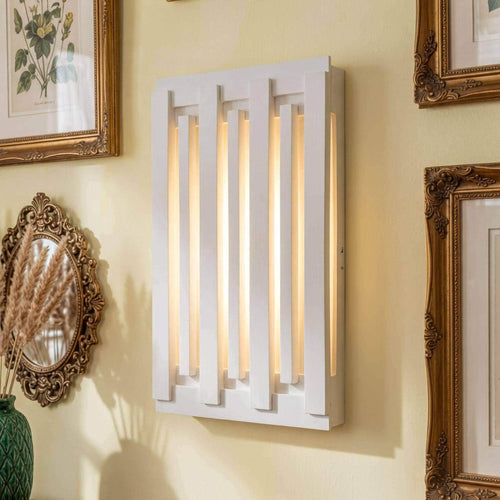
 Japandi Rectangle Wall Light
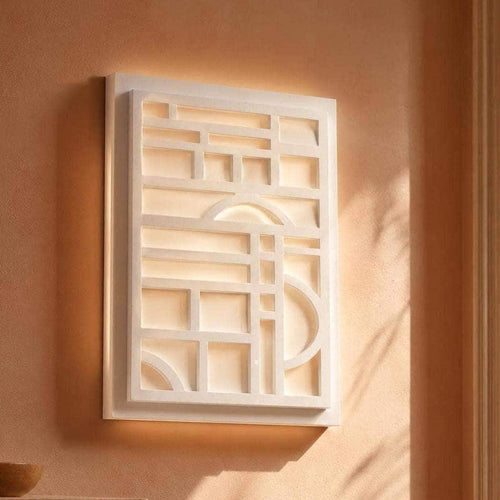
 Bauhaus Wall Light
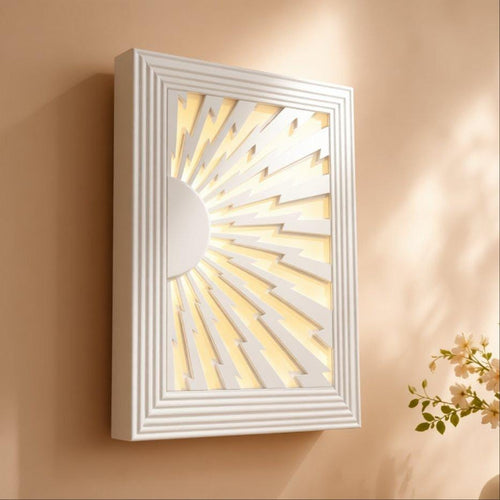
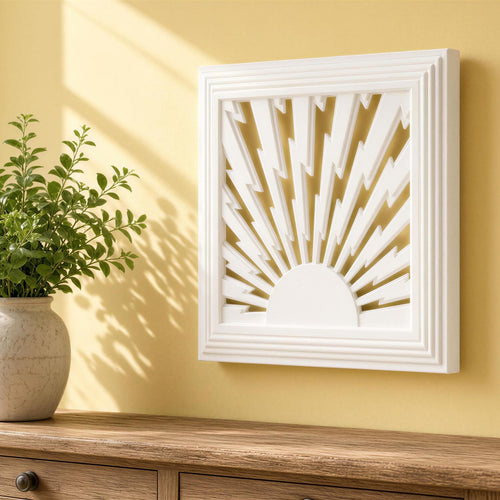
 Sunburst Wall Light (9 in)
 Catalyst Ceiling Rose
How do you bring the Eameses' ideas home?
A plaster wall light beside a reading chair, such as the Japandi Rectangle Wall Light, adds soft light to a mid-century room without clutter. Browse our mid-century collection and modern minimal collection, read our mid-century modern design guide, see how Alvar Aalto bent wood and light in Finland, and compare Charlotte Perriand's approach to modern living. Our guide to layered lighting shows how to combine wall lights and lamps. Our wall lights come as shade only, battery LED with a remote, or UK mains hardwired; hardwired fittings must be installed by a qualified electrician, and in England and Wales notifiable work falls under Part P of the Building Regulations. Every piece is designed and hand-cast in Shrewsbury, and arrives as natural plaster ready to leave raw or paint to suit your room.
Good to know
Common questions
Who were Charles and Ray Eames?
Charles (1907 to 1978) and Ray Eames (1912 to 1988) were an American husband-and-wife design partnership based in Los Angeles. They worked as equals from 1941, designing moulded plywood and fibreglass chairs, the Lounge Chair of 1956, their own house and films such as Powers of Ten.
What is the Eames House?
The Eames House, Case Study House No. 8, is the home and studio Charles and Ray built in Pacific Palisades, Los Angeles, in 1949 from prefabricated steel and glass parts. It is a National Historic Landmark, and the Eames Foundation runs grounds, exterior and small private interior tours.
Where can I see Eames designs in the UK?
The V&A in South Kensington, London, shows an LCW, an Eames Storage Unit and a 1950 fibreglass armchair in its Furniture gallery, with a wartime leg splint and a 1945 prototype chair in Design 1900 to Now. Displays change, so check the V&A website before visiting.
Sources
References and further reading
Harvard style. Web pages were checked on the access date shown.
- Barbican (2015) The World of Charles and Ray Eames. Available at: www.barbican.org.uk/whats-on/2015/event/the-world-of-char... (Accessed: 18 October 2026).
- Beverly Willis Architecture Foundation (n.d.) Ray Kaiser Eames. Pioneering Women of American Architecture. Available at: pioneeringwomen.bwaf.org/?p=168 (Accessed: 18 October 2026).
- Eames Foundation (n.d.) Visit the Eames House. Available at: eamesfoundation.org/visit/ (Accessed: 18 October 2026).
- Eames Office (n.d.) Case Study House #8. Available at: eamesoffice.com/the-work/case-study-house-8/ (Accessed: 18 October 2026).
- Eames Office (n.d.) Molded Plywood Leg Splint. Available at: www.eamesoffice.com/the-work/molded-plywood-leg-splint/ (Accessed: 18 October 2026).
- Eames Office (n.d.) Powers of Ten. Available at: www.eamesoffice.com/the-work/powers-of-ten/ (Accessed: 18 October 2026).
- Victoria and Albert Museum (n.d.) LCW, Charles and Ray Eames. Available at: collections.vam.ac.uk/item/O144157/ (Accessed: 18 October 2026).
- Vitra (n.d.) Charles & Ray Eames. Available at: www.vitra.com/en-gb/about-vitra/designer/details/charles-... (Accessed: 18 October 2026).
How to cite this article
van Locke, J. (2026) ‘Charles and Ray Eames: plywood, play and the modern home’, The Flare Journal. Flare Studio UK. Available at: https://flarestudio.uk/blogs/journal/charles-and-ray-eames-design (Accessed: 12 November 2026).
Shop the style


Conversation
Join the conversation
Questions about the history, a room you are planning, or a piece you have seen in the wild? Leave a comment and Joseph will reply.