

Charlotte Perriand: modern living, from Paris to the Alps


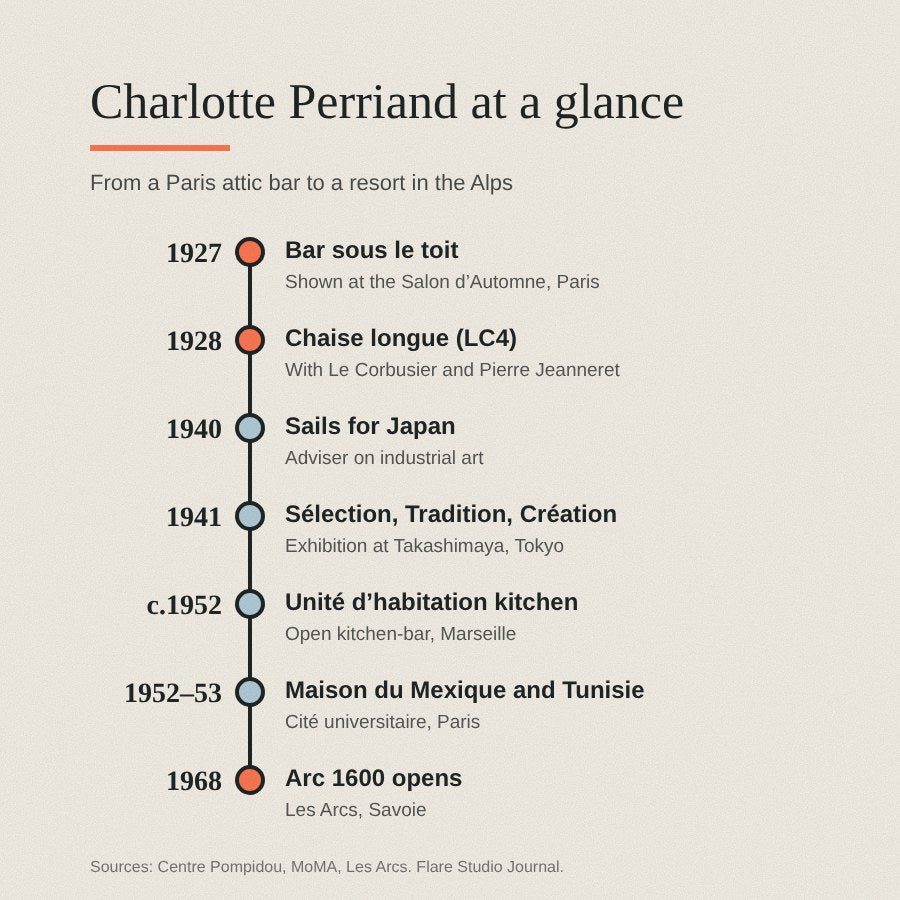
Charlotte Perriand (1903 to 1999) was a French designer and architect who spent seven decades working out how people should live. She began by building a gleaming metal bar in her own Paris attic in 1927, worked for ten years with Le Corbusier and Pierre Jeanneret on furniture such as the LC4 chaise longue, and finished by leading the design of a ski resort in the French Alps.
She matters because she treated the home as a set of everyday problems: where to cook, sit, store and rest. Her answers moved from chrome and steel to wood, bamboo and stone, and that journey from the machine age to natural materials is one many of us are still making in our own rooms.
Who was Charlotte Perriand?
Perriand studied at the Union centrale des Arts Décoratifs in Paris from 1920 to 1925.[1] In 1927, aged 24, she created the Bar sous le toit (bar under the roof) for her apartment on place Saint-Sulpice and showed it at the Salon d'Automne.[1] According to the Centre Pompidou, it used materials borrowed from the car industry.[1] Dwell reports that when she had asked Le Corbusier for a job, he replied "We don't embroider cushions here." After Pierre Jeanneret brought him to see the bar, he took her on.
From 1927 to 1937 she was in charge of furniture and interior equipment in the studio of Le Corbusier and Jeanneret.[1][2] In 1929 she was among the founders of the Union des artistes modernes.[1] In February 1940 the Japanese Ministry of Commerce and Industry invited her to Japan as an adviser on industrial art.[1][7] She sailed from Marseille on 15 June 1940, visited schools and production centres in Tokyo, Kyoto, Osaka and the countryside, with Sori Yanagi as her assistant, and in 1941 staged the exhibition Sélection, Tradition, Création at Takashimaya in Tokyo and Osaka.[1][7] War kept her in Asia, in Japan and then Indochina, until 1946.[1]
Back in France she designed kitchens for the Unité d'habitation in Marseille, worked with Jean Prouvé in Paris, and from 1967 to 1989 led the design team for Les Arcs in Savoie.[1] She published her autobiography, Une vie de création, in 1998 and died in Paris in 1999, aged 96.[1]
Bar under the roof
Her chrome and glass bar at the Salon d'Automne wins her a place with Le Corbusier [1].
What are Charlotte Perriand's key works?
- Bar sous le toit, 1927. A bar for her own home in chrome, glass and aluminium, which won her a place with Le Corbusier.
- Chaise longue (LC4), 1928. Designed with Le Corbusier and Jeanneret and first made by Thonet Frères in Paris.[6] The Design Museum's curator Justin McGuirk notes that Perriand drew all the chaise longue drawings.[3]
- Bamboo chaise longue, 1940. Made in Japan, it swaps steel tube for machined bamboo.
- Unité d'habitation kitchen, about 1952. A compact kitchen opened to the living room, fitted in most of the building's 337 flats.[4]
- Maison du Mexique bookcase, 1952. Shelving that also works as a room divider; Prouvé's workshops made 77, one for each room.
- Les Arcs, from 1967. Arc 1600 opened at Christmas 1968, and the three resort sites would eventually provide 30,000 beds.[5]
What were Perriand's ideas about equipment, nature and light?
- Equipment, not decoration. Her job in Le Corbusier's studio covered furniture and interior equipment. Her 1929 apartment for the Salon d'Automne, reconstructed for the Design Museum in 2021, showed storage, seats and tables working together as one system.[2]
- Open plans for real people. The Design Museum notes that she designed open-plan interiors in the 1920s so that women would not feel trapped in their homes.[2] Her Marseille kitchen-bar took the same view: LACMA quotes her saying it let the cook stay with family and friends while cooking.[4]
- From metal to natural materials. From the 1930s she drew more and more on nature. Her own chalet at Méribel, built in 1961, used stone, a double-pitched roof and local craftsmanship.
- The value of empty space. Japan taught her what she called "the power of emptiness" (Pen).
- Design for the sun. At Les Arcs the tiered buildings were planned to catch as much sunshine as possible, and pedestrians, skiers and cars were kept on separate routes.[5] Light was a starting point, not an afterthought.
- Simple light on the wall. Around 1962 she designed a small bracket wall lamp in plastic and painted metal, now in the Musée des Arts Décoratifs. Like her shelving, it frees the floor.
As a designer, I find the move from the chrome bar to the bamboo chaise the most useful part of her story. The shape barely changes; the material, and the warmth, do.
What do four Perriand pieces show up close?
Four real examples, from a steel chaise in a Le Corbusier villa to an apartment block in the Alps, numbered with the features worth noticing. The swatches are sampled from the photographs themselves, so treat them as a guide rather than a paint match.
1. The chaise longue at the Villa Savoye
An LC4 chaise longue on show at Le Corbusier's Villa Savoye outside Paris. MoMA dates the design to 1928 and credits it to Le Corbusier, Pierre Jeanneret and Charlotte Perriand, in chrome-plated steel, fabric and leather.[6]

- Cylindrical leather headrest
- Curved chrome-plated steel frame, shaped like the body lying down
- Leather mattress over the frame
- Separate dark steel base that the curved frame rests on
- Long band of windows behind
- Sunlight across a plain tiled floor
Colours in this photo:
Leather #314C74Sunlit tiles #8A7659
Take from it: The chaise is a single line drawn around a reclining body. In a calm room, one strong curve is enough.
2. The bamboo chaise longue from Japan
The same idea, remade in Japan. The Musée des Arts Décoratifs in Paris lists this rocking chaise longue as a unique piece made in Japan in 1940 and shown in 1941 at Takashimaya in Tokyo, in bamboo, oak, beech and aluminium.

- Strips of bent bamboo in place of steel tube
- The 1928 curve, now in one flowing run from head to foot
- Solid wooden legs and frame
- Slatted shadows on the plinth
- Paper lamp by Isamu Noguchi, displayed alongside
Colours in this photo:
Bamboo #DA7C30Dark wood #603116Paper shade #D3C1A6
Take from it: Change the material and the same shape gets warmer. Bamboo, wood and paper turn light into soft stripes and glow.
3. The revolving armchair at the V&A
Perriand's revolving armchair (fauteuil pivotant) in the V&A in London. The museum dates the design to 1927, before she joined Le Corbusier's studio, and notes that she first used it in her own Paris apartment.[8] This example was made by Gebrüder Thonet between 1930 and 1933.[8]

- Round, padded backrest that doubles as the arms
- Tubular steel supports holding the back
- Round leather seat cushion
- Central swivel
- Four splayed tubular steel legs
Colours in this photo:
Red leather #7A2B21
Take from it: A circle on a circle. Repeating one simple shape is what makes a modern piece feel resolved.
4. Apartments at Les Arcs
A residential block at Arc 1800, the second village of Les Arcs, which opened in 1974. The Commons description credits the design to Perriand. The resort's own guide says the tiered buildings were planned to catch as much sun as possible.

- Stepped, tiered profile that follows the slope
- A balcony for every flat, framed by a grid of posts
- Dark wall cladding on the stepped blocks
- Upper floors with wide, full-height windows
- Pine forest on the mountainside behind
Colours in this photo:
Balcony blue #445E89
Take from it: Orientation first, decoration never. Every flat faces the light and the view, which is a good test for any room.
- 1A chrome-plated steel frame curved to follow the body from head to feet.
- 2A long cushion covered in fabric or leather.
- 3A head roll at the top end.
- 4A separate black base: the frame rests on it and can be tipped to any angle.
What was the 2019 Paris exhibition like?
The Fondation Louis Vuitton marked twenty years since her death with Le Monde nouveau de Charlotte Perriand (2 October 2019 to 24 February 2020). It filled the whole building, setting her designs among around 200 works by artists such as Fernand Léger and Pablo Picasso, with reconstructions of rooms including the Refuge Tonneau. The London show that followed, Charlotte Perriand: The Modern Life at the Design Museum (19 June to 5 September 2021), was organised with the Perriand family and archive and the Fondation, and marked 25 years since the museum's first Perriand exhibition in 1996.[2]
The Fondation filmed a full walk through the exhibition. It runs to about 21 minutes and shows the reconstructed rooms at full size.
Video: Fondation Louis Vuitton, "Le monde nouveau de Charlotte Perriand | Parcours filmé de l'exposition", via YouTube.
Where can you see Charlotte Perriand's work?
- V&A South Kensington, London. Her revolving armchair is on display in the Dr Susan Weber Gallery (Furniture, Room 133).[8]
- Les Arcs, Savoie. Arc 1600 holds the French Ministry of Culture's Remarkable Contemporary Architecture label.[5] A heritage trail of seven panels in French and English runs from the Mont Blanc chairlift to the Chalets Pointus, and each panel carries a sentence from Perriand's writings.[5]
- Unité d'habitation, Marseille. Built between 1947 and 1952 and part of a UNESCO World Heritage listing of Le Corbusier's work since 2016. The common areas are open, and the tourist office runs booked tours that include a listed apartment.
- Musée des Arts Décoratifs, Paris. The museum's collection includes the bamboo chaise longue made in Japan, a B306 lounger produced by Thonet in 1930 and her bracket lamps.
- Centre Pompidou, Paris. Holds a Maison du Mexique bookcase and a Unité d'habitation kitchen in its design collection.
- In the United States. MoMA holds an LC4 and a Unité kitchen, and LACMA acquired a Unité kitchen in 2019; check what is on view.[6][4]
What design lessons does Charlotte Perriand teach?
- Build storage into the wall. Shelves and cupboards that double as dividers keep the floor clear and the room calm.
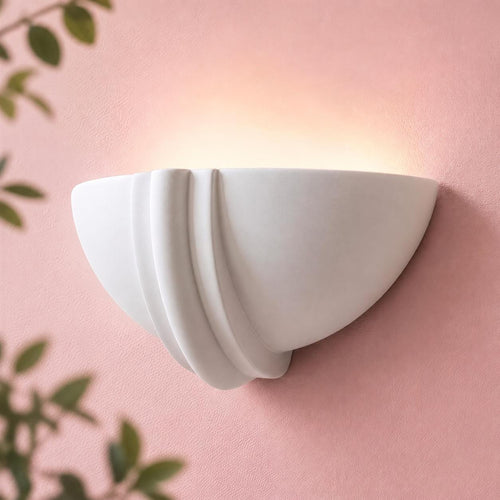
- Keep shapes, warm up materials. Perriand kept her curves and changed steel for bamboo and wood. A matt plaster piece such as the Japandi Curve Plaster Wall Light brings a soft curve to the wall without the chill of metal.
- Face the light. Arrange seats and work surfaces around windows first, then add light where daylight runs out.
- Leave empty space. One good chair and room to move beat a crowded room.
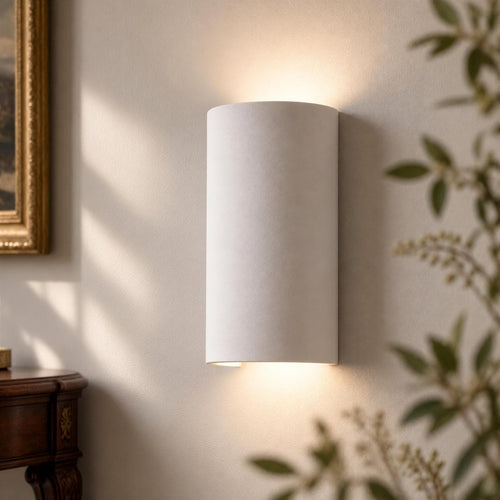
- Put light where people are. A slim wall light such as the Japandi Wall Light (10 in) beside a reading chair or bench does more than a bright central bulb.
Shop the look
Calm, matt plaster shapes for rooms built around natural materials and daylight.
 Japandi Wall Light (10 in)
 Japandi Curve Plaster Wall Light
 Japandi Rectangle Wall Light
 Pebble Wall Light
 Warm Minimalist Wall Light
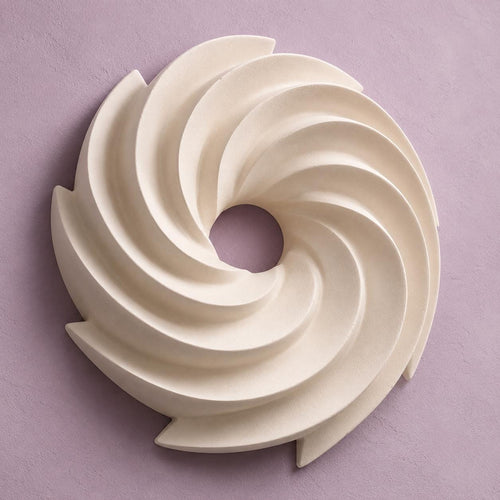
 Ring Ceiling Rose
How do you bring Charlotte Perriand's ideas home?
Pale walls, natural wood and one or two quiet light sources are the simplest way to bring her approach into a room. Our modern minimal collection and wall lights include soft, rounded shapes such as the Pebble Wall Light that suit a room inspired by her work. Our wall lights come as shade only, battery LED with a remote, or UK mains hardwired. Hardwired fittings should be installed by a qualified electrician, under Part P of the Building Regulations in England and Wales for notifiable work. For more, read about her years with Le Corbusier and the modern interior, Isamu Noguchi's Akari lights, our Japandi style guide and the story of Eileen Gray. Every piece is designed and hand-cast in Shrewsbury, and arrives as natural plaster ready to leave raw or paint to suit your room.
Good to know
Common questions
Who was Charlotte Perriand?
Charlotte Perriand (1903 to 1999) was a French designer and architect. She worked with Le Corbusier and Pierre Jeanneret from 1927 to 1937, advised on industrial art in Japan from 1940, designed kitchens for the Unité d'habitation in Marseille and led the design of the Les Arcs ski resort.
Did Charlotte Perriand design the LC4 chaise longue?
MoMA credits the 1928 Chaise Longue (LC/4) jointly to Le Corbusier, Pierre Jeanneret and Charlotte Perriand. The Design Museum's curator notes that Perriand drew all the chaise longue drawings. In Japan in 1940 she remade the idea in bamboo and wood.
Where can I see Charlotte Perriand's work in the UK?
The V&A in South Kensington, London, displays her revolving armchair in its furniture galleries (Room 133). The Design Museum held a major exhibition of her work, Charlotte Perriand: The Modern Life, from 19 June to 5 September 2021.
Did Charlotte Perriand design the LC4 chaise longue?
The LC4 of 1928 was designed by Le Corbusier, Pierre Jeanneret and Charlotte Perriand together, and Perriand drew the chaise longue drawings.
Where can you see Charlotte Perriand's work in London?
Her revolving armchair of 1927 is on display at the V&A in the Dr Susan Weber Gallery (Furniture, Room 133).
Sources
References and further reading
Harvard style. Web pages were checked on the access date shown.
- Centre Pompidou (n.d.) Charlotte Perriand: chronologie [Dossier ressources]. Available at: centrepompidou.fr/fileadmin/user_upload/dossier-ressource... (Accessed: 18 October 2026).
- Design Museum (2021) Charlotte Perriand: The Modern Life. Available at: designmuseum.org/exhibitions/charlotte-perriand-the-moder... (Accessed: 18 October 2026).
- Finney, A. (2021) 'Design Museum curator picks five highlights from Charlotte Perriand: The Modern Life exhibition', Dezeen, 11 August. Available at: www.dezeen.com/?p=1694585 (Accessed: 18 October 2026).
- LACMA (2019) New acquisition: Charlotte Perriand's kitchen from an apartment in Le Corbusier's Unité d'Habitation. Unframed, 16 April. Available at: unframed.lacma.org/2019/04/16/new-acquisition-charlotte-p... (Accessed: 18 October 2026).
- Les Arcs (n.d.) Heritage trail. Available at: ru.lesarcs.com/patrimoine/architecture/discover-it-yourse... (Accessed: 18 October 2026).
- Museum of Modern Art (n.d.) Chaise Longue (LC/4), 1928. Available at: www.moma.org/collection/works/2796 (Accessed: 18 October 2026).
- Pen (n.d.) Charlotte Perriand and Japan. Available at: pen-online.com/design/charlotte-perriand-and-japan/ (Accessed: 18 October 2026).
- Victoria and Albert Museum (n.d.) Fauteuil pivotant (Revolving armchair), Charlotte Perriand. Available at: collections.vam.ac.uk/item/O122238 (Accessed: 18 October 2026).
How to cite this article
van Locke, J. (2026) ‘Charlotte Perriand: modern living, from Paris to the Alps’, The Flare Journal. Flare Studio UK. Available at: https://flarestudio.uk/blogs/journal/charlotte-perriand-modern-living (Accessed: 12 November 2026).
Shop the style


Conversation
Join the conversation
Questions about the history, a room you are planning, or a piece you have seen in the wild? Leave a comment and Joseph will reply.