

Le Corbusier: the modern interior, the five points and colour


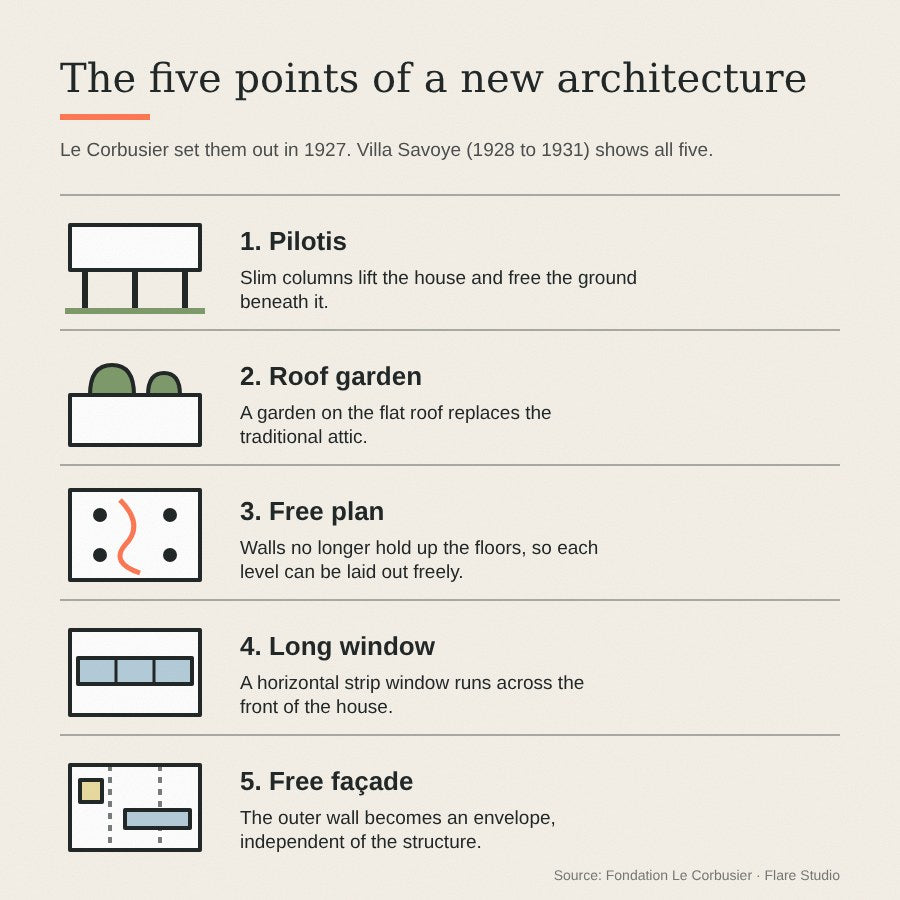
Le Corbusier (1887 to 1965) was a Swiss-born architect, painter and writer who settled in Paris and became one of the most influential voices in modern architecture. Born Charles-Édouard Jeanneret, he gave the modern house its rules: lift it on slim columns, free the plan, run a long window across the front and put a garden on the roof.
He matters to anyone furnishing a home today because he thought about the whole interior, not just the building. He designed furniture with Pierre Jeanneret and Charlotte Perriand, built a palette of wall colours for a wallpaper firm, and treated light as a material. In 2016 UNESCO listed 17 of his works across seven countries as World Heritage.[8]
Who was Le Corbusier?
Charles-Édouard Jeanneret was born on 6 October 1887 in La Chaux-de-Fonds, a Swiss watchmaking town, the son of a watch enameller and a piano teacher.[2] He trained at the local art school, where his teacher Charles L'Eplattenier steered him towards architecture.
In 1917 he settled in Paris for good.[2] With the painter Amédée Ozenfant he launched Purism and, in 1920, the magazine L'Esprit Nouveau, where he first signed his architectural articles "Le Corbusier".[2] In 1922 he began working with his cousin Pierre Jeanneret, and the next year he published Vers une architecture, the book that made his name.[2] From 1924 his studio was at 35 rue de Sèvres in Paris, and he became a French citizen in 1930.
After the Second World War his work turned to raw concrete: the Unité d'habitation in Marseille, the chapel at Ronchamp and the new capital of Chandigarh in India. He died on 27 August 1965 while swimming in the Mediterranean at Roquebrune-Cap-Martin. His reputation is still argued over, and the Fondation Le Corbusier publishes its own page on the controversies around him.
What are Le Corbusier's five points?
Le Corbusier set out his "five points of a new architecture" in 1927, in a brochure for the Weissenhof housing exhibition in Stuttgart.[3] The Fondation Le Corbusier notes that they first appeared in built form at the Maison La Roche in Paris, begun in 1923.[3] All five rest on the concrete frame: once slim posts carry the floors, the walls no longer have to.
Villa Savoye at Poissy, west of Paris, shows all five at once. Pierre and Eugénie Savoye commissioned it in 1928 as a weekend house, and it was finished in the summer of 1931.[7][1] The white upper floor sits on pilotis like "a box in the air", a long window runs round all four sides, and a ramp climbs through the middle to a roof terrace. The Savoyes called it "Les Heures claires", the bright hours.[1]
What were Le Corbusier's ideas about light, colour and the modern interior?
- Equip the house, do not decorate it. At the 1925 Paris exhibition, the great showcase of Art Deco, Le Corbusier and Pierre Jeanneret built the Pavillon de l'Esprit Nouveau: a white box with a tree growing up through its roof.[5] Inside were standard storage units and mass-produced furniture, not costly one-off pieces. The alarmed organisers put up a fence to hide it.
- Furniture as equipment. In October 1927 he hired Charlotte Perriand to work on furniture. In 1928, with Pierre Jeanneret, the team designed metal-framed seats including the chaise longue, the Grand Confort armchairs and a swivel chair, shown at the Salon d'Automne in 1929. Our piece on Charlotte Perriand tells her side of that story.
- Colour is architecture. White was the background, never the whole story. In 1931 he produced a collection of 43 wall colours for the Swiss wallpaper firm Salubra, arranged in "colour keyboards" with card frames for testing two or three tones together. He added 20 stronger shades in 1959.[4] In a 1936 lecture he put it plainly: "If a wall is blue, it recedes; if it is red, it holds the plane."[4]
- Light on four sides. At Villa Savoye the long window turns the landscape into a picture and lets sunlight in on all four sides, which suits its nickname. Artificial light was kept just as plain: for the dining room at the Maison La Roche he designed simple metal rods with bare bulbs.
- Raw concrete and human scale. After the war he left concrete rough from the formwork, an approach the Fondation links to Brutalism.[3] He measured it against the Modulor, a scale of proportions based on a man 1.83 metres tall, which he developed between 1943 and 1950.[3]
- Light as the main event. At Notre-Dame-du-Haut in Ronchamp (1955), painted glass throws coloured light into a chapel of curves, raw concrete and painted plaster.
As a designer who works in plaster every day, I find that list of materials telling: even at his most sculptural, he used a plain painted wall to catch the light.
What are Le Corbusier's buildings like?
Three real buildings, numbered with the features worth noticing. Swatches are sampled from the photographs, so treat them as a guide, not a paint match.
1. The five points on a hillside: Weissenhof, Stuttgart
In 1927 Mies van der Rohe invited 17 architects to build a model housing estate in Stuttgart. Le Corbusier and Pierre Jeanneret built two houses there, both meant to illustrate the five points. This is the double house, which now holds the Weissenhofmuseum.

- Roof terrace under a thin concrete canopy
- Long strip window across the main floor
- A single small window, set freely in the wall
- Slim columns carrying the house
- A recessed ground floor painted dark red
- Sign for the Weissenhofmuseum at the entrance
Take from it: White walls, one long window and a single dark colour pushed back into shadow. The same restraint works on an inside wall.
2. A garden in the sky: the same house, on the roof
The roof terrace of the double house. The Fondation Le Corbusier notes that the roof terrace held a small library and a garden.[7] Here the five points and his use of colour meet.

- Columns painted a deep blue
- A paler blue wall that seems to fall back
- An earth-brown wall that holds its place
- Curved concrete planters for the roof garden
- Large plain paving slabs
- A wide opening framing the view
- A low white parapet
Colours in this photo:
Column blue #2F4F83Wall blue #7399CCEarth brown #605050
Take from it: Three colours do all the work here: two blues and a brown against white. Pick a deep tone for the things you want noticed and a pale one for the walls you want to recede.
3. Colour on raw concrete: the Unité d'habitation, Berlin
The Berlin version of the Unité, built in 1957 for the Interbau exhibition.[6] It has 557 homes, all with a loggia. The Fondation describes a colour system different from his other Unités: pairs of colours split by a diagonal, and colour duos on the walls between the loggias.

- White and red pair split by a diagonal
- Black and sky blue pair
- A colour on the wall between two loggias
- Bands of glazing to every home
- Precast concrete balustrades with an open pattern
Colours in this photo:
Red #871E1ASky blue #6DB3D1Black #1B2023Concrete #E3DBCA
Take from it: Colour does not have to fill a wall. A single diagonal between two tones gives a plain surface energy, and works just as well on a painted headboard or a chimney breast.
What does the Fondation Le Corbusier's film show?
The Fondation Le Corbusier made this short film about the Maisons La Roche and Jeanneret in Paris for the fifth anniversary of the UNESCO listing.[8] It is under four minutes and shows the houses where the five points and his first wall colours were tried out.
Video: Fondation Le Corbusier, "5th Anniversary_Architectural Work of Le Corbusier on UNESCO's_Maisons La Roche & Jeanneret_2021", via YouTube.
Where can you see Le Corbusier's work?
He built nothing in Britain, but London still has something to show. At the V&A in South Kensington, a 1920s edition of Vers une architecture is listed as on display in Design 1900 to Now (Room 74), and the Architecture gallery (Room 128) has a model of his unbuilt Governor's Palace for Chandigarh, made for the Hayward Gallery's centenary exhibition in 1987. Its Prints and Drawings Study Room holds his 1959 Salubra wallpaper sample book. Displays change, so check the V&A website before you go.
Abroad, these are the places where you can walk inside:
- Maison La Roche, Paris. 10 square du Docteur Blanche, run by the Fondation Le Corbusier. The art gallery, the ramp and the early polychromy. Open Tuesday to Saturday; online booking is required.
- Le Corbusier's apartment-studio, Paris. The top two floors of the Molitor building at 24 rue Nungesser-et-Coli, where he lived from 1934. Open on set days, with online booking.
- Villa Savoye, Poissy. 82 rue de Villiers, run by the Centre des monuments nationaux.[1] Open every day except Monday.
- Unité d'habitation, Marseille. Still lived in. The interior street has a hotel, a restaurant and a bookshop, and apartment 643 is kept for tours run by the Marseille Tourist Office.
- Notre-Dame-du-Haut, Ronchamp. The chapel and its hill are open to visitors with a ticket; see the chapel's own website for the season's hours.
- Pavillon Le Corbusier, Zurich. His only steel and glass building, completed in 1967 for Heidi Weber and run by the Museum für Gestaltung Zürich. Open from April to November.
What design lessons does Le Corbusier teach?
- Use white as the ground, not the scheme. Le Corbusier painted most surfaces white and then let a few walls carry strong colour. Pick two or three tones and give each a whole wall; our colour drenching guide takes the opposite route.
- Move walls with paint. A blue or grey-blue wall seems to step back; an earth red or ochre one holds its place. In a narrow room, paint the far wall a cool colour to stretch it.
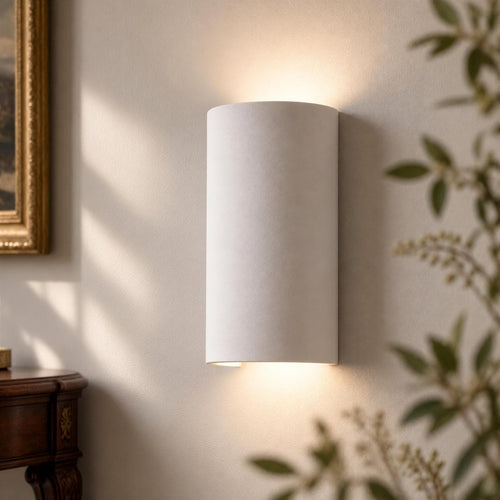
- Keep the light fitting plain. His own fittings were rods and bare bulbs. A simple shape such as the Linear Wall Light keeps the wall calm and lets the light do the work.
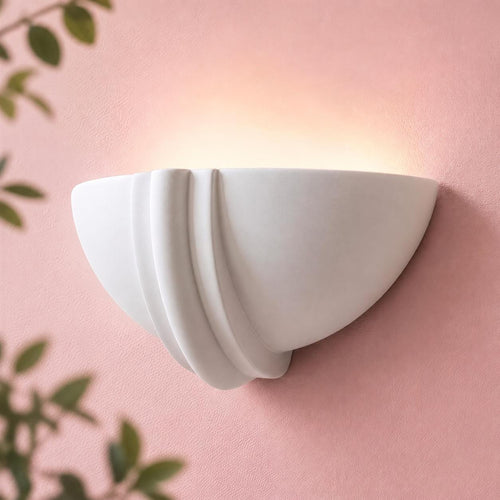
- Let the material show. His later buildings kept the marks of the formwork. Raw, unpainted plaster has the same honesty: the Soft Brutalism Wall Light can be left raw.
- Think in horizontals. A long window, a low shelf or a wide bench all repeat the strip window. A rectangular fitting such as the Japandi Rectangle Wall Light echoes the line on the wall.
Shop the look
Plain shapes, matt plaster and long lines that suit a white-walled modern room.
 Soft Brutalism Wall Light
 Linear Wall Light
 Japandi Rectangle Wall Light
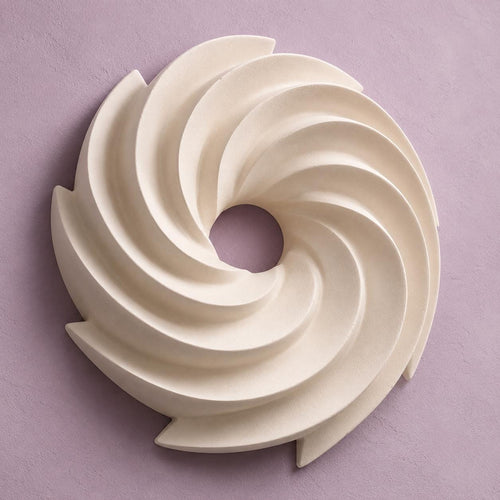
 Bauhaus Round Wall Light
 Ring Ceiling Rose
How do you bring Le Corbusier's ideas home?
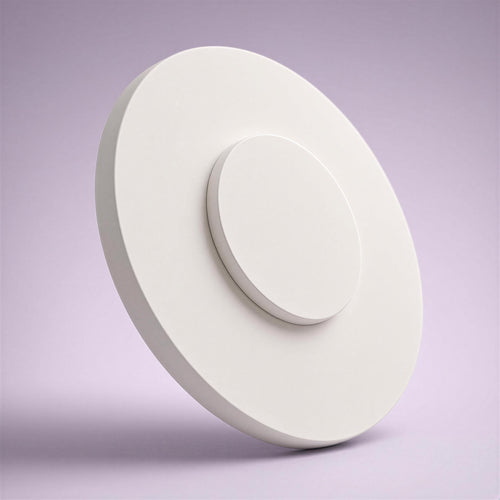
Start with one painted wall and one plain source of light. A single clean circle overhead, such as our Ring Ceiling Rose, suits a white ceiling, and the pieces in our modern minimal collection are shaped with the same restraint. For the story of the white house around him, read our pieces on Mies van der Rohe and Eileen Gray, whose villa E-1027 stands next to his Cabanon. Our wall lights come as shade only, battery LED with a remote, or UK mains hardwired. Hardwired fittings should be installed by a qualified electrician, under Part P of the Building Regulations in England and Wales for notifiable work. Every piece is designed and hand-cast in Shrewsbury, and arrives as natural plaster ready to leave raw or paint to suit your room.
Good to know
Common questions
What are Le Corbusier's five points of architecture?
They are pilotis (slim columns that lift the house), a roof garden, a free plan, a long horizontal window and a free facade. All five depend on a concrete frame carrying the floors, so the walls no longer have to. He set them out in 1927, and Villa Savoye shows all five.
Did Le Corbusier use colour in his interiors?
Yes. White was his background, but he painted chosen walls in strong, matt colours to move them visually: blues to make a wall recede, reds and earths to hold it in place. In 1931 he produced a collection of 43 colours for the Swiss wallpaper firm Salubra, and added 20 more in 1959.
Can you visit Le Corbusier's buildings?
Yes. In Paris you can visit the Maison La Roche and his apartment-studio, both with online booking. Villa Savoye at Poissy is open every day except Monday, apartment 643 in the Marseille Unité d'habitation can be seen on tours, and the chapel at Ronchamp is open with a ticket.
Sources
References and further reading
Harvard style. Web pages were checked on the access date shown.
- Centre des monuments nationaux (n.d.) The villa Savoye in color. Available at: www.villa-savoye.fr/en/discover/the-villa-savoye-in-color (Accessed: 18 October 2026).
- Fondation Le Corbusier (n.d.) Biography, 1917-1922: "À nous deux Paris!". Available at: www.fondationlecorbusier.fr/en/biography/1917-1922/ (Accessed: 18 October 2026).
- Fondation Le Corbusier (n.d.) Corbusean vocabulary. Available at: www.fondationlecorbusier.fr/en/thematic-folder/corbusean-... (Accessed: 18 October 2026).
- Fondation Le Corbusier (n.d.) Le Corbusier's architectural polychromy. Available at: www.fondationlecorbusier.fr/en/le-corbusier/works/archite... (Accessed: 18 October 2026).
- Fondation Le Corbusier (n.d.) Pavillon de l'Esprit Nouveau, Paris, France, 1924-1925. Available at: www.fondationlecorbusier.fr/en/work-architecture/achievem... (Accessed: 18 October 2026).
- Fondation Le Corbusier (n.d.) Unité d'habitation, Marseille, France, 1945-1952. Available at: www.fondationlecorbusier.fr/en/work-architecture/achievem... (Accessed: 18 October 2026).
- Fondation Le Corbusier (n.d.) Villa Savoye and Gardener's Lodge, Poissy, France, 1928. Available at: www.fondationlecorbusier.fr/en/work-architecture/achievem... (Accessed: 18 October 2026).
- UNESCO World Heritage Centre (2016) The Architectural Work of Le Corbusier, an Outstanding Contribution to the Modern Movement. Available at: whc.unesco.org/en/list/1321 (Accessed: 18 October 2026).
How to cite this article
van Locke, J. (2026) ‘Le Corbusier: the modern interior, the five points and colour’, The Flare Journal. Flare Studio UK. Available at: https://flarestudio.uk/blogs/journal/le-corbusier-modern-interiors (Accessed: 12 November 2026).
Shop the style


Conversation
Join the conversation
Questions about the history, a room you are planning, or a piece you have seen in the wild? Leave a comment and Joseph will reply.