Eileen Gray: lacquer, E-1027 and lessons in modern design


Eileen Gray (1878–1976) was an Irish-born designer and architect who worked mainly in France. She began as a master of lacquer, opened her own Paris gallery in the 1920s, and then designed E-1027, a white villa above the sea at Roquebrune-Cap-Martin that is now recognised as one of the key buildings of modern architecture.
Her best-known object is the E-1027 adjustable table, a tubular steel side table whose height can be changed. It sums up her approach: modern materials, clean lines, and design that starts with the person using it rather than with a theory. That is why her work still feels so liveable.
Who was Eileen Gray?
Gray was born near Enniscorthy in County Wexford and studied at the Slade School of Fine Art in London. In 1902 she settled in Paris, where she spent most of her long life. She was independent, private and largely self-taught as an architect, and for decades her work was overlooked or credited to the men around her. Since the 1970s her reputation has grown steadily, and the National Museum of Ireland at Collins Barracks in Dublin holds a permanent collection of her work.
Lacquer
In Paris Gray learned the slow craft of Asian lacquer from the Japanese craftsman Seizo Sugawara. Real lacquer is built up in many thin coats, each dried and polished, and a single screen can take months. Gray made panels, screens and furniture in deep reds, blacks and golds, and by the early 1920s she was creating whole lacquered interiors. In 1922 she opened a shop, Jean Désert, on the rue du Faubourg Saint-Honoré to sell her furniture, lamps and rugs.
As someone who works with a hand-finished material, I find her patience with lacquer moving. She understood that surface is not decoration. It is the thing you see and touch every day.

E-1027
Gray designed E-1027 between 1926 and 1929 with the architect and critic Jean Badovici. The name is a code: E for Eileen, 10 for J (the tenth letter, Jean), 2 for B (Badovici) and 7 for G (Gray). The house sits low on a rocky slope above the Mediterranean, with long windows, shutters that control the light, and a terrace that works as an outdoor room.
Inside, almost everything was designed for the house: built-in cupboards, folding screens, a bed placed to catch the morning light, and furniture that swivels, extends or folds. Later, Le Corbusier painted murals on its walls without her permission, which she regarded as vandalism. After years of decay the house has been restored and can be visited as part of the Cap Moderne site.
Gray's modernism was never cold. Every line in E-1027 answers a question about how someone would sit, sleep, read or look at the sea.
The adjustable table and other furniture
- E-1027 adjustable table. A round glass top on a chrome frame with an open C-shaped base that slides under a bed or sofa. The height adjusts, so it works as a side table or a breakfast tray.
- Bibendum chair. Plump, stacked tubular cushions on a chrome base, named after the Michelin man.
- Folding screens. From lacquered panels to her "brick" screens of pivoting blocks, used to shape space rather than close it off.
- Lighting. Simple, sculptural lamps that treated light as part of the room's composition.
Modern design lessons from Eileen Gray
Gray's work offers practical lessons for anyone furnishing a modern or minimal room.
- Design around habits. Think about where you actually read, eat or rest, and put light and surfaces there.
- Let pieces move. Small, adaptable furniture makes a room work harder than large fixed pieces.
- Control light. Shutters, screens and directional lamps let a room change through the day.
- Use texture, not clutter. A minimal room needs good surfaces: lacquer, leather, wool, plaster.
- Curves soften straight lines. Gray mixed tubular geometry with round tables and soft upholstery.
Bringing her ideas home
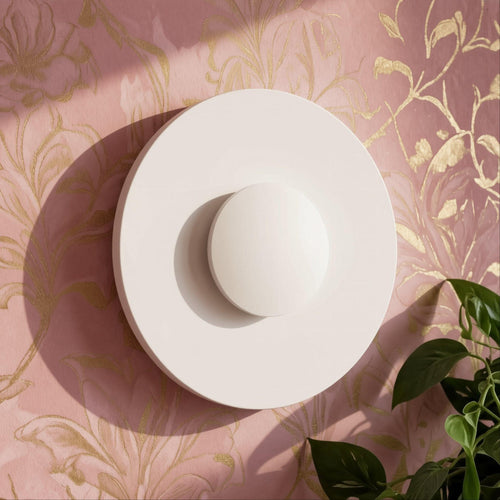
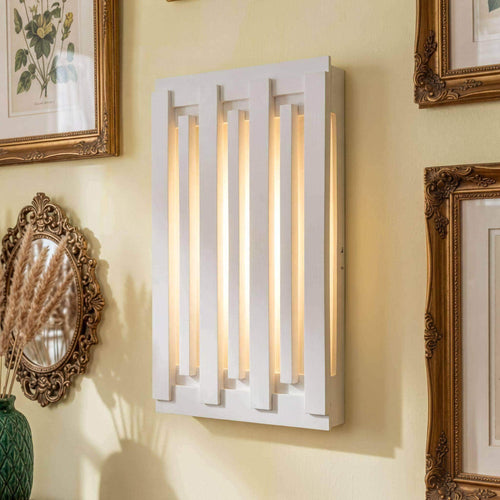
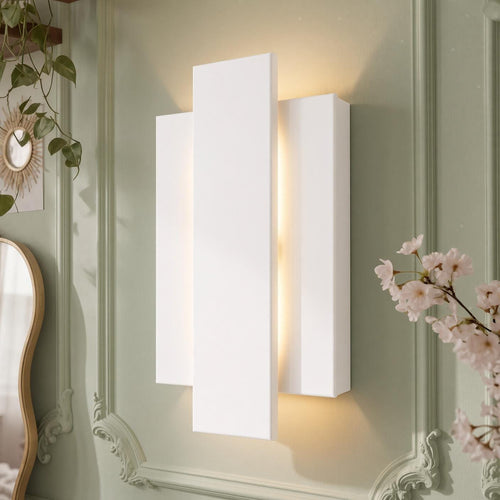
A simple curved wall light beside a reading chair or bed follows Gray's habit of putting light exactly where it is used. Plaster suits a modern room well because its soft, matt surface adds texture without pattern. Our wall lights are hand-cast to order in Shrewsbury and come as shade only, battery LED with a remote, or UK mains hardwired. Hardwired fittings should be installed by a qualified electrician, under Part P of the Building Regulations in England and Wales for notifiable work.
See the modern minimal collection, and for the wider story read our piece on the Bauhaus and modern minimalism.
Good to know
Common questions
Who was Eileen Gray?
Eileen Gray (1878 to 1976) was an Irish-born designer and architect who worked mainly in France. She began in lacquer, opened the Jean Désert gallery in Paris in 1922, and designed the villa E-1027 and the E-1027 adjustable table, now classics of modern design.
What does E-1027 stand for?
It is a code for Eileen Gray and Jean Badovici: E for Eileen, 10 for J (the tenth letter of the alphabet), 2 for B and 7 for G. The villa at Roquebrune-Cap-Martin was designed between 1926 and 1929.
Can you visit E-1027?
Yes. The restored villa is part of the Cap Moderne site at Roquebrune-Cap-Martin, alongside Le Corbusier's Cabanon. Visits are by guided tour and booking in advance is required, so check the Cap Moderne website for dates.
Sources
References and further reading
Harvard style. Web pages were checked on the access date shown.
- Adam, P. (1987) Eileen Gray: Architect/Designer. London: Thames & Hudson.
- Constant, C. (2000) Eileen Gray. London: Phaidon.
- National Museum of Ireland (n.d.) Eileen Gray Collection. Available at: www.museum.ie/collections/collections-and-research/art-in... (Accessed: 8 October 2026).
- Cap Moderne (n.d.) Cap Moderne. Available at: capmoderne.com/ (Accessed: 8 October 2026).
- Ministry of Housing, Communities and Local Government (2013) Electrical safety: Approved Document P. Available at: www.gov.uk/government/publications/electrical-safety-appr... (Accessed: 8 October 2026).
How to cite this article
van Locke, J. (2026) ‘Eileen Gray: lacquer, E-1027 and lessons in modern design’, The Flare Journal. Flare Studio UK. Available at: https://flarestudio.uk/blogs/journal/eileen-gray-modern-design (Accessed: 12 October 2026).
Shop the style