

Marianne Brandt and the Bauhaus lamp


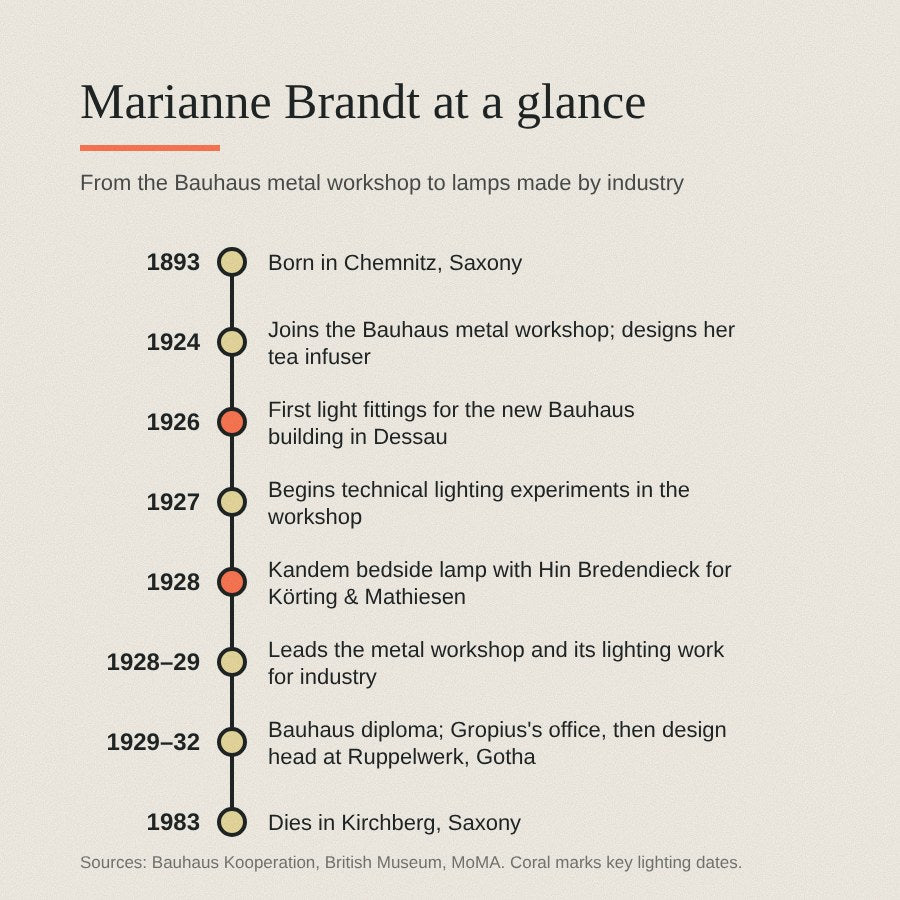
Marianne Brandt (1893–1983) was a German designer who trained in the Bauhaus metal workshop. She arrived as a painter, was the only woman in the Weimar metal workshop, and by 1928 was leading it. Her small silver tea infuser of 1924 has, in the British Museum's words, "become famous as a classic Bauhaus object".[3]
She matters to anyone who cares about lighting because she turned the Bauhaus idea of design for industry into lamps that were actually made and sold. With Hin Bredendieck she developed lights for the Leipzig firm Körting & Mathiesen, including the Kandem bedside lamp of 1928, which stayed in production for nearly two decades.[6] It is a quiet, practical object, and that is the point.
Who was Marianne Brandt?
Brandt was born in Chemnitz on 1 October 1893.[2] She went to a private art school in Weimar in 1911 and then studied painting and sculpture at the Weimar academy of fine art. In 1919 she married the Norwegian painter Erik Brandt.
She joined the Bauhaus in Weimar in 1924.[2] She took the preliminary course, taught by Josef Albers and László Moholy-Nagy, and attended classes by Paul Klee and Wassily Kandinsky. Moholy-Nagy encouraged her into the metal workshop at a time when, as MoMA notes, most women at the school were directed towards textiles.[1][2] The British Museum records that she was the only woman in the Weimar metal workshop.[3]
The Bauhaus said it would take talented students regardless of sex, and in 1919 more women than men began their studies: 84 women and 79 men.[1] Yet Walter Gropius soon called for stricter selection, and women were steered into a separate weaving workshop.[1] Gunta Stölzl became the only woman to lead a workshop as master, in weaving from 1927 to 1931.[1] Brandt made her career in a workshop where most of the students were men.
What are Marianne Brandt's key works?
Brandt's career moved quickly. In 1925 the school moved to Dessau, into a new building designed by Gropius that opened on 4 December 1926. Brandt designed its first light fittings. From 1927 she ran technical lighting experiments in the metal workshop, and from May 1928 to July 1929 she led the workshop and its work on lighting for mass production.[2] She received her Bauhaus diploma on 10 September 1929.[2]
After leaving, she worked for six months in Gropius's architecture office in Berlin, then ran the design department of the Ruppelwerk metal goods factory in Gotha until 1932. After the war she taught in Dresden and Berlin.
What were Brandt's ideas about light?
- Start with the use. The tea infuser is only about three inches high because it was made to brew a strong extract, diluted in the cup to taste. The Metropolitan Museum of Art points out that its size follows directly from that job.[5]
- Solve the small problems. Contemporaries praised the infuser's push-on lid, set away from the spout so it does not drip, and its handle and knob in heat-resistant ebony.
- Build from simple shapes. Circles, hemispheres and cylinders recur across her work. The British Museum links these geometric forms to the Constructivist prints of her teacher Moholy-Nagy.[3]
- Put the light where it is needed. The Kandem bedside lamp has a movable shade, so the light can be pointed at a book rather than spread across the room.[4][6]
- Design for the factory. Her early teapot was hand-forged and remained a prototype. Her later lamps went into mass production. A 2019 paper published by the University of Technology Sydney calls the bedside lamp one of the few complete industrial design projects to come out of the Bauhaus.[8]
As a designer, I find the second point the most useful. Most of what makes a light pleasant to live with is decided by small things: where the switch sits, how the shade hides the bulb, how easily it can be cleaned.
The other Bauhaus lamp
The lamp most people call the "Bauhaus lamp" is not Brandt's. It was designed in 1923 to 1924 by Wilhelm Wagenfeld and Carl Jakob Jucker in the same metal workshop: chromed metal and glass, with simple geometric parts on show and an opaque glass shade that diffuses the light.[7] MoMA notes that its first sales in 1924 failed, mainly because the parts were still assembled by hand.[7] Her Kandem work shows what happened when the workshop stopped making prototypes and started working directly with a manufacturer.
Marianne Brandt's work, annotated
Free-to-use photographs of Brandt's Kandem lamps are hard to find, so here are four other real examples: two pieces from the metal workshop, the building she lit, and her later work for industry. Each photograph is numbered with the features worth noticing. Where the photo is in colour, the swatches are sampled from the photograph itself, so treat them as a guide rather than a paint match.
1. Two teapots, 1924
Two of Brandt's teapots from 1924, photographed in the collection of the Bauhaus Museum Weimar. They are different shapes, but they are built from the same short list of parts.

- Spherical body
- Half-disc handle in dark wood
- Straight, narrow spout
- Small feet that lift the body off the surface
- Shallow, bowl-shaped body
- Round lid, stepped in two levels
- Small dark knob on the lid
Colours in this photo:
Polished metal #7D5931Ebony #1C1B19
Take from it: Two pots, one vocabulary. Choose a single shape, such as a circle or a half-disc, and repeat it across the lights, handles and mirrors in one room.
2. The samovar, 1925
A samovar by Brandt from 1925, in nickel silver, ebony and glass, shown at the Busch-Reisinger Museum at Harvard beside tea glass holders by Josef Albers from the same year.

- Plain cylindrical body in polished nickel silver
- Lid with an ebony knob
- Curved handles ending in small balls
- Tap for drawing off hot water
- Glass rods used as legs
- Flat ring base
- Tea glass holders by Josef Albers, 1925
Take from it: Polished metal, dark wood and clear glass: three materials, each doing one job. A short list of materials is the quickest route to a calm modern room.
3. The Bauhaus building, Dessau
Gropius's Bauhaus building in Dessau, built in 1925 to 1926 and opened on 4 December 1926. Brandt designed its first light fittings, and it was here that she later led the metal workshop. The glass-walled block is the workshop wing.

- Glass curtain wall of the workshop wing
- Vertical BAUHAUS lettering
- Lower storey set back beneath the glass
- Flat roof with a thin, crisp edge
- Studio block with small projecting balconies
- Entrance under a flat canopy
Colours in this photo:
Grey render #A49D9BWhite render #F9F1F0
Take from it: Glass, render and steel, with no applied ornament. Indoors, that becomes plain walls and a few well-made fittings, each placed for a reason.
4. Napkin holders for Ruppelwerk, 1930 to 1932
After the Bauhaus, Brandt ran the design department at the Ruppelwerk metal goods factory in Gotha until 1932. These painted metal napkin holders from those years are in the Milwaukee Art Museum.

- Triangular frame, open at the top
- Grid infill on the coral version
- Conical base
- Folded strip foot on another version
- A finer lattice on a third version
- Frame built from flat strips of metal
Colours in this photo:
Yellow #F2DB78Blue #678B99Mint #CCD8B3Coral #C83B2A
Take from it: One simple form, made in several colours and variations: this is design for production. At home, one shape in two or three colours can tie a set of rooms together.
Watch: a Brandt light up close
The Bauhaus Dessau Foundation's short "From the display case" films each look at one object in its collection. This one, in German, is about a spherical light (Kugelleuchte) by Brandt in the Bauhaus Museum Dessau.
Video: Stiftung Bauhaus Dessau, "Aus der Vitrine – digital | Kugelleuchte von Marianne Brandt | Bauhaus Museum Dessau", via YouTube.
Where can you see Marianne Brandt's work?
- British Museum, London. A silver and ebony tea infuser designed by Brandt in 1924 and made in the Bauhaus metal workshop.[3] At the time of writing the museum lists it on display in Room 48, Europe 1900 to the present.
- Bauhaus Building, Dessau. Gropius's school building of 1925 to 1926, where Brandt designed the first light fittings and later ran the metal workshop. It is part of the Bauhaus UNESCO World Heritage Site, inscribed in 1996, and the Bauhaus Dessau Foundation runs guided tours that can include historic rooms such as the assembly hall.
- Bauhaus Museum Dessau. Opened on 8 September 2019 for the Bauhaus centenary. It holds about 49,000 catalogued objects, the second-largest Bauhaus collection in the world.
- Bauhaus Museum Weimar. Opened in April 2019. Its permanent exhibition includes Brandt's teapot and the Wagenfeld and Jucker table lamp.
- Collections abroad. MoMA in New York holds a Kandem bedside lamp and a 1924 teapot, the Metropolitan Museum of Art has a tea infuser, and the Centre Pompidou in Paris and the Kunstpalast in Düsseldorf both hold the bedside lamp.[4][6] Not every piece is on view, so check the collection pages before you travel.
Modern design lessons from Marianne Brandt
Brandt's work is a good guide for anyone lighting a modern or minimal room.
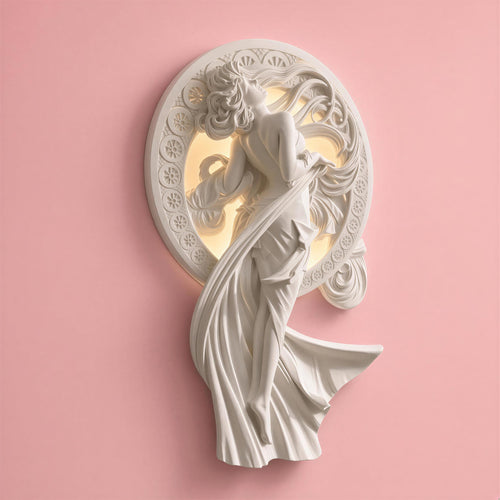
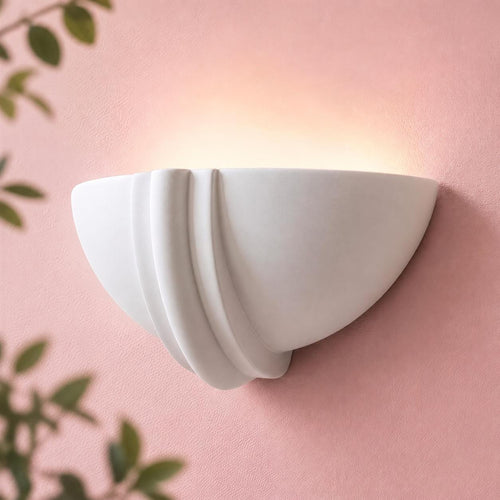
- Light the task first. Before choosing a ceiling light, decide where you read, work and rest, and put a directed light there. A wall light such as the Bedside Wall Light beside a bed does the job of a bedside lamp and frees the table. Our bedroom wall lights guide covers placement.
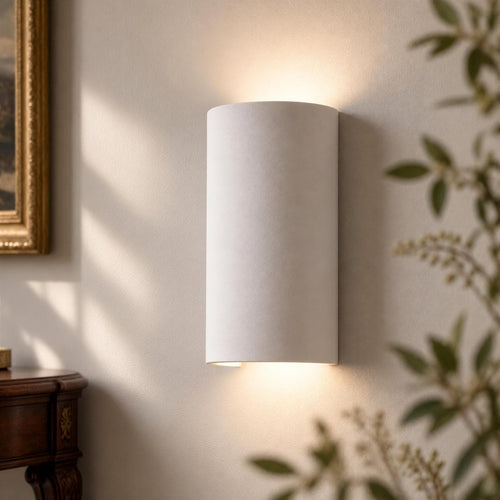
- Use one shape well. A circle, a hemisphere or a cylinder, repeated, gives a room calm. The Bauhaus Round Wall Light keeps to a single geometric form on the wall.
- Hide the bulb. The Wagenfeld and Jucker lamp diffuses its light through opaque glass, and Brandt's bedside lamp turns its shade towards the page. A shade that washes light up or down the wall will feel softer than a bare bulb.
- Keep the ceiling simple. A modern ceiling needs very little. Overhead, a clean circle such as the Ring Ceiling Rose frames a pendant without adding pattern.
- Let the material decorate. Lacquered steel, nickel silver, silver and ebony: Bauhaus objects let the finish do the decorating. Plaster works the same way, left raw or painted one flat colour.
Shop the look
Simple geometric plaster pieces that put light where you need it.
 Bauhaus Round Wall Light
 Bauhaus Wall Light
 Bauhaus Trio Wall Light
 Bedside Wall Light
 Ring Ceiling Rose
 Vogue Ceiling Rose
Bringing Marianne Brandt's ideas home
Brandt's lamps were small, direct and made to be used, and that suits a modern home well. Our modern minimal collection gathers the plainest geometric pieces, and the wall lights come as shade only, battery LED with a remote, or UK mains hardwired. Hardwired fittings should be installed by a qualified electrician, under Part P of the Building Regulations in England and Wales for notifiable work. For the wider story read our guide to the Bauhaus and modern minimalism, see how a fellow modernist approached glare in Poul Henningsen and the glare-free lamp, or read Mies van der Rohe: less is more, explained. Every piece is designed and hand-cast in Shrewsbury, and arrives as natural plaster ready to leave raw or paint to suit your room.
Good to know
Common questions
Who was Marianne Brandt?
Marianne Brandt (1893 to 1983) was a German designer trained at the Bauhaus. She was the only woman in the Weimar metal workshop, led the workshop in 1928 to 1929, and is known for her 1924 tea infuser and the Kandem bedside lamp, designed with Hin Bredendieck for Körting & Mathiesen.
Did Marianne Brandt design the Bauhaus lamp?
No. The table lamp usually called the Bauhaus lamp was designed in 1923 to 1924 by Wilhelm Wagenfeld and Carl Jakob Jucker in the Bauhaus metal workshop. Brandt's best-known light is the Kandem bedside lamp of 1928, made by the Leipzig firm Körting & Mathiesen.
Where can I see Marianne Brandt's work in the UK?
The British Museum in London holds a silver and ebony tea infuser designed by Brandt in 1924 and made in the Bauhaus metal workshop. At the time of writing the museum lists it on display in Room 48, which covers Europe from 1900 to the present.
Sources
References and further reading
Harvard style. Web pages were checked on the access date shown.
- Bauhaus Kooperation (2016) Bauhaus women: from design object to subject [interview with U. Müller]. Available at: bauhauskooperation.com/kooperation/project-archive/magazi... (Accessed: 18 October 2026).
- Bauhaus Kooperation (n.d.) Marianne Brandt. Available at: bauhauskooperation.com/wissen/das-bauhaus/koepfe/biografi... (Accessed: 18 October 2026).
- British Museum (n.d.) Tea-infuser; teapot, 1979,1102.1. Available at: www.britishmuseum.org/collection/object/H_1979-1102-1 (Accessed: 18 October 2026).
- Kunstpalast Düsseldorf (n.d.) Bedside lamp no. 702. Available at: sammlung.kunstpalast.de/en/objects/details/53678 (Accessed: 18 October 2026).
- Metropolitan Museum of Art (n.d.) Tea Infuser and Strainer, Marianne Brandt, ca. 1924. Available at: www.metmuseum.org/art/collection/search/491299 (Accessed: 18 October 2026).
- Museum of Modern Art (n.d.) Marianne Brandt, Hin Bredendieck: Kandem Bedside Table Lamp, 1928. Available at: www.moma.org/collection/works/2463 (Accessed: 18 October 2026).
- Museum of Modern Art (n.d.) Wilhelm Wagenfeld, Carl Jakob Jucker: Table lamp, 1923–1924. Available at: www.moma.org/collection/works/4056 (Accessed: 18 October 2026).
- Pandolfo, B. and McDermott, R. (2019) 'Marianne Brandt: designer of icons or real industrial designer?', Impact! From Bauhaus to Ikea, Sydney: University of Technology Sydney. Available at: opus.lib.uts.edu.au/handle/10453/140458 (Accessed: 18 October 2026).
How to cite this article
van Locke, J. (2026) ‘Marianne Brandt and the Bauhaus lamp’, The Flare Journal. Flare Studio UK. Available at: https://flarestudio.uk/blogs/journal/marianne-brandt-bauhaus-lighting (Accessed: 12 November 2026).
Shop the style


Conversation
Join the conversation
Questions about the history, a room you are planning, or a piece you have seen in the wild? Leave a comment and Joseph will reply.