

Poul Henningsen and the glare-free lamp


Poul Henningsen (1894 to 1967) was a Danish architect, writer and cultural critic who spent much of his life on one question: how do you light a room without hurting the eyes? His answer was the PH lamp, a stack of curved shades that hides the bulb and sends its light out softly. Made with Louis Poulsen in Copenhagen, it won a gold medal at the 1925 Paris exhibition, and versions of it are still made a century later.[1][3]
He matters because he treated light as something to be designed, not just switched on. The new electric bulb was more efficient than gas, but its light was harsher. Henningsen set out to tame it, and the rules he worked out (shield the bulb, bounce the light, keep it warm) are as useful in a modern living room as they were in 1925.
Who was Poul Henningsen?
Henningsen was born in Ordrup, Denmark, on 9 September 1894.[2] His parents were both writers, Agnes Henningsen and Carl Ewald.[2] He became an architect, ran a small practice from 1919, and worked in partnership with the architect Kay Fisker for several years in the early 1920s.[2] Most of his buildings were private houses.
Words mattered to him as much as lamps. He began writing art criticism in 1917 and wrote about architecture for the newspaper Politiken from 1921.[2] From 1926 to 1928 he edited Kritisk Revy, a critical journal whose contributors included fellow architects.[2] In 1933 he published Hvad med Kulturen?, a debate book that attacked Nazi cultural policy.[2] His anti-fascist writing cost him his job at Politiken in 1938, and in 1943 he and his wife Inger fled to Sweden.[2]
His partnership with Louis Poulsen began in 1924, when he started working with Sophus Kaastrup-Olsen of the firm.[3] Louis Poulsen still describes that collaboration as the cornerstone of its design thinking.[3]
The ideas in one picture
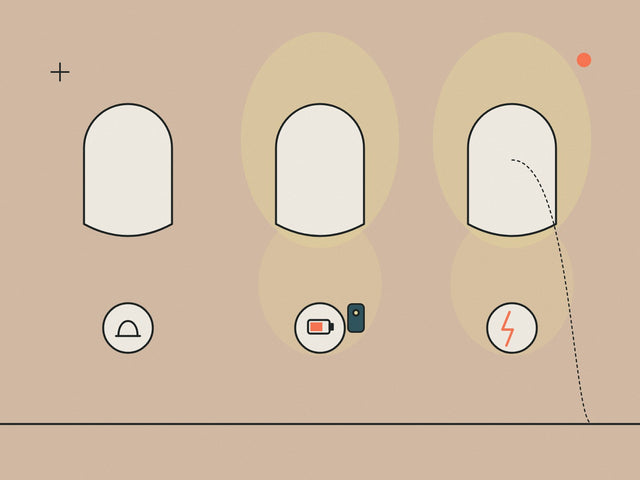
The PH lamp is easier to understand as a diagram than as a description. The point is not the shape of any one lamp. It is a way of placing surfaces between the bulb and the eye so that you only ever see lit, softly glowing surfaces, never the hot point of light itself.
The Philadelphia Museum of Art sums up his studies neatly: a shade's job is "to intercept, direct, and give tone to light".[7]
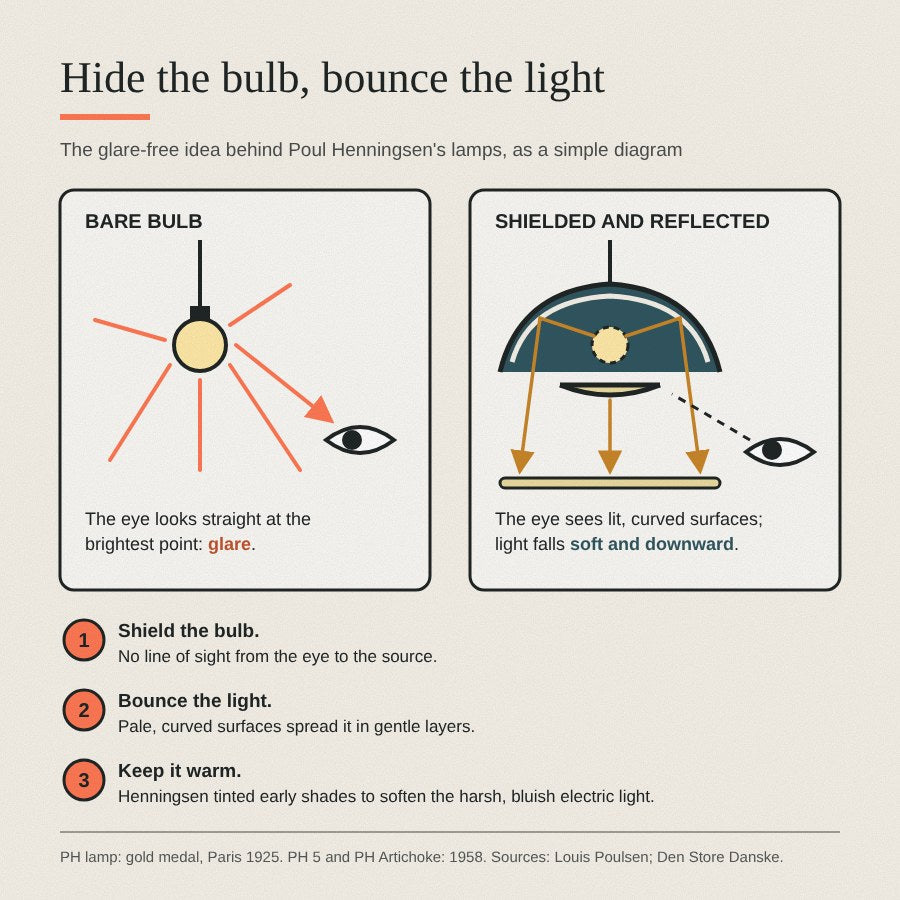
How did Henningsen make a glare-free lamp?
When Henningsen started, the electric light bulb was replacing gas. It was more efficient, but Den Store Danske, the Danish national encyclopedia, notes that its light was bluer and more glaring.[1] Tivoli's account of his life adds that his mother reportedly disliked harsh electric light.
- Several shades, not one. His lamps use concentric, curved shades that partly enclose the bulb. They block the direct view of it and act as reflectors, so the light spreads and shadows soften.
- Three shades, three jobs. In Louis Poulsen's description of the three-shade system, the top shade gives the most light, the middle one redirects and softens it, and the bottom one shields the eyes from glare.[6]
- A natural curve. The shades follow a logarithmic spiral, which Louis Poulsen describes as a natural curve also found in seashells and plants.[6]
- Warmer colour. Henningsen used coloured shades to filter some of the blue from electric light. Early PH 5 lamps had red and blue elements inside to improve the colour of the light.
- A system, not a single lamp. The name of each model is a code. In PH 3/2, for example, the first number is the diameter of the top shade in decimetres (so 30 cm), and the second tells you which smaller set of lower shades sits beneath it.
The lamp's first big public test came straight after Paris. In 1926 Henningsen won the lighting contract for the Forum, a new concert and exhibition hall in Copenhagen, against the German firms Zeiss and Goertz.[1]
As a designer who works mostly with wall lights, I find this the most useful part of his thinking. A wall light that hides its bulb and throws light onto a pale wall or ceiling is doing exactly what he asked of a shade: intercept, direct and give tone.
What are the PH 5 and the PH Artichoke?
PH 5. By the 1950s, bulbs kept changing shape and size, and every change risked letting glare escape from older shades. Louis Poulsen says the PH 5 was designed in 1958 to take any bulb and stay glare-free.[4] Its shades send light down and out to the sides, and some of it back onto the lamp itself, so the fitting glows gently. The "5" comes from the 50 cm top shade.[4]
PH Artichoke. In the same year Henningsen was asked to light the new Langelinie Pavilion, a restaurant on the Copenhagen waterfront designed by Eva and Nils Koppel. The pendant he produced, in about three months, has 72 metal leaves arranged in 12 rows of six.[5] It grew out of his earlier PH Septima glass lamp of around 1927 to 1931, and Louis Poulsen notes that the leaves are placed so that no viewing angle shows glare.[5]
Henningsen's world, annotated
Four photographs, from a 1937 Copenhagen restaurant to a lamp seen from below, numbered with the details worth noticing. Where the photo is in colour, the swatches are sampled from the photograph itself, so treat them as a guide rather than a paint match.
1. A Copenhagen restaurant, 1937
A restaurant on Sallingvej in Copenhagen, photographed in August 1937 by the Elfelt studio. It shows how quickly the PH lamp became an everyday fitting: the pendants and the wall lights are all shaded, multi-layered designs.

- A pendant with several multi-shade lamps on curved arms
- Small shaded wall lights on the pillars
- Tall windows letting in daylight
- A second, smaller pendant over the far tables
- A plain, pale ceiling that reflects light back down
- White tablecloths that catch the light from above
- Wooden strip floor
Take from it: No bare bulb is visible anywhere in the room. Every source is shaded, so the light falls on tables and walls rather than into the diners' eyes.
2. A university hall
The Aula, the great hall at Aarhus University in Denmark, photographed in 2017. Its tall pendants, built from many stacked rings, are catalogued on Wikimedia Commons as PH lamps. The rings work like a vertical version of the multi-shade idea: you see glowing edges, not the bulb.

- Tall pendant of stacked, ring-shaped shades
- A second pendant, lit from within
- Pale brick wall
- Long bench covered in cowhide
- Grand piano
- Herringbone oak parquet in sunlight
- Full-height window
- Rows of light wooden chairs
Colours in this photo:
Oak parquet #D9B78A
Take from it: Brick, wood and leather absorb light, so the room needs large, bright reflecting surfaces overhead. Pale plaster can do the same job in a smaller room.
3. The shades at work
A Louis Poulsen PH pendant, photographed in August 2014 against a blue evening sky. The low light outside makes it easy to see which surfaces glow and which stay in shade.

- Flared top shade, lit from inside
- Wide middle shade
- Lower shade
- Small bottom bowl, glowing
- Slim rods holding the shades apart
- Light from the top shade landing on the middle one, so the lamp lights itself
- Blue sky outside, far cooler than the lamp
Colours in this photo:
Warm glow #FEE9C1Blue hour #428ED1
Take from it: Look for where the light lands, not where it starts. A good shade gives you a series of soft, glowing surfaces instead of one hard point.
4. The view from underneath
A PH lamp seen from directly below, photographed in Copenhagen in 2010. Even from this angle, where a plain shade would show you the bulb, there is nothing to dazzle.

- Underside of the outer shade, lit by reflected light
- Inner shade, glowing at its edge
- A red ring: early PH 5 lamps used red and blue elements to adjust the colour of the light
- Dark centre: the bulb is hidden from view
- Slim support rods
Colours in this photo:
Warm reflected light #FECE98Red ring #8D2F12
Take from it: Test a light from every place you will see it, including lying down. If the bulb disappears from below, it will not glare across a bed or sofa.
Where can you see Henningsen's work?
- Tivoli Gardens, Copenhagen. Henningsen was Tivoli's architect from 1941, and in 1945 drew up a development plan for the gardens with the landscape architect G. N. Brandt. Tivoli lists the Glass Hall Theatre, the small fountains in the Parterre Garden and the spiral lamps by the lake as his surviving work there.[8]
- Langelinie Pavilion, Copenhagen. The Koppels' glass-and-steel pavilion of 1958 sits on the harbour front, and Louis Poulsen says the original Artichoke is still on display there. The building is now used mainly for events, so check before you go.
- In museum collections. The Philadelphia Museum of Art holds a PH 5 lamp.[7] In the UK I have not found a museum that keeps a Henningsen lamp on permanent display, so Copenhagen remains the place to go. Louis Poulsen notes that the PH lamp became a fixture of Danish public buildings and homes.[3]
Modern design lessons from Poul Henningsen
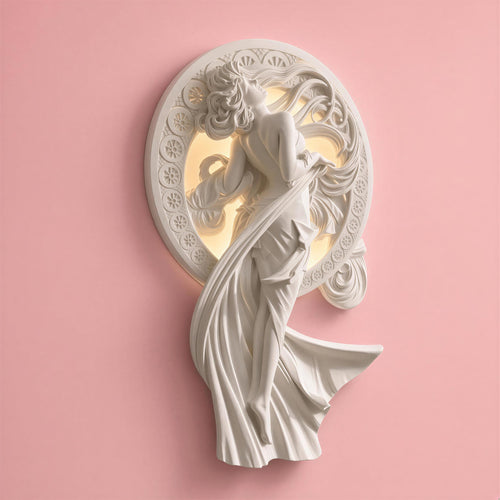
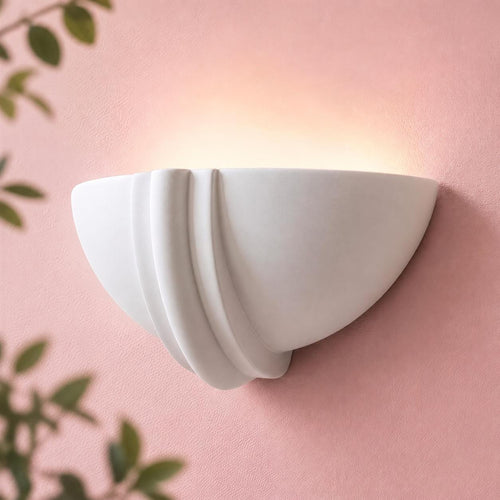
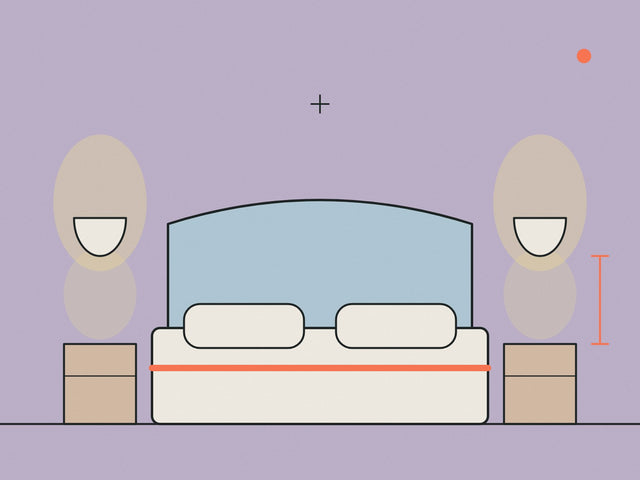
- Never look at the bulb. Before you buy a light, picture it from the sofa, the bed and the dining chair. If you can see the bare bulb from any of them, you will feel the glare. A half-bowl wall light such as the Warm Minimalist Wall Light hides the source and lets the wall glow instead.
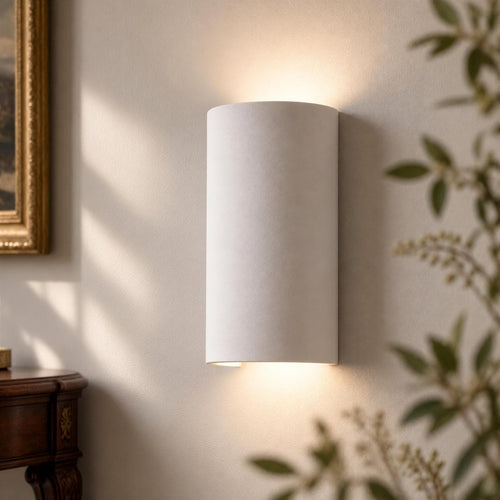
- Let surfaces do the work. Henningsen's shades were reflectors. A matt, pale plaster shade does the same job: light lands on it and leaves softly. The Half Moon Wall Light spreads light across the wall in a broad, curved wash.
- Light down where you eat, out where you sit. A low pendant over a dining table, with its light kept off your eyes, is pure Henningsen. Mark its place on the ceiling with a simple rose, such as the Ring Ceiling Rose.
- Warm it up. He fought the cold blue of early electric light. Today the equivalent is choosing warm-white bulbs and pale, warm wall colours that reflect a softer tone.
- Layer, do not flood. Use several low sources rather than one bright ceiling light. Our guide to layered lighting in a living room shows how.
Shop the look
Curved plaster shades that hide the bulb and let the wall glow, with simple roses to frame a pendant.
 Warm Minimalist Wall Light
 Half Moon Wall Light
 Japandi Curve Plaster Wall Light
 Bedside Wall Light
 Ring Ceiling Rose
 Vogue Ceiling Rose
Bringing Henningsen's ideas home
Henningsen's lesson is simple: hide the bulb, bounce the light, keep it warm. Curved plaster wall lights from our wall lights collection follow the same idea, and the modern minimal collection adds plain ceiling roses for a pendant. Our wall lights come as shade only, battery LED with a remote, or UK mains hardwired; hardwired fittings must be installed by a qualified electrician, and in England and Wales notifiable work falls under Part P of the Building Regulations. For more on Scandinavian light, read our Scandinavian style guide and the story of Alvar Aalto's warm modernism, or compare Henningsen with Marianne Brandt and the Bauhaus lamp. Every piece is designed and hand-cast in Shrewsbury, and arrives as natural plaster ready to leave raw or paint to suit your room.
Good to know
Common questions
Who was Poul Henningsen?
Poul Henningsen (1894 to 1967) was a Danish architect, writer and cultural critic. He is best known for the glare-free PH lamp, made with Louis Poulsen from 1924, which won a gold medal in Paris in 1925, and for later designs such as the PH 5 and PH Artichoke.
How does the PH lamp avoid glare?
It uses several curved shades around the bulb. The shades block the direct view of the bulb and reflect its light, so you only see softly lit surfaces. In the three-shade system the top shade gives most light, the middle one softens it and the bottom one shields the eyes.
What does the 5 in PH 5 mean?
In Louis Poulsen's naming system the first number is the diameter of the top shade in decimetres. The PH 5, introduced in 1958, has a top shade 50 cm across, and was designed to take any bulb shape while staying glare-free.
Sources
References and further reading
Harvard style. Web pages were checked on the access date shown.
- Den Store Danske (n.d.) PH-lampe. Lex.dk. Available at: lex.dk/PH-lampe (Accessed: 18 October 2026).
- Den Store Danske (n.d.) Poul Henningsen. Lex.dk. Available at: lex.dk/Poul_Henningsen (Accessed: 18 October 2026).
- Louis Poulsen (n.d.) Heritage. Available at: www.louispoulsen.com/en/about-us/heritage (Accessed: 18 October 2026).
- Louis Poulsen (n.d.) PH 5. Available at: www.louispoulsen.com/en-us/catalog/private/pendants/ph-5 (Accessed: 18 October 2026).
- Louis Poulsen (n.d.) PH Artichoke. Available at: www.louispoulsen.com/en/catalog/professional/decorative-l... (Accessed: 18 October 2026).
- Louis Poulsen (n.d.) System PH: the PH three-shade system explained. Available at: www.louispoulsen.com/en/reflections/system-ph (Accessed: 18 October 2026).
- Philadelphia Museum of Art (n.d.) "PH-5" Lamp. Available at: www.philamuseum.org/objects/76343 (Accessed: 18 October 2026).
- Tivoli (2019) PH in Tivoli: exhibition. Available at: www.tivoli.dk/en/om/presse/pressemeddelelser/2019/ph-i-ti... (Accessed: 18 October 2026).
How to cite this article
van Locke, J. (2026) ‘Poul Henningsen and the glare-free lamp’, The Flare Journal. Flare Studio UK. Available at: https://flarestudio.uk/blogs/journal/poul-henningsen-ph-lamp (Accessed: 12 November 2026).
Shop the style


Conversation
Join the conversation
Questions about the history, a room you are planning, or a piece you have seen in the wild? Leave a comment and Joseph will reply.