Scandinavian interiors: light, birch and the art of a calm home


Scandinavian style is the most familiar look in British homes today: white walls, pale wood, soft textiles and plenty of light. It did not arrive all at once. It grew from Swedish manor houses of the 1700s, an artist’s family home in the 1890s, Finnish and Danish modernism, a touring exhibition in the 1950s and, much later, a Danish word for cosiness. This guide explains where the style came from, the colours and details that define it, four real rooms to learn from, and how to get the look without making a room feel cold.
What is Scandinavian style?
Scandinavian style is a light, simple and practical way of furnishing a home, built on pale walls, natural wood, soft textiles and good everyday design from Sweden, Denmark, Finland and Norway. Its roots are older than most people think.
The Gustavian look. Gustav III was King of Sweden from 1771 until his death in 1792, and his name is now attached to the Swedish neoclassical style. Cooper Hewitt explains that he admired French fashion on visits to Versailles and hired French craftspeople to bring the Louis XVI style to the royal palace. Fashionable rooms were pale, lit by sparkling glass chandeliers. A lighter, simpler version then spread to town houses and country estates, and became a distinctly Swedish style.
Carl and Karin Larsson. In the summer of 1889 the painter Carl Larsson and his wife Karin moved to Lilla Hyttnäs, a house in Sundborn. According to the Nationalmuseum, Karin designed the furniture and textiles, which she embroidered and wove, and the rooms combined rural simplicity with influences from England, Scotland and Japan. Carl’s watercolours of the house were published as Ett hem (A Home) in 1899. That same year the writer Ellen Key argued for light, new-style homes in her essay Beauty for All, and praised the Larssons’ house for its homely, original feel.
Modern Scandinavia. In Finland, Aino and Alvar Aalto, Maire Gullichsen and Nils-Gustav Hahl founded Artek in 1935 to sell furniture and promote a modern culture of living. In Denmark, Poul Henningsen set out in the early 1920s to design lamps that cut glare, and Louis Poulsen began making his PH lamps in 1926. In 1954 the exhibition Design in Scandinavia opened at the Brooklyn Museum with more than 700 home furnishings from Denmark, Finland, Norway and Sweden, then toured the United States and Canada for about three years.
The Scandinavian palette
The base is pale. Gustavian rooms were light in colour, and the Aaltos and Finn Juhl both used white walls as a backdrop. Against that sit greys, soft blues and the honey colour of birch, a wood Aalto used for his bent furniture.
The Larssons show the other side of the story: green boarded walls, red doors and painted frames, used with confidence in a simple room. A good modern Scandinavian scheme uses a pale ground for walls and ceiling, wood for warmth, and one or two painted colours kept to doors, frames, furniture or textiles.

Signature motifs, shapes and materials
Pale wood. Birch, pine and other light timbers, left visible. The V&A describes an Aalto table of birch and birch plywood, its legs bent using a technique he patented.
Painted surfaces. Panelling, boarded walls, doors and older furniture, painted rather than polished.
Tiled stoves. Tall tiled stoves, often white with a painted pattern, are a feature of older Swedish rooms such as those at Skogaholm.
Curves made from wood. Bent birch frames, rounded table corners and sculpted chair arms, from Aalto to Juhl.
Woven and handmade textiles. Karin Larsson wove curtains, tapestries and simple chair seats, and designed a blanket pattern for local women to weave and sell.
Plants and candles. Karin Larsson filled windowsills, tables and shelves with flowers and potted plants.
The details that define a Scandinavian room
- Ceiling. White or very pale, kept plain so that it reflects as much daylight as possible.
- Walls. White, grey-white or soft colour, sometimes as painted panelling or vertical boards.
- Floors. Pale boards, often left bare, with a woven or rag rug.
- Lighting. Several soft sources rather than one bright one: a shaded pendant, a wall light, a table lamp and candles. Henningsen’s aim, to shield the eye from the bulb, still holds.
- Furniture. Light, well made and useful, in pale wood with simple curves. Built-in seats and shelves are common.
- Textiles. Linen curtains, wool throws, sheepskins, striped and woven rugs.
- Objects. A few ceramics, glass, plants and books rather than a crowd of ornaments.
Real Scandinavian rooms, annotated
Here are four real rooms, from an 18th-century Swedish manor to a Danish designer’s own home. Each picture is numbered with the features worth noticing. Where we could sample a colour reliably, the swatches come from the image itself, so treat them as a guide rather than a paint match.
1. A Swedish manor room, Skogaholm
Skogaholm Manor now stands at Skansen, the open-air museum in Stockholm. The Wennerstedt family owned it from 1689 to 1815, and Skansen sets its house tour in 1794, as a major renovation is being finished. It shows the pale, painted manor look of 18th-century Sweden in a real country house rather than a palace.

- Tall tiled stove in the corner, white with a painted pattern, the heart of the room in a cold climate
- Painted panel with a rose-pink border and a darker outline
- Garland painted at the top of the panel, light and symmetrical
- Painting set into the panelling above the door
- Armchair with a carved, pale painted frame and blue-grey striped upholstery
- Grey-green painted dado below the panels
- Wide, unpolished pine floorboards
- Doorway lined up with the next room, so light runs through the house
Colours in this photo:
Pale panel #C0BDBDChair blue-grey #99A9BFFloorboards #847978
Take from it: Almost everything is pale and painted, so the little colour there is (a pink border, a blue seat) carries far. Try one soft accent against grey-white walls.
2. The Larssons’ dining room, Sundborn
Not a photograph but a portrait of a real room: Carl Larsson’s watercolour of the dining room at Lilla Hyttnäs, from the series A Home, now in the Nationalmuseum in Stockholm. The museum notes that Karin Larsson designed the furniture and textiles, and that the rooms mixed rural simplicity with influences from England, Scotland and Japan.

- Leaded windows with painted figures in the glass
- Painted motto frieze above the door: Bien faire et laisser dire (do well and let them talk)
- Panelled door painted red and green
- Vertical boarded walls painted a soft green
- Old table with twisted legs and a cloth runner
- Painted, decorated cupboard
- Plate shelf on shaped wooden brackets
- Pale, bare floorboards
Colours in this photo:
Boarded green #626758Door red #B66F4CFloor #BDAF90
Take from it: Strong colour works when it sits on simple, honest surfaces. Paint boards, doors and frames, and leave the floor plain.
3. The Aalto House, Helsinki
Aino and Alvar Aalto designed this house in Munkkiniemi for themselves, and it was finished in August 1936. The Alvar Aalto Foundation describes plentiful wood as a finishing material, and the house is now a home museum. This sitting room shows the modern, birch-and-white version of Scandinavian style.

- Long window screened by wooden slatted blinds
- Pendant light with layered shades that hide the bulb
- Wall shelves on curved wooden brackets
- Table lamp with a pleated shade
- Armchair with a bent birch frame and a rust-red seat
- Low wooden table with rounded corners
- Stacking stools tucked beside the sofa
- Round woven rug
Colours in this photo:
Birch #D99F6DSeat red #963C22White wall #CFC1AE
Take from it: Light wood, white walls and one warm colour make a room that feels calm in daylight and cosy at night. Note how many light sources there are.
4. Finn Juhl’s House, Ordrup
Finn Juhl designed and furnished this house north of Copenhagen himself, at the age of 30, and it was completed in 1942. Museum Ordrupgaard calls it the best-preserved functionalist single-family house in Denmark, furnished with Juhl’s sculptural furniture and works by Danish artists he chose.

- Sloping white ceiling, left plain
- Abstract painting in a pale frame
- Built-in shelving from floor to ceiling, edged in red
- Armchairs with shaped wooden arms and grey woven upholstery
- Table with a pale top on a wooden frame
- Long built-in sofa in ochre along the wall
- Candlesticks grouped on the table
- Deep, pale rug over the floor
Colours in this photo:
Sofa ochre #D1C295Chair grey #4D4D4F
Take from it: Here the furniture is the ornament. With white walls and a plain ceiling, a few well-shaped wooden pieces and one good painting are enough.
How Scandinavian style reached British homes
Britain met modern Scandinavian furniture early. The V&A records that Aalto’s furniture first became widely known here at the Wood Only exhibition at Fortnum and Mason in November 1933. In 1934 P. Morton Shand and Geoffrey Boumphrey founded Finmar to import it, and Britain later became Aalto’s largest export market. The V&A suggests his use of wood rather than tubular steel appealed to buyers who found steel too radical.
After the war, Heal’s, Finmar and Harrods imported Danish modern furniture. The Museum of the Home notes that middle-class homes of the 1950s and 1960s could be furnished in Scandinavian design, though it never represented mainstream taste. Our guides to the 1950s and to mid-century modern design cover this period in more depth. IKEA opened its first UK store in Warrington in 1987, and in 2016 the Danish word hygge, which Meik Wiking calls “the art of creating a nice atmosphere”, was shortlisted for Oxford’s word of the year. The Swedish lagom, roughly “just the right amount”, followed as a softer cousin.
How to get the Scandinavian look
- Start pale. Paint walls and ceiling in white or a soft grey-white. In a north-facing room choose a warmer white so it does not turn blue. Suits any room.
- Keep the ceiling clean and calm. If you want a ceiling rose (ceiling medallion), choose a plain ringed design rather than leaves and flowers, and paint it the ceiling colour. Our guide to the ceiling rose in a modern home has more ideas, and our fitting guide shows how to put one up. Best for living rooms and bedrooms.
- Layer soft light. Pair a shaded pendant with a wall sconce at seated height, a table lamp and candles. See our guide to layered lighting in a living room. Especially good in living rooms and bedrooms.
- Bring in pale wood. One or two pieces in birch, ash or pine, ideally with a curve: a chair, a stool or a simple shelf. Good for hallways and dining rooms.
- Use one painted colour. Borrow from the Larssons and paint a door, a frame or an old cupboard in green, red or soft blue. Ideal for kitchens and children’s rooms.
- Soften with textiles. Linen at the window, a wool throw, a woven rug. This is what stops white rooms feeling cold.
- Add life. Plants on the windowsill and a few books and ceramics on open shelves.
Common mistakes to avoid
- All white, no warmth. White walls with white furniture and grey floors can feel like a showroom. Add wood and texture.
- One harsh overhead light. A bare bulb or a single bright downlight undoes the calm. Use shades and several low sources.
- Buying the look in one go. Real Scandinavian rooms mix old and new, as the Larssons did with inherited and handmade things.
- Too many props. Signs that say hygge, rows of identical baskets and fake fur on every chair read as a theme, not a home.
- Heavy ornament overhead. A deep, leafy ceiling rose fights with plain walls and simple furniture. Keep it to rings and soft curves.
- Confusing it with Japandi. The two overlap, but Japandi is darker and sparser. Read our Japandi style guide to see the difference.
Three Nordic homes you can visit
Each of the rooms above comes from a house that welcomes visitors. Booking arrangements differ, so check before you go.
- The Aalto House, Helsinki. Aino and Alvar Aalto bought the site in 1934 and finished the house in August 1936. It was built as both a family home and a studio, and you can see the split from the street: the office wing is slender and white-painted, while the residential part is clad in dark-stained timber battens. Alvar Aalto lived there until his death in 1976. The Foundation lists a guided tour of the house.
- Finn Juhl's House, Charlottenlund, Denmark. Completed in 1942, it is described by Museum Ordrupgaard as the best-preserved functionalist single-family house in Denmark. Juhl's furniture was made with the cabinetmaker Niels Vodder. On weekdays the visit is about 40 minutes, starting with a ten-minute guided introduction; at weekends you visit on your own. It needs a separate ticket from the museum.
- Carl Larsson-gården, Sundborn, Sweden. The house, Lilla Hyttnäs, is presented as "both home and work of art". Visitors see Carl Larsson's watercolours, Karin Larsson's hand-woven tapestries and textiles, and custom-designed furniture including Karin's rocking chair. Tickets are booked online.
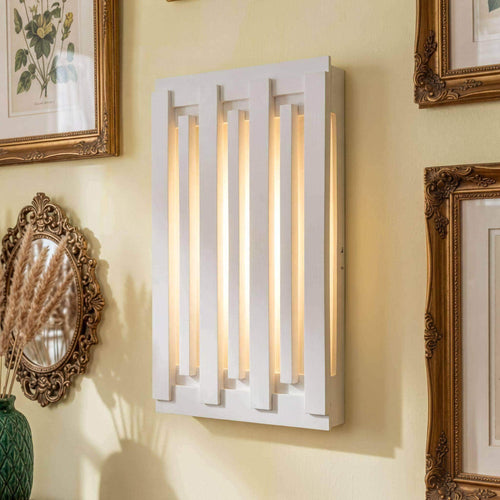
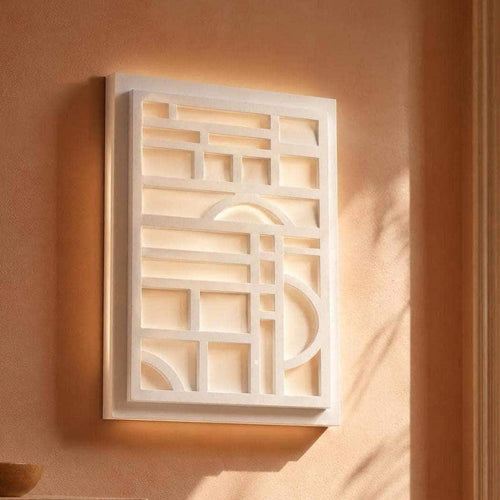
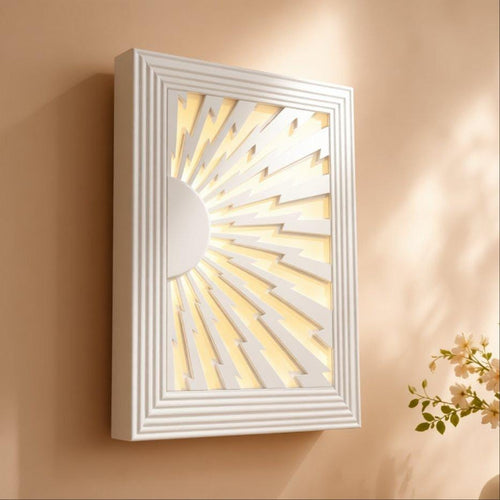
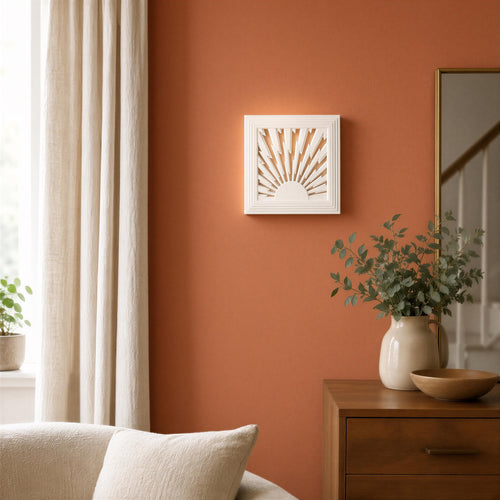
What carries over to a British home is the lighting as much as the paint. In a pale room with one plain ceiling, small wall lights on plaster walls give the soft, low pools of light these houses rely on. Our Bedside Wall Light and Pebble Wall Light are quiet enough for that role.
Shop the look
Plain, softly curved plaster pieces that keep a pale Scandinavian-style room calm.


Scandinavian ceiling roses, wall lights and plaster details
For a Scandinavian ceiling, our Ring Ceiling Rose gives a plain, ringed frame for a shaded pendant. On the walls, our Warm Minimalist Wall Light, Japandi Curve Wall Light and 10 in Japandi Wall Light add the soft, low glow the style depends on. Leave them chalk white, or paint one in a Gustavian grey or a Larsson green.
Every piece in our Modern & Minimal collection is designed and hand-cast in Shrewsbury, and arrives as natural plaster ready to leave raw or paint to suit your room.
Good to know
Common questions
What is Scandinavian interior design?
A light, simple and practical way of furnishing a home, built on pale walls, natural wood, soft textiles and good everyday design from Sweden, Denmark, Finland and Norway.
How do I make a room look Scandinavian?
Paint walls and ceiling pale, add one or two pieces of light wood, layer soft lighting from a shaded pendant, wall lights, lamps and candles, and finish with linen, wool and plants. Keep ornament to a few good things.
What ceiling rose suits a Scandinavian room?
A plain, ringed design rather than leaves and flowers, painted the same colour as the ceiling so it frames the pendant without drawing the eye.
Sources
References and further reading
Harvard style. Web pages were checked on the access date shown.
- Alvar Aalto Foundation (n.d.) The Aalto House. Available at: www.alvaraalto.fi/en/architecture/the-aalto-house/ (Accessed: 12 October 2026).
- Artek (n.d.) Art and technology since 1935. Available at: www.artek.fi/en/company (Accessed: 12 October 2026).
- Brooklyn Museum (n.d.) Design in Scandinavia [Exhibition, 20 April to 16 May 1954]. Available at: www.brooklynmuseum.org/opencollection/exhibitions/1092/De... (Accessed: 12 October 2026).
- Carl Larsson-gården (n.d.) The interior. Available at: carllarsson.se/en/?p=10488 (Accessed: 12 October 2026).
- DigitaltMuseum (n.d.) Brännvinsglas, Skogaholm, SKANM.0187868D. Skansen. Available at: digitaltmuseum.org/011024633611 (Accessed: 12 October 2026).
- Lancashire Evening Post (2018) 'The IKEA phenomenon: IKEA's long history with the North West', 18 May. Available at: www.lep.co.uk/business/ikea-phenomenon-ikeas-long-history... (Accessed: 12 October 2026).
- Larsson, C. (1899) Ett hem [Title page]. Wikimedia Commons. Public domain. Available at: commons.wikimedia.org/wiki/File:Carl_Larsson_-_Ett_hem_-_... (Accessed: 12 October 2026).
- Larsson, C. (n.d.) The Dining Room. From A Home (26 watercolours) [Watercolour]. Nationalmuseum, Stockholm, via Wikimedia Commons. Public domain. Available at: commons.wikimedia.org/wiki/File:The_Dining_Room._From_A_H... (Accessed: 12 October 2026).
- Lord, J. (2016) Finn Juhl House interior [Photograph]. Wikimedia Commons. CC BY 2.0. Available at: commons.wikimedia.org/wiki/File:Finn_Juhl_House_interior.jpg (Accessed: 12 October 2026).
- Museum of the Home (n.d.) Coffee table, Fritz Hansen, c.1958 (273/1998). Available at: collections.museumofthehome.org.uk/object28609 (Accessed: 12 October 2026).
- Museum Ordrupgaard (n.d.) Finn Juhls hus. Available at: museumordrupgaard.dk/finn-juhls-hus (Accessed: 12 October 2026).
- Ninara (2020) Intérieur Villa Aalto [Photograph]. Wikimedia Commons. CC BY 2.0. Available at: commons.wikimedia.org/wiki/File:Int%C3%A9rieur_Villa_Aalt... (Accessed: 12 October 2026).
- NPR (2016) 'It's not just a Danish word that made dictionary's shortlist; it's a lifestyle'. Available at: www.npr.org/transcripts/505159329 (Accessed: 12 October 2026).
- Pollock, R. (n.d.) 'The neoclassical north', Cooper Hewitt, Smithsonian Design Museum. Available at: cooperhewitt.org/?p=12422 (Accessed: 12 October 2026).
- Skansen (n.d.) Guided tour in Skogaholm Manor. Available at: www.skansen.se/en/see-and-do/open-air-museum/guided-tour-... (Accessed: 12 October 2026).
- Tersmeden, F. (2012) Skogaholms herrgård; interiör [Photograph]. Wikimedia Commons. CC BY-SA 3.0. Available at: commons.wikimedia.org/wiki/File:Skogaholms_herrg%C3%A5rd;... (Accessed: 12 October 2026).
- Trope, C. (n.d.) PH lamp, Poul Henningsen [Object of the Day], Cooper Hewitt, Smithsonian Design Museum. Available at: www.cooperhewitt.org/?p=33959 (Accessed: 12 October 2026).
- Victoria and Albert Museum (n.d.) Occasional table, Alvar Aalto, designed 1933 (CIRC.518-1974). Available at: collections.vam.ac.uk/item/O129436 (Accessed: 12 October 2026).
- Visit Alvar Aalto (n.d.) The Aalto House in Helsinki. Available at: visit.alvaraalto.fi/en/destinations/the-aalto-house/ (Accessed: 12 October 2026).
- Visit Denmark (n.d.) Finn Juhl's House. Available at: www.visitdenmark.com/finn-juhls-house-gdk558940 (Accessed: 12 October 2026).
- Visit Sweden (n.d.) Swedish lagom lifestyle. Available at: visitsweden.com/about-sweden/swedish-lagom-lifestyle/ (Accessed: 12 October 2026).
How to cite this article
van Locke, J. (2026) ‘Scandinavian interiors: light, birch and the art of a calm home’, The Flare Journal. Flare Studio UK. Available at: https://flarestudio.uk/blogs/journal/scandinavian-style-guide (Accessed: 17 October 2026).
Shop the style