

Isamu Noguchi: Akari light sculptures and the art of paper light


Isamu Noguchi (1904 to 1988) was a Japanese-American sculptor who also designed gardens, stage sets, furniture and lighting. He is best known in homes today for two things: the Noguchi coffee table, a sheet of glass on two interlocking pieces of wood, and Akari, the paper and bamboo lights he began designing in Gifu, Japan, in 1951.
Akari matter because they made sculpture light, portable and ordinary. A shade folds flat for packing, yet once opened and lit it turns a corner of a room into something close to an artwork. More than seventy years on, the soft glow of washi paper is part of the everyday language of Japandi and organic modern interiors.
Who was Isamu Noguchi?
Noguchi was born in Los Angeles on 17 November 1904.[6] His father, Yone Noguchi, was a Japanese poet; his mother, Léonie Gilmour, was American. She took him to Japan in 1907, and he grew up there until 1918, when he was sent to school in Indiana.[6] He enrolled on a premedical course at Columbia University in New York in 1923, took evening sculpture classes, and soon chose art.
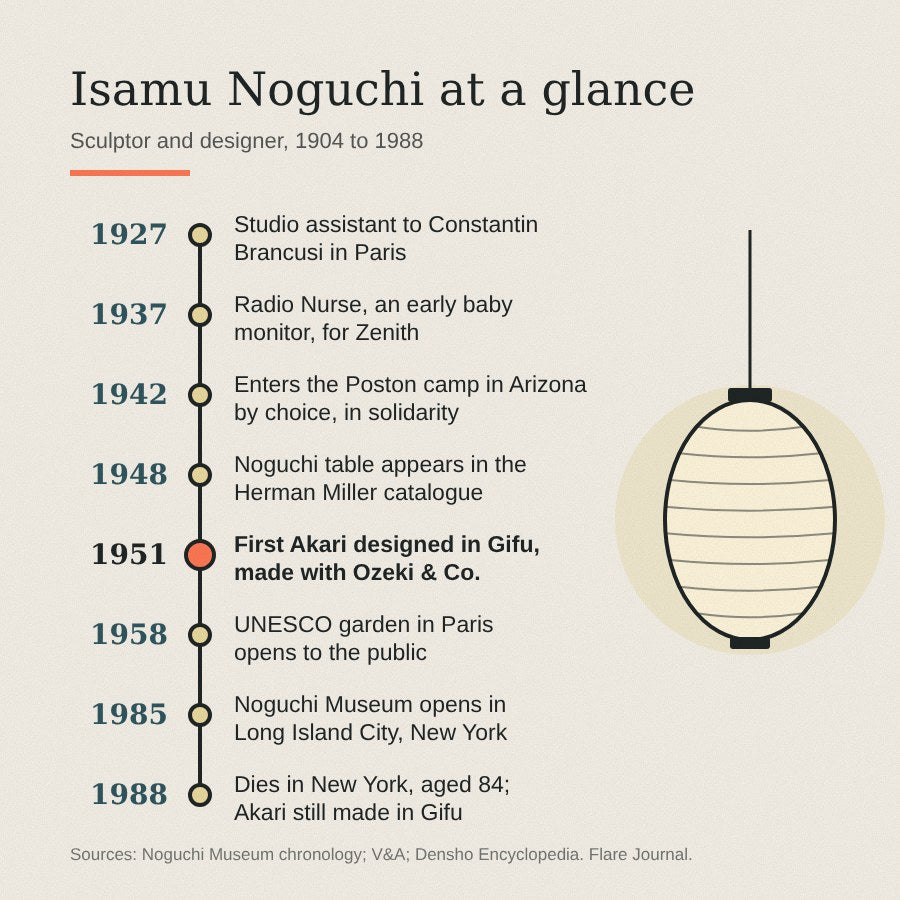
In 1927 he worked in Paris as studio assistant to Constantin Brancusi, which pushed him towards abstraction.[6] Back in America he made portrait busts to earn a living, and in 1940 a large commission for the Associated Press Building at Rockefeller Center brought public work. In 1942 he went voluntarily into the Poston camp in Arizona, where Japanese Americans were confined, as an act of solidarity, and stayed for about six months.[2][6]
That double belonging runs through his work. He moved between stone and paper, New York and Japan, and treated a lamp or a table as seriously as a bronze.
Noguchi at a glance: key works
A handful of designs explain why Noguchi still matters to anyone furnishing a home.
- Radio Nurse (1937). One of the first commercially made baby monitors, for the Zenith Radio Corporation.[8] The V&A notes it was his first industrial commission.
- The Noguchi table (1947). Two identical wooden forms carry a heavy glass top. It appeared in Herman Miller's 1948 catalogue, and Herman Miller reintroduced it in 1984.[6]
- Akari (from 1951). Light sculptures of washi paper and bamboo, first produced in 1952 and still made by hand in Gifu.[4]
- Gardens and parks. His garden for UNESCO in Paris opened in 1958, and Moerenuma Park in Sapporo, which he planned in his last year, was completed in 2005.[6]
How did Akari begin?
In 1951 Noguchi was travelling to Hiroshima for a commission at the Peace Memorial Park.[4][5] According to the Noguchi Museum, the mayor of Gifu asked him to help revive the city's lantern industry with a modern lamp that could be exported.[4][5] Gifu was known for lanterns and umbrellas made from mulberry-bark paper and bamboo, and Noguchi was also taken by the lanterns used for night fishing on the Nagara River.[4]
He worked with Ozeki & Co., a family firm founded in 1891 that still makes the shades.[4] The method is the old one. Thin bamboo ribbing, called higo, is wrapped around a wooden mould made for each model. Panels of washi are glued on with rice glue and trimmed, and after drying in a heated room the mould is collapsed and taken out from inside. The finished shade folds flat for packing.
The name Akari is a Japanese word for light in the sense of illumination.[4] The logo abstracts a sun and a crescent moon, drawn from the character 明, which is linked to light. Noguchi kept designing them for 37 years, and made more than 200 models.[4]
Are Akari sculptures or lamps?
- Light as sculpture. Noguchi saw them as sculptures made with light, and the museum still calls them light sculptures. They grew out of his self-lit Lunar sculptures, made after his time at Poston, and in 1986 he showed a full Akari line in the American Pavilion at the Venice Biennale.[5]
- Glow, not glare. Washi diffuses the bulb into an even, warm light. The paper becomes the light source, so the whole form glows rather than throwing a hard beam.
- Lightness. Paper and bamboo make forms so light that they can hang, stand on thin legs or sit on the floor.
- Sculpture for every home. Akari were designed to bring sculpture into ordinary rooms. Noguchi called Akari "the one thing that I've done out of pure love".[5]
- A whole home in three things. He said that a room, a tatami mat and Akari are all you need to start a home. It is a useful test for any minimal scheme.
As a designer who casts light fittings by hand, I find that last point the most useful. Akari prove that a light can be the simplest object in a room and still the one people remember.
Noguchi's work, annotated
Four real examples, from a wall of lit Akari to Noguchi's own garden. The swatches are sampled from each photograph, so treat them as a guide rather than a paint match.
1. A family of shapes
A row of Akari light sculptures, lit, at the Noguchi Museum in Queens, New York. Seen together, they show how far Noguchi pushed one simple method of paper over bamboo ribs.

- A faceted, folded form, more crystal than lantern
- A tall column built up in stacked sections
- Rib lines showing through the lit paper
- Thin metal legs that lift the shade off the floor
- A pleated, concertina-like profile
- A simple globe, the shape closest to a traditional lantern
- The gallery's painted brick wall and steel-framed window
Colours in this photo:
Lit washi #E8A45FPainted brick #685F59
Take from it: One material and one method can make a whole family of shapes. Choose one form and repeat its softness elsewhere in the room rather than mixing many lamp styles.
2. Paper globes by daylight
A gallery of hanging paper globes at the Noguchi Museum, photographed during Open House New York in 2018. Unlit, you see the structure that the light usually hides.

- Fine horizontal ribs, closely and evenly spaced
- Vertical seams where the panels of paper meet
- A wire fitting across the top opening
- Small globes hung among large ones
- Soft creases in the matt paper surface
- A plain wooden floor
- A window at the end of the gallery
Colours in this photo:
Wood floor #3B2218
Take from it: By day a paper shade is a soft, pale object; by night it is the light source. Hang it where it looks good in both states.
3. The museum garden
The garden of the Noguchi Museum, which Noguchi designed himself. The museum occupies a converted 1920s photo-engraving plant in Long Island City.

- A stone column of stacked blocks in two tones
- A large rough boulder on a stone base
- Grey gravel in place of lawn
- Silver birch trunks
- A low, spreading pine
- Bamboo against the far wall
- The red-brick building with steel-framed windows
- A plain wooden bench
Colours in this photo:
Red brick #4C2C2AGrey gravel #7E7A78Stone sculpture #595456Ground cover #5A6A63
Take from it: Rough against smooth, stone against paper: Noguchi's rooms work by contrast of texture, not by colour.
4. The Noguchi table
An IN-50 coffee table made by Herman Miller, on display at the Indianapolis Museum of Art. The V&A describes the base as two identical wooden forms, set one inverted against the other.

- A thick glass top in a rounded, free-form triangle
- The front wooden piece
- The second, identical piece, turned the other way
- The point where the two pieces meet
- The glass sits on the base and is not fixed to it
- Three points touch the floor
Colours in this photo:
Wood base #793D1B
Take from it: Glass lets the eye run through to the sculpture beneath. Keep whatever surrounds a favourite piece light.
Watch Akari being made
Vitra, which distributes Akari in Europe, made this short film of the shades being produced by hand. It shows the materials and moulds described above.
Video: Vitra, "Production of the Akari Light Sculptures, Isamu Noguchi, 1951", via YouTube.
Where can you see Noguchi's work?
- V&A South Kensington, London. The Radio Nurse is on display in the Design 1900 to Now gallery (Room 74).[8] The museum also holds several Akari shades, currently in store, and a Noguchi table.[7]
- Young V&A, London. Noguchi's set model for King Lear (1955) is shown in the Imagine gallery.
- The Noguchi Museum, New York. At 9-01 33rd Road in Long Island City, Queens. Noguchi opened it in 1985 in a converted photo-engraving plant across the street from his studio.[6] It has a garden he designed and galleries of sculpture, drawings and models.
London last had a major Noguchi show in 2021. The Barbican's retrospective, which opened on 30 September 2021 and ran into January 2022, brought together more than 150 works, and hung Akari among the tropical plants of the Barbican Conservatory.[1][3]
Paper light in a Japandi room
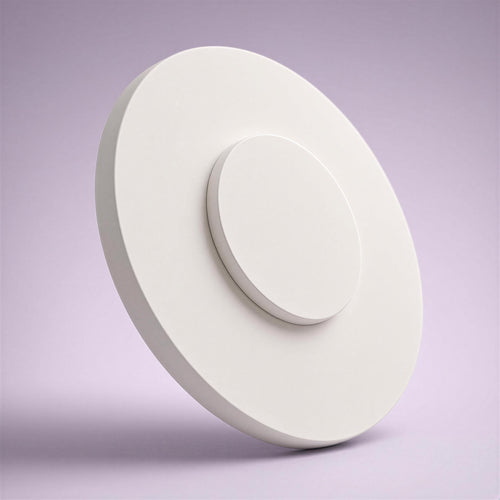
Japandi mixes Japanese restraint with Scandinavian comfort, and soft, diffused light holds the two together. A paper globe over a low table or a small shade on the floor gives the warm glow of a lantern. Plaster wall lights do a similar job on the wall: their matt surface catches and softens the light rather than reflecting it. Our Japandi style guide covers the wider palette, and our guide to layered lighting explains how to mix ceiling, wall and floor light.
Modern design lessons from Noguchi
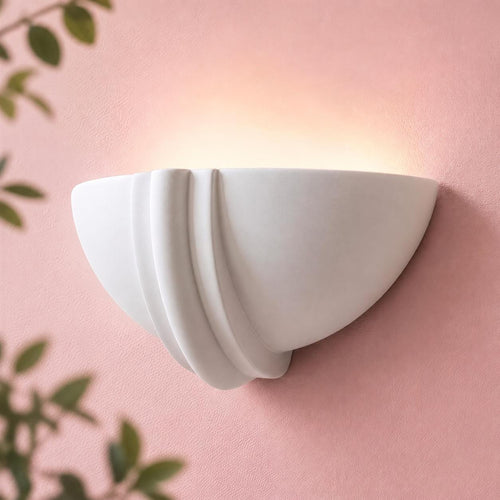
- Diffuse, do not dazzle. Hide the bulb and let a soft surface glow. A wall light such as the Pebble Wall Light washes the wall in the same spirit.
- Treat light as an object. Choose fittings that look good switched off as well as on.
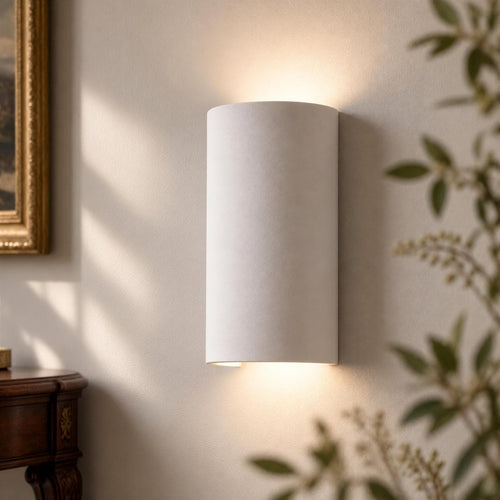
- Use natural materials honestly. Paper, bamboo, wood and stone, left close to how they come. Plaster belongs on that list, and the Japandi Curve Plaster Wall Light shares the soft curves of a paper shade.
- Place light low. Many Akari stand on the floor or on low tables. Light at sitting height makes a room feel calmer.
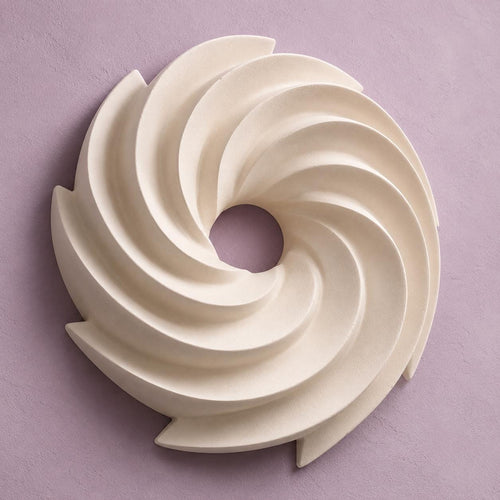
- Contrast textures. Set something smooth against something rough, as he set paper against stone. A round, matt form such as the Organic Round Wall Light reads well against linen or wood.
Shop the look
Soft, matt plaster pieces that share Akari's quiet glow and natural surfaces.
 Japandi Wall Light (10 in)
 Japandi Curve Plaster Wall Light
 Pebble Wall Light
 Organic Round Wall Light
 Ring Ceiling Rose
Bringing Noguchi's ideas home
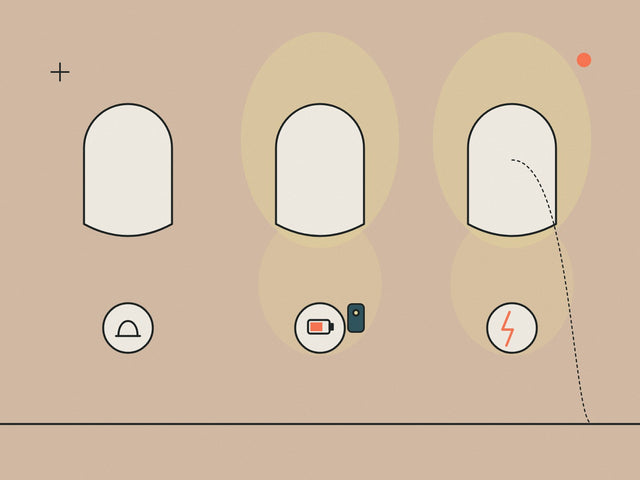
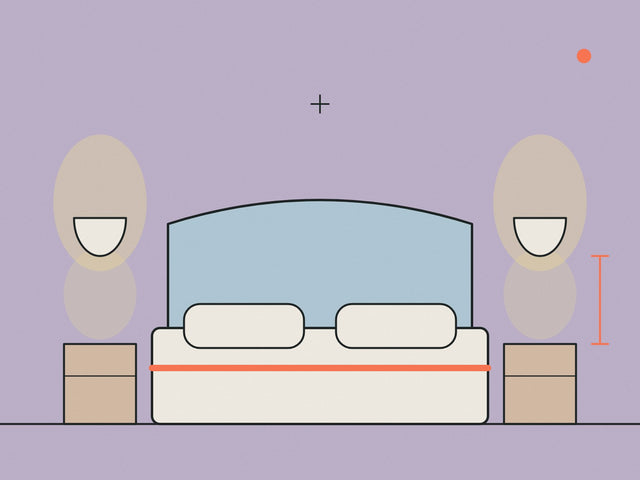
Start with one soft light source and build the room around it, then keep the ceiling calm with a single plain rose such as the Ring Ceiling Rose. Our modern minimal collection and wall lights share Noguchi's idea of light as a quiet, sculptural object. For two other designers who changed how we light rooms, read about Poul Henningsen and the glare-free lamp and Alvar Aalto's warm modernism, and for Herman Miller's other great partnership see Charles and Ray Eames. Our wall lights come as shade only, battery LED with a remote, or UK mains hardwired. Hardwired fittings should be installed by a qualified electrician, under Part P of the Building Regulations in England and Wales for notifiable work. Every piece is designed and hand-cast in Shrewsbury, and arrives as natural plaster ready to leave raw or paint to suit your room.
Good to know
Common questions
What are Noguchi Akari lights?
Akari are light sculptures that Isamu Noguchi began designing in Gifu, Japan, in 1951. The shades are handmade from washi paper and bamboo ribbing by Ozeki & Co., fold flat for packing, and give a soft, diffused glow. Noguchi designed more than 200 models over 37 years.
What does Akari mean?
Akari is a Japanese word for light in the sense of illumination. Noguchi chose it for the series, and its logo abstracts a sun and a crescent moon, inspired by the character 明, which is linked to light. He thought of the pieces as light sculptures rather than lamps.
Where can I see Noguchi's work in London?
The V&A in South Kensington shows Noguchi's 1937 Radio Nurse in its Design 1900 to Now gallery, and Young V&A displays his set model for King Lear. The V&A also holds Akari shades in store. Further afield, the Noguchi Museum in Queens, New York, has his garden and sculpture.
Sources
References and further reading
Harvard style. Web pages were checked on the access date shown.
- Barbican (2021) Noguchi [press release]. Available at: www.barbican.org.uk/our-story/press-room/noguchi (Accessed: 18 October 2026).
- Densho Encyclopedia (n.d.) Isamu Noguchi. Available at: encyclopedia.densho.org/Isamu_Noguchi/ (Accessed: 18 October 2026).
- Tesler, F. (2021) 'Isamu Noguchi a "pioneer of social sculpture" says Barbican curator', Dezeen, 29 October. Available at: www.dezeen.com/2021/10/29/isamu-noguchi-barbican-video/ (Accessed: 18 October 2026).
- The Noguchi Museum (n.d.) Akari light sculptures. Available at: shop.noguchi.org/akari.html (Accessed: 18 October 2026).
- The Noguchi Museum (n.d.) Akari: Sculpture by Other Means. Available at: www.noguchi.org/museum/exhibitions/view/akari-sculpture-b... (Accessed: 18 October 2026).
- The Noguchi Museum (n.d.) Chronology. Available at: www.noguchi.org/isamu-noguchi/biography/chronology/ (Accessed: 18 October 2026).
- Victoria and Albert Museum (n.d.) Akari 33N lampshade. Available at: collections.vam.ac.uk/item/O1360282/ (Accessed: 18 October 2026).
- Victoria and Albert Museum (n.d.) Radio Nurse. Available at: collections.vam.ac.uk/item/O179620/ (Accessed: 18 October 2026).
How to cite this article
van Locke, J. (2026) ‘Isamu Noguchi: Akari light sculptures and the art of paper light’, The Flare Journal. Flare Studio UK. Available at: https://flarestudio.uk/blogs/journal/isamu-noguchi-akari-light-sculptures (Accessed: 12 November 2026).
Shop the style


Conversation
Join the conversation
Questions about the history, a room you are planning, or a piece you have seen in the wild? Leave a comment and Joseph will reply.