

Thomas Telford in Shropshire: Bridges, Churches and Roads

Who was Thomas Telford?
Thomas Telford was born on 9 August 1757 at Glendinning in Eskdale, Dumfriesshire, in Scotland, and died on 2 September 1834 in Westminster, London, aged 77.[1] He is remembered for roads, canals and bridges across Britain, including the Pontcysyllte Aqueduct in Wales and the Menai Suspension Bridge.[2] But the place where he first made his name was Shropshire.
In 1787, through his patron William Pulteney, he became Surveyor of Public Works for Shropshire.[1] The work he did there is unusually varied: a castle and a prison in Shrewsbury, stone and iron bridges, an aqueduct, and churches. This guide takes them in the order a visitor is likely to meet them, explains what you are looking at, and separates what the sources document from what is local tradition.
If you are new to the area, start with our overview of Shropshire’s architectural heritage.

Shrewsbury: a castle, a prison and a warning
Telford’s first Shropshire jobs were in the county town. Wikipedia’s entry for Shrewsbury Castle records that after 1780 repairs were carried out by Telford for Sir William Pulteney, MP for Shrewsbury, following designs by the architect Robert Adam.[3] The castle is Grade I listed and today houses a regimental museum.[3]
He also worked on the town prison. Wikipedia says Telford built the original building to plans by the Shrewsbury architect John Hiram Haycock, with a prison on the site since 1793;[4] his biography says the work brought him into contact with the prison reformer John Howard.[1] The present Victorian prison was built in 1877 on top of the Georgian one, and the prison was decommissioned in 2013.[4] Sources give slightly different dates for the earlier work (the Shropshire Star says 1787), so treat the dates as approximate.[2]
The best-known Shrewsbury story is also a cautionary one. In 1788 Telford was called in about a leaking roof at St Chad’s church and warned that it was in imminent danger of collapse; it collapsed three days later. He was not the architect of the replacement.[1] The round church that stands today is by George Steuart. Our guide to St Chad’s and St Mary’s tells the full story.
Montford Bridge: the first of about forty
Montford Bridge, west of Shrewsbury, is where the story of Telford’s bridges begins. It was designed in 1790 to carry the London to Holyhead road over the Severn, and Wikipedia describes it as the first of some 40 bridges he built in Shropshire.[1] Historic England records it as built 1790 to 1792, with a datestone reading 1792, and as the first bridge Telford built as County Surveyor of Bridges for Shropshire.[5] The builders were John Carline and John Tilley, and the cost was £5,800.[6]
The material is red sandstone ashlar,[5] from Nesscliffe Hill, about four miles away.[6] It has three elliptical arches with raised keystones, separated by pilaster strips and semicircular cutwaters;[5] the spans are two of 55 feet and a central one of 58 feet.[6] An elliptical arch is flatter than a half-circle, which lets the roadway stay low and level (general background, not cited).

Wikipedia reports Telford’s own verdict: his contractors produced a “substantial edifice” that after more than forty years remained “quite perfect”.[6] It was widened in 1963 with a reinforced concrete slab and is Grade II listed (first listed on 29 January 1952).[6][5] The A5 formerly ran through the village over the bridge but has since been diverted onto the Shrewsbury bypass.[6]

Iron in Shropshire: Buildwas and Longdon
Shropshire was where iron was changing what could be built, and Telford used it. The Iron Bridge at Coalbrookdale opened on 1 January 1781,[7] six years before he became the county’s surveyor; see our guide to the architecture of the Ironbridge Gorge. Telford’s own iron work began with Buildwas Bridge,[1] which Wikipedia describes as a cast-iron arch built in 1796 to replace a brick and stone bridge that had stood since medieval times until floods in 1773 and 1795 destroyed it. It survived later floods until 1905, when it was replaced by a steel Pratt truss, itself replaced in 1992.[8] So Buildwas is a bridge you will read about, not one you will see.
What does survive is the Longdon-on-Tern Aqueduct, which carried the Shrewsbury Canal over the River Tern. Wikipedia says it was completed in 1796, one month after Benjamin Outram’s Holmes Aqueduct on the Derby Canal, which it calls the world’s first cast-iron canal aqueduct; Historic England’s list entry gives 1795 and notes that an earlier aqueduct was destroyed in floods in early 1795.[9][10] Telford re-engineered the crossing after the flood. The canal runs in a cast-iron trough 9 feet wide and 3 feet deep, carried on four spans of 47 feet 8 inches over a total length of 186 feet.[9] Historic England describes a square-section cast-iron trough on iron uprights with diagonal bracing, with sandstone and brick abutments.[10]
The aqueduct has been Grade I listed since 30 March 1971.[10] The Shrewsbury Canal closed in 1944, and the aqueduct is now disused and drained, with a towpath on its south side.[9] Because the trough is no longer in water, you can see the structure of the iron itself, which is part of its appeal.

Cantlop Bridge: a late iron bridge
A second surviving iron bridge, at Cantlop near Shrewsbury, shows the idea at a smaller scale. Historic England records it as erected in 1813, after public subscription funds were raised in 1812 for a new carriage bridge, to a design approved by Telford, though it is unclear whether he designed it himself; the castings were probably supplied by William Hazeldine.[11] (Wikipedia gives 1818 and says the design is “possibly” Telford’s; we follow the list entry.[12]) It has a single segmental span of 9.5 metres, with four parallel arched cast-iron ribs springing from stone abutments.[11]
Cantlop is Grade II* listed (first listed 8 May 1972).[11] Wikipedia says it is in the care of English Heritage, freely accessible to pedestrians but closed to vehicles, which makes it one of the easiest stops on this trail.[12]

The comparison with Montford is the point. As general background (not cited), stone arches push their weight sideways and need heavy abutments, while an iron span can be lighter and flatter. Telford used each where it made sense.
Telford’s churches: Bridgnorth and Madeley
The most surprising thing about Telford’s Shropshire work is that he designed churches. St Mary Magdalene in Bridgnorth was designed by Telford in 1792, according to Historic England, and Wikipedia gives the building dates as 1792 to 1795, by John Rhodes and Michael Head.[13][14] The Shropshire Star calls it his first and best church.[2] Historic England describes a Renaissance-style church with a pedimented portico on raised Doric columns and a cupola on the north tower, set on a north to south axis to take advantage of the view from East Castle Street; an apse was added by Blomfield in 1876.[13] Wikipedia adds a copper-covered roof and a tower about 120 feet high with a clock and eight bells.[14] It is Grade II* listed (since 18 July 1949)[13] and is an active Church of England parish church.[14] For the town around it, see our guide to period towns of the Welsh Marches.
St Michael’s in Madeley followed. Wikipedia says Telford designed it as a rebuild of an older church in 1796 (the Shropshire Star gives 1793 to 1796).[15][2] It is octagonal, with a square tower, and is Grade II* listed, with the churchyard’s northern boundary wall listed Grade II, both in 1983. It is an active parish church. The churchyard contains several cast-iron tombstones, a reminder of how closely the iron industry shaped Madeley.[15] Wikipedia states the Telford attribution without a specific citation, so treat it as that page’s claim.
As a general observation (not cited), Telford’s churches show a Georgian preference for clear plans and plain surfaces over medieval complexity. Compare them with the medieval and Georgian churches in our Shrewsbury churches guide.
Roads and canals: the bigger picture
Most of what Telford did in Shropshire was practical. The government asked him to improve the roads from London and Shrewsbury to Holyhead, and the Shropshire Star records his Holyhead Road improvements as carried out in stages between 1815 and 1829.[2] Wikipedia notes that between London and Shrewsbury most of the work was improvement of the existing road, and that later rebuilding was completed by his assistant John MacNeill.[1] If you drive the A5 and its older alignments, you are following the route he worked on.
On the water, he succeeded Josiah Clowes, who died in 1795, as engineer of the Shrewsbury Canal, and in 1793 was appointed to the Ellesmere Canal, whose most famous structure is the Pontcysyllte Aqueduct in Wales, completed in 1805 and a UNESCO World Heritage Site since 2009. William Jessop oversaw that project but left the detailed execution to Telford.[1] The Shropshire Star calls the Shropshire Union Canal his final major project, one he did not live to see completed.[2]
A Telford trail


The sites are spread across the county, so this is a day by car or bike rather than a walk. Start at Montford Bridge, west of Shrewsbury, then go into town. Cantlop and Longdon lie to the south-east and east. Madeley and Bridgnorth are further along the Severn. The map above is schematic and for orientation only.
How to recognise Telford’s hand
Rule of thumb, not cited: no single feature identifies Telford, and several attributions here are stated cautiously by the sources, but the works above show some patterns. Bridges use local stone where it was available and cast iron where a long, light span was needed. Arches are elliptical or segmental, flatter than a Roman half-circle. Detail is restrained: parapets, copings and keystones rather than ornament. The churches have clear plans, an octagon at Madeley and a portico at Bridgnorth. Treat these as patterns to look for, not a rule that proves a building is his.
The same discipline of proportion appears in Georgian houses; see our Georgian interiors guide.
Planning a visit
Montford Bridge and Cantlop Bridge are outdoor structures and can be looked at from public paths, though you should keep to rights of way and take care near roads. The Longdon aqueduct is disused and drained; check access to the towpath before you go. Bridgnorth and Madeley are working churches, so check opening arrangements, avoid service times, and ask before photographing inside. Shrewsbury’s castle and former prison have their own visitor arrangements, which change, so look at their websites. We do not give opening times here because they change.
Glossary
- Abutment: the structure at each end of a bridge that takes the thrust of the arch.
- Aqueduct: a bridge that carries water.
- Cast iron: iron poured into moulds, strong in compression.
- Elliptical arch: an arch shaped like part of an ellipse, flatter than a semicircle.
- Keystone: the central stone at the crown of an arch.
- Parapet: a low wall along the edge of a bridge.
- Pier: a support between two arches.
- Segmental arch: an arch that is a segment of a circle, less than a semicircle.
- Trough: the channel that holds water on an aqueduct.
Common mix-ups

- “Telford built the Iron Bridge.” No. The Iron Bridge opened on 1 January 1781; Telford became Shropshire’s surveyor in 1787.[7][1]
- “Telford designed the round church of St Chad’s.” No. He warned of the old church’s collapse in 1788; the new church is by George Steuart.[1][16]
- “Longdon was the world’s first iron aqueduct.” Wikipedia says Holmes Aqueduct on the Derby Canal opened a month earlier and is the world’s first cast-iron canal aqueduct.[9]
- “Telford built Pontcysyllte on his own.” William Jessop oversaw the project and left detailed execution to Telford.[1]
- “Buildwas Bridge is still there.” The iron bridge lasted until 1905, and its steel replacement was itself replaced in 1992.[8]
From Georgian engineering to your own home
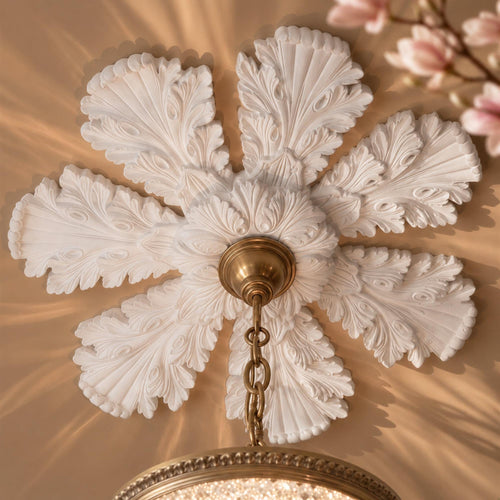
Telford worked in the Georgian period, when plain proportion and honest materials were the fashion in civil engineering as much as in houses. If you are drawn to that restraint, it is worth bringing a little of it indoors: see our guide to overdoor pediments and our history of the ceiling rose. Flare Studio makes handmade plaster pieces in the classical tradition.
Keep reading
- Ironbridge Gorge
- St Chad’s and St Mary’s
- Brother Cadfael’s Shrewsbury
- Period towns of the Welsh Marches
- Shropshire’s architectural heritage
Shop the look


Frequently asked questions
What did Thomas Telford build in Shropshire?
He was Surveyor of Public Works for Shropshire from 1787 and designed or worked on bridges including Montford Bridge, the Longdon-on-Tern Aqueduct and Buildwas Bridge, and churches at Bridgnorth and Madeley, as well as work at Shrewsbury Castle and the town prison.
What was Telford’s first bridge in Shropshire?
Montford Bridge over the Severn, designed in 1790 and built 1790 to 1792 in red sandstone with three elliptical arches. Wikipedia describes it as the first of some 40 bridges he built in the county.
Is the Longdon-on-Tern Aqueduct still there?
Yes. It was built in 1795–96, is Grade I listed, and is now disused and drained, with a towpath on its south side.
Did Telford build the Iron Bridge?
No. The Iron Bridge at Coalbrookdale opened in 1781, before Telford became Shropshire’s surveyor in 1787.
Can you visit Cantlop Bridge?
Yes. It is an iron bridge of 1813 in the care of English Heritage, freely accessible to pedestrians but closed to vehicles, according to Wikipedia. It is Grade II* listed.
Did Telford design churches?
Yes. St Mary Magdalene in Bridgnorth (designed 1792) and St Michael’s in Madeley (1796), an octagonal church, are both attributed to him.
Did Telford design St Chad’s church in Shrewsbury?
No. He warned in 1788 that the old church was in danger of collapse, and it fell three days later. The new round church is by George Steuart.
When did Telford die?
On 2 September 1834 in Westminster, London, aged 77.
Sources
References and further reading
Harvard style. Web pages were checked on the access date shown.
- Wikipedia contributors (n.d.) ‘Thomas Telford’, Wikipedia, The Free Encyclopedia. Available at: en.wikipedia.org/wiki/Thomas_Telford (Accessed: 27 October 2026).
- Shropshire Star (2016) ‘Thomas Telford’s legacy all around us (2 September)’, Shropshire Star. Available at: www.shropshirestar.com/news/2016/09/02/thomas-telfords-le... (Accessed: 27 October 2026).
- Wikipedia contributors (n.d.) ‘Shrewsbury Castle’, Wikipedia, The Free Encyclopedia. Available at: en.wikipedia.org/wiki/Shrewsbury_Castle (Accessed: 27 October 2026).
- Wikipedia contributors (n.d.) ‘Shrewsbury Prison’, Wikipedia, The Free Encyclopedia. Available at: en.wikipedia.org/wiki/Shrewsbury_Prison (Accessed: 27 October 2026).
- Historic England (n.d.) ‘Montford Bridge (List Entry 1366920)’, National Heritage List for England. Available at: historicengland.org.uk/listing/the-list/list-entry/1366920 (Accessed: 27 October 2026).
- Wikipedia contributors (n.d.) ‘Montford Bridge’, Wikipedia, The Free Encyclopedia. Available at: en.wikipedia.org/wiki/Montford_Bridge (Accessed: 27 October 2026).
- Wikipedia contributors (n.d.) ‘The Iron Bridge’, Wikipedia, The Free Encyclopedia. Available at: en.wikipedia.org/wiki/The_Iron_Bridge (Accessed: 27 October 2026).
- Wikipedia contributors (n.d.) ‘Buildwas Bridge’, Wikipedia, The Free Encyclopedia. Available at: en.wikipedia.org/wiki/Buildwas_Bridge (Accessed: 27 October 2026).
- Wikipedia contributors (n.d.) ‘Longdon-on-Tern Aqueduct’, Wikipedia, The Free Encyclopedia. Available at: en.wikipedia.org/wiki/Longdon-on-Tern_Aqueduct (Accessed: 27 October 2026).
- Historic England (n.d.) ‘Shrewsbury Canal, Longdon Aqueduct (List Entry 1037006)’, National Heritage List for England. Available at: historicengland.org.uk/listing/the-list/list-entry/1037006 (Accessed: 27 October 2026).
- Historic England (n.d.) ‘Cantlop Bridge (List Entry 1366715)’, National Heritage List for England. Available at: historicengland.org.uk/listing/the-list/list-entry/1366715 (Accessed: 27 October 2026).
- Wikipedia contributors (n.d.) ‘Cantlop Bridge’, Wikipedia, The Free Encyclopedia. Available at: en.wikipedia.org/wiki/Cantlop_Bridge (Accessed: 27 October 2026).
- Historic England (n.d.) ‘Church of St Mary Magdalene, Bridgnorth (List Entry 1177357)’, National Heritage List for England. Available at: historicengland.org.uk/listing/the-list/list-entry/1177357 (Accessed: 27 October 2026).
- Wikipedia contributors (n.d.) ‘Church of St Mary Magdalene, Bridgnorth’, Wikipedia, The Free Encyclopedia. Available at: en.wikipedia.org/wiki/Church_of_St_Mary_Magdalene,_Bridgn... (Accessed: 27 October 2026).
- Wikipedia contributors (n.d.) ‘St Michael’s Church, Madeley’, Wikipedia, The Free Encyclopedia. Available at: en.wikipedia.org/wiki/St_Michael%27s_Church,_Madeley (Accessed: 27 October 2026).
- Historic England (n.d.) ‘Church of St Chad, Shrewsbury (List Entry 1344941)’, National Heritage List for England. Available at: historicengland.org.uk/listing/the-list/list-entry/1344941 (Accessed: 27 October 2026).
How to cite this article
Tire, G. (2026) ‘Thomas Telford in Shropshire: Bridges, Churches and Roads’, The Flare Journal. Flare Studio UK. Available at: https://flarestudio.uk/blogs/journal/thomas-telford-in-shropshire-bridges-churches-roads (Accessed: 12 November 2026).
Shop the style










Conversation
Join the conversation
Questions about the history, a room you are planning, or a piece you have seen in the wild? Leave a comment and Joseph will reply.