1930s interiors: the history, the look and how to get it right


Step inside almost any 1930s semi and you can still find the decade's fingerprints: a curved bay of steel windows, a tiled fireplace that steps up like a city skyline, a sunburst on the garden gate. The years between the wars filled Britain's suburbs with new homes, and with them came a way of decorating that was lighter, cleaner and more modern than anything the Victorians or Edwardians knew. Here is where the look came from, what defines it, and how to bring it home without your living room feeling like a film set.
A new kind of home
When the First World War ended, Britain was short of an estimated 600,000 homes. The Tudor Walters Report of 1918 set out how the new suburbs should look, and the government's Housing Manual of 1919 followed with ready-made house plans. Two-thirds of those plans were for semi-detached houses, and the semi became the shape of the British suburb.
By the 1930s private builders had taken over. Cheap building society loans and a growing number of white-collar jobs meant that many families could buy a home for the first time. Developers sold them in every style buyers might want: Tudorbethan gables, neo-Georgian fronts, Art Deco details and, at the bolder end, white flat-roofed modern houses.
Behind many of those houses sat a quiet revolution in windows. The Crittall company of Braintree, in Essex, made steel window frames, and from 1926 it built Silver End, a model village of around 600 homes that includes some of England's earliest Modernist houses. By the 1930s, curved metal bay windows were a familiar sight on suburban streets.
The 1930s palette
Colour is where the 1930s parted company with the decades before. The Edwardians liked strong, rich colours; the 1930s turned the volume down. At Eltham Palace, English Heritage describes pale paint colours throughout the 1930s house, a deliberate contrast with Edwardian taste.
Green was the colour of the decade. Dulux, founded in 1931, picks out eau de nil, sea green and pastel green as the defining shades of the period, and green turned up on almost everything, from cutlery and cars to fridges and the outsides of buildings. Cream and ivory kept ceilings and woodwork soft, while black lacquer, chrome and polished walnut added the sharpness that stops a pale room from feeling washed out.
At the very top of society, white itself became fashionable. In 1927 the decorator Syrie Maugham unveiled an all-white music room at her house on the King's Road in Chelsea, with fluted mirror walls and great arrangements of white flowers, and white quickly became her signature.

Two moods: glamour and calm
The 1930s home had two personalities. The first is glamour, and the best place to see it in Britain is Eltham Palace in south-east London. Built in 1933 to 1936 by the architects Seely and Paget for Stephen and Virginia Courtauld, the house is a showcase of the period. The entrance hall, by the Swedish designer Rolf Engströmer, is lined in blackbean veneer and lit by a glass dome. The dining room, by Peter Malacrida, has bird's-eye maple walls and an aluminium-leaf ceiling, and many of the bedrooms use the built-in, curved-ended furniture known as the "Cunard style", after the ocean liners.
The second mood is calm, and it is the one most of us live with. In an ordinary 1930s semi, the glamour arrives in small doses: a sunburst on the gate, a tiled fireplace, a walnut radiogram, a fan-shaped light on the landing. The rest of the room stays quiet, pale and practical.
The details that define a 1930s room

- The ceiling. A plain, smooth ceiling with a single statement: a sunburst or stepped ceiling rose around a simple pendant. Opal glass globes were a favourite.
- The windows. Steel frames with slim horizontal glazing bars, often in a curved bay. They give the room its long, low lines.
- The fireplace. A tiled surround that steps up in tiers, usually in buff, green or mottled tiles, with a curved or arched opening.
- The lighting. Fan and shell-shaped wall lights that throw light up the wall, plus table lamps with simple shades.
- The furniture. Veneered walnut, rounded corners, built-in cupboards and curved "cloud" armchairs.
- The floor. Wood-block or parquet floors, or linoleum, softened by a rug with a plain banded border.
Real 1930s rooms, annotated
Drawings only go so far, so here are six real rooms from the period, from a modest flat to Eltham Palace. Each photograph is numbered with the features worth noticing, followed by a strip of colours sampled from the photograph itself. Lighting shifts colour, so treat the swatches as a guide rather than a paint match.
1. The everyday living room
This is a museum recreation of a living room in a Streatham flat in 1935, shown at the Geffrye Museum (now the Museum of the Home) and photographed dressed for Christmas. It is the calm side of the decade: pale, plain walls, with the boldness saved for the rug, the fireplace and a few pieces of furniture.

- Opal glass globe pendants
- Plain, pale green walls
- Slim tubular wall lights
- Tiled fireplace with black banding
- Veneered sideboard with a gramophone
- Curved, fully upholstered armchair
- Rug with a bold abstract pattern
- Chrome cocktail shaker on a drinks trolley
Colours in this photo:
Walls #B0BBB7Veneer #B6814FUpholstery #C5BAB1Tiled fireplace #9C9B90Rug #E8E3E2Carpet #3D2922
Take from it: Keep the walls quiet and let three things carry the period: the light fittings, the fireplace and the rug.
2. The kitchen
A 1930s kitchen display at Portsmouth Museum. Everything is practical and wipe-clean: tiles, enamel and painted cupboards, with colour coming from the paintwork and the floor.

- Freestanding kitchen cabinet with a pull-out worktop
- Cream paint with green trim
- White rectangular wall tiles
- Chequerboard floor
- Enamelled cooker
- Ceramic sink with wall-mounted taps
- Wooden plate rack
- Tall larder cupboard
Colours in this photo:
Cream cupboards #C0BBA8Green paint #545341White tiles #DDCAC5Floor (green) #667160Floor (black) #24211D
Take from it: Cream with a soft green trim is an easy combination to borrow, and a chequerboard floor sets the date straight away.
3. The entrance hall (glamour)
The entrance hall at Eltham Palace, designed by the Swedish designer Rolf Engströmer. The walls are lined in blackbean veneer with marquetry scenes, including a Viking facing a Roman soldier, and the room is lit from above by a glass dome.

- Blackbean veneer walls
- Marquetry figures and city scenes
- Circular rug designed by Marion Dorn (the one on show is a reproduction)
- Curved, white upholstered chairs
- Walnut and blackbean table
- Band of high, curved windows
Colours in this photo:
Blackbean veneer #210E03Marquetry #633C16Rug ground #D9D3C8Rug pattern #855243Upholstery #D4D5D2
Take from it: One dark, rich material used generously, softened by pale upholstery and a curved rug, is pure 1930s glamour.
4. The dining room (glamour)
The dining room at Eltham Palace, by the Italian designer Peter Malacrida. The walls are bird's-eye maple and the ceiling recess is aluminium leaf, lit by hidden uplighters. The warm light in this photograph makes the aluminium look copper.

- Aluminium-leaf ceiling recess with concealed uplighting
- Stepped ceiling with recessed lights
- Bird's-eye maple veneer walls
- Polished aluminium fireplace in a black and silver key-pattern surround
- Upholstered dining chairs (replicas of Malacrida's originals)
- Full-length curtains
Colours in this photo:
Leafed ceiling (lit) #815733Maple walls #994F16Black surround #211009Curtains #832F17Chair leather #8D3520
Take from it: Light the ceiling, not the table. A plain ceiling recess washed with hidden light gives the same glow on a much smaller budget.
5. The bedroom
Virginia Courtauld's bedroom at Eltham Palace, also by Malacrida. It is circular, with curved walls in maple veneer, inlaid sycamore "pilasters", and the main light and heating hidden in the round ceiling.

- Circular ceiling hiding the main light
- Curved walls in maple veneer
- Inlaid sycamore "pilasters"
- Dressing table set into a recess
- Venetian-style mirror
- Plain stone fireplace
- Curved, upholstered armchair
- Striped curtains in green and cream
Colours in this photo:
Maple walls #6C3816Ceiling #CCB08FBay walls #C3D0A9Curtain green #8D8259
Take from it: Curves and hidden light make a bedroom feel calm. Even one curved armchair and a soft uplight will move a room towards the 1930s.
6. The bathroom (glamour)
Virginia Courtauld's bathroom at Eltham Palace: a vaulted room lined with onyx, with the bath set in a niche of gold mosaic, gold-plated taps, a lion-mask spout and a statue of Psyche.

- Vaulted ceiling
- Gold mosaic bath niche
- Onyx-lined walls and bath
- Gold-plated taps and lion-mask spout
- Statue of Psyche
- Gilt towel rail
- Glass shelves in a wall recess
Colours in this photo:
Gold mosaic #A57D3DOnyx bath rim #7E8896Black base #0D0C0C
Take from it: Few of us will line a bathroom in onyx, but a single niche of metallic mosaic behind the bath captures the same idea.
How to get the style right
The 1930s look is easy to overdo. These are the rules I follow when I design for a 1930s room.
- Start with the architecture. Restore or add the fixed details first: ceiling rose, fireplace, picture rail, doors. Accessories come last.
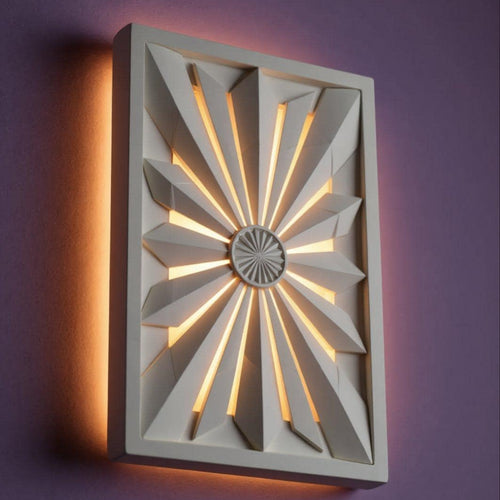
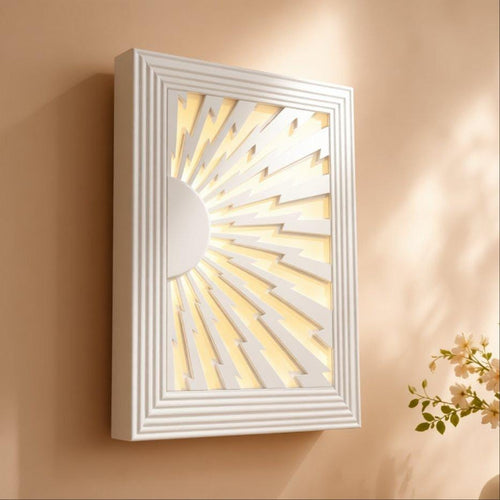
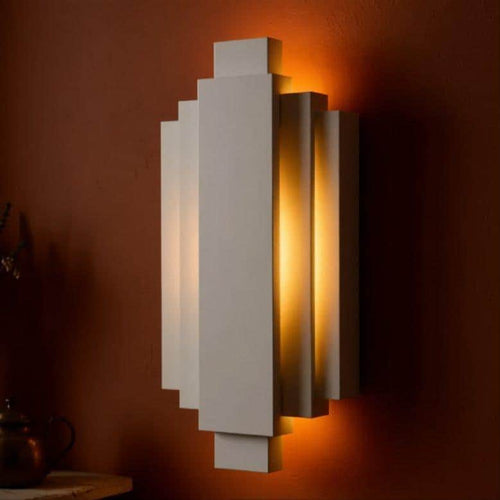
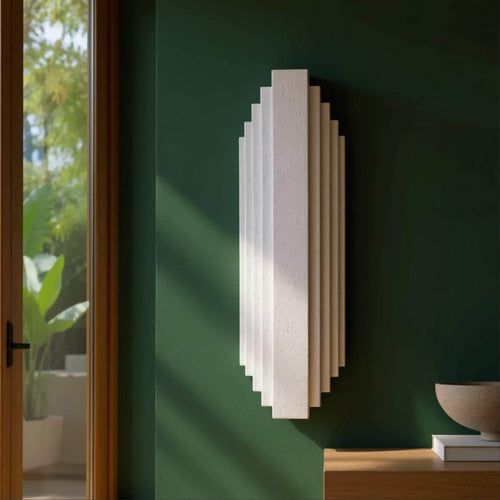
- Choose one shape and repeat it. Pick the sunburst, the fan or the stepped line (our Stepped Wall Light (11 in) has the last) and echo it two or three times, for example in the ceiling rose, a wall light and a mirror.
- Paint lighter than you think. Soft greens, warm creams and stone tones suit the period. Keep the ceiling pale, or paint it the same colour as the walls for a calmer, modern take. Our guide to painting the ceiling has more ideas.
- Mix materials, not patterns. Smooth plaster, polished wood, chrome and glass do more than busy wallpaper.
- Light it softly. An opal globe from the ceiling and fan wall lights washing up the walls give the warm, even glow the decade loved.
- Soften the corners. A curved armchair, a round mirror or a cabinet with rounded ends instantly reads as 1930s.
The 1930s home is not a Hollywood set. It is pale, practical and quietly modern, with one or two moments of real glamour.
Eltham Palace: the technology behind the glamour
The glamour at Eltham Palace sat on top of some very modern engineering. Stephen and Virginia Courtauld took a 99-year lease from the Crown in 1933 and commissioned the architects Seely & Paget to build a modern home beside the medieval great hall. English Heritage lists what went into it:
- Electric fires, and synchronous clocks in most rooms, regulated by the incoming mains supply.
- A loudspeaker system that could broadcast records to the ground-floor rooms.
- A private internal telephone exchange installed by Siemens.
- A centralised vacuum cleaner in the basement.
- Gas-powered underfloor and radiant ceiling heating throughout.
The exterior is described as "Wrenaissance", partly inspired by Hampton Court. Four incendiary bombs damaged the roof of the great hall in September 1940, the Courtaulds moved out in May 1944, and English Heritage took on the whole site in 1995. The entrance hall furniture and rug you see today are recreations of the originals.
Common mistakes to avoid
- All black and gold. The glossy "Gatsby" look belongs to hotels and cocktail bars. Most British homes of the period were far softer.
- Too many motifs. A sunburst, a zigzag, a fan and a chevron in one room will fight each other. Let one lead.
- Getting the scale wrong. An oversized ceiling rose in a modest semi looks heavy. Our guide to choosing the right size of ceiling rose explains how to measure.
- Removing what survives. Original fireplaces, doors and plasterwork are hard to replace. Repair before you replace: see our guide to repairing cracked plaster.
Shop the look
A few pieces from our range that suit this look, each designed and hand-cast in Shrewsbury.


Bringing the 1930s home with plaster
If you only change one thing, change the ceiling. A sunburst ceiling rose such as our Sunburst Ceiling Rose around a simple globe pendant sets the period the moment you walk in, and it works just as well in a new-build as in an original 1930s semi. Pair it with a fan-shaped wall light such as our Scallop Wall Light and you have the decade's two signature shapes in one room. For the wider story of the style, read What is Art Deco?
Every piece in our Art Deco collection is designed and hand-cast in Shrewsbury, and arrives as natural plaster ready to leave raw or paint to suit your room.
Good to know
Common questions
What colours were used in 1930s homes?
1930s homes favoured soft, pale colours, a deliberate move away from the strong Edwardian palette. Greens such as eau de nil, sea green and pastel green were the defining shades, with cream and ivory on ceilings and woodwork. Black lacquer, chrome and polished walnut added contrast.
How do I make a 1930s house feel authentic without it looking like a film set?
Start with the fixed architecture, such as the ceiling rose, fireplace, picture rail and doors, then add furniture and accessories. Pick one signature shape, such as the sunburst, fan or stepped line, and repeat it two or three times. Keep walls pale and use materials like plaster, walnut, chrome and glass rather than busy pattern.
What ceiling rose suits a 1930s house?
A sunburst or stepped Art Deco ceiling rose around a simple globe pendant suits most 1930s rooms. Keep the scale modest for a typical semi, and paint it to match the ceiling for a quiet look or pick it out in a contrasting colour to make it a feature.
Sources
References and further reading
Harvard style. Web pages were checked on the access date shown.
- Andrew, N. (2016) 'Amazing interiors: Eltham Palace and Gardens, Greenwich', Pooky, 9 September. Available at: www.pooky.com/blogs/inspiration/amazing-interiors-eltham-... (Accessed: 12 October 2026).
- DesignCurial (2017) 'Geffrye Museum of the Home launch tour of London interior design through the ages', 4 September. Available at: old.designcurial.com/news/the-geffrye-museum-of-the-home-... (Accessed: 12 October 2026).
- Dulux (n.d.) 1930s art deco and pastel greens. Available at: www.dulux.co.uk/en/celebrating-90-years-with-dulux-interi... (Accessed: 12 October 2026).
- English Heritage (n.d.) Description of Eltham Palace. Available at: www.english-heritage.org.uk/visit/places/eltham-palace-an... (Accessed: 12 October 2026).
- Institute of Historic Building Conservation (2025) HE's 'Brief Introduction to Semi-Detached Housing'. Available at: newsblogs.ihbc.org.uk/?p=43347 (Accessed: 12 October 2026).
- Marathon (2024) The Dining Room at Eltham Palace [Photograph]. Geograph, via Wikimedia Commons. CC BY-SA 2.0. Available at: commons.wikimedia.org/wiki/File:The_Dining_Room_at_Eltham... (Accessed: 12 October 2026).
- Marathon (2024) Virginia Courtauld's Bathroom, Eltham Palace [Photograph]. Geograph, via Wikimedia Commons. CC BY-SA 2.0. Available at: commons.wikimedia.org/wiki/File:Virginia_Courtauld%27s_Ba... (Accessed: 12 October 2026).
- Marathon (2024) Virginia Courtauld's Bedroom at Eltham Palace [Photograph]. Geograph, via Wikimedia Commons. CC BY-SA 2.0. Available at: commons.wikimedia.org/wiki/File:Virginia_Courtauld%27s_Be... (Accessed: 12 October 2026).
- Owen, J. (2022) 'A history of Crittall windows', Homes & Antiques, 5 July. Available at: homesandantiques.com/antiques/collecting-guides-antiques/... (Accessed: 12 October 2026).
- Parnell, T. (2015) Eltham Palace - interior, view of entrance hall [Photograph]. Wikimedia Commons. CC BY-SA 4.0. Available at: commons.wikimedia.org/wiki/File:Eltham_Palace_-_interior,... (Accessed: 12 October 2026).
- Petts, J.E. (2015) 1930s period room [Photograph]. Wikimedia Commons. CC BY-SA 2.0. Available at: commons.wikimedia.org/wiki/File:1930s_period_room_-_23832... (Accessed: 12 October 2026).
- Scott, P. (2013) The Making of the Modern British Home: The Suburban Semi and Family Life between the Wars. Oxford: Oxford University Press.
- Sheerman-Chase, T. (2024) Highbury Kitchen, 1930s [Photograph]. Wikimedia Commons. CC BY 2.0. Available at: commons.wikimedia.org/wiki/File:Highbury_Kitchen,_1930s_-... (Accessed: 12 October 2026).
- St Clair, K. (2020) 'Colour pioneer: Syrie Maugham's white out', ELLE Decoration UK, 14 April. Available at: www.elledecoration.co.uk/decorating/colours/a32092213/syr... (Accessed: 12 October 2026).
- English Heritage (n.d.) History of Eltham Palace and Gardens. Available at: www.english-heritage.org.uk/visit/places/eltham-palace-an... (Accessed: 13 October 2026).
How to cite this article
van Locke, J. (2026) ‘1930s interiors: the history, the look and how to get it right’, The Flare Journal. Flare Studio UK. Available at: https://flarestudio.uk/blogs/journal/1930s-interiors-guide (Accessed: 17 October 2026).
Shop the style