American 1930s interiors: Streamline Moderne, Art Deco and the small house


In 1930s America the money ran out but the design kept moving. While families held on to their homes through the Depression, a new profession of industrial designers set about making everything from trains to pencil sharpeners look fast and modern. The result is two very different American 1930s looks: the modest, traditional small house, and the gleaming, streamlined world of chrome, glass block and Art Deco skyscrapers. Here is how they came about, the colours of the decade, five real interiors to learn from, and how American 1930s style compares with British.
Designing through the Depression
By early 1933 around half of all American home mortgages were in default. The National Housing Act, signed on 27 June 1934, created the Federal Housing Administration (FHA), which helped standardise the long, low-interest mortgage. It also reinforced racial discrimination in lending.
The houses that suited FHA-insured loans were small and simple. Today they are called "Minimal Traditional": one or one-and-a-half storeys, low roofs and very little ornament, a stripped-back version of the Tudor and Colonial Revival styles, often painted white or a soft colour to look larger. Tudor Revival, with steep gables and decorative half-timbering, stayed popular too.
History was fashionable. At Colonial Williamsburg in Virginia, restored with Rockefeller money from 1926, the Raleigh Tavern opened in 1932 as the first exhibition building, and President Roosevelt dedicated its main street in 1934.
The American 1930s palette
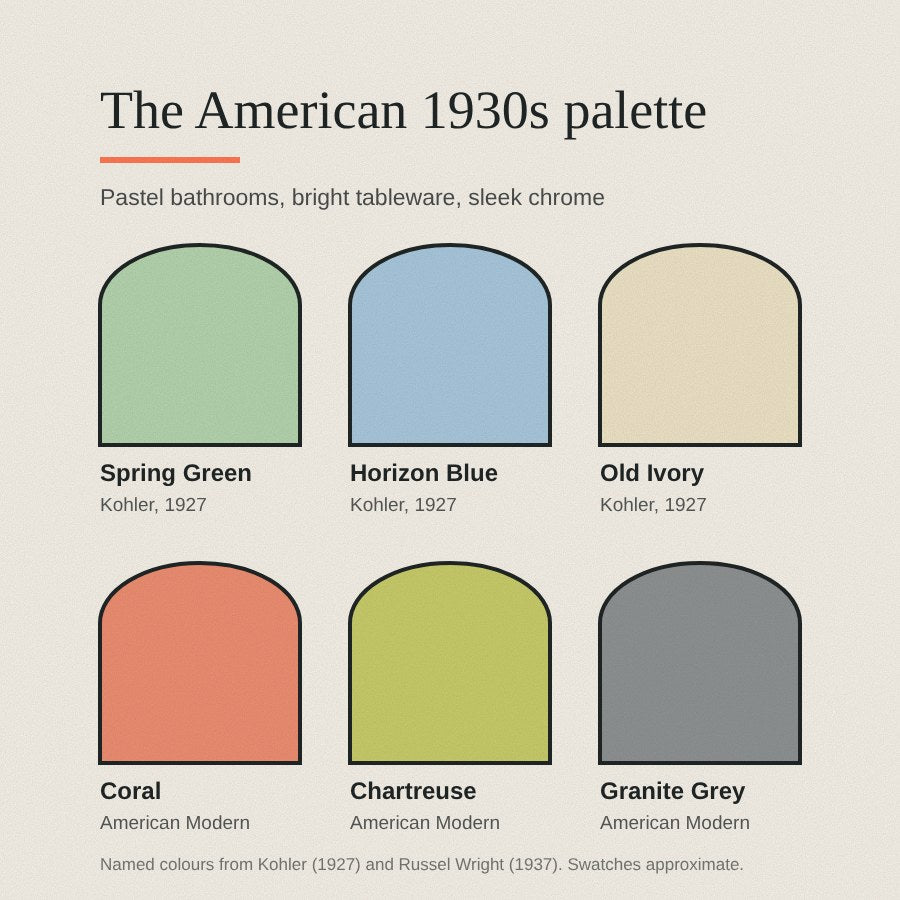
American colour in the 1930s was brighter and more confident than British. In 1927 Kohler launched bathroom fixtures in six soft colours, including Horizon Blue, Old Ivory, Spring Green and Lavender. In 1936 Homer Laughlin introduced Fiesta, brightly coloured tableware designed by Frederick Hurten Rhead, and in 1937 Russel Wright designed American Modern, with colours such as Chartreuse, Coral, Cedar Green and Granite Grey. The Metropolitan Museum calls it the best-selling ceramic service ever made.
Plastics added even more colour. Catalin, a filler-free relative of Bakelite, could be cast in bright, translucent and marbled colours, and makers used it to restyle radios in modern colours. One myth to avoid: the famous pastel buildings of Miami Beach were painted in a later restoration scheme, not in the 1930s.
Streamlining everything
The Cooper Hewitt museum calls the 1930s the "golden age" of the American industrial designer. Four pioneers led the way: Norman Bel Geddes, Walter Dorwin Teague, Henry Dreyfuss and Raymond Loewy. Bel Geddes' book Horizons (1932) popularised streamlining, and soon even objects that gained nothing from aerodynamics, such as pencil sharpeners, food mixers and bathroom scales, were given teardrop curves and speed lines.
- At home: Teague's Kodak Baby Brownie camera (1934) was made in Bakelite, and Dreyfuss's Model 302 telephone appeared in 1937.
- Furniture: Gilbert Rohde began working with Herman Miller in 1930; the company sold its first modern line, a bedroom suite, in 1932. Rohde also furnished the "Design for Living" house at the 1933 Chicago fair.
- Glass block: Owens-Illinois began making structural glass block in 1931 and built its 1933 Chicago pavilion from it.
- The future on show: the 1933 to 1934 Century of Progress fair in Chicago had eleven "homes of the future", including a twelve-sided glass House of Tomorrow with one of the first home dishwashers. At the 1939 New York World's Fair, Bel Geddes' Futurama for General Motors covered more than 35,000 square feet.
Art Deco skyscraper glamour
America's Art Deco reached for the sky. The Chrysler Building (1928 to 1930) was briefly the tallest building in the world, and the Empire State Building opened in 1931 with a lobby ceiling of gold stars, sunbursts and gears, recreated from 2007 in gold and aluminium leaf. Rockefeller Center, built through the 1930s, grew to 19 buildings, mostly in the Art Deco style. Inside its Radio City Music Hall, Donald Deskey used aluminium-foil wallpaper, chrome furniture and gunmetal mirrors, with carpets and textiles by Ruth Reeves.
The 1930s kitchen and bathroom
- The refrigerator arrives. GE's Monitor Top fridge of 1927 cost about $525, falling to as little as $200 within a few years. The share of American homes with a refrigerator rose from 10% in 1930 to 56% in 1940.
- Built-in cabinets. Around two million freestanding Hoosier cabinets were in use by 1942, but built-in kitchen cabinets were taking over.
- Coloured floors. Linoleum came in many colours and patterns, from mosaics and tiles to marbles.
- Coloured bathrooms. Pastel fixtures, like Kohler's, brought colour into the bathroom.
Frank Lloyd Wright's other path
Not every modern American house was streamlined. Frank Lloyd Wright designed Fallingwater in 1935 as a weekend house over a waterfall, and it was completed in 1937. At the other end of the scale, the Jacobs House in Madison (1936 to 1937), his first "Usonian" house, cost about $5,500. It had walls of pine and redwood boards, underfloor heating, an L-shaped plan and no separate dining room. Both houses are in our annotated examples below.
Real American 1930s interiors, annotated
Here are five real interiors, from a World's Fair living room to a skyscraper lobby. Each photograph is numbered with the features worth noticing. Where the photo is in colour, the swatches are sampled from the photograph itself, so treat them as a guide rather than a paint match.
1. The house of tomorrow, 1939
A living room in the "House of Glass" at the 1939 New York World's Fair, photographed that June by Gottscho-Schleisner. The fair's theme was the "World of Tomorrow", and this is what tomorrow's living room was meant to look like.

- Floor-to-ceiling picture windows
- Slim column
- Pale wood desk with a rounded end
- Armchair in a chevron fabric
- Glass doors to a terrace
- Plaid curtains
- Lamp with a glass base
- Plain, unornamented ceiling
- Traditional-style houses outside
Take from it: Big glass, pale wood and one bold pattern on the upholstery: an easy formula for a light, modern room.
2. The small modern house
The living room of the Jacobs House in Madison, Wisconsin (1936 to 1937), Frank Lloyd Wright's first Usonian house. It cost about $5,500, and its walls of pine and redwood boards, with exposed brick, needed no paint or wallpaper.

- Horizontal board-and-batten walls in pine and redwood
- Exposed brick
- Built-in bookshelves
- High clerestory windows
- Tall glass doors to the garden
- Timber ceiling
- Concrete floor, heated from below
Colours in this photo:
Pine and redwood #A45B01Brick #653117Floor #50160ECeiling wood #7B2E04
Take from it: Honest materials left unpainted give warmth without ornament. One wall of timber or brick does a lot of work.
3. The weekend house
The living room at Fallingwater, Frank Lloyd Wright's weekend house over a waterfall in Pennsylvania, designed in 1935 and completed in 1937 for the Kaufmann family. It was given to the Western Pennsylvania Conservancy in 1963.

- Recessed ceiling lights in a wood-framed grid
- Long band of windows onto the woods
- Stone chimney laid in thin horizontal courses
- Window frames and shelf edges painted red
- Built-in seat along the window wall
- Low wooden tables
- Red spherical kettle on a swing arm
- Stone floor
Colours in this photo:
Stone #917F65Red trim #7F3827Built-in seat #B19877Cushion red #94261ACushion yellow #9B762D
Take from it: Long, low and horizontal. Built-in seating under a window is the easiest way to borrow the idea.
4. The glamour of Radio City
The grand foyer of Radio City Music Hall in New York, which opened on 27 December 1932 with interiors by Donald Deskey. The New York landmarks report describes a mirrored, gold-ceilinged foyer with two-ton chandeliers.

- Gold ceiling
- One of the foyer's great glass chandeliers
- Wall-height mural above the stair
- Tall mirrors
- Sweeping staircase with a curved balcony
- Deep red walls
Colours in this photo:
Gold ceiling #6A4E33Red walls #592E22Brass rail #8E704DMural cream #D2BA9E
Take from it: Glamour is about scale and light. A tall, slender pendant over a stair or a dining table gives a hint of it at home.
5. The skyscraper lobby
The lobby of the Chrysler Building in New York (William Van Alen, 1928 to 1930), for a time the tallest building in the world. Its materials include red Moroccan marble, Siena travertine floors, "Nirosta" steel, Mexican onyx light panels and a ceiling mural by Edward Trumbull.

- Ceiling mural by Edward Trumbull
- Red Moroccan marble walls
- Onyx light panels
- Stepped metal light fitting with a clock
- Polished steel doors and trim
- Uplighters
- Polished stone floor
Colours in this photo:
Marble #763114Onyx light #F5F3EECeiling mural #A55717
Take from it: Stepped shapes and lit stone are pure Art Deco. A stepped mirror or a fan-shaped wall light brings the skyline indoors.
American and British 1930s style at a glance
For the British side of the story, read our guide to British 1930s interiors, or our wider 1930s interiors guide.
| Britain | America | |
|---|---|---|
| The typical new home | A speculatively built suburban semi, bought with a mortgage | A small “Minimal Traditional” house, often bought with an FHA-insured loan from 1934 |
| The favourite look | Tudorbethan: gables, mock timbers, leaded glass | Colonial Revival and Tudor Revival, simplified |
| The modern edge | White, flat-roofed Modernist houses and curved metal bays | Streamline Moderne: speed lines, curves, glass block and chrome |
| Where to see the glamour | Odeon cinemas, the Hoover Building, Eltham Palace | The Chrysler Building, Radio City Music Hall, Rockefeller Center |
| Signature motif | The rising sun, especially in front-door glass | Speed lines and teardrop curves, even on pencil sharpeners |
| Colour | Creams and greens, coffee-and-cream tiles, bright Clarice Cliff pottery | Pastel bathroom fixtures, bright Fiesta tableware, coloured plastics |
| Names to know | Wells Coates, Ernő Goldfinger, Clarice Cliff, Marion Dorn, Gordon Russell | Raymond Loewy, Henry Dreyfuss, Donald Deskey, Russel Wright, Frank Lloyd Wright |
Where to see 1930s America today
- Fallingwater, Pennsylvania. Frank Lloyd Wright's house sits partly over a waterfall on Bear Run in the Laurel Highlands, about 43 miles south-east of Pittsburgh. Tour reservations can be made online or by phone, and the site is closed on Wednesdays.
- Miami Beach Art Deco District, Florida. The district was listed on the National Register of Historic Places in 1979, with 800 contributing buildings. The Miami Design Preservation League runs the Art Deco Welcome Center at 1001 Ocean Drive and offers an Art Deco walking tour. Remember the earlier warning about the pastel paint schemes, which came later.
1930s America: key dates
- 1928 to 1930. The Chrysler Building is built.
- 1931. The Empire State Building opens, and Owens-Illinois begins making structural glass block.
- 1932. Bel Geddes publishes Horizons, and Radio City Music Hall opens on 27 December.
- 1933 to 1934. The Century of Progress fair in Chicago shows eleven "homes of the future".
- 1934. The National Housing Act is signed on 27 June, creating the FHA.
- 1935 to 1937. Wright designs Fallingwater (1935, completed 1937) and builds the Jacobs House (1936 to 1937).
- 1939. The New York World's Fair opens with the "World of Tomorrow" as its theme.
How to get the American 1930s look
- Add one curve. A rounded sofa, a round mirror or a sideboard with curved ends instantly suggests Streamline Moderne. The Streamline Moderne Wall Light (14.5 in) repeats the idea on the wall.
- Draw speed lines. Three thin parallel lines, in paint, tape or metal trim, are the decade's shorthand for speed.
- Mix pastels with brights. Keep walls soft, like Kohler's pastels, and bring the bright colours in through tableware and accessories, as Fiesta and American Modern did.
- Use metal and glass. Chrome, mirror and glass block bounce light around a room.
- Or go natural. If streamlining feels too much, follow Wright instead: timber, brick and built-in furniture.
Shop the look
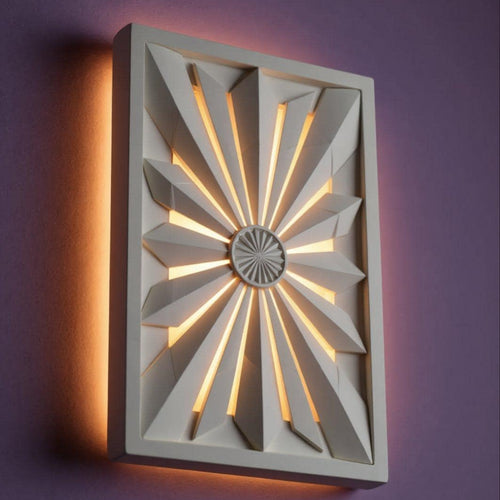
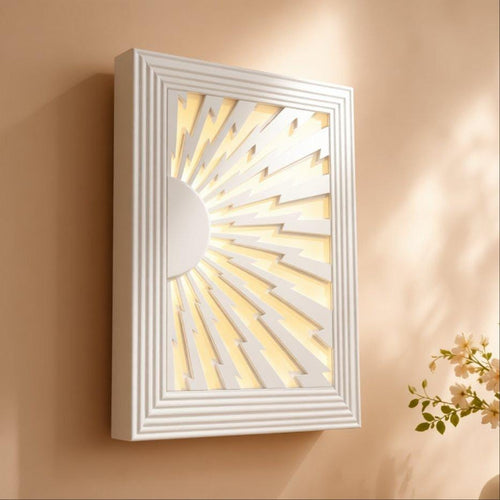
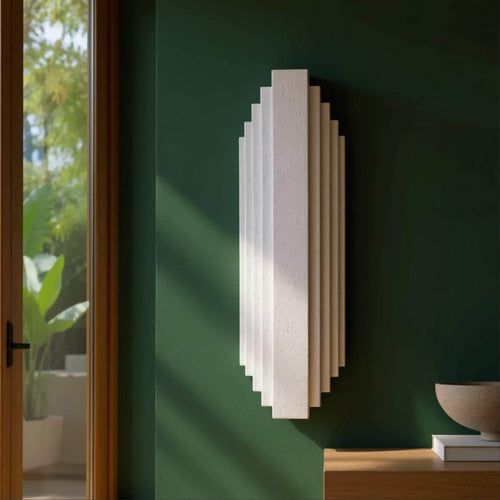
Skyscraper steps, sunbursts and streamlined curves, cast in plaster.


Bringing the American 1930s home with plaster
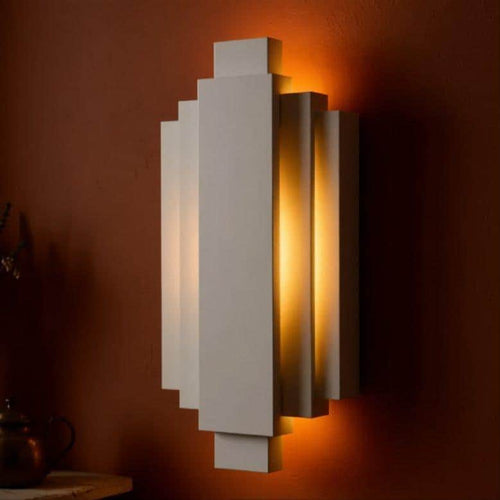
A stepped or sunburst ceiling rose, such as the Cosmos Ceiling Rose or the Sunburst Ceiling Rose, nods to the skyscraper lobbies of New York, and a fan-shaped wall light, such as the Neo-Deco Wall Light, gives the soft upward glow the decade loved. Every piece in our Art Deco collection is designed and hand-cast in Shrewsbury, and arrives as natural plaster ready to leave raw or paint to suit your room.
Good to know
Common questions
What is Streamline Moderne?
Streamline Moderne is the late Art Deco style of the 1930s, inspired by aerodynamics. It uses smooth curves, horizontal speed lines, chrome, glass block and rounded corners, and American industrial designers applied it to everything from trains to kitchen gadgets.
What did a typical American 1930s house look like?
Most new houses were modest. The small 'Minimal Traditional' house, popular because it suited FHA-insured loans, was a simplified version of the Colonial and Tudor Revival styles, with one or one-and-a-half storeys, a low roof and little ornament.
What colours were popular in American 1930s homes?
Bathrooms took on soft pastels such as Kohler's Horizon Blue, Spring Green and Old Ivory, while tableware like Fiesta and Russel Wright's American Modern brought brighter colours such as coral and chartreuse. Coloured plastics such as Catalin added bright, marbled accents.
Sources
References and further reading
Harvard style. Web pages were checked on the access date shown.
- Albany Institute of History & Art (n.d.) GE Monitor Top refrigerator. Available at: albanyinstitute.org/online-exhibition/50-objects/section/... (Accessed: 12 October 2026).
- City of Florence, Alabama (2023) Tudor Revival Style Guide. Available at: florenceal.org/wp-content/uploads/2023/10/Tudor-Revival-S... (Accessed: 12 October 2026).
- Colonial Williamsburg Foundation (n.d.) Through the Decades. Available at: research.colonialwilliamsburg.org/features/throughthedecades (Accessed: 12 October 2026).
- Cooper Hewitt (2013) Fast as a silver bullet. Available at: www.cooperhewitt.org/2013/05/17/fast-as-a-silver-bullet/ (Accessed: 12 October 2026).
- Drueding, M. (2018) 'Edge of Tomorrow', Preservation, Summer. Available at: savingplaces.org/stories/edge-of-tomorrow-the-unexpected-... (Accessed: 12 October 2026).
- Empire State Building (n.d.) Architecture and design. Available at: www.esbnyc.com/about/architecture-design (Accessed: 12 October 2026).
- Fullerton Heritage (n.d.) Minimal Traditional. Available at: www.fullertonheritage.org/Gallery/minimal-traditional.php (Accessed: 12 October 2026).
- Gottscho-Schleisner, Inc. (1939) World's Fair, House of Glass no. 4. Living room I [Photograph]. Library of Congress, via Wikimedia Commons. Public domain. Available at: commons.wikimedia.org/wiki/File:House_of_Glass_Worlds_Fai... (Accessed: 12 October 2026).
- Gross, L. (2018) The evolution of linoleum. Hagley Museum and Library. Available at: www.hagley.org/librarynews/evolution-linoleum (Accessed: 12 October 2026).
- Harry Ransom Center (2012) I Have Seen the Future: Norman Bel Geddes Designs America. Available at: www.hrc.utexas.edu/press/releases/2012/i-have-seen-the-fu... (Accessed: 12 October 2026).
- Hisgett, T. (2011) Chrysler Building Lobby 3 [Photograph]. Wikimedia Commons. CC BY 2.0. Available at: commons.wikimedia.org/wiki/File:Chrysler_Building_Lobby_3... (Accessed: 12 October 2026).
- Living New Deal (n.d.) National Housing Act (1934). Available at: livingnewdeal.org/glossary/national-housing-act-1934/ (Accessed: 12 October 2026).
- Lousteau, M. (2020) A Pastel Paradise. Miami Design Preservation League. Available at: mdpl.org/?p=5246 (Accessed: 12 October 2026).
- Lupton, E. (2014) Model 302 Telephone, Henry Dreyfuss. Cooper Hewitt. Available at: www.cooperhewitt.org/2014/11/06/model-302-telephone-henry... (Accessed: 12 October 2026).
- Metropolitan Museum of Art (n.d.) 'American Modern' Dinnerware. Available at: www.metmuseum.org/art/collection/search/490913 (Accessed: 12 October 2026).
- Museum of Fine Arts, Houston (n.d.) Baby Brownie camera. Available at: emuseum.mfah.org/objects/55266/baby-brownie-camera (Accessed: 12 October 2026).
- Neal, J. (2007) Fallingwater sitting area [Photograph]. Wikimedia Commons. CC BY-SA 3.0. Available at: commons.wikimedia.org/wiki/File:Fallingwater_sitting_area... (Accessed: 12 October 2026).
- NYC Landmarks Preservation Commission (1978) Chrysler Building (LP-0996). Available at: s-media.nyc.gov/agencies/lpc/lp/0996.pdf (Accessed: 12 October 2026).
- NYC Landmarks Preservation Commission (1978) Radio City Music Hall Interior (LP-0995). Available at: s-media.nyc.gov/agencies/lpc/lp/0995.pdf (Accessed: 12 October 2026).
- PBS American Experience (n.d.) Streamliners: the designers. Available at: www.pbs.org/wgbh/americanexperience/features/streamliners... (Accessed: 12 October 2026).
- Petit, Z. (2023) 'Kohler's colourful bathroom fixtures', Fast Company, 19 April. Available at: www.fastcompany.com/90882356/kohler-colorful-bathroom-fix... (Accessed: 12 October 2026).
- Rhododendrites (2018) Radio City Music Hall lobby [Photograph]. Wikimedia Commons. CC BY-SA 4.0. Available at: commons.wikimedia.org/wiki/File:Radio_City_Music_Hall_(30... (Accessed: 12 October 2026).
- Smithsonian Institution (n.d.) Fiesta pitcher. Available at: www.si.edu/object/fiesta-pitcher:nmah_335341 (Accessed: 12 October 2026).
- Steakley, J. (2015) Jacobs First House, living room [Photograph]. Wikimedia Commons. CC BY-SA 4.0. Available at: commons.wikimedia.org/wiki/File:Jacobs_First_House_-_livi... (Accessed: 12 October 2026).
- The Cultural Landscape Foundation (n.d.) Rockefeller Center. Available at: www.tclf.org/rockefeller-center (Accessed: 12 October 2026).
- The Henry Ford (n.d.) Refrigerator (digital collections). Available at: www.thehenryford.org/collections-and-research/digital-col... (Accessed: 12 October 2026).
- University of Chicago CEGU (n.d.) Hoosier cabinet. Available at: cegu.uchicago.edu/exhibitions/calumet/hoosier-cabinet (Accessed: 12 October 2026).
- University of Toledo Libraries (n.d.) Owens-Illinois glass block. Available at: www.utoledo.edu/library/canaday/services/exhibits/oi/OIEx... (Accessed: 12 October 2026).
- Victoria and Albert Museum (n.d.) FADA Model 115 radio. Available at: collections.vam.ac.uk/item/O369377/fada-model-115-radio-f... (Accessed: 12 October 2026).
- Western Pennsylvania Conservancy (n.d.) Fallingwater history. Available at: fallingwater.org/history/ (Accessed: 12 October 2026).
- White, K. (2020) Gilbert Rohde and D.J. De Pree. The Henry Ford. Available at: www.thehenryford.org/collections/explore/articles/gilbert... (Accessed: 12 October 2026).
- Wisconsin Historical Society (n.d.) Jacobs House. Available at: www.wisconsinhistory.org/Records/Property/HI16085 (Accessed: 12 October 2026).
- Fallingwater (n.d.) Fallingwater: Frank Lloyd Wright's masterpiece. Available at: fallingwater.org/ (Accessed: 13 October 2026).
- Miami Design Preservation League (2021) National Register of Historic Places. Available at: mdpl.org/archives/2021/05/national-register-of-historic-p... (Accessed: 13 October 2026).
- Miami Design Preservation League (n.d.) Miami Design Preservation League. Available at: mdpl.org/ (Accessed: 13 October 2026).
How to cite this article
van Locke, J. (2026) ‘American 1930s interiors: Streamline Moderne, Art Deco and the small house’, The Flare Journal. Flare Studio UK. Available at: https://flarestudio.uk/blogs/journal/american-1930s-interiors (Accessed: 17 October 2026).
Shop the style