

Handmade plaster in Shropshire: casting ceiling roses and wall lights in Shrewsbury



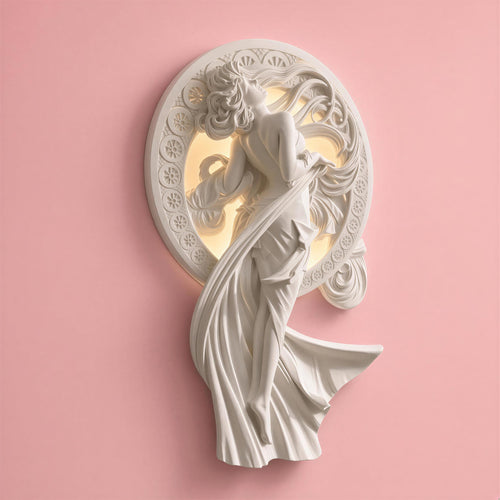
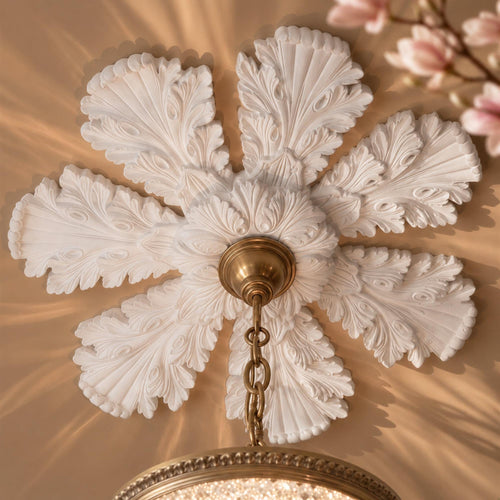
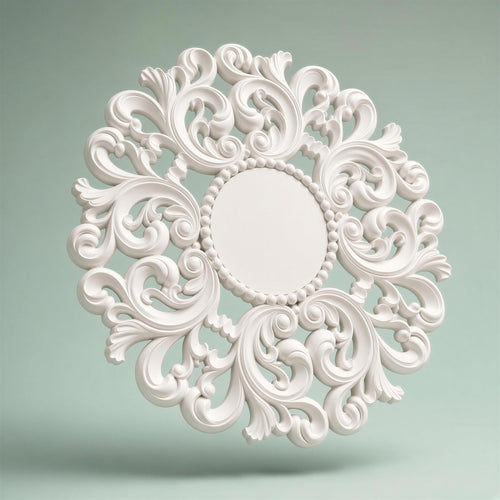
Flare Studio UK casts its plaster ceiling roses, wall lights, overdoors and switch surrounds by hand, to order, in Shrewsbury. Shropshire is a good place to do it: the county is full of the buildings that plasterwork was invented to decorate.
A county built of old houses
Shrewsbury has a large collection of Tudor timber-framed buildings, built on the wealth of the medieval and Tudor wool and cloth trade[1], among them Ireland's Mansion of about 1575[2]. There are also Georgian terraces such as The Crescent of 1793[3], Victorian villas and the industrial heritage of the Ironbridge Gorge, where the Iron Bridge was completed in 1779[4][5], and further south the fortified manor house of Stokesay Castle, built in the 1280s and 1290s[6][7]. Walk through the town and you pass most of the periods that have shaped British interiors. We have written about it in Shropshire's architectural heritage, with closer guides to Shrewsbury's timber-framed buildings, Georgian Shrewsbury and Stokesay Castle and the fortified manor houses of the Welsh Marches, and the house you live in, whatever its age, probably has a plaster story of its own.
Why plaster
Plaster is a long-established decorative ceiling material: surviving plaster ceilings range from high-status palaces to vernacular domestic interiors[8], and for good reason. It takes crisp detail, it is mineral-based so it does not burn like timber or foam (fibrous gypsum casts reinforced with sisal or jute are classed as Euroclass A1, no contribution to fire, without further testing[9]), and it accepts paint as well as any surface can. Read a short history of plaster for the long version and fibrous plaster explained for how it was used on a large scale: fibrous plaster, plaster of Paris reinforced with hessian and cast in workshops, grew in use from the mid to late 19th century[10][11].
How a piece is made here
Each piece starts as a design, becomes a mould and is cast, left to cure, trimmed and checked by hand before it is packed. The full story is in how a plaster piece is cast and on our craftsmanship page. Because pieces are made to order, a handmade ceiling rose comes with small variations a factory casting does not have.
For customers in Shropshire and the Marches
If you are restoring an old house in Shrewsbury, Ludlow, Church Stretton, Bridgnorth or across the border in Wales, we are happy to talk through sizes and styles. Shropshire has 128 conservation areas[12], and a listed building is protected inside as well as out, so works affecting its special interest need listed building consent[13]. See how to choose the right size and which ceiling rose suits your home. We also ship across the UK and beyond: see shipping.
Visit and ask
Questions about a specific room or a bespoke piece? Send photographs and measurements through our contact page, or read how a bespoke commission works.


Frequently asked questions
Where are Flare ceiling roses made?
Cast by hand, to order, in Shrewsbury, Shropshire.
Do you serve customers in Shropshire and the Marches?
Yes, and across the UK and beyond. Contact us about sizes and styles for your house.
Why plaster?
It takes crisp detail, is mineral-based so it does not burn like timber, and accepts paint well.
Can I ask about a specific room?
Yes: send photos and measurements through the contact page.
Sources
References and further reading
Harvard style. Web pages were checked on the access date shown.
- Shrewsbury Civic Society (n.d.) Tudor Shrewsbury: A Shrewsbury Civic Society Self-Guided Tour. Shrewsbury Civic Society. Available at: www.shrewsburycivicsociety.co.uk/wp-content/uploads/4-Tud... (Accessed: 27 October 2026).
- Historic England (n.d.) Ireland's Mansion, Shrewsbury, Shropshire. Historic England education resources. Available at: cms.historicengland.org.uk/education/schools-resources/ed... (Accessed: 27 October 2026).
- Shrewsbury Civic Society (n.d.) Georgian Shrewsbury: A Shrewsbury Civic Society Self-Guided Tour. Shrewsbury Civic Society. Available at: www.shrewsburycivicsociety.co.uk/wp-content/uploads/5-Geo... (Accessed: 27 October 2026).
- English Heritage (n.d.) History of Iron Bridge. English Heritage. Available at: www.english-heritage.org.uk/visit/places/iron-bridge/hist... (Accessed: 27 October 2026).
- UNESCO World Heritage Centre (n.d.) Ironbridge Gorge. UNESCO. Available at: whc.unesco.org/en/list/371 (Accessed: 27 October 2026).
- English Heritage (n.d.) History and Stories: Stokesay Castle. English Heritage. Available at: www.english-heritage.org.uk/visit/places/stokesay-castle/... (Accessed: 27 October 2026).
- Historic England (n.d.) Stokesay Castle (scheduled monument, list entry 1003011). The National Heritage List for England. Available at: historicengland.org.uk/listing/the-list/list-entry/1003011 (Accessed: 27 October 2026).
- Ireland, R. (2021) Investigation and assessment of decorative plaster ceilings. Journal of Building Survey, Appraisal & Valuation, 9(3), pp. 228-245. Available at: doi.org/10.69554/ZLIA3018 (Accessed: 27 October 2026).
- European Commission (2010) Commission Decision of 2 December 2010 establishing the classes of reaction-to-fire performance for certain construction products as regards fibrous gypsum plaster casts (2010/738/EU). Official Journal of the European Union, L 317. Available at: eur-lex.europa.eu/eli/dec/2010/738/oj (Accessed: 27 October 2026).
- Napier, W. (2019) How to survey and assess fibrous and traditional plasterwork. RICS Built Environment Journal. Available at: ww3.rics.org/uk/en/journals/built-environment-journal/how... (Accessed: 27 October 2026).
- Historic England (2019) Historic Fibrous Plaster in the UK: Guidance on its Care and Management. Historic England. Available at: cms.historicengland.org.uk/images-books/publications/hist... (Accessed: 27 October 2026).
- Shropshire Council (n.d.) Conservation areas and Article 4 directions. Shropshire Council. Available at: next.shropshire.gov.uk/environment/historic-environment/c... (Accessed: 27 October 2026).
- Historic England (2021) Listed Building Consent: Historic England Advice Note 16. Historic England. Available at: historicengland.org.uk/images-books/publications/listed-b... (Accessed: 27 October 2026).
How to cite this article
van Locke, J. (2026) ‘Handmade plaster in Shropshire: casting ceiling roses and wall lights in Shrewsbury’, The Flare Journal. Flare Studio UK. Available at: https://flarestudio.uk/blogs/journal/handmade-plaster-shrewsbury-shropshire (Accessed: 12 November 2026).
Shop the style





Conversation
Join the conversation
Questions about the history, a room you are planning, or a piece you have seen in the wild? Leave a comment and Joseph will reply.