Boho and maximalist interiors: pattern, plants and collected things


Boho and maximalist rooms are the opposite of a showroom. They are full of pattern, colour, plants, books, pictures and things picked up over years, and they look as if someone interesting lives there. In Britain the look has a long history, from Victorian artists’ houses to Bloomsbury, Liberty and Biba. This guide explains where the style came from, the colours and details that define it, four real rooms to learn from, and how to get the look without turning a room into clutter.
What is boho and maximalist style?
Boho, short for bohemian, is a relaxed, artistic style that mixes pattern, colour, natural materials and collected objects from many places and periods. Maximalism is its bolder relation, which layers as much pattern, colour and personal display as a room will take. The word has a curious history. In French, bohémien meant a Romani person from the 1400s, because the Romani people were wrongly believed to have come from Bohemia. By 1834 the French were using it for anyone living an unconventional life, and Henri Murger’s stories of poor Paris artists, collected as Scènes de la vie de Bohème, later became the basis of Puccini’s La Bohème. The word reached English in 1848, in Thackeray’s Vanity Fair.
In Britain the look grew in three waves. The first was the Victorian Aesthetic Movement. In 1875 Arthur Lasenby Liberty borrowed £2,000 and opened a shop on Regent Street selling fabrics, ornaments and objects from Japan and the East. The same year the cartoonist Linley Sambourne moved into 18 Stafford Terrace in Kensington and filled it with Japanese, Chinese and Middle Eastern things. The second wave was Bloomsbury. Roger Fry founded the Omega Workshops at 33 Fitzroy Square in 1913, where artists including Vanessa Bell and Duncan Grant painted furniture, screens and boxes. In 1916 Bell and Grant moved to Charleston, a farmhouse in Sussex, and painted its walls, doors, fireplaces and furniture, inspired by Italian frescoes and the Post-Impressionists. You can read more about the first of these movements in our guide to William Morris and Arts and Crafts.
The third wave came in the 1960s and 1970s. A V&A exhibition of Aubrey Beardsley’s drawings in 1966 set off a wider revival of Art Nouveau, and Sanderson issued a Beardsley wallpaper in 1967. Barbara Hulanicki opened her first Biba shop in a former chemist’s on Abingdon Road in 1964, and in 1973 took over the Derry & Toms department store in Kensington, with dimly lit period interiors and loud music. Today’s maximalism is a fourth wave. The design magazine Livingetc describes it as a reaction against the neutral walls of 2000s minimalism, built on pattern, colour and texture. See our guides to the 1960s and 1970s for the decades when the bohemian look went mainstream.
The boho maximalist palette
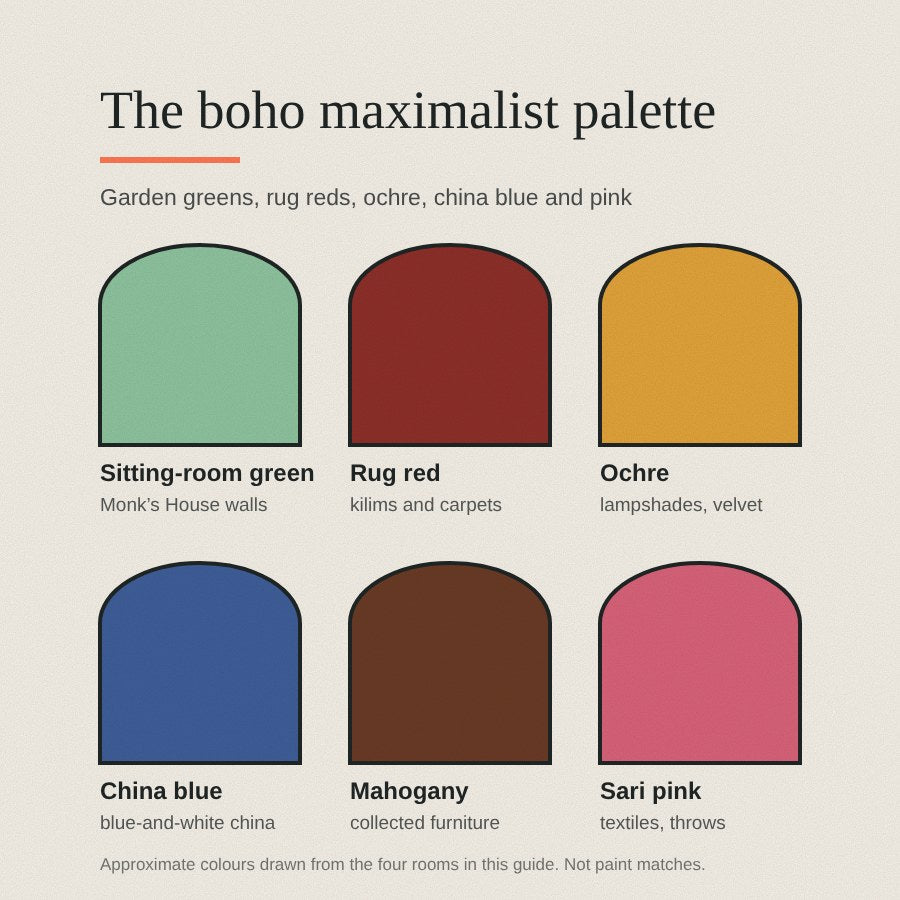
There is no single boho colour chart, but the rooms in this guide share a family of colours: garden greens on the walls, deep reds from rugs and kilims, ochre and mustard from lampshades and velvet, blue and white from china, and the warm brown of old wood. Brighter accents, such as pink and coral, come from textiles rather than paint. The palette card below is drawn from the four rooms we annotate further down.
Two approaches work. A light ground, like the soft green at Monk’s House, lets colourful pieces stand out. A dark ground, like the Sambourne drawing room, makes gilt, china and pictures glow. Whichever you choose, repeat each colour at least three times around the room so the mix looks intended.
Signature motifs, shapes and materials
- Pattern on pattern. Florals, stripes, geometric kilims and paisley used together, linked by shared colours.
- Plants and botanical motifs. Real plants, and leaves, fruit and flowers in wallpaper and fabric. The Sambournes chose William Morris’s Fruit wallpaper for their house.
- Things from far away. Rugs, lanterns, china and textiles from many countries, the stock in trade of Liberty from its first year.
- Hand-painted surfaces. Painted tables, screens, tiles and fireplaces in the Bloomsbury manner. At Monk’s House, Vanessa Bell painted the tiles around the fireplace in Virginia Woolf’s bedroom, inscribed “VW from VB 1930”.
- Natural materials. Cane, rattan, wool, linen, old wood and brick, which calm the colour and pattern.
- Collections on show. Plates on a high shelf, pictures hung close together, books everywhere.
The details that define a boho maximalist room
- Ceiling. Rarely left blank. A decorative ceiling rose, a painted or papered ceiling, or a deep cornice finishes the room. House of Hackney’s Frieda Gormley suggests papering every wall, and sometimes the ceiling.
- Walls. Patterned wallpaper, a strong paint colour, or pictures hung edge to edge.
- Floors. Rugs layered over boards, brick or carpet. More than one is normal.
- Lighting. Several warm, low sources: a fringed or patterned pendant, a wall sconce or two, table lamps and lanterns.
- Furniture. Mismatched and collected over time: an old chest, a cane chair, a velvet sofa, a painted table.
- Textiles. Cushions, throws, kilims and curtains in different patterns but related colours.
- Display. Open shelves, plates on walls, framed prints and plants at every level.
Real boho and maximalist rooms, annotated
Here are four real places, from a Victorian collector’s drawing room to a family front room in 1987. Each photograph is numbered with the features worth noticing. Where we show swatches, they are sampled from the photograph itself, so treat them as a guide rather than a paint match.
1. The collector’s drawing room: Sambourne House, Kensington
The Punch cartoonist Linley Sambourne and his family lived at 18 Stafford Terrace from 1875 until his death in 1910. They decorated it in the fashionable Aesthetic style, filled with Japanese, Chinese and Middle Eastern objects, and the rooms survive much as they left them. This is the drawing room, a textbook Victorian collector’s room.

- Oval ceiling rose set in a dark painted ceiling, framed by a deep cornice
- Blue and white plates and vases lined up along a high shelf
- Framed pictures hung edge to edge, almost covering the wall
- Ornate bracket clock, one of many large objects on show
- A pair of large, brightly patterned vases on a chest of drawers
- Heavy curtains with a fringed pelmet across the bay window
- Long patterned rug over a darker floor
Colours in this photo:
Rug brick #966654Blue and white china #6D83A9Curtain brown #6D5751Ceiling green #758271
Take from it: Maximalism works when the objects share a colour story. Here it is dark wood, gilt and blue and white, repeated all round the room, which is why it feels rich rather than chaotic.
2. The Bloomsbury cottage: Monk’s House, Rodmell
Leonard and Virginia Woolf bought Monk’s House in Sussex in 1919. Virginia painted the walls herself and chose green for the oak-beamed sitting room, and the house holds painted furniture by her sister Vanessa Bell and Duncan Grant. It shows the softer, homemade side of bohemian style.

- Exposed oak beams, left dark
- Walls painted a soft green, with window frames picked out in a deeper green
- Paintings hung singly and informally, at different heights
- Patterned orange lampshade on a standard lamp
- Low table topped with hand-painted tiles
- Cane-backed chairs with painted top rails
- Patterned rugs thrown over the floor
- Old brick floor left bare between the rugs
Colours in this photo:
Sitting room green #719167Lampshade ochre #F7B23DTile blue #5C7EBD
Take from it: Bohemian rooms are made by hand. One painted piece, a coloured wall and a few rugs on a plain floor give more character than a room of new matching furniture.
3. The shop that sold the look: Liberty, London
Arthur Lasenby Liberty opened his Regent Street shop in 1875 to sell fabrics, ornaments and objects from Japan and the East. Its carpet department, photographed here at Christmas 2012, still sells the layered, worldly look the shop helped make fashionable.

- Rugs and woven bags hung from the ceiling
- Metal lanterns with long turquoise tassels
- Armchair covered in a striped kilim
- Woven pouffes and floor cushions
- A deep stack of rugs, with a blue rug on top
- A modern striped rug in faded red, cream and green
- Carved wooden figure stool
- Rugs hung flat on the wall like paintings
Colours in this photo:
Rug blue #3A5682Kilim red #602724Faded green #9DB8AETerracotta #F08C72
Take from it: Textiles are the quickest way to the look. A rug on the wall, a kilim on a chair and a stack of cushions change a room without a single new piece of furniture.
4. The lived-in front room: a British Indian home in 1987
Maximalism was never only a designer’s look. This installation at the Museum of the Home in Shoreditch, created by Ajay Chhabra and Simmy Gupta of the arts company Nutkhut, recreates from memory the front room of a British Hindu family of tailors in 1987. It is workshop, family room and dining room at once, dressed here for both Christmas and Diwali.

- Pale striped wallpaper as a quiet background
- Framed devotional prints hung on the wall
- Small tree with fairy lights on a carved cabinet
- Television and video recorder on a stand
- Patterned rug over a red fitted carpet
- Sewing machine on a table: the family’s trade
- Tinsel and bright cloth thrown over the sofa
- Wooden coffee table covered with everyday things
Colours in this photo:
Carpet red #74140DPink cloth #CB5A5D
Take from it: Real layered rooms grow from the life lived in them. Display what matters to you, and let the room hold more than one purpose.
Where to see bohemian and maximalist rooms
Sambourne House, Monk’s House and the Museum of the Home all appear above. Three more places show the layered look at full strength, and all three can be visited.
Charleston, Sussex
The Charleston Trust calls it the modernist home and studio of the painters Vanessa Bell and Duncan Grant. From 1916 they painted its walls, doors, fireplaces and furniture, so that an ordinary farmhouse became one continuous decorated interior. From the outside it still looks like a plain Sussex house, which is part of the lesson.

This short House & Garden film walks through the painted rooms, and shows better than any still photograph how pattern runs from wall to door to furniture.
Video: House & Garden, "Exploring Charleston House: An Expression of Early 20th-Century Art | Houses with History", via YouTube.
Emery Walker’s House, Hammersmith
The house at 7 Hammersmith Terrace is described by its trust as believed to be the most authentic Arts and Crafts home in Britain. Hand-blocked Morris & Co wallpapers from the 1920s hang in nearly every room, alongside seventeenth- and eighteenth-century English furniture, Middle Eastern rugs and Chinese and Moroccan ceramics. Under the hall rugs is thought to be the only surviving Morris lino still in its original home. It is the best place in London to see how different periods and countries can share one room.
Sir John Soane’s Museum, London
The architect’s own house at 13 Lincoln’s Inn Fields has been kept as it was when he died in 1837, and entry is free, as Soane intended. Antiquities, casts, furniture, paintings by Hogarth, Turner and Canaletto and more than 30,000 architectural drawings fill every wall and alcove. It is maximalism as a collector’s life’s work.

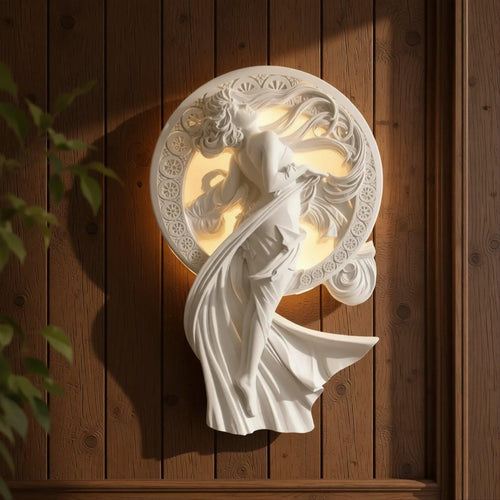
Take from them: In all three houses the decoration does not stop at eye level. Ceilings, door panels and the tops of walls carry pattern too. A botanical ceiling rose picked out in a colour from your rug, such as our Nomad Ceiling Rose, and a sculptural wall light like the Art Nouveau Bird Wall Light carry the layering upwards.
How to get the boho maximalist look
- Choose a ground colour first. A soft green or warm white for a bright, bohemian room; a deep teal, plum or brown for a richer, maximalist one. A dark ground suits a snug or dining room. If you want to go all in, our guide to colour drenching explains how to paint walls, woodwork and ceiling in one shade.
- Layer the floor. Put a smaller patterned rug over a larger plain or striped one. It works in any living room or bedroom.
- Hang pictures close together. Plan a gallery wall on the floor first, keep gaps even, and mix frames. A hallway or stair wall is a good place to start.
- Look up. A ceiling rose (ceiling medallion) gives a central pendant a proper setting, and you can paint it the ceiling colour or pick out its pattern in a second colour. Our guides to choosing a ceiling rose size and painting a plaster ceiling rose will help, and our fitting instructions show how to put one up.
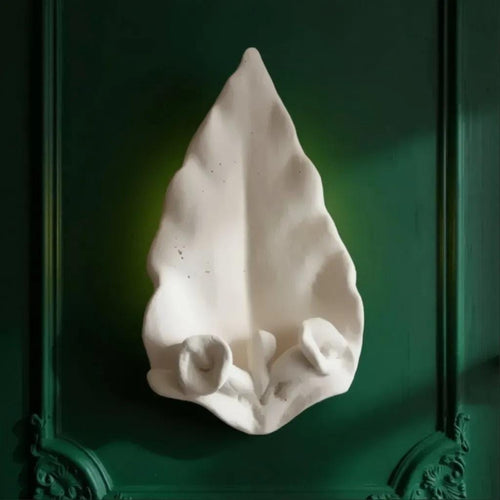
- Light it low and warm. Add wall lights and lamps so the room glows in the evening rather than being lit from one bulb. A sculptural piece such as our Flower Wall Light works as wall decoration by day. See layered lighting in a living room.
- Bring in plants. A big leafy plant on the floor and a trailing one up high fill the gaps between objects. Bathrooms and kitchens suit plants well.
- Buy slowly. Livingetc’s view of the new maximalism is fewer, well-made pieces that mean something, not overconsumption. Antique shops and markets are the natural source.
Common mistakes to avoid
- Too many unrelated colours. Pattern on pattern works only when the colours repeat. Pick four or five and stick to them.
- Everything at the same height. Put objects high, low and in between, from ceiling to floor, or the room looks like a shop.
- A bare ceiling. A plain ceiling with a single bulb flattens a busy room. Give the light a rose and a shade with character.
- Buying the look in one go. A room bought in a weekend from one shop never looks collected.
- No place to rest the eye. Leave one quiet surface, such as a plain sofa, a clear table top or a calm floor.
- Borrowing culture as costume. Choose textiles and objects you know something about and genuinely love, rather than generic “ethnic” décor.
Shop the look
Paintable plaster pieces with enough pattern to hold their own in a layered room.


Boho ceiling roses, wall lights and plaster details
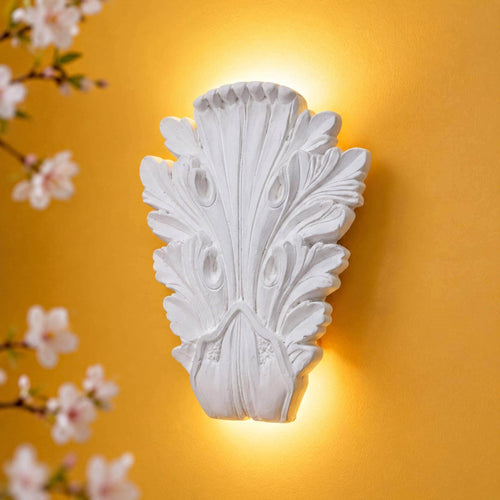
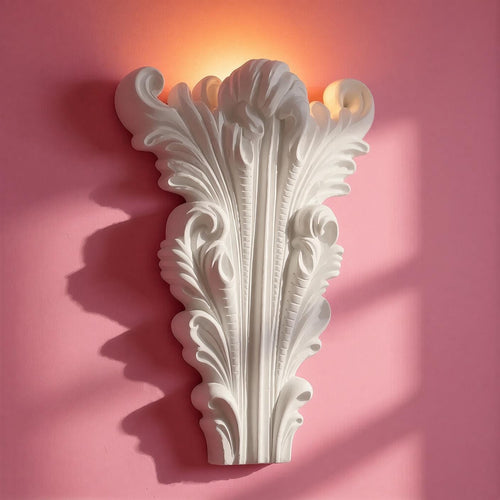
A boho room needs a ceiling and walls with as much character as the rest of it. Our Boho Ceiling Rose gives a pendant a patterned setting, and our Boho Wall Light adds a warm, low glow to a sofa wall or bedside. For a botanical, Aesthetic Movement mood, try our Sunflower Ceiling Rose or Lotus Ceiling Rose, and paint them to pick up a colour from your rug or wallpaper. Our guide to Art Nouveau shows where those flowing plant forms came from.
Every piece in our All Ceiling Roses collection is designed and hand-cast in Shrewsbury, and arrives as natural plaster ready to leave raw or paint to suit your room.
Good to know
Common questions
What is boho style in interior design?
Boho, short for bohemian, is a relaxed, artistic style that mixes pattern, colour, natural materials and objects collected from many places and periods. Maximalism is its bolder relation, layering as much pattern, colour and personal display as a room will take.
How do I make a room look boho without it looking cluttered?
Choose four or five colours and repeat each around the room, layer rugs and textiles, hang pictures close together and leave one calm surface, such as a plain sofa or clear table, to rest the eye.
What ceiling and lighting suit a boho maximalist room?
Avoid a bare ceiling with a single bulb. A decorative ceiling rose gives a fringed or patterned pendant a proper setting, and wall lights, table lamps and lanterns add the warm, low glow the style relies on.
Where can I see a real maximalist interior in Britain?
Sir John Soane's Museum in London is kept as it was when Soane died in 1837 and is free to visit. Emery Walker's House in Hammersmith mixes Morris & Co wallpapers with antique furniture, Middle Eastern rugs and Chinese and Moroccan ceramics, and Charleston in Sussex shows rooms painted throughout by Vanessa Bell and Duncan Grant.
Sources
References and further reading
Harvard style. Web pages were checked on the access date shown.
- AndyScott (2025) Sambourne House, Drawing room [Photograph]. Wikimedia Commons. CC0. Available at: commons.wikimedia.org/wiki/File:Sambourne_House,_Drawing_... (Accessed: 12 October 2026).
- Artist Studio Museum Network (n.d.) Sambourne House (18 Stafford Terrace). Available at: artiststudiomuseum.org/studio-museums/18-stafford-terrace/ (Accessed: 12 October 2026).
- Daderot (2016) Sitting room, Monk's House, Rodmell, East Sussex, England [Photograph]. Wikimedia Commons. CC0. Available at: commons.wikimedia.org/wiki/File:Sitting_room_-_Monk%27s_H... (Accessed: 12 October 2026).
- Doyle of London (2022) 1970s British Asian Room in the Museum of the Home [Photograph]. Wikimedia Commons. CC BY-SA 4.0. Available at: commons.wikimedia.org/wiki/File:1970s_British_Asian_Room_... (Accessed: 12 October 2026).
- Flanagan, K. (2021) 'Maximalism in interior design explained', Livingetc, 13 October. Available at: www.livingetc.com/features/maximalism-in-interior-design (Accessed: 12 October 2026).
- Furniture History Society (n.d.) Omega Workshops (1913-1919), British and Irish Furniture Makers Online. Available at: bifmo.furniturehistorysociety.org/entry/omega-workshops-1... (Accessed: 12 October 2026).
- History Hit (n.d.) Charleston: history and facts. Available at: www.historyhit.com/locations/charleston/ (Accessed: 12 October 2026).
- Liberty London (n.d.) Store heritage. Available at: www.libertylondon.com/uk/information/the-store/store-heri... (Accessed: 12 October 2026).
- Mansfield, I. (2022) '400 years of Christmas Past on display at the Museum of the Home', ianVisits, 6 December. Available at: www.ianvisits.co.uk/articles/400-years-of-christmas-past-... (Accessed: 12 October 2026).
- National Trust Collections (n.d.) Monk's House. Available at: www.nationaltrustcollections.org.uk/place/monk's-house (Accessed: 12 October 2026).
- Nutkhut (n.d.) The British Indian Front Room in 1987. Available at: www.nutkhut.co.uk/?p=3186 (Accessed: 12 October 2026).
- Online Etymology Dictionary (n.d.) Bohemian. Available at: www.etymonline.com/word/bohemian (Accessed: 12 October 2026).
- Petts, J. (2012) Carpets, Liberty of London [Photograph]. Wikimedia Commons. CC BY-SA 2.0. Available at: commons.wikimedia.org/wiki/File:Carpets,_Liberty_of_Londo... (Accessed: 12 October 2026).
- Royal Borough of Kensington and Chelsea (n.d.) Sambourne House. Available at: www.rbkc.gov.uk/museums/sambourne-house (Accessed: 12 October 2026).
- Victoria and Albert Museum (n.d.) Biba catalogue (O1248759). Available at: collections.vam.ac.uk/item/O1248759/ (Accessed: 12 October 2026).
- Victoria and Albert Museum (n.d.) Wallpaper, Aubrey Beardsley, Arthur Sanderson & Sons Ltd, about 1967 (E.404-1998). Available at: collections.vam.ac.uk/item/O11753/ (Accessed: 12 October 2026).
- Charleston Trust (n.d.) Charleston. Available at: www.charleston.org.uk/ (Accessed: 13 October 2026).
- Emery Walker's House (n.d.) The house. Available at: emerywalker.org.uk/house (Accessed: 13 October 2026).
- Sir John Soane's Museum (n.d.) About. Available at: www.soane.org/about (Accessed: 13 October 2026).
- House & Garden (n.d.) Exploring Charleston House: An Expression of Early 20th-Century Art | Houses with History [Video]. YouTube. Available at: www.youtube.com/watch?v=B8JYBViouj0 (Accessed: 13 October 2026).
- Elisa.rolle (2017) Charleston Farmhouse, Firle, 2017 [Photograph]. Wikimedia Commons. CC BY-SA 4.0. Available at: commons.wikimedia.org/wiki/File:Charleston_Farmhouse,_Fir... (Accessed: 13 October 2026).
- Daderot (2024) Interior view, Sir John Soane's Museum [Photograph]. Wikimedia Commons. CC0. Available at: commons.wikimedia.org/wiki/File:Interior_view_-_Sir_John_... (Accessed: 13 October 2026).
How to cite this article
van Locke, J. (2026) ‘Boho and maximalist interiors: pattern, plants and collected things’, The Flare Journal. Flare Studio UK. Available at: https://flarestudio.uk/blogs/journal/boho-maximalist-style-guide (Accessed: 17 October 2026).
Shop the style